I keep breaking 1/2 ratchets on my lug nuts.

   / I keep breaking 1/2 ratchets on my lug nuts. #21  
Torque multiplier is the way to go if you have lug nuts that are being a pain. Yes, a good battery powered impact wrench or a good air driven one (if you have enough air volume) will usually do the trick, but when that fails, a Torque Multiplier will spin off just about any tight lugnut within the limits of the socket that you are using. Most Torque Multipliers are 3/4 drive sockets, at least the ones I have seen.
David from jax
 
   / I keep breaking 1/2 ratchets on my lug nuts. #22  
   / I keep breaking 1/2 ratchets on my lug nuts. #23  
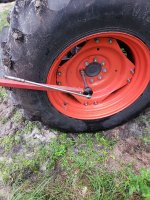
Here is one of my Torque Multipliers removing a lug on my M7040 with almost no effort.
David from jax
 

Attachments

  • 20191019_143357.jpg
    20191019_143357.jpg
    8.9 MB · Views: 178
   / I keep breaking 1/2 ratchets on my lug nuts. #24  
I remember my old cutlass needed a tire change one time. First lugnut snapped right off, went to the second one, it snapped off as well. I started to do #3 and then thought what am I nuts? Drove home on the flat. Ended up having to buy 3 new lugs. Another one snapped off, but at least it was at home. Not sure who the heck torqued those lug nuts prior to me trying to get them off, but never had that happen again on any vehicle. Crazy.
 
   / I keep breaking 1/2 ratchets on my lug nuts. #27  
Now comes the question, has anybody used a torque wrench?....
Yes. Every time. I spin the nuts in with a 1/4" electric impact driver, which probably only gets them to 60 ft-lb., then set the vehicle on the ground to final torque with a torque wrench.

The next question though is, has anybody calibrated their torque wrench?
I have, but don't bother regularly. I came up with my own way of verifying torque using a pull scale and measuring length between drive center and where pull scale attaches to handle, with drive pin held in a vice and wrench horizontal (to eliminate handle weight error).

Simple math: set your torque wrench to middle of range, say 150 ft-lb. Now put pull gauge on handle 18" from drive pin and pull. If pull gauge records 100 lb. max when it clicks over, that's 150 ft-lb., and no need to recalibrate.

Pull gauge itself can be re-calibrated or checked using fixed weights.
 
   / I keep breaking 1/2 ratchets on my lug nuts. #28  
I have busted a huskey ratchet without using an extension so
now I spray them and just use a breaker bar and socket and
pound on it with a rubber mallet keeping pressure on the bar

willy
 
   / I keep breaking 1/2 ratchets on my lug nuts. #29  
harbor freight and craftsman have broken on me getting lug nuts loose. I am rough with them using a 6 ft pipe.

I do have a impact driver maybe that will work better.

Keep in mind, if you're working on your Ford Courier, then half the lug nuts are lefties. Probably a few other Fords from the early to mid 70's. If you work hard enough you'll break them off.

If I ever have a nut that needs either breaking loose, or breaking off, I just grab the Armstrong. It hasn't failed me yet.

wrenches-jpg.853157


As far as Harbor Freight tools. They have a unique ratcheting breaker bar. So far I've been impressed with it. It seems to work reasonably well. It has bigger ratchet steps than most ratchets, so I assume larger pawls. Anyway, it is worth a try. Still, if you abuse it with a cheater, you may be able to damage it.

image_25950.jpg


   / I keep breaking 1/2 ratchets on my lug nuts. #30  
Now comes the question, has anybody used a torque wrench?....
Every time I rotate tires or have them off for any reason. Hand start lug nuts, run them up with impact, tap them a couple times, then finish with torque wrench
 
   / I keep breaking 1/2 ratchets on my lug nuts. #31  
Every time I rotate tires or have them off for any reason. Hand start lug nuts, run them up with impact, tap them a couple times, then finish with torque wrench
Same. I've also taken to leaving the torque wrench laying out on the garage counter, as a reminder to re-check them after driving the car the next day. Most stay right on the money, but sometimes you find one that "seated in" a bit after that first day's driving.

I briefly owned a truck with Ø40" x 17" tires on 5-lug wheels, not my doing, the prior owner configured it that way. What I learned from that experience was that the actual level of torque was much less important than evenness of torque. Put otherwise, I could tighten the ever-loving crap out of those lugs by hand, and they'd still work loose over time, if not all even. But if I used a torque wrench and got them all even, even at a lower torque, they'd never work loose. That was an eye-opener for me, in always using a torque wrench, given the speeds I like to travel on the expressway.
 
   / I keep breaking 1/2 ratchets on my lug nuts. #32  
Just to make sure it is clear, a Torque Wrench is not the same thing as a Torque Multiplier.
A Torque Wrench is used to make sure that a bolt is as tight as you are supposed to have it, and a Torque Multiplier is used to loosen nuts and bolts that are too tight to get loose without breaking your ratchet or having to use an extension to increase the force. A Torque Multiplier uses a planetary gear system to use a smaller force to increase the torque to loosen a nut.
David from jax
 
   / I keep breaking 1/2 ratchets on my lug nuts. #33  
Same. I've also taken to leaving the torque wrench laying out on the garage counter, as a reminder to re-check them after driving the car the next day. Most stay right on the money, but sometimes you find one that "seated in" a bit after that first day's driving.

I briefly owned a truck with Ø40" x 17" tires on 5-lug wheels, not my doing, the prior owner configured it that way. What I learned from that experience was that the actual level of torque was much less important than evenness of torque. Put otherwise, I could tighten the ever-loving crap out of those lugs by hand, and they'd still work loose over time, if not all even. But if I used a torque wrench and got them all even, even at a lower torque, they'd never work loose. That was an eye-opener for me, in always using a torque wrench, given the speeds I like to travel on the expressway.
There was a time I used to run them in with a impact and said good enough. Driving to work one night the valve stem extender came loose and broke the valve on the inside dual. Because it was fieldwork season had everything with me including at that time Craftsman 1/2" impact. Pulled off, jacked up the truck changed tire, and ran all the lug nuts and hammered away. Still got to work before start time. 2 weeks later truck acted funny on corners. Got to the field and realized the dual I changed had worked loose. From that day on made sure always torqued to specs.

I don't double check though and that would be a good practice to get into.
 
   / I keep breaking 1/2 ratchets on my lug nuts. #35  
There is a lot of talk about your personal torque wrenches on this thread. Nobody has mentioned this important detail on click type torque wrenches besides the calibration note. After use the torque wrench needs to be backed off from it's torque value. My Proto .50 micrometer torque needs to be backed off to 50 ft./lbs. My .38 Proto goes back to 20 ft./lbs. Leaving the spring mechanism compressed at some value higher value shortens the life of the calibration. Another note from years ago work, on a freshly torqued fastener it takes approximately 20% less torque for breakaway. Another note from previous years is that a deflecting beam type torque is the most accurate of torque wrenches. I don't have the exact details but from work we did again years ago a click style torque is more accurate in the mid to upper range of the torque wrench.
 
   / I keep breaking 1/2 ratchets on my lug nuts. #36  
If the owner of the torque wrench bothered to read the enclosed instructions that came with it, it plainly states all the criteria of operation in that manual... Of course most people never bother reading instructions and that also applies to tractors and vehicles in general. Far as torque wrenches are concerned, storing one in whatever 'relaxed' position is entirely up to what type of wrench it is. Never used a torque multiplier to remove any lug nuts or anything else for that matter and that includes 10 hole Bud style big truck wheels. I use an air powered impact wrench of sufficient capacity to remove them and I always use a torque wrench to remount them.

One thing most people don't realize is that when mounting any wheel to a spindle, it has to be torqued properly or the mounting studs can be stretched or the 'coined' mounting holes (in the case of steel wheels) can be deformed and the wheel can become detached in use.

Most if not all owners manuals will state the correct prevailing torque for mounting.
 
   / I keep breaking 1/2 ratchets on my lug nuts. #37  
Never used a torque multiplier to remove any lug nuts or anything else for that matter and that includes 10 hole Bud style big truck wheels. I use an air powered impact wrench of sufficient capacity to remove them and I always use a torque wrench to remount them.
The issue with using an air powered impact wrench of sufficient capacity...is you can't carry that out to the field where you have a flat tire. Most people don't even have the air capacity to run a one inch drive impact, much less own an impact of that size. The new battery powered impacts are appoaching the capacity needed to remove such a lugnut, but not quite there yet.
My Snap-On Torque Multiplier is rated at 2000 pounds of torque, and can be carried in one hand out to where the tractor is. The fact that you have never used one means you should probably just refrain from addressing that subject, not sticking in your $.02 worth to tell us what is so much better because that is the way you do it. Most people don't have the need for the elaborate setup needed to change semi trailer tires. A Torque Multiplier won't have a battery life, or require a huge compressor to run it.
David from jax
 
   / I keep breaking 1/2 ratchets on my lug nuts. #38  
Of course most people never bother reading instructions and that also applies to tractors and vehicles in general.
Not to start a whole other tangent, but I can't blame people, here. I own a lot of vintage tools and associated paperwork, and manuals used to be condensed down to a very few and very useful pages, always worth a read. But today's tools and vehicles come with manuals that are usually 50% to 80% full of useless warnings for scenarios I couldn't even imagine being a problem for any reasonable person, to the point where it's difficult to even find the actual useful content, assuming it hasn't been removed or truncated in favor of more legalese.
 
   / I keep breaking 1/2 ratchets on my lug nuts. #39  
I looked into this years ago, and the break-out force on most of the better 1/2" ratchets seemed to be around 500 ft-lb. I don't know what 1/2" breaker bars are rated to handle, but spent much of my late teens and early 20's bouncing and jumping on the end of a 4' pipe extension slipped over the handle of mine, and it never broke (back then... it has since).

I will say that I've seen Craftsman ratchets break more than all other brands combined. But then again, back when I was spending all my free hours wrenching on cars (1990's), Craftsman also sold more ratchets than probably all other brands combined. I've also seen a few broken Snap-On ratchets, but oddly, never a broken vintage Proto.

The vintage Proto ratchets make a good hammer too, they're a bit large in the hand by today's standards. But if you're in the habit of breaking ratchets, and don't mind their larger head size, that may be the brand for you. I don't know if their new stuff is any good, they're owned by Stanley now, but their original 1960's hardware made out of their Los Angeles plant was bullet-proof.

The only Craftsman ratchets I own today are two ratcheting clicker-type torque wrenches. They don't get used hard, so they haven't failed. All of the other Craftsman ratchets I have ever owned broke, and were tossed in the garbage.

I've never used, probably never even seen, a Harbor Freight ratchet. But you also couldn't pay me to use one. I'm not that cheap, and I like the skin to remain on my knuckles as much as possible.
I like the SK (Wayne) triple tooth contact Pro ratchets as far as ratchets go, they have held up and if I was at a dismantling yard and all I had was a short cheater bar and that socket set that is what got abused. For stuck lug nuts and a few stubborn axle nuts or hydraulic cylinder rod/piston nuts, I try with a 3/4" breaker bar set up or the Aircat 1/2"impact, then bought a 1" Vevor "advertised" 4280 ft lb. air Impact for when that fails and 'so far' it has worked when everything else failed, but I need to add a reserve air tank with large lines to make it work at full power. Supposed to have 175 psi it does but still need 1/2" air lines for the tool use volume. it is an absolute air pig and at almost 50lb is a pain to use.

I was sold after the comment about easily breaking the piston rod nut loose on a 325 CAT Excavator boom cylinder
 
Last edited:
   / I keep breaking 1/2 ratchets on my lug nuts. #40  
No issue with me at all but... Torque wrenches, in order for them to retain their accuracy, must be stored in a 'relaxed' position and that position varies by construction.

My 2 requirements for any torque wrench is 1. It must indicate torque in both directions, that is tightening torque and loosening torque or should I say left hand torque as in left hand threaded nuts and 2. It must come with a certification document and be easy to calibrate. The HF Icon torque wrenches check those boxes for me.
 

Tractor & Equipment Auctions

2018 Forest River Flagstaff Pop Up Trailer (A59231)
2018 Forest River...
2015 Peterbilt 348 Dump Truck (A55973)
2015 Peterbilt 348...
2022 Brush Wolf 7800-HF Skid Steer Brush Cutter (A56438)
2022 Brush Wolf...
2020 VOLVO 760 TANDEM AXLE SLEEPER (A57880)
2020 VOLVO 760...
2019 International WorkStar 7300 4x4 Altec AA55 56ft. Insulated Bucket Truck (A60460)
2019 International...
2013 KENWORTH T880 HYDRO EXC VACUUM TRUCK (A59823)
2013 KENWORTH T880...
 
Top