Land grader design question

/ Land grader design question #1  

FTG-05

Elite Member
Joined
Jan 7, 2011
Messages
2,593
Location
TN
Tractor
Kubota L4330 GST w/FEL, Kubota RTV-XG850, Kubota ZD326S
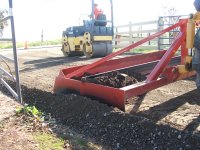
I plan to design and build my own land grader so I can better maintain the one mile gravel I live on. Right now I'm using a ~700lb 6' box blade. The BB works great for about 85% of the road, but there are two-three places that turn into mudholes and I have the "wavy" road surface that's a pain to work with a BB.

My plan is 3/8" side walls using two 5"x5"x3/8" angle as the cutting blades. I'll drop the "blades" below the sidewalls by about 3/4"-1" (i.e. about the same as the BB cutter).

My question is this: Angle the blades or keep them straight (i.e. 90 degrees to the direction of travel)?

My preference is to angle them (right side forward; left side towards the back) to try and get some of the side gravel back onto the road bed, plus help with crown.

Comments, suggestions, wise cracks, all the above?

Thanks!

 
/ Land grader design question #2  
My Landpride has angled blades, so I'll throw my two cents into the pot.

The angled blades provide very little side to side material movement, that I've seen anyway. I think that the angled blades do help to "slice" and level washboard though. It's just like grading packed washboard dirt with a bucket. If you attack the humps at a bit of an angle, it's easier to get it flat. I run my land plane's blades at 3/8" below the skids in front and level with the skids in back.
 
/ Land grader design question #3  
Properly angled blades serve several tasks: They reduce the wavelength of the ripples in the roasdway as they slice off the high spots. For that reason, even a landscape rake set at 45 degrees does a fine job of this. Also, the angle makes the material flow better from the front carver blade to the rear leveler blade. There is usually a height difference between them, too.

I suggest you watch a few videos on YouTube showing how some of these road graders work. Watch the material flow from front to back. That will give you some ideas on how you want yours to function.
 
/ Land grader design question #4  
I think you can go either straight or angled blades on a land plane and couldn't tell the difference. I use straight blades on mine for field leveling and when I designed it back in 2009 thought this would be better for my intended uses. When grading a road never have had an issue with ripples, the long longitudinal skids prevent this problem. When using a landscape rake or rear blade without the benefit of the skids angling the blade makes a huge difference. The angle setting on most of the land planes I have seen is limited to about 10 degrees, not enough to make much difference. One benefit of the angled blades is less tracking or overflow which is limited to one side of the plane, so might have better looking finish,

I would recommend you work in the cost of good grader blades into your project.

Having built two straight blade land planes here are some things to consider that I have learned. First I find that the skids can carry a lot of gravel and drop them on the lawn or roadway so my second land plane I used box tubing to eliminate this issue, no flanges to hold the rocks. My cross supports are to low and can hold grass and debris where sod is present in large amounts, make sure you have plenty of clearance. Gordon Gould pointed this out to me and was correct but it was already built. I will raise the cross members on my larger land plane to eliminate this when I have the time. Another thing is to make sure the whole frame assembly is rigid without any flexing the whole purpose of a plane is to mill the surface for lack of a better term. So build a heavy strong structure that won't give or allow the blades to deflect.

There will be a lot of comments about the slicing ability of the angled blades and in theory it sounds good but with only about 10 degrees of angle it isn't going to make a difference imo. From what I have seen and read on the forum I am one of the few who has built straight blade land planes and have used both types. I am not opposed to either design but find that the straight blades work better for large area smoothing because when pitching the land plane forward the blades will stay parallel with the surface. This is not an issue for driveway work as this can be desirable to have the leading edge on one side cut deeper. If I did more driveway work I would consider having one of each.

Here are the two land planes I have built, cost about $110/ft of width for materials.
 

Attachments

  • Butch W  new lawn work 002.jpg
    Butch W new lawn work 002.jpg
    379.8 KB · Views: 1,627
  • Butch W  new lawn work 003.jpg
    Butch W new lawn work 003.jpg
    342.1 KB · Views: 850
  • Butch W  new lawn work 004.jpg
    Butch W new lawn work 004.jpg
    422.3 KB · Views: 1,025
  • Butch W  new lawn work 001.jpg
    Butch W new lawn work 001.jpg
    379.7 KB · Views: 1,557
  • shop pad landplane 006.jpg
    shop pad landplane 006.jpg
    360.5 KB · Views: 770
  • landplane 001.jpg
    landplane 001.jpg
    409.3 KB · Views: 986
  • landplane 002 triple weights.jpg
    landplane 002 triple weights.jpg
    435.2 KB · Views: 775
/ Land grader design question
  • Thread Starter
#5  
Properly angled blades serve several tasks: They reduce the wavelength of the ripples in the roasdway as they slice off the high spots. For that reason, even a landscape rake set at 45 degrees does a fine job of this. Also, the angle makes the material flow better from the front carver blade to the rear leveler blade. There is usually a height difference between them, too.

I suggest you watch a few videos on YouTube showing how some of these road graders work. Watch the material flow from front to back. That will give you some ideas on how you want yours to function.

I've watched a bunch of these, the one I recall the best is the EA version they posted here and on their site; hence that's why I recall the angled blades.

One problem though I see in virtually every video I've seen is that the driveway is already pretty smooth and it looks like all they're doing is finish type work, not really getting rid of big problem areas (i.e. a road that's been neglected for quite some time). About 85% of my one mile drive is fine - the BB works for that. It's the other 15% that has the mudholes and the long wave dips and bumps. This is the part I'm trying to address, not just for this year but for the foreseeable future (i.e. as long as I live here, which hopefully will be quite a while).


I think you can go either straight or angled blades on a land plane and couldn't tell the difference. I use straight blades on mine for field leveling and when I designed it back in 2009 thought this would be better for my intended uses. When grading a road never have had an issue with ripples, the long longitudinal skids prevent this problem. When using a landscape rake or rear blade without the benefit of the skids angling the blade makes a huge difference. The angle setting on most of the land planes I have seen is limited to about 10 degrees, not enough to make much difference. One benefit of the angled blades is less tracking or overflow which is limited to one side of the plane, so might have better looking finish,

I would recommend you work in the cost of good grader blades into your project.

[snip for quote brevity]

Here are the two land planes I have built, cost about $110/ft of width for materials.

I have worked two grader blades into this project but it will be some time in the future - I still have one house to sell.

I saw your grader pics in another thread and saved them to my PC - this is where I got the idea to do one in the first place - it may have been you who recommended I build/buy a land grader in that other thread.

Rigidity and high cross bars/tubes: got it.

Unfortunately, I just bought the steel for this and one of those was the 3/8"x 2 1/2" for the bottom runners. Oh well.

Thanks,
 
/ Land grader design question #6  
I've watched a bunch of these, the one I recall the best is the EA version they posted here and on their site; hence that's why I recall the angled blades.

One problem though I see in virtually every video I've seen is that the driveway is already pretty smooth and it looks like all they're doing is finish type work, not really getting rid of big problem areas (i.e. a road that's been neglected for quite some time). About 85% of my one mile drive is fine - the BB works for that. It's the other 15% that has the mudholes and the long wave dips and bumps. This is the part I'm trying to address, not just for this year but for the foreseeable future (i.e. as long as I live here, which hopefully will be quite a while).

Unfortunately, I just bought the steel for this and one of those was the 3/8"x 2 1/2" for the bottom runners. Oh well.

Scarifying helps the rough areas prior to pulling the landplane. I think after you get it in shape the first time that keeping it in shape with just the landplane will be pretty easy.

The runners carrying material is more of an annoyance that anything when your doing work for customers. Nothing ticks me off more than dropping gravel off on a lawn that I've spent hours trying not to screw up. I hate picking gravel out of grass!
 
/ Land grader design question #7  
How about just adding side runners to your BB

Not much out of pocket $, and if it doen't work to your liking, Well, You have the runners for your land plane on hand ;-)

Sort of the "incemental approach". ;-)
 
/ Land grader design question
  • Thread Starter
#8  
How about just adding side runners to your BB

Not much out of pocket $, and if it doen't work to your liking, Well, You have the runners for your land plane on hand ;-)

Sort of the "incemental approach". ;-)

Funny you should mention that:

This land grader will not be a stand alone implement. I'll have it bolted to the back of my box blade. Like I said above, I'm still paying for two homes until we sell the Madison house and I get paid nothing to maintain this one mile gravel road. So I'm going to make do with what I can.

I guess I gotta take back that comment about not getting paid to maintain the road: If the runners hold as much gravel as you guys suggest, I'll just "clean my box blade" out near my pole barn and recycle the gravel where I could use some......

Thanks!
 
/ Land grader design question #9  
Funny you should mention that:

This land grader will not be a stand alone implement. I'll have it bolted to the back of my box blade. Like I said above, I'm still paying for two homes until we sell the Madison house and I get paid nothing to maintain this one mile gravel road. So I'm going to make do with what I can.

I guess I gotta take back that comment about not getting paid to maintain the road: If the runners hold as much gravel as you guys suggest, I'll just "clean my box blade" out near my pole barn and recycle the gravel where I could use some......

Thanks!

I think that the guys complaining about the runners holding material are professionals and don't like material falling into the grass that they might be working next to for their customers. While my runners collect material, it is nothing that I worry about, in fact if I let it just build up, it packs in at a 45 degree slope and doesn't hold any more, so then nothing falls out anyway. Conditions can make a big difference with what one needs.

Use your box blade for now, but a LPGS is faster and easier in the long run. ;)
 
/ Land grader design question #10  
We had a home made grader or 'drag' with 3 angled blades, the overall size being 8' wide by 8' long.
All blades were angled and it worked great.
The angles were calculated so that the angle of the one about balanced the drag of the other 2. i.e. one at 30 deg and the other 2 at 15 deg each to balance the resistance in order to follow in a straight line, worked out quite well.
With 2 blades you invite humps to not be well 'scalped' while with 3 blades you get a nice even surface, the idea being like a road grader with blade in middle.
Or again, first blade scalps, 2nd spreads and fills holes while the 3rd acts as a finishing blade.
Angling the blades makes the scalped loose material travel from side to side.
 
/ Land grader design question #11  
I think that the guys complaining about the runners holding material are professionals and don't like material falling into the grass that they might be working next to for their customers. While my runners collect material, it is nothing that I worry about, in fact if I let it just build up, it packs in at a 45 degree slope and doesn't hold any more, so then nothing falls out anyway. Conditions can make a big difference with what one needs.

Use your box blade for now, but a LPGS is faster and easier in the long run. ;)


The thing is if you are aware of the problem of the flanges holding the rocks why not design it so the problem goes away? Using rectangular box tubing solves that problem. And you can fill them with sand, weight material (Bayrite) or concrete to add more weight.

I should also mention that pieces of rectangular box tubing is available used in lengths appropriate for the skids if you look through scrap yards. Most were used for large signs and these things get replaced enough to make this a good find.
 
/ Land grader design question #12  
The thing is if you are aware of the problem of the flanges holding the rocks why not design it so the problem goes away? Using rectangular box tubing solves that problem. And you can fill them with sand, weight material (Bayrite) or concrete to add more weight.

I should also mention that pieces of rectangular box tubing is available used in lengths appropriate for the skids if you look through scrap yards. Most were used for large signs and these things get replaced enough to make this a good find.

It's a bit harder to do if you use taller runners. Even with your 8' LPGS, aren't the sides 12" tall. My sides are 22" tall. Tubing, if you could even find it would be very expensive, or you are piecing your runners to get what you want. Probably better to just weld in a filler piece if holding the material on the runners is a concern. Sort of what is done on some dump truck beds.

Many people mention purchasing scrap material from a local supplier, everyone does not have that option at a reasonable cost. Not that the scrap isn't there, you just pay new prices for it. :(
 
/ Land grader design question #13  
I suspect you and I have slightly different approaches to using a land plane. I don't try to make deep cuts all the time and have my blades set flush with the skids, if it is flat I don't need to cut it deeper. Your technique and use from what I gather is to cut deeper and carry more material along as you go, your blades are always cutting below the surface. I use my box blade to cut and move large amounts of material and use the land plane to finish the ground smooth. Where you need to mix the material and bring the gravel to the surface I think your method works pretty well. My main use for a land plane is to smooth lawns and fields where the ground is softer and having the blades set flush works better. I did try it with the blades set below the skids and it was continually cutting, even in the low spots.

I mention the above because I don't have to use high sides on the skids and don't have any issues with material going over the sides. I do think it is better to have more clearance between the blades and the cross members than I have. Next time I build a new land plane I will change the design to affect this.

While you may not be able to find scrap at a lower price it is worth mentioning, some on here can use this information and others may not. Living in a ski resort town as I do without any industry makes if difficult to find but on trips to the large cities I have found some good deals.
 
/ Land grader design question #15  
Hey, I'm from Missouri so I gotta be "shown" everything.

I think if building one, I'd angle one blade to the left, one blade to the right. Being a grader guy I want to move the material laterally as much as I can to create a level bed. Then I could adjust the 3pt or hit the hydraulic lever on the tilt to crown or shape whatever I was working on.

I think these variations in opinions and desires are based on the many uses of a tool such as this.
 
/ Land grader design question #16  
Hey, I'm from Missouri so I gotta be "shown" everything.

I think if building one, I'd angle one blade to the left, one blade to the right. Being a grader guy I want to move the material laterally as much as I can to create a level bed. Then I could adjust the 3pt or hit the hydraulic lever on the tilt to crown or shape whatever I was working on.

I think these variations in opinions and desires are based on the many uses of a tool such as this.

That works great, angled slices tops and slides the material sideways to fill the dips. Having right and left angle balances the drag as well for a more even pull.
Just one thing to add: a third blade!
With only 2 blades the drag will ride up and down over bumps and valleys while a 3-bladed drag will have one blade slicing while the other 2 act as supports as well as spreading the material.

3 blade drags were very common in our neck of the woods in the 40's and early 50's and were even pulled by horses for a while.
 
/ Land grader design question #17  
Hey, I'm from Missouri so I gotta be "shown" everything.

I think if building one, I'd angle one blade to the left, one blade to the right. Being a grader guy I want to move the material laterally as much as I can to create a level bed. Then I could adjust the 3pt or hit the hydraulic lever on the tilt to crown or shape whatever I was working on.

I think these variations in opinions and desires are based on the many uses of a tool such as this.


Richard you could do that and increase the angle enough to actually move the material sideways. If you are willing to make the skids longer so all of this will fit. Your 9540 could handle it much better than my smaller compacts. There would be a lot more weight farther away from the rear wheels.
 
/ Land grader design question #18  
Hey, I'm from Missouri so I gotta be "shown" everything.

I think if building one, I'd angle one blade to the left, one blade to the right. Being a grader guy I want to move the material laterally as much as I can to create a level bed. Then I could adjust the 3pt or hit the hydraulic lever on the tilt to crown or shape whatever I was working on.

I think these variations in opinions and desires are based on the many uses of a tool such as this.

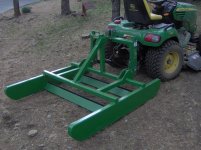
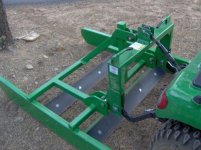
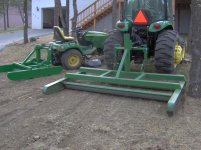
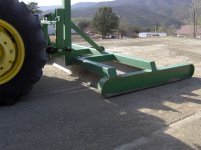
I still think (for a grader guy) that an "asphalt float" would be a wonderful tool. It uses the blade to cut and a "smoocher" to smooth material out the back. I'm not too sure how the smoocher part would work for a typical tractor since these are designed for skiploaders weighing 14k with down pressure. For sure it would have to be constructed heavier.

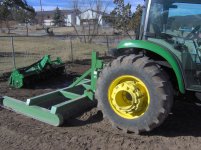
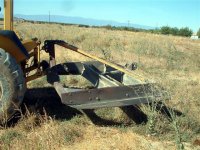
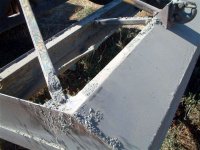
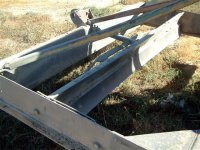
The first three pics are from one of our fellow TBN members. I don't know if it's a one-off custom or what, but I like it a lot. The last one I found on the web. It's a much simpler design built by Flynn and Thomas Mfg. There's no ability to angle the blade. I don't like it much.
Gravel Float 02.jpg Gravel Float 03.jpg Gravel Float 04.jpg Gravel Float Thomas.jpg


Marketplace Items

2013 Infiniti JX35 AWD SUV (A61574)
2013 Infiniti JX35...
Arrow Quip 10' Corral Panel X 4 (A64047)
Arrow Quip 10'...
2019 HYUNDAI V12530152-AJS 53' 102" T/A VAN TRAILER (A59910)
2019 HYUNDAI...
2009 Blue Bird All American/ All Canadian School Bus (A61568)
2009 Blue Bird All...
Mahindra 4550-4L Tractor with Front Loader - 49 HP, 4WD, Heavy-Duty Utility (A63118)
Mahindra 4550-4L...
2012 PROCO 130BBL VAC TRAILER (A63569)
2012 PROCO 130BBL...
 
Top