Large lawn improvement

/ Large lawn improvement #1  

LittleBittyBigJohn

Veteran Member
Joined
Jun 7, 2021
Messages
1,385
Location
Central Arkansas
Tractor
John Deere 1025R, Kubota ZD1211
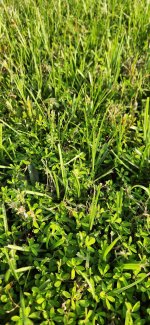
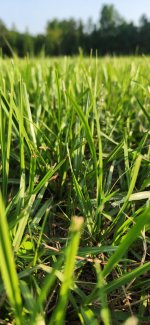
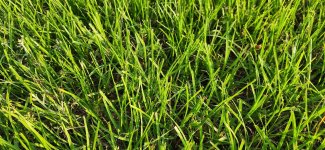
I'm getting to the point in my new home project that I want to start fixing up my lawn. But it's about 10 acres worth... I have a small area around my house where hay was fed back when there were cows on it, so there are a few stands of good Bermuda. I feel like I can get the close area around my house to convert over to that Bermuda with a couple years worth of selective herbicide and fertilizer. The larger area looks good-ish but it looks to me like it's all Nutsedge and some sort of cloverlike groundcover.

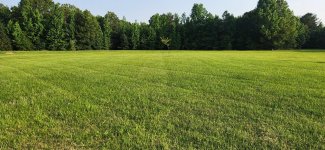
I don't really know the best way to start. I don't own any large equipment to make quick work of it. The only tillage equipment I have is a 50" tiller and I would rather not till 10 acres to prepare a seed bed. I also don't really want to spend many thousands of dollars. It's ok if it's a several year project. Since summer is just about in full swing I will probably not start until next year, unless there is something I need to do in the fall for preparation. In the far back, you can see some bare dirt. It's about an acre and a half that's up to 18" or so inches of heavy clay from my pond excavation so it's really poor soil.

My thoughts are either to use selective herbicide in increasingly larger areas for the established Bermuda to slowly expand out over several years. As well as take some plugs of it into different areas to establish more small Bermuda areas to get multiple areas spreading. Or tilling a few strips here and there and spread seed in hopes of creating several larger areas that can spread. I guess the fastest and most expensive way would be to roundup all of it and try to find a no-till drill to drill a ton of seed all at once on the whole place.

Have any of you done a project like this?

20250602_184527.jpg20250602_184705.jpg20250602_184606.jpg20250602_184628.jpg20250602_184818.jpg
 
/ Large lawn improvement
  • Thread Starter
#3  
I'll be planting a bunch of trees and a garden spot. I eventually want to add a small orchard spot with fruit and nut trees to break up the open space and add shaded areas as well as some food. I enjoy the outdoors and spend most of my time out on the property. I've got chickens in the back, ducks and the pond in the front so I'm always walking back and forth. I don't like the grass up on my legs when I'm out there. Also to me it just looks really nice for it all to be mowed. It also cuts way down on the rodents and snakes. My house is dead in the center so there is not really a big area that is out of sight. I typically only mow all the way back to the trees every 2nd or 3rd mow. There are a few small terraces breaking up the slight slope down to the back. Stopping on the back side of the first one usually looks plenty nice if I don't let it go more that 2-3 weeks.
 
/ Large lawn improvement #4  
10 acres is a lot to do anything with without spending a fair amount of money. It sounds like the grade or smoothness of the lawn is satisfactory to you or you would be working it up and starting from scratch which adds up in a hurry grass seed alone would be pricey.

I would start out with some soil samples to local ag office they don't cost much and they will advise what fertilizer and lime to get your soil in shape to grow turf. Some of the weeds will disappear just by getting the soil acidity in the right range. A herbicide applied in the fall will help get rid of the rest of the weeds, if it is ground ivy aka creeping charlie you may need a second application about 10 days after the first. I recently used a herbicide containing Dicamba I got at Fleet Farm with good results also some 24d will take care of a lot of the broadleaf weeds.

Mowing your grass taller will give you way better results, my mower setting is 4 inches, keep your blades sharp, I fertilize twice a year usually and leave the mower clippings on the lawn. A thick lawn helps choke out the weeds and taller helps shade the roots so the lawn stays healthier. Some people use a slit seeder to go over the lawn to plant seeds without working it up, you may have a place to rent one around you. It will take a little time but if you start with the little things and see what is working best and go from there you will get to where you want to be. There will always be some areas you would like to be better especially with 10 acres. The clay soil area will probably take quite a while to look decent unless you add some topsoil or good organic materiel and mix it with the clay. You may want to consider doing a few acres around the house and just mowing the rest taller, 6 inches or more,about once a month until you get good at converting the 2 acres. Good luck.
 
/ Large lawn improvement #5  
That's a pretty decent lawn now other than a few weeds!

I'm with Jimmy Joe - Dicamba to get rid of the weeds, then let it grow long - cut at 5" or so will shade and retain the moisture better too.

Then selectively slit seed in the fall as needed, and till some sand or topsoil in the bare areas and seed at the same time.
 
/ Large lawn improvement #6  
I'll be planting a bunch of trees and a garden spot. I eventually want to add a small orchard spot with fruit and nut trees to break up the open space and add shaded areas as well as some food. I enjoy the outdoors and spend most of my time out on the property. I've got chickens in the back, ducks and the pond in the front so I'm always walking back and forth. I don't like the grass up on my legs when I'm out there. Also to me it just looks really nice for it all to be mowed. It also cuts way down on the rodents and snakes. My house is dead in the center so there is not really a big area that is out of sight. I typically only mow all the way back to the trees every 2nd or 3rd mow. There are a few small terraces breaking up the slight slope down to the back. Stopping on the back side of the first one usually looks plenty nice if I don't let it go more that 2-3 weeks.

Oh I agree, being outside is the best! I am not a man who watches TV or spends my time inside. When I get home from work every day, I change my clothes and head straight outside only to come in to go to bed. Same on weekends, straight outside until dark every day. I have 20 acres that keeps me busy with projects, upkeep, and improvements. Me personally, I just find mowing to be about one of the most useless waste of time a man can do so I try to keep it minimal. I spend hours every week mowing and weed trimming my yard but, I can think of so many other things I could be doing with my valuable time besides cutting weeds shorter. But we're all different so what makes me happy, may not be the same for the next guy.
 
/ Large lawn improvement #7  
In this area it is usually easier to establish a lawn by planting in the fall when cooler but still getting some rain. Seems like planting in spring or early summer planted grass just doesn’t take root like it does in the fall.

Not sure how it works in your area.
 
/ Large lawn improvement #8  
I'm getting to the point in my new home project that I want to start fixing up my lawn. But it's about 10 acres worth...
I can offer a lot of advice based years of maintaining a quality cool season turfgrass lawn, namely tall fescue for our local climate. Most of this probably translates over to Bermuda, but you'll definitely want to lean on local knowledge.
  1. A perfect lawn via mass distribution of chemical is possible, no need for weeding and tilling, but you will be spending money on product.
  2. We figure on approximately $1000/acre per year (wholesale) to maintain a really nice lawn, if you're doing all of your own fertilzation and overseeding. Half of this cost is the yearly overseeding, so you can cut the number to $500 per year if your grass is a creeping variety that self-repairs.
  3. Fertilization is done in five or six rounds per year, with rates and compositions dictated by yearly soil test. Overseeding is done once per year in September (at least here).
  4. Aeration is done once per year, with plug aerator immediately before overseeding.
  5. Weed kill spray can be done 2x per year, generally May and August, but you'll probably find yourself skipping this step after the first two or three years, as there won't be any weeds left to spray.
  6. Pre-emergent weed block goes down with first yearly round of fertilizer, usually late March or early April around here.
  7. Grub control goes down in June, which controls Japanese beetles and ticks, with appropriate product selection. I have only encountered one tick in 15 years on my property, whereas each of my three direct neighbors find them weekly, and two have had Lyme disease.
I have a 4 acre yard and can't stand it. Trying to get some of it to turn back into woods. I couldn't imagine maintaining a 10 acre yard!
I have 4 acres, and have whittled it down to about 3 acres of lawn, by adding gardens and wooded areas. Honestly, I think the lawn is the least work of all the various areas, gardens and woods both require more labor. But the lawn is also the most expensive, mostly due to overseeding each year, as tall Fescue is the most durable species in our climate, but it does not self-repair.
 
/ Large lawn improvement
  • Thread Starter
#9  
I can offer a lot of advice based years of maintaining a quality cool season turfgrass lawn, namely tall fescue for our local climate. Most of this probably translates over to Bermuda, but you'll definitely want to lean on local knowledge.
  1. A perfect lawn via mass distribution of chemical is possible, no need for weeding and tilling, but you will be spending money on product.
  2. We figure on approximately $1000/acre per year (wholesale) to maintain a really nice lawn, if you're doing all of your own fertilzation and overseeding. Half of this cost is the yearly overseeding, so you can cut the number to $500 per year if your grass is a creeping variety that self-repairs.
  3. Fertilization is done in five or six rounds per year, with rates and compositions dictated by yearly soil test. Overseeding is done once per year in September (at least here).
  4. Aeration is done once per year, with plug aerator immediately before overseeding.
  5. Weed kill spray can be done 2x per year, generally May and August, but you'll probably find yourself skipping this step after the first two or three years, as there won't be any weeds left to spray.
  6. Pre-emergent weed block goes down with first yearly round of fertilizer, usually late March or early April around here.
  7. Grub control goes down in June, which controls Japanese beetles and ticks, with appropriate product selection. I have only encountered one tick in 15 years on my property, whereas each of my three direct neighbors find them weekly, and two have had Lyme disease.
My brain is spinning on this one.. Lots of great info! Thank you for the detailed response.

I'm definitely not going to be able to justify that kind of continued expense. I may have to come up with a Dollar General version taking bits and pieces from your list each year...
 
/ Large lawn improvement #10  
I would go with a low maintenance grass like hard fescue. I put this around my pond and wish I had it more places. It does a good job of choking out the weeds, doesn't require fertilizing or watering and only needs to be mowed once a month or so.
 
/ Large lawn improvement #11  
My brain is spinning on this one.. Lots of great info! Thank you for the detailed response.

I'm definitely not going to be able to justify that kind of continued expense. I may have to come up with a Dollar General version taking bits and pieces from your list each year...
The biggest factor, which I guess I failed to mention because it's not really a yearly chore, is to get your pH right. Most will require lime to get their pH on-target, and the great news is that lime is the cheapest of all the lawn ammendments you'll ever need.

I even had the tech's at my turf product wholesaler once tell me, "if your pH isn't right, all the fertilizer in the world isn't going to save you." A bold and unprofitable statement for them to make, considering pH correction is cheap, and they make most of their money on fertilizer.

In 15 years on this property, I think I've only had to nudge the pH three times with lime applications, it holds pretty steady for several years. The down side is that it takes a lot of lime, I've done over 1000# per acre in a single application, but the up side is that it's so cheap you'll think they mis-charged you.

I'd start with a soil test, the cost of which is usually between free and $30. That will tell you how far off you are on pH and various nutrients. The biggest mistake I see most folks making is spending money on fertilizer they don't need. But even if you choose to not dial everything in to perfection, at least you'll know the general direction you want to nudge things. If your soil test comes back with a recommendation for lots of Nitrogen and zero potatasium, at least you'll know to be shopping 20-x-0 fertilizers, whatever you end up actually buying.

You probably already know this, but every bag of fertilizer sold in the USA has an N-P-K designation on the bag. That's Nitrogen-Phosphorus-Potassium. Given you're working with 10 acres rather than a 1/4 acre in-town lot, making sure you're not wasting money on an ingredient you don't actually require is going to matter to you.

I buy my products from SynaTek Solutions, but in your area you have Agra Turf Inc., which I believe is a similar company. These companies are where golf courses and athletic field contractors buy their products, and they will usually partner someone like you up with one of their in-house sales experts who can help you develop a yearly plan at any budget level. Moreover, their dollar per acre rates are going to be way lower than the low-density crap you can buy at Lowes Depot, since they package at higher density rates (e.g. 200 lb/acre for most products).

If I were in your shoes, I'd pick out the "pretty" 2 - 3 acre plot around the house, and put my budget and energy there. The remaining 7 - 8 acres might only get lime and spring pre-emergent, which will cost you under $120/acre per year. This aligns with another member here who said he'd mow concentric circles around his house and see how far he got in an hour, before calling that his "lawn". :D 2 - 3 acres of pretty lawn is plenty for someone who has a full-time job elsewhere.

PS - People always throw out things like "soil test", assuming people know where to get them, which isn't always obvious. If you end up buying product from Agra Turf, they should give you free soil tests after the first year. Maybe they'll charge you $30 for the first one. Also, any university that has an agricultural extension can either test your soil or point you to a lab that will do it. Just collect a dozen samples from around the property at grass root depth (I use a bulb planter to pull a plug and shake a few soil crumbs into a baggie). Mix the crumbs of a dozen samples until you have a homogeneous handfull, and then drop it off at Agri Turf or any other turf products supplier. Usually takes a week or two to get results back.
 
/ Large lawn improvement #12  
Mr. Winterdeere, what specific product do you use for grub control?

Japanese Beetles have decimated my garden the last 2 years...

And how do you spread the lime?
 
Last edited:
/ Large lawn improvement #13  
That's a pretty decent lawn now other than a few weeds!

I'm with Jimmy Joe - Dicamba to get rid of the weeds, then let it grow long - cut at 5" or so will shade and retain the moisture better too.

Then selectively slit seed in the fall as needed, and till some sand or topsoil in the bare areas and seed at the same time.
I agree with mowing high, I mow to 4", but let it get 6-8" before mowing.
This shades weeds and trash, early on and prevents it from getting healthy.
I don't subscribe to the lawn company's hype about killing everything but one or two grasses. Whatever is green grows into a great looking lawn from a distance.
I only spray nuisance weeds. Sat I sprayed some old-fashoned nettles that sprang up after the county swept the old blacktop in prep for the new layer of blacktop.
Some people don't realize clovers are a broadleaf plant that support local bee colonies while also looking good in a lawn.
 
/ Large lawn improvement #14  
Mr. Winterdeere, what specific product do you use for grub control?

Japanese Beetles have decimated my garden the last 2 years...

And how do you spread the lime?
I use a product called Milky Spore for Japanese beetle grub control. It requires 2 - 3 applications for two consecutive years an then can last for 8 to 10 years or more without another application. The only insect this product affects is the Japanese Beetles grub.

Not inexpensive but I like it since doesn’t bother beneficial insects like bees, butterflies, etc.
 
/ Large lawn improvement #15  
Mr. Winterdeere, what specific product do you use for grub control?

Japanese Beetles have decimated my garden the last 2 years...

And how do you spread the lime?
I've toggled back and forth between Allectus and Entourage, depending on which was available in the fertilizer blend I needed that year. Or during the COVID years, which one was available, period.

I seem to have had much better results with keeping Japanese beetle populations down on the years I use Entourage, but that could have as much to do with application timing, weather, and even what my neighbors are doing each year, as my choice of product.

Target application date around here is June 15, for maximum control of Japanese beetle grubs. But it requires some rain to activate, so jump on it early if it looks like late June could be dry, or vice versa. I think recommended watering-in is about 0.5" of rain, or equivalent.

Remembering back now, Entourage might be a proprietary local brand name, so you might not see it everywhere. Allectus is definitely available nearly everywhere. Most of these products are packaged with fertilizer, most easily purchased and used at a rate of four 50 lb. bags per acre, which works well in most broadcast spreaders running in the lower third or their deposit rate range. I use a Herd M12 at setting 6.0 to 6.5 for these products, but used to use a crappy Precision brand tow-behind spreader on a garden tractor before the Herd.
 
/ Large lawn improvement #18  
The biggest factor, which I guess I failed to mention because it's not really a yearly chore, is to get your pH right. Most will require lime to get their pH on-target, and the great news is that lime is the cheapest of all the lawn ammendments you'll ever need.
cheap ? $70/ton for lime vs $600 for 20-10-20...Makes me wonder why every time I reach for the checkbook. Last couple of years, definitely more receipts and less deposits.
 
/ Large lawn improvement #19  
cheap ? $70/ton for lime vs $600 for 20-10-20...Makes me wonder why every time I reach for the checkbook. Last couple of years, definitely more receipts and less deposits.
Yep, that roughly agrees with my memory, lime is roughly 10% the cost of fertilizer. And quality seed is 5x the cost of fertilizer, at least for most of the better tall fescue blends with higher germination rates. So for the love of everything holy, get your pH and nutrients right, before blowing a dime on seed!

I see people throwing away money on re-seeding, without even bothering to do a soil test to see if their pH is way off. That's fine if you have a 1/2 acre yard, you might waste $300 on seed and starter fertilizer, but it's a more expensive mistake on 5 - 10 acres.
 
/ Large lawn improvement #20  
I have a 4 acre yard and can't stand it. Trying to get some of it to turn back into woods. I couldn't imagine maintaining a 10 acre yard!
Yup! How do plan on maintaining 10ac of lawn? Why what I see that's alreaty there just mow it how it currently sits. In a few meetings you fill find that unless you have large equipment (and you said you didnt) you wont want a 10ac lawn after a few mowing sessions.
 

Marketplace Items

2007 Caterpillar 262C Compact Wheel Loader Skid Steer (A59228)
2007 Caterpillar...
APPROX (30) PIECES OF 8"&10" UP TO 18' I BEAMS (A60430)
APPROX (30) PIECES...
DEUTZ MARATHON 60KW GENERATOR (A55745)
DEUTZ MARATHON...
2017 Chevrolet Express 12FT Box Van w/ Liftgate (A59230)
2017 Chevrolet...
(APPROX.104), 2X4X8 NO.2 PRIME LUMBER (A60432)
(APPROX.104)...
Bobcat T590 (A53317)
 
Top