Laser Grading

   / Laser Grading #1  

Industrial Toys

Super Star Member
Joined
Feb 25, 2008
Messages
17,407
Location
Ontario Canada
Tractor
Kubota R510 Wheel Loader + Cab and backhoe, JD 6200 Open Station, Cushman 6150, 4x4, ten foot 56 hp Kubota diesel hydraulic wing mower, Steiner 430 Diesel Max, Kawasaki Diesel Mule, JD 4x2 Electric Gator
Does anyone have any experience using laser controlled grading equipment?

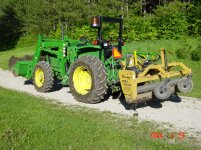
I have a Harley Pro 8 rake and have figured out a way to make the height adjustment be laser controlled quite easly and cheaply, relatively speaking.

Does anyone think this might be usefull, or is it just more trouble then it's worth? It would just be for plain flat work. Nothing fancy.

I would start by buying a Topcon rotating laser, which I want anyway. Are there "must have" features and would they even be applicable to my simple application? These things always seem to be evolving and older ones are always available cheap on E-Bay and Craigslist. Are Remotes a usefull feature? Is one manufactures laser compatible with others receivers?

Thanks

 
   / Laser Grading #2  
I am a land surveyor and have done a lot of construction staking. I don't really know a lot about making the equipment work, but have seen it used a lot. When its setup and working well, its great stuff. We own a lot of Topcon equipment and have had good luck with it.
 
   / Laser Grading #3  
I have a Trimble cr 600 receiver that has a magnetic mount and I will just slap it on the bucket and follow the lights manually.
 
   / Laser Grading #4  
Does anyone have any experience using laser controlled grading equipment?

I have a Harley Pro 8 rake and have figured out a way to make the height adjustment be laser controlled quite easly and cheaply, relatively speaking.

Does anyone think this might be usefull, or is it just more trouble then it's worth? It would just be for plain flat work. Nothing fancy.

I would start by buying a Topcon rotating laser, which I want anyway. Are there "must have" features and would they even be applicable to my simple application? These things always seem to be evolving and older ones are always available cheap on E-Bay and Craigslist. Are Remotes a usefull feature? Is one manufactures laser compatible with others receivers?

Thanks

I have done some research on this over the past year and am currently setting up for laser grading with machine control. Hard to decide between single slope and dual slope laser but will go with the dual slope most likely because I would hate to have pay the upgrade cost later. For my work environment where the laser and receivers need to clear the top of my cab that puts the laser about 10' high so a remote seems like a good idea. Adjustment from the tractor cab is another advantage, being able to adjust the laser and the receivers from the cab should make set up a heck of a lot easier to do.

I don't have any experience with the Harley rake used for grade work but would think it might be limited in its ability to carry the dirt enough to do you much good. Seems a Harley rake would be a good tool for loosening up the hard packed soils prior to using a box blade to level

Very curious what you have found that is easy and cheap about this stuff, I am getting ready to buy the equipment this spring. Right now I am considering a Topcon RL200 2/s laser with remote and elevating tripod. For receivers the Topcon lsb110w with remote for one side of the box blade and also for use on the backhoe. The second receiver would be a 110 without the remote for the opposite side of the box blade. These will be connected to a Topcon system 5 dual controller in the tractor cab. The hydraulic valve was the hardest part to spec out, but after a bunch of reading I finally worked out the details. I decided to go with a Sauer Danfoss PVG 32 series proportional controlled valve with two spools. For the cylinders I decided on Prince tee style 3x8" with a 16" closed pin to pin as these were the best fit for my design.

The box blade I am converting is a Gannon/Frontier BB1284 with hydraulic scarifiers and is 7' wide. It will work as both a 3 point and as a towable box blade with self leveling caster wheels I am building up from scratch. Spent a lot of time with TurboCad designing this over the Holidays at night and am finally starting to cut out the parts to assemble. The caster wheels are 20x10-10 slick tires for limited tracking and I hope these will work out. I am taking pictures and will post a thread when I am closer to completion.
 
   / Laser Grading #5  
Like jenks mentioned, the power rake would be nice for loosening up soil to be graded with a laser controlled box blade, but IMHO the laser setup would be a waste on the Harley rake. It's not what it's designed to do. I'd go with a dual slope for everything but straight and level building pads.
 
   / Laser Grading
  • Thread Starter
#6  
DSC00314.jpgDoes a laser only shoot out one beam? Does that mean if your receiver is only a foot long and the laser isn't hitting it, that you are out of luck? Trying to understand this.

What is the difference between a single slope and dual slope?

As far as the rock rake goes, it would have been the easiest to incorporate. We have very stoney ground around here and the box blade would be useless for grading. The stones roll under the edge raising it.

I was going to use my JD that has a hydraulic remote that is electically controlled. It is actually for the loader/grapple, but I can easily plumb that to the rear, and then to the up/down circuit on the Harley Rake. Then I would get a receiver that is designed for visual operation (not machine control) like one mentioned above, and wire some opto isolators into the up and down LEDs and with this signal and relays, operate the cylinder. That for me, is the easy part.

This older Harley with the flat serrated bars shaves off high ground like no fixed blade can (short of a dozer) but I concede that filling in low areas could well be an issue. Maybe it's a waste of time and money, but it is something I would be thrilled to play with and maybe just kind of an introduction into automated machine control.

Rancher. How did you ever get that gravel delination sooo perfect????
 
Last edited:
   / Laser Grading #7  
All the machine control I've seen is usually hooked up to doziers, graders and pavers and most of them use GPS instead of lazers.
 
   / Laser Grading
  • Thread Starter
#8  
Somehow the machine needs an elevation reference for grading, maybe to within an inch or better. No way GPS could do that, but I am curious what the GPS is used for in construction. In Ag it's obvious.
 
   / Laser Grading #9  
Application of GIS in Geological Mapping - Revolution in Surveying Areas with Precise Measurements
This article talks about geological mapping in 3D but I too would not think that the elevation (Z axis) would be accurate enough for precision grading. Perhaps someday it will be.

Edit: On the other hand, this article talks about GPS accuracy for grading purposes:
GPS Machine Control
Excerpt taken from the article:

So what is a typical vertical accuracy for GPS Machine Control systems without lasers? Anywhere from ス to セ inch (12 to 18mm). Of course, the more GPS satellites you are receiving, the better your vertical accuracy will be. These tolerances can be decreased by a factor of 3 by adding lasers into the system....
 
   / Laser Grading #10  
View attachment 356334Does a laser only shoot out one beam? Does that mean if your receiver is only a foot long and the laser isn't hitting it, that you are out of luck? Trying to understand this.


Rancher. How did you ever get that gravel delination sooo perfect????


The laser is shooting a very narrow beam so if you are out of the pick up band of the receiver you are out of luck as you say. The less expensive receivers have a shorter pick up range than the better ones too. For rough grading it should be obvious when you need to keep cutting down until you are with in the working parameters of the receiver. It should be just as obvious where you need to fill in a large depression to reach grade. Also notice some receivers pick up the laser for a full 360 degrees while some have a lesser arc.


About Rancher's work, he takes pride in his work and has plenty of seat time. Good job:thumbsup:
 
   / Laser Grading
  • Thread Starter
#11  
Maybe that is where GPS would be more usefull than a laser. If you have to cut six feet it can tell you that.

Jenkinsph. How do you get the laser up that high? Do you have a regular tripod and then a pole?
 
   / Laser Grading #12  
Maybe that is where GPS would be more usefull than a laser. If you have to cut six feet it can tell you that.

Jenkinsph. How do you get the laser up that high? Do you have a regular tripod and then a pole?


I think the GPS systems are great but I can't make that pay or afford those systems anyway. A good laser set up with two receivers, hydraulics with proportional control and a good laser runs about $12,000 best I can tell. GPS would be $25,000 and beyond.


About the height of the laser, I am planning on 10' to clear the cab of my tractor and a larger tractor later if needed. The mounting for the laser has to be rock solid for long distance use or all is lost. I will likely buy a very good elevating tripod for the short shots and make a larger heavy duty stand for the longer field shots. Wind can be a real problem in my locale in the early spring when most of the leveling work is taking place. When you consider a 1000' shot it doesn't take much movement to have the laser line jumping up and down and worthless. I am working on a drawing now to design a good stand for the field work.
 
Last edited:
   / Laser Grading #13  
Yeah, GPS is very expensive to add for machine control. What's nice about GPS is does the vertical and the horizontal at the same time. If you are grading a site all at the same elevation, it doesn't matter but for something like a highway, it works great. GPS is accurate to about and inch in the vertical, which is good enough for dirt work but not paving. Topcon actually makes a system that combines GPS and lazers for use in paving. Needless to say its big bucks.

I'm not sure exactly what it cost to add GPS to something like a dozer or motor grader. There is usually a GPS antenna on both corners of the blade. I'd just guess your talking $50,000 or more by the time you add everything up.

For reference, a survey grade GPS system, which is accurate to about an inch, cost in the neighborhood of about 20 to 30k. It also takes a lot of training and experience to learn how to use it. The companies that are big into machine control usually have someone on staff that understands all this stuff and also knows how to setup the files that are loaded into the controller that the equipment operator follows. A lazer system is much easier to use for someone starting out.
 
   / Laser Grading
  • Thread Starter
#14  
If you have a thousand foot range on the laser, it's a thin beam and you only have let's say a foot or so of receiver looking at that beam, how is that supposed to work?

Still curious about the single and dual slope, understanding neither!
 
   / Laser Grading #15  
If you have a thousand foot range on the laser, it's a thin beam and you only have let's say a foot or so of receiver looking at that beam, how is that supposed to work?

Still curious about the single and dual slope, understanding neither!

Say your laser is setup at elevation 105. Say you want what your are grading at elevation 100. You would put your receiver at the point on your rod where it picks up the beam and see where you are at. Say the beam is picked up at the 10 foot mark on the rod. It should be at the 5 foot mark to be at grade. This means you need to fill 5 foot of dirt to be at grade.

Say the beam is at the 2' mark. That means the elevation is 103 and you need to cut 3 feet of dirt to be at grade.

Hope that makes sense.
 
   / Laser Grading
  • Thread Starter
#16  
You speak of a ten foot rod. THAT would make sense. But some of the receivers I see are only like a foot long. Maybe not even that. That is an awfully small window to work with.
 
   / Laser Grading #17  
You speak of a ten foot rod. THAT would make sense. But some of the receivers I see are only like a foot long. Maybe not even that. That is an awfully small window to work with.

Most of the receivers that are a foot long only pick up a band of 5 to 9 inches. If you are willing to spend several thousand you can get a wider band and a motorized unit which will scope up and down the rod. When I start out grading I usually cut down the highest spots and pull them to the lowest spots. I can then run a landplane grader blade over the field to smooth everything out. I don't see the need for a laser on the machine to help me determine where to make a 5' cut or fill in a similar hole. 90% of grading work is smoothing out the last 10% of the job. For my work leveling irrigated fields the water levels out and tells the story, everybody knows whether you get it right or not.

About the single slope vs dual slope, you can set the angle of slope you wan't possibly to follow terrain or to an incline. With a dual slope laser you can set up two slopes at the same time, for instance you might need to set up for a 10 degree slope running north to south and only 2 degree slope east to west. The laser is not set up level all the time like you might do for grading a concrete slab.
 
   / Laser Grading #18  
You speak of a ten foot rod. THAT would make sense. But some of the receivers I see are only like a foot long. Maybe not even that. That is an awfully small window to work with.

You have to move the receiver up or down on the rod to get within the working range of the laser beam.

I have a dual slope laser transmitter. I use it to grade football fields. Here is an example of how 'dual' slope works.

If I set up my transmitter behind the goal post in the north endzone, and I want to grade my field to have a peak at the center of the field (in a straight line between goal posts), and I want it to slope towards the sideline (east and west). And, I also want it to slope towards the south. A 'dual' slope transmitter allows me to set my laser in both east and south directions, or west and south. A 'single' slope transmitter would only allow me to set my laser in one direction. South, or east, or west. For my needs, a 'dual' slope was my only option.

They also make a 'cone' transmitter, which is for use in constructing baseball fields, where the transmitter is set up on the pitcher's mound, or home plate, and the field is graded outwards from there.
 
   / Laser Grading #19  
And, a remote to adjust the slope is a good option.

And different brand receivers should be compatible with transmitters. In my case I borrowed a 'cone' transmitter to do a baseball field, and it was a different brand than my transmitter, and it worked flawlessly with my receiver.
 
   / Laser Grading #20  
To use the laser, most people use a level rod, they can be up to 25' long but most of the time a shorter one is used for a laser. The way I've seen them used the receiver is attached to the rod. If the guy doesn't know where the beam is, he just lifts the rod up and down until he finds it. You then have an idea where to put the receiver to get the signal.


Tractor & Equipment Auctions

SKID STEER ATTACHMENT SIFT BUCKET (A58214)
SKID STEER...
2018 Toro Groundsmaster 7200 72in Zero Turn Commercial Mower (A59228)
2018 Toro...
2017 Ford Expedition SUV (A59231)
2017 Ford...
TANK MANIFOLD (A58214)
2025 CFG Industrial MX12RX Mini Excavator (A59228)
2025 CFG...
Unused 2025 CFG Industrial H15R Mini Excavator (A59228)
Unused 2025 CFG...
 
Top