lightning rods any believers ?

/ lightning rods any believers ? #41  
The home we live in was the "rebuild" following the original farmhouse burning to ground after a lightening strike. In addition to the direct hit, there are 3 trees within 10 feet that have been hit. Plus, 2 trees hit within 10 feet of the garage that we converted to a MIL house. :shocked:

I would not dream of not having lightening rods.
 
/ lightning rods any believers ? #42  
My 2 cents: Electrons travel on the outside of the wire, probably doesn't matter what it's made of. I'd use galvanized re-rod. The system bleeds off the electrons that are comming from the earth trying to get to the cloud. People that have seen the rods struck have actually seen them operate properly. No wire size is going to stand up to a real strike.
Now my house is gonna get hit because I opened up my mouth.
 
/ lightning rods any believers ? #43  
Read your reply John. I have aluminum wire and rods should it be reused?
thanks. framer

Code here, framer, allows copper, copper-tin alloy or aluminum.

My own preference is for copper as it's more ductile and so easier to bend and mould when fixing to the outside of the building if there's a need to shape around cornices and the like.

You'd need to check codes in your own locality to see what's allowed.
 
/ lightning rods any believers ? #44  
Fools rush in where angles fear to tread...

We used to have The Bell System, they did a lot of work done figuring out what lightning was. The results were written up. First, a general comment and then here are the three measurements that affect a lot of lightning protection decisions:

The general comment is that current kills and voltage spans the gap. You can walk across a carpet and get a 10,000 volt hit (that would be on a gap of about 3/8 of an inch). The high voltage is what breaks down the air and causes the spark to jump. But the current is so low it doesn't cause a problem. Similarly, in a lightning protection system the voltage causes the arc. High voltages cause the arc from the cloud to the ground, and it takes a lot of voltage to cross 500 to 5000 feet. But the current in that arc is what does the damage and the current is what you have to get to ground.

Measured stuff 1:
The current in a lightning strike can be between 1000 amps and 500,000 amps. The typical strike is about 20,000 amps. There is a distribution between the min and max ranges. Think of a bell (or Gaussian) curve with it's average and standard deviation. Well, there is a similar curve for the probability that you'll get a strike at a certain current.

Measured stuff 2:
The duration and nature of the strike also change. A strike can be a few milliseconds, or it can last for around a second. Think of a cloud as a great big bucket of electrons. A big cloud will take longer for the bucket to empyy than a smaller cloud. If you've listened to a radio station or watched on TV and there was a bolt somewhere, you know that the interference caused by lightning is not uniform. Similarly, sometimes the energy is in distinct pulses that might be 20 millionths of a second apart, sometimes you get distinct groups pulses milliseconds apart. People who have been close to a lightning strike have described everything from a single pop to a rapid series of pops.

Measured stuff 3:
There is a concept of a "cone of protection". If you have a high spot, like a rod up in the air, and then draw a cone from the top to the ground with a 30 degree angle, then 90% of the time lightning will strike the high spot and not anything in the cone of protection. I have seen towers get a mid section strike, but it's not nearly as common as a strike on the top.

Now all these measurements were with equipment, nothing subjective to it. So part of what makes one a "believer" or not (to use the OPs terminology) depends on how lucky you were (or weren't) when lighting hit. Most of us only have a handful of encounters with lighting in our lives, so given all the variability of the current, duration and impact of high objects all around us we all have a different picture of what lightning does.

There is a wide range in protection systems because you get to play a game of how likely a certain sized strike would be, and weight the cost of that strike. If the odds of a 400,000 amp strike are one in 2 million, it's hard to justify a super system. A system that can handle a 20,000 amp strike makes good sense, since that's an average strike. The various building/electrical codes, Bell System recommendations and the IEEE recommendations for protection all have quiet subtle assumptions built in because it is so hard for everyone to deal with all this probability stuff. Also everyone has a different level of risk they are comfortable with. If you've got a 2000 ft TV tower, the probability of being struck is high, and the cost is high, you do a lot. A house is a small foot print and is low to the ground, it doesn't get as high quality of a protection system.

Note also that the currents here are so high that they are outside of our everyday common sense. That's why you see a lot of codes on what sized conductors to use and various ways to terminate the wires. There are approved ground rod clamps, and you can also weld the wire to the ground rods. It's hard to have common sense about uncommon things :).

My personal beliefs on all this should be clear from my earlier postings.

One last comment on the wire that goes from the rods or roof to the ground. A lot of the energy of a strike, particularly in the early stages, is at radio frequencies. This is why lightning crackles your radio and can be "seen" on your TV. High frequency signals travel predominantly on the surface of a conductor. So a lot of cell sites and towers use copper strap from 1.5 to 4 inches thick for grounding things. The woven copper wire is mostly for ease of installation, but it also increased the surface area when compared to a solid conductor. As for copper vs. aluminum, as has been already pointed out copper has a higher melting point, so when all that energy is in the top thousandth of a inch of the wire the copper can get hotter without melting. Copper also has a lower resistance than aluminum, so it heats of less. Copper, especially in the ground, is better at resisting corrosion. As for size, the bigger the wire the less the resistance so the better it can absorb the near instantaneous heat (no matter what the material). Note also that even big wire like the stranded copper ground wire used in a lot of systems can build up on the order of 10,000 volts of drop across it during the peak of some strikes.

The one thing you have to be careful about with either metal is the normal precautions for galvanic protection. If you put your copper cable directly on your tin (or zinc-tin allow) roof, there will be corrosion of the roof at the points of contact. So before you go mixing and matching materials, learn about this stuff. I've gone from copper to stainless steel, and from stainless to tin to avoid galvanic corrosion. I also have sacrificial anodes in the ground.

I have all my buried wire in conduit so that strikes to that ground (and trees) have a lower chance of getting into the house via the conduit. Most conduit is good for around 10KV of insulation. Note that even here I have to hedge with the word "most", which reflects back to that probability thing.

Finally, you have to have a good ground system so there is somewhere to dump all that energy. Towers have 200 to 500 ground rods. I've got 1200 feet of wire in the ground for my ground system. It's another reason to work with someone who understands this stuff and not to DIY it. To the OP, you had a system there, so you can just connect up rods on the roof and _probably_ be ok.

Regrettably, all such discussions on public forums are made with the knowledge that we have more lawyers than engineers in the US. There is more I could say and more recommendations and examples I could make, but no.

People who understand this stuff, please realize I'm trying to simply things here.

Pete
 
/ lightning rods any believers ? #45  
a wooden structure with a metal roof is probably adaquately insulated, but a metal frame would definitely be a problem, most structures here in tenessee nolonger have lightning rods because we would rather not attract lightning to a building
 
/ lightning rods any believers ? #46  
kinda like saying a single match can't burn down a whole forest, ofcourse it can!
 
/ lightning rods any believers ? #47  
For me, the question is not, do lightning rods help prevent a fire when lighting strikes. I believe that they do. For me, the real question is, will the existance of lightning rods on a structure increase or decrease the chances that the structure will be damaged by lightning?

Some people believe that lightning rods on a house or barn tend to attract lightning and are therefore a greater risk than not having the rods. I don't know if there are objective studies to answer the question. Also every situation is different so what applies to one structure and location might not apply to another.

Yes there are lots of companies who make and/or install expensive lightning protection systems so you can guarantee that you can find "studies" that back up the claims made by these companies. However, who other than a lightning protection system manufacturer is motivated to spend thousands of dollars to study whether or not these systems make your house or barn safer? The people who pay for the study are very likely to get results that they want to get.

I'm not putting lightning rods on the house that we are building. We have tall trees that surround the house; I hope that lightning will hit one of them instead of our house. Actually, lightning did.

 
/ lightning rods any believers ? #48  
FWIW...
As a GC in what is generally regarded as the "lightning capital of North America" (W. central FL)...in over 35 years (doing both residential and commercial) I only had one architect/engineer specify demands for lighting rods per se...and that was on an airport facility...some clients did however have them added after the fact...

I have never seen "lightning rods" listed on any homewoners insurance requirements etc...or never seen any discounts if they were added after the fact (construction)...However the power companies for a minimum fee install what is called "lightning protection" on the service masts which extend above common roof lines...
...as I previously stated...older houses that were plumbed with cast iron have always been more susceptible to strikes because they (cast iron vent stacks) are directly grounded...and I have seen increased premiums on homeowners policies if the stacks were not replaced with non conductive pipe...they generally just cut them off in an attic space and run PVC back up through the roof penetrations...

There are far more residences that burn down due to faulty wiring, rodents chewing through wires and improper use of extension cords in the same geographic region than are due to lighting strikes...
 
/ lightning rods any believers ? #49  
Obed,

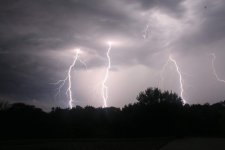
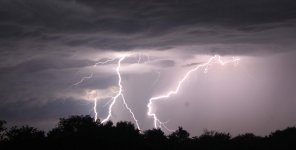
That picture is quite impressive. It's hard to believe humans survive encounters with lightning.
 
/ lightning rods any believers ?
  • Thread Starter
#50  
Good replys for and against lightning protection.I think Petes explanation was
right on the mark especially about copper wire on roofs the galvanic issue. Framer
 
/ lightning rods any believers ? #51  
One other aspect of lightning protection is not only the rod "may" be hit first but by having the system properly installed will also create a electrical bubble around the building and will allow the electrostatic energy that is building and being stored in the atmosphere to safely drain off. My source for this is from a old communications manual.
 
/ lightning rods any believers ? #52  
I have a 50' TV tower next to my house. I "think" the bottom section is in contact with the ground (concrete in a about a 3' diameter hole and about 4' deep). It has a TV antenna on top, I wonder if this would serve as a lightening rod for the house?
 
/ lightning rods any believers ? #53  
Insert all disclaimers that keep me from being sued here -> [ ]

The tower would have that 30 degree "cone of protection", but remember that the cone works about 90 percent of the time, so the formal answer is "No, this will not serve as a lightning rod for the house". But it has a higher probability of being struck than the house for any given strike that would hit in that area.

If it gets a strike, it can also arc over from the tower to the house, another reason for a "Sorry, no" answer.

The lead in wire from that TV antenna on the tower needs _real_ good lightning protection. Not the little F connector block from Radio Shack (Americas Technology Store, and doesn't that explain a lot :laughing:). You need a protector with a gas tube in it, and it needs a couple of ground rounds in the ground.

You see the towers at power substations with big tall rods going up in the air. They are doing the "cone of protection" thing there. And it works _most_ of the time.

Unfortunately, the "probability of a strike" things makes matters clear as mud. But lightning rods and the associated ground wires on your roof are the best protection you can get. Bottom line is you need a way to get a strike on the roof to the ground. No 100% guarantee, but far better than nothing at all if your house is going to be hit.

There have been lots of studies on the "Does lightning rods/protection increase the chance of being hit or decrease it?" There is no simple way to go into all that, it's just :confused2:. All I'll say is my roof is protected :thumbsup:.

Pete
 
/ lightning rods any believers ? #54  
........ and will allow the electrostatic energy that is building and being stored in the atmosphere to safely drain off.............


Also, see post #16.


Look at this video. I can't say at what time into it bec I don't have time to watch it right now. Bit somewhere in there, you'll see rods w spiked balls on them sticking out around the top of the tower. This is to drain off the charge bef it arcs.


http://www.youtube.com/watch?v=uhtgsAXmz7U


.
 
/ lightning rods any believers ? #55  
........ and will allow the electrostatic energy that is building and being stored in the atmosphere to safely drain off.............


Also, see post #16.


Look at this video. I can't say at what time into it bec I don't have time to watch it right now. But somewhere in there, you'll see rods w spiked balls on them sticking out around the top of the tower. This is to drain off the charge bef it arcs to the clouds.


http://www.youtube.com/watch?v=uhtgsAXmz7U


.
 
/ lightning rods any believers ? #56  
Some people will believe anything. Lightning will strike where it wants to, Metal roof by a golf course, golfer out golfing, lightening strikes golfer, why. Do you really think you are directing the lightning to a specific area, or warding off lightning. Does the lighten strike up or down? How many metal roof buildings in the US? How many cars have been struck by lightning? They have rubber tires. Go figure. How come lightning strikes church steeples, metal or wood? That is the good lords house of worship. Why, Why Why

There doesn't seem to be any logic where lightning will strike.

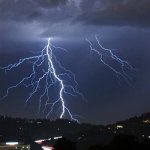
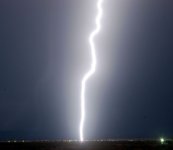
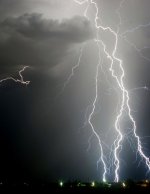
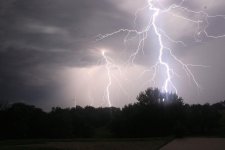
Somebody in those pictures had a bad day.

Lightning rods seem to draw attention, like saying, pick me, pick me. l

I have been in aircraft struck by lightning. The plane just got in the path of the charge. It did knock out a few things, and burned holes in the radar housing. .
 

Attachments

  • d5f0576eb2128352e0fb165b1cf0843f.jpg
    d5f0576eb2128352e0fb165b1cf0843f.jpg
    20.8 KB · Views: 119
  • 125.jpg
    125.jpg
    25.1 KB · Views: 124
  • 133.jpg
    133.jpg
    31.9 KB · Views: 118
/ lightning rods any believers ? #57  
Glad I did a search before starting a new thread.
Sorry to resurrect such an old one but good info.
Ironically we have our first tornado warnings of the year in Central Alberta as I was researching this.
Tis the season. LOL

Most of what I was wondering has been covered.

I am building in a clearing of 80-100' poplars, and think putting lightning rods on the house will be attracting attention. I think I have my own 30* cone naturally. I will stick with the type of rods Obed is using (nice pic). Got lots of them. Probably more likely to burn the house down in the ensuing forest fire. Opting for fire protection over copper wire.
 
Last edited:
/ lightning rods any believers ? #58  
Here are few pictures of storm taken from my porch at night. All pictures were taken in about 30 minutes. Each exposure was 30 sec. The power line got hit and all electronic dimmers in our house were damaged.
 

Attachments

  • Night storm 05.jpg
    Night storm 05.jpg
    99 KB · Views: 168
  • Night storm 06.jpg
    Night storm 06.jpg
    82.1 KB · Views: 152
  • Night storm 02.jpg
    Night storm 02.jpg
    65.8 KB · Views: 145
  • Night storm 04.jpg
    Night storm 04.jpg
    77.7 KB · Views: 147
/ lightning rods any believers ? #59  
It's code in much of Europe to ground copper gutters and roofs with a heavy copper wire to earth.

Also, most modern panels there have good surge protectors for the whole house because lightning is frequent in some areas.

Near my Grandparents Dairy Farm was a neighbor farm that had burn to the ground twice in lightning storms...

The last time it was rebuilt they went all out on protections... the rod has been hit several times and one time it fused some of the copper... and it is still standing.

Here in CA when I was in grade school we were at recess and all of a sudden a big wind came in the sky got really dark... saw lightning strike the flag pole, burn the flag and knock out a chunk of concrete with cement block... that was many years ago and the damage is still evident.

75' from me the pine was hit and the entire top glowed orange... no visible flames. The tree survives to this day, but only the bottom 2/3 is green.
 
/ lightning rods any believers ? #60  
There seem to be many here who believe lightning rods and their cables and grounds are meant to safely conduct the current from the lightning strike to the ground. This belief is not correct, but it is very common.

As many of you have said above, a lightning strike presents far too much current for any reasonable cable to handle.

Lightning protection systems are there to ground the structure and maintain it at the same potential as the surrounding landscape. In laymen's term, this sort of "flattens" the structure, reducing its electrical presence.

A good example - look at sailboats. Every single sailboat has its mast grounded to the vessel's bonding system, and the bonding system is 'connected' with the water. When sailboats do get hit, they generally lose all their electronics and they often have a hole blown through the hull where the bonding system is in contact with the water. The grounds can't conduct the lightning away. Instead, the grounds reduce the charge on the boat, keeping it at the same potential as the surrounding water, essentially "hiding" it instead of making it an attractor.
 

Marketplace Items

BUNDLE OF 20'-2 1/2" PURLINS (A60432)
BUNDLE OF 20'-2...
STORAGE FEES (A59905)
2021 TAKEUCHI  TB260 (A58214)
2021 TAKEUCHI...
1990 21ft Center Console Fishing Boat with T/A Boat Trailer (A59231)
1990 21ft Center...
Case Axial-Flow Combine Wheels NO RESERVE (A61307)
Case Axial-Flow...
RoGator RG1100C (A61307)
RoGator RG1100C...
 
Top