MIG setup - Voltage, Current, Wire Speed

   / MIG setup - Voltage, Current, Wire Speed #1  

frugalangler

Gold Member
Joined
Jun 15, 2017
Messages
352
Location
Mid-Central MO
Tractor
Massey Ferguson GC1720
I've searched multiple ways and haven't found a satisfactory explanation, don't know if it's my search skills or there is not one out there?

I was welding over the weekend using a friends Simadre MIG-200M (supposedly called a Synergic Welder and it's controls are very similar to Everlast Power i-MIG 275S Synergic), and was puzzled by it's setup, as there is a setting for wire thickness, voltage, and current. I've read their manual and it's really basic, doesn't explain much other than where to plug in leads and what the icons on the front mean and do, but nothing about setting up. (Nor have I seen this in some other big name brand machine manuals I've downloaded.)

In playing with it's settings, it appears that wire thickness adjusts the starting wire feed speed, and knowing what little I know about MIG, being it's a CV (Constant Voltage) process, you set the voltage for what you're welding, but this welder also can set current. Take for example, Miller suggests for E71T-11 flux core on 3/16" with .035" wire to use 15.0 Volts and 210 ips as a starting point. Being the Simadre has you set the wire diameter, that is all I can do for wire speed, or so I think, without using a custom setting (which there is one).

So, this begs the question, where do you set the current and what is the rationale behind how it is set? Does setting that current to a value coupled w/ the wire diameter establish a wire feed speed by the welder to achieve keeping sufficient wire to keep an arc maintaining the requisite voltage setting? Some information implies that wire feed speed is control of current, so does a automated machine like the Simadre control wire speed to achieve the current set by the dial to keep a constant voltage as set by the dial? I'm good with that if so, and can adjust my technique accordingly just need to understand what goes on in the background.

I'm dumbfounded by these new machines, having done all my MIG using a fairly basic 4 switch setting & variable wire speed machine with pretty good results, I don't know the relationships and how to set up these new machines. I did quite a bit of test beads, but never really got what I'd consider as good a weld bead as with the old box I was used to. Hopefully, if someone can explain this it might serve to explain to me and others that have similar questions.
 
Last edited:
   / MIG setup - Voltage, Current, Wire Speed #2  
I can't explain with words how to set a Mig welder. I could show you in person in just a few minutes. I don't pay any attention to gauges, I go by the sound of the weld. Sound tells me everything I need to know about a Mig weld.
Use this calculator by Miller for a good starting point.
Weld Setting Calculators - MillerWelds
 
   / MIG setup - Voltage, Current, Wire Speed #3  
Can't help. All the migs I use have a voltage setting and a wire speed and that's it.

I would think adjusting your amperage wod change the wire speed?

Did you try it out? What real time changes occur when adjusting amperage on the fly?
 
   / MIG setup - Voltage, Current, Wire Speed #4  
I can't explain with words how to set a Mig welder. I could show you in person in just a few minutes. I don't pay any attention to gauges, I go by the sound of the weld. Sound tells me everything I need to know about a Mig weld.
Use this calculator by Miller for a good starting point.
Weld Setting Calculators - MillerWelds


I agree. And after many hours of use you may still find yourself making slight adjustments. Always be willing to experiment with improvement as the objective.
 
   / MIG setup - Voltage, Current, Wire Speed #5  
My problem is with a cheaper wire machine that IMHO feeds the wire much too fast.
While I have done a few welds with it I really would like to slow down the feed.

I have a good rod machine and purchased the wire machine for that thin (almost tin) stock.
In the past I used the rod machine with as small as 3/32 rod with OK results but really wish to make use of the wire machine for that thin stuff.

Any ideas as to how to slow down the wire feed?
 
   / MIG setup - Voltage, Current, Wire Speed #6  
I looked up a picture of that machine. What is the left knob for, if not for wire speed? I could not read the word under the knob I saw.
 
   / MIG setup - Voltage, Current, Wire Speed #7  
I've searched multiple ways and haven't found a satisfactory explanation, don't know if it's my search skills or there is not one out there?

I was welding over the weekend using a friends Simadre MIG-200M (supposedly called a Synergic Welder and it's controls are very similar to Everlast Power i-MIG 275S Synergic), and was puzzled by it's setup, as there is a setting for wire thickness, voltage, and current. I've read their manual and it's really basic, doesn't explain much other than where to plug in leads and what the icons on the front mean and do, but nothing about setting up. (Nor have I seen this in some other big name brand machine manuals I've downloaded.)

In playing with it's settings, it appears that wire thickness adjusts the starting wire feed speed, and knowing what little I know about MIG, being it's a CV (Constant Voltage) process, you set the voltage for what you're welding, but this welder also can set current. Take for example, Miller suggests for E71T-11 flux core on 3/16" with .035" wire to use 15.0 Volts and 210 ips as a starting point. Being the Simadre has you set the wire diameter, that is all I can do for wire speed, or so I think, without using a custom setting (which there is one).

So, this begs the question, where do you set the current and what is the rationale behind how it is set? Does setting that current to a value coupled w/ the wire diameter establish a wire feed speed by the welder to achieve keeping sufficient wire to keep an arc maintaining the requisite voltage setting? Some information implies that wire feed speed is control of current, so does a automated machine like the Simadre control wire speed to achieve the current set by the dial to keep a constant voltage as set by the dial? I'm good with that if so, and can adjust my technique accordingly just need to understand what goes on in the background.

I'm dumbfounded by these new machines, having done all my MIG using a fairly basic 4 switch setting & variable wire speed machine with pretty good results, I don't know the relationships and how to set up these new machines. I did quite a bit of test beads, but never really got what I'd consider as good a weld bead as with the old box I was used to. Hopefully, if someone can explain this it might serve to explain to me and others that have similar questions.

Uhhh...no. Simadre badly copies other original foreign and chinese designs, and who even knows if they have it working correctly. It isn't similar to the 275S. It's a good bit different size wise, operation wise, and factory wise. A lot are decent, but the warranty tells you all you need to know about them. From what you tell me, there was a good manufacturer that makes Thermal Arc ESAB products that had a quirk in how you set the machine that they copied.

IF you want to talk Everlast basic synergic machines, you select wire type and wire diameter. This creates an optimized volt/amp ratio. You adjust the amps and the volts automatically together as you turn the amp knob. This preset value is optimized based off several factors, but the settings can be fine tuned easily and overidden by simply adjusting voltage to reset a new volt amp ratio, which will be remembered as you readjust the amp knob.

Now, in Syn MIG mode, the unit reads in amps, because when a wire diameter is fed into the machine, the machine can then determine the amperage the machine will produce. In the standard mode, it will revert back to wirespeed when adjusting because the wire diameter is unknown, and it cannot compute amperage because amperage is a factor of wire speed, and the ampacity of the wire at that speed. Larger wires need to feed slower because of that to achieve the same amps of a smaller wire.

No, it does not determine the optimum wire speed or amps, because the metal thickness is unknown. Yes, you could enter that as a factor if the program allowed, but this unit is designed to allow some input from the user to be able to easily tune to his/her needs, so it does not take that parameter into account. By ignoring metal thickness (which is often unknown by the user) the unit defaults to say something like 80 amps and allows the customer to tune in volts and amps by adjusting the amp knob only. This feature also works with the spool gun, which allows the user to control both volts and amps on the dial on the spool gun on-the-go without going back to the machine to tune the volts further. The readjustments can also be permanently saved to the program of the machine. Get ready for a long confusing sentence...but read it through a few times: The arc force control controls the inductance of the machine which in turns controls the current rise time which dictates the stick out of the wire from the gun while welding, affecting the arc length, and overall feel of how wet or stiff the arc feels.

Does not appear the Simadre is too advanced.although it looks like it is claiming MIG TIG and stick function. Likely it is very basic and like our original PowerMTS 200S from 2009/2010 with a feature or two stripped out.
 
   / MIG setup - Voltage, Current, Wire Speed
  • Thread Starter
#8  
I looked up a picture of that machine. What is the left knob for, if not for wire speed? I could not read the word under the knob I saw.

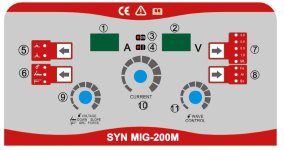
This is from the manual, although the knobs on the machine I used were in different locations, all were present and labeled the same.
simadre front panel.JPG

Here's some text from the manual on MIG setup:
ON MIG MODE
1. Gas choosing
...1) When the wire material is Fe, the shielding gas is 80%Ar + 20%CO2 ;
...2) When the wire material is Ss, the shielding gas is 98%Ar + 2%O2 ;
...3) When the wire material is Al, the shielding gas is 100%Ar..
2. Welding mode selection
...1) Set to be MIG mode
...2) Select the correct welding wire diameter (0.6--1.0). You can choose SPL, in which
mode that you can adjust the wire feed speed and welding voltage separately by manual.
Note:The current display is the wire feed speed (cm/min).
...3) Select the welding material (Fe/Ss/Al);
...4) Select 2T/4T;
3. Adjust Welding parameter
...1) Adjust the current knob to set the welding current, the corresponding welding voltage is
changed automatically;
...2) When the programmable welding voltage isn't perfect for the operator, the voltage can
be changed slightly by adjusted the knob;
...3) Adjust the wave control knob to better control the arc characteristics.
Note:When you select the SPL mode, you can adjust the burn back time inside the wire feed
mechanism.

Now, a something I noticed: When you trigger the gun free air, the wire speed starts slow for a second or so, then kicks up pretty fast (unlike my old manual box that is fixed), so.......... this gives me the implication that (and based on the text above) that you set the wire type/size, then the desired current for the thickness of the metal being welded, but this is similar to the 'slow run-in of wire' feature on the Everlast. Yes, Mark, I know it's not a clone of and I wasn't implying so, but looking at the controls they are strikingly similar albeit the Everlast does expose some more features.

I'll have a chance to spend some more time with it not under pressure to get a job completed, so I'll play more with setting it up and trying some beads on some plates, since I didn't have access to the manual when I used it last, now having the set up info maybe I can learn more how it works. The more I read about Synergic control, the more I think I'll like it, but it will take time as it's definitely different than the 4 current setting box I'm used to, it was very easy to set up by sound, and this one may well be so, just need more time to adjust to it. Basically, I believe it's a decent machine, it definitely can lay a bead and weld but unfortunately documentation is less than admirable.
 
Last edited:
   / MIG setup - Voltage, Current, Wire Speed
  • Thread Starter
#9  
Got a chance to spend some time last nite with the Simadre and got some better results.

I set up per the instructions for it on some 3/16" with .030 FC - (set machine to .045 wire, see comment below) I ended up at about 130A/21V and midpoint on the wave control - when I attempted to run higher A and lower V following some of the charts, it just didn't have the sound I was looking for, it was much coarser bacon fry then the typical egg fry I like, and the weld seemed to stand too tall and not penetrate to my liking. The machine actually set up per the instructions pretty close to where I ended up, it's when I tried to follow suggested settings from a chart that it was disappointing. When I tweaked what the machine started from then I got a much better run. I'm still not done, but what I think I'm finding is that the programing on this machine may be a little different then some other brands. It was just surprising to run as high a voltage as what it (or I) seemed to be happy with.

The other thing I was doing was attempting to compensate the settings for wire size, the machine appears to be calibrated primarily for gas, and I believe flux core generally requires a little higher wire feed. Therefore, I was setting the welder for the next size wire than what I was using, but I believe I actually went the WRONG direction, I was setting for larger dia. wire which would lower the feed speed, but I believe I actually should set for smaller dia. wire (FC actually has less copper cross section for it's size than solid due to the flux being part of the diameter). So, next I'm going to go back and run the same tests but set up using the next size smaller wire, then tweak those settings and see where I get. So, using my .030 FC, I'll set up for .023 wire and see if it improves any.

Other than that, again this machine seems to be a pretty solid machine, the drive sets up nicely, the only other thing I'm still not quite sure on is the 'burn back' setting.
 
   / MIG setup - Voltage, Current, Wire Speed #10  
I'm not a welder by any means.

But friends of mine who are, and one has been for fifty years welding 7 days a week rarely adjust their settings unless something unusually heavy or light needs to be welded. They adjust their speed welding and I'm guessing that's easier then fiddling with the controls all the time. In fact, some of the machines are mounted so high and the feeders on booms, so adjustment on these machines isn't even easy.

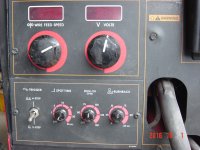
I too have a Lincoln with all those EXTRA knobs including burnback. I at first tried to make sense of them, but so far have personally found no advantage to them.

DSC04369.JPG

At least Lincoln was nice enough to label the knobs rather then just meaningless icons.
 
   / MIG setup - Voltage, Current, Wire Speed #11  
I'm not a welder by any means.

But friends of mine who are, and one has been for fifty years welding 7 days a week rarely adjust their settings unless something unusually heavy or light needs to be welded. They adjust their speed welding and I'm guessing that's easier then fiddling with the controls all the time. In fact, some of the machines are mounted so high and the feeders on booms, so adjustment on these machines isn't even easy.

I too have a Lincoln with all those EXTRA knobs including burnback. I at first tried to make sense of them, but so far have personally found no advantage to them.

View attachment 531857

At least Lincoln was nice enough to label the knobs rather then just meaningless icons.

My 255 has the exact same panel. I don't use it that often but I do use them. When I have a very long weld to do I will switch the left hand switch so I just have to tap the trigger to start then tap it again to stop. It's not needed and if you forget and leave it on and it keeps welding when you let off the trigger it'll surprise you. The spot feature is nice for doing sheet metal work. With a small hole in the top layer of metal, usually autobody work where you drilled out an old spot weld, you can fill the hole in. The spot feature just makes easier for repetitive work.

The one I like is the burn back feature. Occasionally I'll weld aluminum. Without a spool gun it's much harder. One of the problems I've run into is that once I stop welding the aluminum wire will melt and stick to the tip. With steel wire I rarely have this problem (usually happens when I try to use .035 wire vs switching to .045 and have the power turned up a little too hot). When it happens the rollers just slip on the wire. But with aluminum it has caused it to bird cage. It was a problem on my SP125. I never had a problem on my 255 because the burnback keeps the wire moving just long enough to prevent it. With the SP125 if welding it was very easy to stop for the slightest of moments and squeeze the trigger and then spend minutes clearing out the wasted wire. I'm sure a spool gun would be the answer but my 255 is the older C model and it's expensive for occasional use.

I've never used the run in. I assume it's a ramp rate allowing the wire to start off slow then speed up. I really think the panel was designed for the production worker so they could fine tune the welder to their tastes.
 
   / MIG setup - Voltage, Current, Wire Speed #12  
Thanks for that.

This fall I was welding galvanized 3/4" anchor bolts. Aside from setting fire to my jacket twice and my hair once, I had the wire (.035) stick to the tip a few times upon finishing. Mostly it broke free a few seconds later on its own. Would the burn back have helped that?
 
   / MIG setup - Voltage, Current, Wire Speed
  • Thread Starter
#13  
Didn't do a lot last nite, but did pop a couple short beads w/ the Simadre using the next smaller wire size setting vs. the next larger (see previous post) and it made a big difference in how the machine acted so I'm fairly sure it's a operator issue that I simply went the wrong direction in my FC compensation approach. Using .030 (.8MM) but setting for .023 (.6mm) brought the sound back where I expected and the bead edges flowed much better and penetration was great on my 3/6". Even the burnback seemed to do what it was supposed to do, but I've got to burn up some more wire before I get a handle on that.

Thanks for everyone's comments and suggestions, they as always have been helpful.
 
   / MIG setup - Voltage, Current, Wire Speed #14  
Oh man, all this is too complicated for me, I would quit welding if I had to go thru all that. My Miller Mig welder has two controls, wire speed and apms, simple, easy and welds sooooo nice, I never have used a chart or anything more than trying new settings and now I have a good idea of the wire speed and amps to use just by looking at the thickness of the metal I need to weld, I love it. The thing I am frustrated with is my plasma cutter but I am sure this is because I just don't use it enough. Actually I don't use it at all anymore because I don't have the time to learn it and my cutting torches are sitting there saying "Use me!" "Use me!" I can lay a bead just as good with my torches as I can with my Mig. Motorcycle frames I welded in the 70's with my touches are still being used and I am talking about cutting and adding rake to choppers so yes, the welds needed to be strong. This and motorcross bike frames. I grew up with torches in hand and learned to do everything with them, never had enough money for more modern or advanced welders until in my 50's. Good luck with your new fangled welder, I hate learning new tech stuff.
 
   / MIG setup - Voltage, Current, Wire Speed #15  
My Miller Mig welder has two controls, wire speed and apms, simple, easy and welds sooooo nice, I never have used a chart or anything more than trying new settings and now I have a good idea of the wire speed and amps to use just by looking at the thickness of the metal I need to weld, I love it.

Which mig welder do you have?

I think you meant to write "wire speed and volts" as the wire speed controls the amps (more wire takes more amps to melt) and the other knob is normally labeled volts - but I could always be wrong.

I'm with you on "new fangled" technology. It can be a serious hassle :)

I prefer to not use "new" stuff until it's about 10 years old...then I start to maybe trust it a little...maybe :D
 
   / MIG setup - Voltage, Current, Wire Speed #16  
It's a Lincoln, and it is Arc Volts, sorry.... it's all the same to me.
 

Tractor & Equipment Auctions

2012 BIG TEX PIPE TRAILER (A58214)
2012 BIG TEX PIPE...
2005 MACK TRI AXLE DUMP TRUCK (A52707)
2005 MACK TRI AXLE...
2010 Ford F550 Bucket Truck with Altec AT37G Boom (A56435)
2010 Ford F550...
Pat's QH and hydraulic top-link.
Pat's QH and...
2017 PJ TRAILER 20' T/A TRAILER (A58214)
2017 PJ TRAILER...
CAT 930M (A58214)
CAT 930M (A58214)
 
Top