Millermatic 180 vs I-mig 200

   / Millermatic 180 vs I-mig 200 #1  

Slowtorque

Member
Joined
Dec 24, 2010
Messages
35
Tractor
Cub Cadet 1782
I think I am comparing apples to apples here. I once had a MM210 that I really enjoyed but it was kinda large for my needs and could not be moved out into the field easily. Have never heard of the Everlast brand. How does this model Imig 200 compare to the Millermatic 180. I have 230v power in my shop and will be using fluxcore wire primarily and may also buy another tank (wish I had kept the one I had). Many thanks for the input. Oh, my use of the welder will be general repairs on mild steel and some light fabrication of same.
 
   / Millermatic 180 vs I-mig 200 #2  
I don't know anything about the IMIG, but the Millermatic 180 has an odd automatic heat range/wire speed control that can sometimes be frustrating to deal with.

I bought my MIG welder about six years ago and thought that I just HAD to have a 180 as opposed to a lighter unit to use only on sheet metal. If I had it to do over again, I would have gotten a 120 with gas to use only on sheet metal. I have never become comfortable using a MIG on heavier material. Stick welding makes for better penetration and thus a stronger weld on heavier material.

I have a tombstone that I've had for 24 years and the MIG I've had for six. I use the MIG with gas only on sheet metal work and the tombstone for everything else. You can get a stick welder cheap and I believe you would find it to be much more useful and versatile.

Those are just my opinions and I'm not trying to force them on you, but since you are at the point of buying a welder I offered them in hopes that you will find them of some use.

Best of luck with your decision.
 
   / Millermatic 180 vs I-mig 200 #3  
Well you are comparing apples and crabapples at least.
The 180 compares more to our 160 I-MIG.

The IMIG-200 would compare more in line with the 212 on performance, but more in line with the 211 on size, though the 200 is physically smaller still than both and lighter than either but same wire capacity .

But I will be glad to make the comparison for you.

Duty cycle: Miller180: 35% at 135 amps;Everlast 200 35%@ 160 amps
Power Range: Miller 180: 30-180; Everlast 200: 30-200
Weight: Miller 180 70 lbs; Everlast 200 35
Type: Miller 180 transformer; Everlast200 Inverter
Inductance control: Miller 180 NO; Everlast 200 YES
Digital Control/Readout: Miller 180 NO; Everlast 200 YES
WireFeed: Miller 180 plastic components and some steel; Everlast 200 Cast Aluminum and steel
Spool Gun ready: Miller 180 Yes. Everlast 200 YES
Gun Connection: Miller 180 Proprietary internal connection;Everlast Common external Euro Style quick connect
Gun Type: Miller 180 M100 10ft; Everlast 200 High Quality Abicor Binzel MB15AK 10ft
STICK Weld: Miller 180 NO; Everlast200 Yes, 165 amps.
Standard wire size: Miller 180 .023-035; Everlast 200 .030-.045
Spool Diameter: Miller 180 4 and 8"; Everlast 200 4" and 8"
Polarity change: Miller 180 Internal change; Everlast 200 quick change external

There are more comparisons/differences but usually these are all that people appreciate knowing.

I am inserting a link for a brochure for the I-MIG 200. It will spell out all the details about the machine. http://www.everlastgenerators.com/Brouchers/Power-I-MIG-200.pdf

Right now we have 15% off our 200 I-MIG. If you are interested or have any questions give me a call directly at 877-755-9353 EXT 204
 
   / Millermatic 180 vs I-mig 200
  • Thread Starter
#4  
Mark, thanks very much for the info. I spent some time on your website, and that PowerArc 200 is intriguing as well. I have never done any stick welding, kind of intimidated by it.
 
   / Millermatic 180 vs I-mig 200 #5  
Mark, thanks very much for the info. I spent some time on your website, and that PowerArc 200 is intriguing as well. I have never done any stick welding, kind of intimidated by it.

What I read there about the IMIG was quite impressive. As I said, the Millermatic has a strange automatic setting that might not work well for everybody anyway.

I totally understand someone being intimidated by a stick welder, but if you would get some scrap and burn some rod, with a little practice, you would find it to be easy to master on heavy material. As material and rod gets thinner, stick welding takes more and more practice.

Good luck with your decision.
 
   / Millermatic 180 vs I-mig 200 #6  
Mark, thanks very much for the info. I spent some time on your website, and that PowerArc 200 is intriguing as well. I have never done any stick welding, kind of intimidated by it.

I have its little brother the PA160 and I really like it. for 1/8 on up to 1/2 it is the ticket. Of course stick welding for less than 1/8 gets harder and harder for thinner you go. But with proper prep and good rod, you can make some nice welds with this little unit. But for welding on thicker materials where it really counts, I dont think you can beat stick for good solid welds for low amounts of money invested.
James K0UA
 
   / Millermatic 180 vs I-mig 200 #7  
I've got a 180 Miller, used to have a 135 Miller. Other than the spoolgun for aluminum (came with mine), I think I liked the 135 better. The 180 was free, so I wasn't about to look the gift horse in the mouth.

Up to about 1/8 stock, the Miller is great, very smooth. I have more spatter than I'd like above 1/8 material, but that may be the wire I'm using also.

The 180 doesn't like running off my generator, poor weld quality in my opinion. The 135 never missed a beat, there must be something different in the circuitry. The Auto-Set feature works well, you simply select the wire size you're using, adjust for material thickness, and squeeze the trigger. I've played with the manual settings (both are available) and really couldn't improve much on the Auto-Set.

As for portability... well, it weighs over 70 pounds, which is a handful in my opinion. The inverter technology is a real plus if you're planning on taking it with you much.

If you're looking at Miller, I'd suggest you consider one that has the MVP plug and can be run on both 120 and 230 power. They also sell inverter models, (Passport maybe?), but the duty cycle is lower if that's a concern.

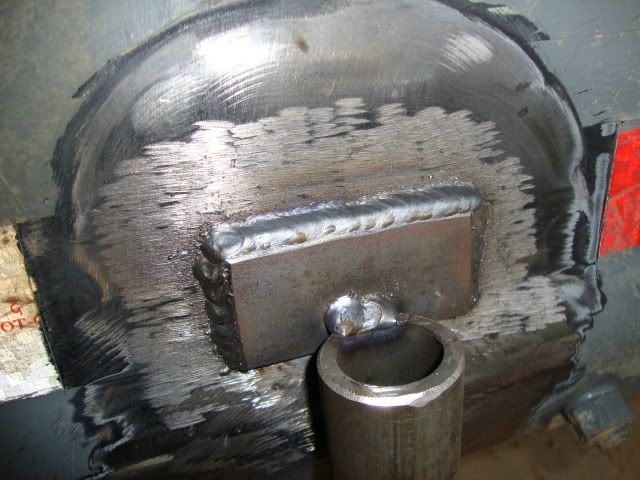
This was welded with the 180, 1/4 plate to 5/16 plate in one pass.
DSC00601.jpg


In all honesty, if it holds up well, I suspect the Everlast is as good a welder as the Miller, possibly better in some respects. I've got Blue blood in my veins, so that's about as good as it gets from me. One other thing, check where they're made if it makes a difference to you. I buy North American made if I can if the quality is the same, but there's a Honda in my driveway...

Sean
 
   / Millermatic 180 vs I-mig 200 #8  
There's nothing odd about the Millermatic 180 Auto Set feature. It works very well and I use it all the time. If you don't want to use that feature don't turn the knob to "Auto" and set voltage and speed to whatever settings you desire. For me, it's handy as heck. I just figure the gauge of the metal I'm welding and the machine is usually right on the money.

Having designed inverter power supplies in the past I can tell you that the high speed switching semi-conductors (IGBT's) used in inverter welders are much more prone to failure as is any semiconductor device than say, a large transformer. The sophisticated push pull circuitry of an inverter circuit working at high voltages and frequencies requires a very delicate balancing act between the control circuits and the output stages. Any little bit of timing gets off (capacitor drift, etc.) and phase angles come into play and before you know it the thing goes up in smoke.

Google "inverter schematics" and you'll see a host of people looking to fix their welders on their own rather than paying top dollar to have an electronics technician fix it for them.

It's easy to compare Everlast to Miller in a list but without seeing them side by side and using them you can't make the judgment. Miller is pretty expensive but you usually get what you pay for. Visit the welding forums to get a better picture of any comparison.

My two cents.
 
   / Millermatic 180 vs I-mig 200 #9  
Having designed inverter power supplies in the past I can tell you that the high speed switching semi-conductors (IGBT's) used in inverter welders are much more prone to failure as is any semiconductor device than say, a large transformer. The sophisticated push pull circuitry of an inverter circuit working at high voltages and frequencies requires a very delicate balancing act between the control circuits and the output stages. Any little bit of timing gets off (capacitor drift, etc.) and phase angles come into play and before you know it the thing goes up in smoke.

Google "inverter schematics" and you'll see a host of people looking to fix their welders on their own rather than paying top dollar to have an electronics technician fix it for them.

I am a sales engineer. and this is what we call FUD Fear, Uncertainey and Doubt. We like to "stir" that up to make people think that product A might have some problems.. We dont care if product A does or does not for a fact have those problems, we just "throw" that out there in general terms. So the audience will say to themselves, "better play it safe and choose the proven technology". Whether the poster had any intentions to do so or not does not matter, what matters is now there is doubt that Everlast machines are "any good" or "reliable" and better stick with Miller. Never mind that Miller machines are also going to the same Inverter technology and will have the same failures. The damage has been done. Better not buy into the "new fangled" machines. I have said and done the same things, and had it done to me on a daily basis..
James K0UA
 
   / Millermatic 180 vs I-mig 200 #10  
I am considering the Miller 211 vs the I-Mig 200, both have their + and -, still undecided. I like some of the features of the I-Mig, light weight and ability to do stick or MIG. I like the flexibility of the dual input voltage on the 211 and the comfort of being able to drive 10 miles down the road where I have a Miller service center if I ever need repairs. I am a bit apprehensive about having to pack up and ship the I-Mig out if I ever need repairs. Everything I have read from folks who have actually used the machines, both do a very good job. Although Marks' comment about 15% off at the moment on the I-Mig is making that more tempting.
 
   / Millermatic 180 vs I-mig 200 #11  
"this is what we call FUD Fear"

Fear is usually of the unknown. I call it "speaking from experience" since I own a Millermatic 180 and also spent a good amount of years pioneering the development of high power switching power supplies.

Nothing I have stated is outlandish and can be substantiated by a little research which is what I encourage anyone interested in the topic to do.

Does anyone find themselves asking how it is that Everlast can "outperform" the Miller by a substantial amount but still cost much less? You should ask, and to help with answering the question, like I said, visit the welding forums.
 
   / Millermatic 180 vs I-mig 200 #12  
"this is what we call FUD Fear"

Fear is usually of the unknown. I call it "speaking from experience" since I own a Millermatic 180 and also spent a good amount of years pioneering the development of high power switching power supplies.

Nothing I have stated is outlandish and can be substantiated by a little research which is what I encourage anyone interested in the topic to do.

Does anyone find themselves asking how it is that Everlast can "outperform" the Miller by a substantial amount but still cost much less? You should ask, and to help with answering the question, like I said, visit the welding forums.

+1 QFT.

Talk to any guy who does this for a living. Look on welding trucks. Go to any shop in any plant. Look in barns art the welder sitting under the bench rotting away, yet still works. You might not see only miller, Lincoln has a large presence with Esab/Airco dragging up the rear. Any one of these brands would be a fine buy. I guarantee you wont see Everlast or Lotos or Longeviety or whatever flavour of the week it is.

That speaks more volumes as to what lasts Vs. any FUD coming out of these newly sponsored forums.
 
   / Millermatic 180 vs I-mig 200 #13  
+1 QFT.

Talk to any guy who does this for a living. Look on welding trucks. Go to any shop in any plant. Look in barns art the welder sitting under the bench rotting away, yet still works. You might not see only miller, Lincoln has a large presence with Esab/Airco dragging up the rear. Any one of these brands would be a fine buy. I guarantee you wont see Everlast or Lotos or Longeviety or whatever flavour of the week it is.

.
There is a huge difference between a comercial welders that is on a job site and what we are buying for home use. I have never seen a Miller180 on a job site or in a comercial fab shop. We are talking about affordable welders that will do what we need to do and will hold up. I have a Lincoln powermig 255 at work and would love on at home but cannot justify spending $2400.00 for it. I will be talking to Mark next week about a imig 200.
Bill
 
   / Millermatic 180 vs I-mig 200 #14  
My last post on this topic.

I was making comments on two fronts here. First, I don't care if Miller, Lincoln or Everlast is the manufacturer of the inverter welder. My point was, and remains that they all use a pulse width modulator circuit to control high power semiconductors. This circuit does not have the robustness of a more basic transformer setup and will not last as long. How many years do you expect to get out of your computer before it fails? Not many and when it does fail chances are you aren't going to able to fix it yourself. Just like an inverter welder. How many years do you expect to get out of your Kubota before it fails? Probably quite a few and when it does fail, chances are you will be able to fix it. Just like a transformer setup. Sure Invertecs and the like are small and handy but there's a trade off, just like everything in life.

Secondly, anyone should automatically be skeptical of a comparison sheet produced by an Everlast salesman where all 100 features show the Everlast as superior. Especially given the reputation and desirability of Miller and also considering Everlast is a Chicom product. To reiterate, my second point is not to blast Everlast but to encourage anyone to research. A tractor forum is not the best place to seek advice on welders. Everyone will recommend the brand they own, kinda like tractors and ATV's. It's wiser to seek the advice of professionals, chances are they have used a wider variety of brands and know more of what to look for than your neighbor with the Hobart and home-made log splitter. Would you walk into a Ford dealer and ask him what the best make of car is? Don't be silly. :confused2:
 
   / Millermatic 180 vs I-mig 200 #15  
Most computer issues I have experienced are virus or disk related. I still have the LCD monitor, and printer from a computer I bought 10 years ago and they work fine (though the ink is $$$). The computer failed after 5 years when a virus got into the bios and it was cheaper to replace it. I left it on and running 24/7.

The components you find in a inverter welder are similar but definitely much heavier and geared toward longer life and easier service. Most new commercial Lincoln engine drive welders use electronic chopper technology as well which are similar.

As far as being skeptical...Any reasonable mind compares and contrasts what is being said. I would expect it. But the hard comparisons are true. These are not subjective claims. I would venture to say anyone familiar with the Binzel product would say its inferior in any way with durability, ergonomics, and over all design to the Miller stock gun. A look at the drive systems, most people would favor the all metal construction. Duty cycle can be easily tested and proven. Most of these things I mentioned are easily verifiable.

I have said it before but it is worth repeating. The factories that manufacture our product are private, not state owned in China. Most people have misconceptions that all companies in China are state owned. They are not. China has allowed private enterprise for some time now.

Additionally, our units use name brand electronic components, with many of the companies based and manufacturing in the US and worldwide. Texas Instruments, IXYS, Infineon, Panasonic, Sharp, DN etc are all common well known electronic companies.

I am offering a choice...Not telling anyone what to buy. If the Miller is equal, I said it was equal. There are common points of items they share. I guess if I announced that our spool guns come from the same assembly lines in China that Miller uses, that would be a surprise?
 
   / Millermatic 180 vs I-mig 200 #16  
troutsqueezer Lincoln and Miller have had problems in the last few years. Friend of mine is a pipeliner in Nashville he has a Pipe Pro 304 had nothing but problems with it. Miller finally replaced it after countless times back to the repair shop. Miller even sent their techs to look at the machine.
Lincoln is having problems with their Classic 300D's, a lot of pipeliners are wishing they never bought one. There is a guy on Welding Web converting a Classic 200D, he dumped the generator replaced it with a 24KW 30KW 3-phase generator so he can run his Miller XMT-350 Inverter. If a guy was happy with a machine you think he'd go through all this trouble?

Just like Ford, Chevy, and Dodge, Lincoln, Miller, and Hobart are all capable of building lemons!;)
 
   / Millermatic 180 vs I-mig 200 #17  
In the past, welding power supplies have been based on transformers. The power supply took in 60 Hertz 230, 460 or 575 volt power. A metallic transformer changed it from the relatively high input voltage to 60 Hertz current at a lower voltage. This low voltage current was then rectified by some sort of rectifier bridge to get direct current (DC) welding output. Control of this output was usually performed by some sort of relatively slow magnetic amplifiers.

Transformers are relatively inefficient operating at 50 or 60 Hertz. A lot of heat is generated in the transformer, and the transformer must be relatively large and heavy. A significant part of the power cost goes into heating the transformer and the surrounding air. Most such welding power supplies weigh around 400 pounds and have a shape something like a 32 inch cube. Additionally, if 60 Hertz is used, control signals are limited to being issued at no more than 120 per second, so it's impossible to pulse the welding current any faster than this.

In inverter controlled power supplies, the same incoming 60 Hertz power is used. However, instead of being fed directly into a transformer, it is first rectified to 60 Hertz DC. Then it is fed into the inverter section of the power supply where it is switched on and off by solid state switches at frequencies as high as 20,000 Hertz. This pulsed, high voltage , high frequency DC is then fed to the main power transformer, where it is transformed into low voltage 20,000 Hertz DC suitable for welding. Finally it is put through a filtering and rectifying circuit . Output control is performed by solid state controls which modulate the switching rate of the switching transistors.


What advantages does this new inverter controlled design offer? First, the main power transformer, which operates at 20,000Hertz is vastly more efficient than 60Hertz transformers, which means it can be much smaller. Remember, transformer - based machines typically weigh 400 pounds plus and are a 32 inch cube. The accompanying photo shows the Lincoln line of inverter - based gas tungsten arc welding (GTAW) power supplies. The machine in the center, the V205, weighs 33 pounds and is 9 inches wide, 19 inches deep and 15 inches high. The other two machines are DC only inverters and are even lighter and smaller. So there is a huge advantage in weight and portability in favor of the inverter - based machines.

There is another advantage of the inverter power supplies - power cost. The inverter equipment is much more efficient than transformer equipment. For instance, the current draw at 205 amperes for the Lincoln V205 is 29 amperes on 230Volt single phase power. The current draw of an older transformer welder is typically 50 to 60 amperes on 230 Volt single phase power when welding at similar currents. While the cost savings in switching to inverters is often overstated, under normal circumstances, it is safe to say that annual power savings are approximately 10% of the power supply purchase price.

The other significant advantage of inverter power supplies is that, by "chopping up" the incoming AC so finely, we end up with a very steady DC, without the typical 60 Hertz ripple. This results in a much smoother, more stable DC welding arc.


By packaging two inverters inside one case inverters can supply AC. By having them run at different polarities and alternately switching them on and off, a pseudo AC output was generated. Some inverters still generate AC in this manner. There are also more sophisticated methods of generating AC today, but for the purposes of this article, it's easier to think of generating the AC from two inverters at opposite polarities.


The ability to generate AC is what really makes the inverter shine for welding aluminum using GTAW. The fact that the arc voltage never truly goes through zero means that the AC arc is much more stable than previously. Most inverter - based GTAW power supplies do not need the high frequency to be on continuously for stability. In fact, the Lincoln V205 has no provision for using continuous high frequency. It will automatically be extinguished as soon as the arc starts.. The elimination of continuous high frequency drastically reduces the amount of RFI generated by the power supply.

Second, the fact that we can send control signals at 20 kilohertz means that we can vary the frequency of the AC welding output. Older machines were 60 Hertz AC output only. The V205 can put out AC at anywhere 20 and 150 Hertz. Higher frequencies can be beneficial in welding thin materials. As the frequency is raised, the arc cone, and the weld, become narrower, resulting in deeper penetration.


Those are not my words but Frank G. Armao from the Lincoln Electric Company. It's clear to anyone that coil based technology is dying just like push rod technology in cars.
 
   / Millermatic 180 vs I-mig 200 #18  
+1 QFT.

Talk to any guy who does this for a living. Look on welding trucks. Go to any shop in any plant. Look in barns art the welder sitting under the bench rotting away, yet still works. You might not see only miller, Lincoln has a large presence with Esab/Airco dragging up the rear. Any one of these brands would be a fine buy. I guarantee you wont see Everlast or Lotos or Longeviety or whatever flavour of the week it is.

That speaks more volumes as to what lasts Vs. any FUD coming out of these newly sponsored forums.

And Snap-on and MAC tools are great too. But for most people good old Craftsman gets the job done just fine. The reason you find all those good old welders rusting away in a barn is because the coil in them is so heavy that's the only place they can be stored.
 
   / Millermatic 180 vs I-mig 200 #19  
And Snap-on and MAC tools are great too. But for most people good old Craftsman gets the job done just fine. The reason you find all those good old welders rusting away in a barn is because the coil in them is so heavy that's the only place they can be stored.

Right... has nothing to do with durability. Leave an inverter especially a chinese one out in a cold damp barn for 5 years and tell me how it works.

Heavy? what are you going to do, take it in your purse to dinner? ITS A WELDER, BUILD A CART or add a runner kit if you want to move it. The Thunderbolt 225 Ac/DC is only 104 lbs. When your talking about 400lb machines, your into large industrial multiprocess types like a dimension.
 
   / Millermatic 180 vs I-mig 200 #20  
I'm not worried about. So much so my Everlast PP60 is sitting on top of my Lincoln 255 MIG in my unheated garage. I have no plans on keeping it anywhere else. So why is an Inverter so susceptible to being left outdoors when other electronics are fine? The electronics on my Lincoln have been outside for almost 10 years now with no problems.

Clearly Lincoln feels differently than some here about Inverter tech.
main_inverter2.jpg

or is somebody going to say that having a rack holding 6 inverters is just for Joe 6 pack and no pro welder would use such a thing. Finally do you think that Lincoln, Miller, or any other large welder mfg has it's own semiconductor fab to make it's own insulated-gate bipolar transistors? Do you understand how Smei-conductors are made and why is much less important as to where it's made but what equipment that's used? Do even know IGBT technology is being used by companies like Toyota in their Hybrid cars and in industrial applications like high speed electric trains?
 

Marketplace Items

DEUTZ MARATHON 60KW GENERATOR (A58214)
DEUTZ MARATHON...
2012 Ford F-550 4x4 Chipper Truck (A55973)
2012 Ford F-550...
MASSAGE CHAIR (A58214)
2021 Ver-Mac PCMS-3812 Solar S/A Towable Trailer Message Board (A55973)
2021 Ver-Mac...
2001 CATERPILLAR D400E 6X6 OFF ROAD DUMP TRUCK (A60429)
2001 CATERPILLAR...
2025 GIYI SE61 61in Sweeper Skid Steer Attachment (A59228)
2025 GIYI SE61...
 
Top