More electric code questions for kitchen

   / More electric code questions for kitchen #1  

ejb

Platinum Member
Joined
May 2, 2000
Messages
734
Hi folks.

More electrical code questions as I prepare my permit/plan for the inspector - I am sure the inspector will flag anything that is wrong, but I figure the more accurate I am on first pass, the better...

Anyway, heres a few questions:

1. I'll have 2 - 20AMP small appliance circuits for all the over-the-counter plugs as required; I am running seperate 12/2 wires for them - Question: Does it matter which plugs are on which wire? i.e. can one side all be on one wire and the other on the other? or does it actually need to alternate back and forth?

2. The recessed cans and island lights will be on a 15A circuit and will switch on and off from 3 seperate locations...is it possible to use a dimmer at one of those 3 locations? and if so, does the wiring pattern change(i.e. will the wiring be the same no matter which of the three spots has the dimmer?)

3. The receptacles over the counter will generally be 4' or less apart...but how far from the sink should they be? I have an 3 ft sink centered under a 8' window...my preference would be to have NO plugs under the window (they would need to be in the backsplash - lower than all the rest, but to the right and the left of the window I could have a plug and then space them correctly after that...

4. Related question - how far away from the gas cooktop should the counter-top receptacles be?

5. Last question: I am adding a subpanel directly under the kitchen to facilate wiring and cut down on the number of runs back to the main...its a Murray 100A subpanel. Plan (A) is to protect it with a 50A breaker at the main and have all circuits go to the sub except the 2 30A wall oven ciruits....so I would use 6/3 copper for the 50A sub and 2 10/3 circuits for the ovens...plan (B) would be to actually use the full 100A capacity of the sub and thus only have a single run back to main panel protected by a 100A breaker...what is the correct wire size for a 100A sub?

Thanks all...and fear not - this will all be done under a permit so any advice will not be relied upon without being checked against local codes /forums/images/graemlins/smile.gif
 
   / More electric code questions for kitchen
  • Thread Starter
#2  
Hi folks.

More electrical code questions as I prepare my permit/plan for the inspector - I am sure the inspector will flag anything that is wrong, but I figure the more accurate I am on first pass, the better...

Anyway, heres a few questions:

1. I'll have 2 - 20AMP small appliance circuits for all the over-the-counter plugs as required; I am running seperate 12/2 wires for them - Question: Does it matter which plugs are on which wire? i.e. can one side all be on one wire and the other on the other? or does it actually need to alternate back and forth?

2. The recessed cans and island lights will be on a 15A circuit and will switch on and off from 3 seperate locations...is it possible to use a dimmer at one of those 3 locations? and if so, does the wiring pattern change(i.e. will the wiring be the same no matter which of the three spots has the dimmer?)

3. The receptacles over the counter will generally be 4' or less apart...but how far from the sink should they be? I have an 3 ft sink centered under a 8' window...my preference would be to have NO plugs under the window (they would need to be in the backsplash - lower than all the rest, but to the right and the left of the window I could have a plug and then space them correctly after that...

4. Related question - how far away from the gas cooktop should the counter-top receptacles be?

5. Last question: I am adding a subpanel directly under the kitchen to facilate wiring and cut down on the number of runs back to the main...its a Murray 100A subpanel. Plan (A) is to protect it with a 50A breaker at the main and have all circuits go to the sub except the 2 30A wall oven ciruits....so I would use 6/3 copper for the 50A sub and 2 10/3 circuits for the ovens...plan (B) would be to actually use the full 100A capacity of the sub and thus only have a single run back to main panel protected by a 100A breaker...what is the correct wire size for a 100A sub?

Thanks all...and fear not - this will all be done under a permit so any advice will not be relied upon without being checked against local codes /forums/images/graemlins/smile.gif
 
   / More electric code questions for kitchen #3  
The two 20 amp small appliance circuits will need to be GFCI protected and if you use the receptacle type GFCIs they go in the first box from the main run. You will be able to tie all the rest of the circuits to this receptacle and they will also be GFCI protected. As far as all circuits on one side and and all of the rest on the other, that would be fine but take into consideration where will the small appliances be used the most and split up from there (so you don't trip breakers by overloading) Toasters, toaster ovens, microwaves, small grills, and items that cook by heat will draw the most amps. I ran a dedicated circuit for the microwave and ran 6 separate circuits for the countertops (overkill-I know but have never had any problems-which is why I did it this way) Are you installing a garbage disposal? Light switches by the sink? Many more things we need to know before giving much advise. Why are you putting in a 100 amp sub panel and only protecting it to 50 amps? I would protect it to 100 amps for anything that would come up in the future. Spacing from the sink would be no closer than the outside of the first stud from the sink or stovetop (my opinion only) Can you talk to the inspector before starting this project for pointers on how he wants it? He has the final say anyway.
 
   / More electric code questions for kitchen #4  
The two 20 amp small appliance circuits will need to be GFCI protected and if you use the receptacle type GFCIs they go in the first box from the main run. You will be able to tie all the rest of the circuits to this receptacle and they will also be GFCI protected. As far as all circuits on one side and and all of the rest on the other, that would be fine but take into consideration where will the small appliances be used the most and split up from there (so you don't trip breakers by overloading) Toasters, toaster ovens, microwaves, small grills, and items that cook by heat will draw the most amps. I ran a dedicated circuit for the microwave and ran 6 separate circuits for the countertops (overkill-I know but have never had any problems-which is why I did it this way) Are you installing a garbage disposal? Light switches by the sink? Many more things we need to know before giving much advise. Why are you putting in a 100 amp sub panel and only protecting it to 50 amps? I would protect it to 100 amps for anything that would come up in the future. Spacing from the sink would be no closer than the outside of the first stud from the sink or stovetop (my opinion only) Can you talk to the inspector before starting this project for pointers on how he wants it? He has the final say anyway.
 
   / More electric code questions for kitchen #5  
You don't protect the subpanel, you protect the wire. It is very common to have 100 amp subpanels fed with only a 60 amp or even smaller breaker. It allows you to either have more individual circuits and thus breakers or at the very least, gives you plenty of room to work in the panel. The cleanest, easiest panel to work in is a Siemens. You can't get those at Home Depot here.
 
   / More electric code questions for kitchen #6  
You don't protect the subpanel, you protect the wire. It is very common to have 100 amp subpanels fed with only a 60 amp or even smaller breaker. It allows you to either have more individual circuits and thus breakers or at the very least, gives you plenty of room to work in the panel. The cleanest, easiest panel to work in is a Siemens. You can't get those at Home Depot here.
 
   / More electric code questions for kitchen #7  
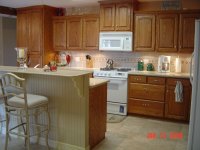
I don't know if these photo's help. You can see the outlets on the back splash. There's also the switches for the above and below cabinet lighting.
 

Attachments

  • 893114-Stove top (600 x 450).jpg
    893114-Stove top (600 x 450).jpg
    63.4 KB · Views: 267
   / More electric code questions for kitchen #8  
I don't know if these photo's help. You can see the outlets on the back splash. There's also the switches for the above and below cabinet lighting.
 
   / More electric code questions for kitchen #9  
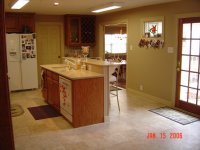
Here's the outlets on the island. Each outlet is a duplex and a switch. One switch (left side of sink) is for the recessed lights above the island and the other (right side of sink) is for the disposal.
 

Attachments

  • 893122-Island counter (600 x 450).jpg
    893122-Island counter (600 x 450).jpg
    58 KB · Views: 206
   / More electric code questions for kitchen #10  
Here's the outlets on the island. Each outlet is a duplex and a switch. One switch (left side of sink) is for the recessed lights above the island and the other (right side of sink) is for the disposal.
 
   / More electric code questions for kitchen
  • Thread Starter
#11  
Yes, the microwave, fridge and dishwasher each has its own dedicated 20A circuit. Lights are also on their own circuit.

The plugs are just for the toaster and coffee maker (and occassional blender) so 2 20A circuits is overkill for us, but required anyway...my current kitchen is ALL on a single 20A circuit (fridge, microwave, dishwasher, coffee maker, toaster oven, clocks etc) and I still have never had a problem....

Yes, I can (and will) talk to the inspector before works starts...but don't want to pepper him with too many questions I can answer myself from research like this...

Oh, yea all the plugs will be GFCI proected as required. What is the *best* way to do GFCI proection? In the sub-panel with a GFCI breaker? just the first plug on each line? or individual plugs in each receptacle? (by best I mean which has the least nusiance trips and which provides the most protection?)
 
   / More electric code questions for kitchen
  • Thread Starter
#12  
Yes, the microwave, fridge and dishwasher each has its own dedicated 20A circuit. Lights are also on their own circuit.

The plugs are just for the toaster and coffee maker (and occassional blender) so 2 20A circuits is overkill for us, but required anyway...my current kitchen is ALL on a single 20A circuit (fridge, microwave, dishwasher, coffee maker, toaster oven, clocks etc) and I still have never had a problem....

Yes, I can (and will) talk to the inspector before works starts...but don't want to pepper him with too many questions I can answer myself from research like this...

Oh, yea all the plugs will be GFCI proected as required. What is the *best* way to do GFCI proection? In the sub-panel with a GFCI breaker? just the first plug on each line? or individual plugs in each receptacle? (by best I mean which has the least nusiance trips and which provides the most protection?)
 
   / More electric code questions for kitchen #13  
1. As mentioned, 2 20Amp circuits split up in the kitchen, no need for alternating. If you run two toasters and a frypan, you will trip a 20 amp circuit so just attempt to have them where you would be on the two circuits

2. A 3 or 4 way dimmer can go in any of the locations. If it is in the middle though, it will need to be a four way.

3. Code will vary, but have the receptacles at least 1 ft from the sink.

4. I don't think there is a minimum.

5. I would have to look again, but I think 100 amp rated Cu wire is #1 AWG. Home Depot has the NEC chart at the wire rack. Copper right now is through the roof. You could consider a 100 amp and feed it with aluminum. Aluminum gets a bad rap and sometimes deservedly so. The connectors in panels and breakers are well designed for aluminum connections. Clean/inhibitor/tighten and retighten the lugs the next day. It was the small #12 wire on 15 amp circuits that was terrible. With aluminum, you need to go one wire size up. For peace of mind and if you question your skills, stick with copper.
 
   / More electric code questions for kitchen #14  
1. As mentioned, 2 20Amp circuits split up in the kitchen, no need for alternating. If you run two toasters and a frypan, you will trip a 20 amp circuit so just attempt to have them where you would be on the two circuits

2. A 3 or 4 way dimmer can go in any of the locations. If it is in the middle though, it will need to be a four way.

3. Code will vary, but have the receptacles at least 1 ft from the sink.

4. I don't think there is a minimum.

5. I would have to look again, but I think 100 amp rated Cu wire is #1 AWG. Home Depot has the NEC chart at the wire rack. Copper right now is through the roof. You could consider a 100 amp and feed it with aluminum. Aluminum gets a bad rap and sometimes deservedly so. The connectors in panels and breakers are well designed for aluminum connections. Clean/inhibitor/tighten and retighten the lugs the next day. It was the small #12 wire on 15 amp circuits that was terrible. With aluminum, you need to go one wire size up. For peace of mind and if you question your skills, stick with copper.
 
   / More electric code questions for kitchen #15  
For me the "best" GFCI protection is a GFCI receptacle at each location. No downstream trip problems, no guessing which device did the tripping. The GFCI units are only $10-11 bucks these days, not like my first house in 1977 where they were $50ea. The starter wife's hair dryer kept tripping it and we had to run downstairs to reset it. Upper and lower bath and outdoor outlet were all on the one GFCI receptacle located in the lower bath.

100A copper is #2. Pushing the temp limits for THHN you could bet away with #3, if you can find it. #2 is commonly available.
 
   / More electric code questions for kitchen #16  
For me the "best" GFCI protection is a GFCI receptacle at each location. No downstream trip problems, no guessing which device did the tripping. The GFCI units are only $10-11 bucks these days, not like my first house in 1977 where they were $50ea. The starter wife's hair dryer kept tripping it and we had to run downstairs to reset it. Upper and lower bath and outdoor outlet were all on the one GFCI receptacle located in the lower bath.

100A copper is #2. Pushing the temp limits for THHN you could bet away with #3, if you can find it. #2 is commonly available.
 

Tractor & Equipment Auctions

20FT X 12FT LIVESTOCK SHELTER (A58214)
20FT X 12FT...
500 BBL FRAC TANK (A58214)
500 BBL FRAC TANK...
2021 Ver-Mac PCMS-3812 Solar S/A Towable Trailer Message Board (A55973)
2021 Ver-Mac...
2011 CATERPILLAR 279C SKID STEER (A60429)
2011 CATERPILLAR...
12 X 20 CAR PORT (A58214)
12 X 20 CAR PORT...
Galvanized Livestock Wire Gate - 4FT x 11.5FT (A56436)
Galvanized...
 
Top