My Work Light Installation

   / My Work Light Installation #1  

DennisFolsom

Gold Member
Joined
Oct 6, 2003
Messages
427
Location
Central Maine
Tractor
John Deere 4600, John Deere X380
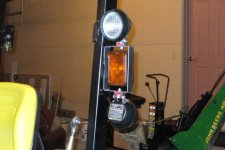
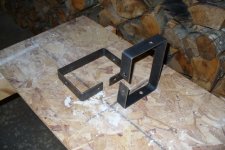
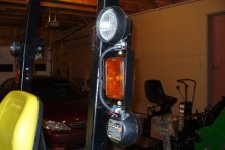
This afternoon, I made a pair of "brush guard" type light mounts for my John Deere 4600. I used 1.25 " x 1/8" steel, which I bent cold using a vise, hammer and anvil. These are a similar design to the John Deere Brush Guards, and mount the same way.

The photos show the trial fit, before painting and hooking up the wiring. There's also a shot of the mounts just before painting.

I painted the primer coat earlier this evening. I brought them into the Living Room after painting, so the paint would cure faster. I'm not sure I can get away with this, but I'd like to top coat them before I go to bed tonight, so I can install them, and hook up my wiring tomorrow.

The way my ROPS is built, the access at the bottom is poor. It may be tricky fishing the wires through them. The best method I have thought of is to pull out the existing wires, using them to pull some twine down through. Then, I can pull the new and existing wires back up with the twine.

The lights are Halogen Work Lights from Harbor Freight. If I remember correctly, I paid about 8 bucks apiece for them.

If all goes well, I'll post more photos tomorrow evening.
 

Attachments

  • P1040042.JPG
    P1040042.JPG
    131.7 KB · Views: 931
  • P1040045.JPG
    P1040045.JPG
    134.8 KB · Views: 818
  • P1040047.JPG
    P1040047.JPG
    130.7 KB · Views: 818
  • P1040049.JPG
    P1040049.JPG
    152.9 KB · Views: 730
   / My Work Light Installation #2  
Good job, looks great.
 
   / My Work Light Installation #3  
The way my ROPS is built, the access at the bottom is poor. It may be tricky fishing the wires through them. The best method I have thought of is to pull out the existing wires, using them to pull some twine down through. Then, I can pull the new and existing wires back up with the twine.

Looks Good :thumbsup: I mounted a bracket and lights on the inside of my rops . I used mechanics wire to feed the wire up inside the tube . Be patient , it's worth it . :thumbsup:
 
   / My Work Light Installation #4  
Looks great I also have the same lights. For the money you can't beat them.
 
   / My Work Light Installation #5  
Fishing the wires through the ROPS isn't as difficult as you may think as I've run a number of wires through mine.
 
   / My Work Light Installation #6  
I think what you have done.

Two questions, 1) how do you plan to bring the wiring out of the ROPS? 2) What size gauge wire are you using?
 
   / My Work Light Installation #7  
This afternoon, I made a pair of "brush guard" type light mounts for my John Deere 4600. I used 1.25 " x 1/8" steel, which I bent cold using a vise, hammer and anvil. These are a similar design to the John Deere Brush Guards, and mount the same way.

The photos show the trial fit, before painting and hooking up the wiring. There's also a shot of the mounts just before painting.

I painted the primer coat earlier this evening. I brought them into the Living Room after painting, so the paint would cure faster. I'm not sure I can get away with this, but I'd like to top coat them before I go to bed tonight, so I can install them, and hook up my wiring tomorrow.

The way my ROPS is built, the access at the bottom is poor. It may be tricky fishing the wires through them. The best method I have thought of is to pull out the existing wires, using them to pull some twine down through. Then, I can pull the new and existing wires back up with the twine.

The lights are Halogen Work Lights from Harbor Freight. If I remember correctly, I paid about 8 bucks apiece for them.

If all goes well, I'll post more photos tomorrow evening.

Good job:thumbsup:

I did the same thing you did(kinda).

My Massey came with metal guards around the turn signals, so I just attached my worklights to those. I placed 1 one each side, 1 forward, 1 backward.
 
   / My Work Light Installation
  • Thread Starter
#8  
I think what you have done.

Two questions, 1) how do you plan to bring the wiring out of the ROPS? 2) What size gauge wire are you using?

There is a hole for the wiring between the two bolt holes where the original tail lights mount. The thickness of my brush guard/bracket is 1/8" which provides enough clearance for the wire to come out between the tail light and the ROPS. I am also using the split plastic conduit to protect the wires and neaten the installation.

I am using 16 gauge wire. I believe that should be adequate and I already had some on hand.

I'm part way through the wiring now. Gotta have lunch and get back to it.

I'll post some photos tonight.
 
   / My Work Light Installation #9  
Nice Job :thumbsup:
 
   / My Work Light Installation
  • Thread Starter
#10  
My Work Light project is done - at least for now. I have a change I might make.

Pulling the wires did turn out to be less trouble than I anticipated. On somebody's post (either on TBN or on another forum) I saw them using a garage door cable to pull wires through the ROPS. While hunting through my storage boxes for some wire, I found an extra garage door cable. I folded the ROPS and fed the cable down from the top, plain end first. When I got to the bottom, I poked around a bit, and was able to get the cable out through the open area at the front of the bottom of the ROPS tube. (Due to the brackets for the ROPS and the backhoe, you can't look straight up into mine, and you can't get into it directly from the rear of the tractor.) I taped my wires to the cable and first pulled them all the way out the top of the lower ROPS section. Then, using needle-nosed pliers, I was able to pull each wire out through the hole in the side of the ROPS, between the taillight mounting bolt holes.

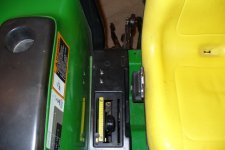
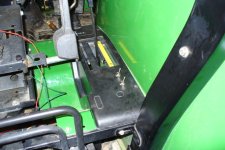
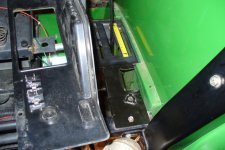
I had selected a spot on the plastic panel behind the 3PT hitch control to mount the switches. I measured carefully, installed my switches in the panel (which I had removed), then discovered that I hadn't done enough exploration. There is a steel plate under that plastic panel. It doesn't sit close enough to the plastic piece to mount the switches through both. In the first photo, you can see my solution to the problem. I drilled holes in the corners, made a couple of cuts, and folded a chunk of the panel to make a rectangular opening. This steel panel doesn't really carry any load, so I think it's still strong enough.

The third photo shows the location of the switches. These are heavy duty, supposedly waterproof, toggle switches that I ordered from Vetco. With shipping, 3 of them cost more than my lights did. I am pleased with the switch location. My hand drops easily to where they are and I can use them by feel.

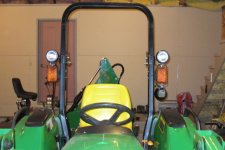
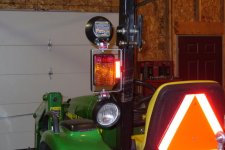
The 4th and 5th photos show the finished light installation. Note the flexible conduit to protect the wires. I need to get some Liquid Rubber, or something similar, to seal where the wire exits from the top side (as mounted) of the rear-facing lamp. While at it, I will seal all of them.

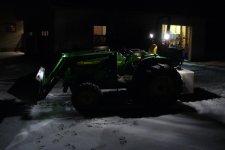
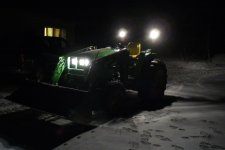
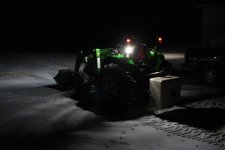
Photos 6, 7 and 8 were taken outdoors without using the flash on the camera. They don't really do justice to how much the added lights brighten up the sides and the rear. Also, the operator's station is well illuminated. I think they will make the tractor more visible to oncoming traffic when I am clearing the intersection of my driveway with the road.:)

The last photo is the view to the rear from the driver's seat. The photo looks a bit dark, but without the rear light, you would see nothing but blackness. Again, the camera did not do it justice. You really can see back there quite well.

Overall, I'm quite happy with the setup.:D

The one disappointment I did have was that when the tractor light switch is in the position that gives you flashers plus headlights, the work lights are not powered. They are only powered when the tractor switch is in the headlights and tail lights position. I would like to be able to run the flashers when the work lights are on. For that reason, I may run a separate wire and fuse back from the battery and power the work lights independently of the tractor light switch and wiring harness.

In my brief trial of the new lights, I can see why some folks are buying or making glare hoods. I have an idea for some home-made ones that I may try.

I have an LED warning beacon with a magnetic mount. I want something stronger for its original purpose (my construction inspection work), so I may dedicate that one to the tractor. My problem with that is that my ROPS will just fit through the garage door in the up position. However, I have been thinking of ways to get around that limitation. If I do put the warning beacon on, I would be less concerned about not being able to run the flashers at the same time as the work lights.

More to come, but that's enough for tonight. Stay tuned.
 

Attachments

  • P1040055.JPG
    P1040055.JPG
    121.7 KB · Views: 432
  • P1040053.JPG
    P1040053.JPG
    114.9 KB · Views: 416
  • P1040052.JPG
    P1040052.JPG
    154.7 KB · Views: 424
  • P1040051.JPG
    P1040051.JPG
    148.9 KB · Views: 471
  • P1040056.JPG
    P1040056.JPG
    135.8 KB · Views: 424
  • P1040063.JPG
    P1040063.JPG
    93.7 KB · Views: 447
  • P1040064.JPG
    P1040064.JPG
    91.1 KB · Views: 465
  • P1040065.JPG
    P1040065.JPG
    83.8 KB · Views: 419
  • P1040061.JPG
    P1040061.JPG
    103.4 KB · Views: 369
   / My Work Light Installation #11  
Dennis:

Are you going to put rubbers on the toggle switches?

I agree that glare shields would be a good thing on the forward facing lights at least.
 
   / My Work Light Installation
  • Thread Starter
#12  
Dennis:

Are you going to put rubbers on the toggle switches?

I agree that glare shields would be a good thing on the forward facing lights at least.

The switches were claimed to be waterproof. They have what appears to be a nylon ball at the base of the toggle. I keep the tractor indoors, except when I am using it. I think I won't bother with rubbers for them.

When I aimed the lights, I turned the front ones out and down a little. That helped a bit, but glare shields would help a lot more.
 
   / My Work Light Installation #14  
Really nice job. I also am installing lights on my tractor. I'm taking notes and pictures. I will start a thread when it's done
 
   / My Work Light Installation
  • Thread Starter
#15  
I gave my work lights a good test tonight. I did a quick job of snow plowing before dark, then my wife and I went to a party. After we got home, I finished the plowing with the lights. They worked great!:thumbsup: I can see to the sides, my operator station is lit up, I can see to the rear. I can see as much of the bucket and the bucket roll indicator as I can in daylight. I can see well where my front wheels are, which helps as I run them up to the edge of the ditch.

If you snowplow in the dark without worklights, you would really appreciate the difference after you add them.
 
   / My Work Light Installation #16  
My Work Light project is done - at least for now. I have a change I might make.


The one disappointment I did have was that when the tractor light switch is in the position that gives you flashers plus headlights, the work lights are not powered. They are only powered when the tractor switch is in the headlights and tail lights position. I would like to be able to run the flashers when the work lights are on. For that reason, I may run a separate wire and fuse back from the battery and power the work lights independently of the tractor light switch and wiring harness.

I would make this change, you might be drawing too much current for the headlight switch to handle with everything on. Unless there are relays used to power the lights and the headlight switch only powers the relays.
 
   / My Work Light Installation
  • Thread Starter
#17  
I would make this change, you might be drawing too much current for the headlight switch to handle with everything on. Unless there are relays used to power the lights and the headlight switch only powers the relays.

I looked at the wiring diagram in the JD Tech manual before. I'm quite sure their work light circuit is through its own relay. I know for sure that it has its own separate fuse.
 
   / My Work Light Installation #18  
Just did the same thing to my 4310 - sort of. I bought the light kit from Deere for $60 bucks I think (normally more then I would spend). However, the tractor is already prewired for the Kit - you find the connectors near the three point arms and simiply plug in. So I took the easy way out. However, pulling the wires thru the rops looked like a nightmare, so I ran them thru a clear vinyl hose on the outside of the rops and zip tied them to the rops.

One other thing, since I see your backhoe setting in the back ground... I have a habit of working past dark digging with mine, I installed the lights almost at the top of the rops. This way they are above my head when I am in the backhoe seat, if I turn to look off the tractor I do not get blinded, they also actually do a pretty good job lighting up the hole.

My two cents worth...
 
   / My Work Light Installation #19  
On my work lights, I went with "glueing" my wires to the rops. I purchased black silicone calk and then glued the wires down, I beaded the silicone over. It has held up quite well now for more than 4 years.

Carl
 

Tractor & Equipment Auctions

International 9200 (A56438)
International 9200...
KUBOTA L3410 TRACTOR (A60430)
KUBOTA L3410...
2012 DIAMOND C  40FT GOOSENECK TRAILER (A58214)
2012 DIAMOND C...
2021 CATERPILLAR GP30N STRAIGHT MAST FORKLIFT (A60429)
2021 CATERPILLAR...
(APPROX. 20) 4' X 8' X 3/8" SHEETING (A52706)
(APPROX. 20) 4' X...
2020 CATERPILLAR D5K2 LGP CRAWLER DOZER (A60429)
2020 CATERPILLAR...
 
Top