Natural Gas Pipe Sizing question

   / Natural Gas Pipe Sizing question #1  

EddieWalker

Epic Contributor
Joined
May 26, 2003
Messages
27,619
Location
Tyler, Texas
Tractor
Several, all used and abused.
I'm in a long, drawn out process of adding on and remodeling my house. One of the things I'm doing is adding Natural Gas to my house. I have the gas line next to my house, but I haven't built my garage yet, which is where the line will come into my house. I plan on having a manifold in the garage attic to distribute the Natural Gas to my kitchen stove, water heater, HVAC, BBQ and probably a stand by generator.

Here in Texas, you have to be a licensed plumber to buy the yellow colored stainless steel lines. That is an option, but one I'm trying to avoid since the garage isn't built yet.

I'm getting close to finishing off the ceiling of my back porch. Before I do this, I want to run a line to the BBQ.

I've used black iron pipe several times and I have a pipe threader for half inch and 3/4 inch pipe. I'm very comfortable running black pipe for the gas line.

My question comes from reading online on what size pipe to run. I was going to run half inch, but then got confused with what I read online, and the recommendations to go with one inch and even 1 1/4 inch pipe. It's a simple 3 burner BBQ. If it dies, it will be replaced with another 3 burner BBQ. This has proven to be more then enough grill for us.

The hose off of the Propane tank isn't even close to as big as a half inch pipe.

I'm planning on using 5 sticks of pipe that are 10 feet long. This will be capped in my attic for now, and then another ten feet to where the manifold will be in the garage attic. 60 feet total run from the manifold when it's done.

Can I use half in pipe or is there a reason to go bigger?

It is legal in TX for a home owner to run their own Natural Gas lines, but it does have to be tested and certified by a licensed plumber. I've been through this process a few times, and I've always passed the first time.

This is my porch ceiling so far. I need 37 more cedar boards, but I'm hating that they have become so expensive.
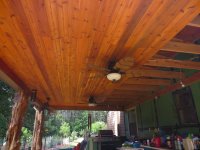

IMG_8659.JPG
 
   / Natural Gas Pipe Sizing question #2  
Around here cedar has never been cheap. I can only imagine what it costs now. BTW - that makes a beautiful ceiling.

Natural gas was "THE" fuel when we lived in Anchorage. Dirt cheap and all new subdivisions had gas.

As I remember - the yellow line running to our house was one inch. I would imagine it depends upon the pressures the gas company runs their main lines at.
 
Last edited:
   / Natural Gas Pipe Sizing question #3  
1/2" is sufficient for a normal gas grill.
 
   / Natural Gas Pipe Sizing question #4  
Your porch looks gorgeous!

Two minor items, neither of which totally answers your question:
  1. Corrosion: around here all buried gas lines have plastic over wrap to reduce corrosion. Who wants a gas leak? Can you get plastic coated pipe for gas?
  2. Gas has a relatively low pressure in distribution pipes. So that means much larger pipes compared to water, or compressed air.
The generator alone will probably need at least 1 1/4" back to a large enough regulator (I would check the installation guide for the size you are thinking about.). Many require (suggest?) a separate regulator just for the generator to keep from disrupting things like pilot lights on water heaters. Personally, I would plan on a second regulator for the generator.

FWIW: here is a cheat sheet to compute appropriate pipe sizing. 1/2" looks small to me for most modern BBQs.

All the best,

Peter
 
   / Natural Gas Pipe Sizing question #5  
Eddie... I agree with @Menagerie-Manor...

We use Trac-Pipe here (not the Yellow stuff)...

But if I looked up steel pipe sizing correctly 1/2" on natural gas with up to an 80' run would be good for aprox. 40,000 - 42,000 BTU's... This doesn't account for fitting lose... etc
3/4" would be closer to 90,000 - 95,000BTU

I'm guessing your 3 burner Grill is closer to 27,000 - 30,000BTU's
 
   / Natural Gas Pipe Sizing question #6  
Your porch looks gorgeous!

Two minor items, neither of which totally answers your question:
  1. Corrosion: around here all buried gas lines have plastic over wrap to reduce corrosion. Who wants a gas leak? Can you get plastic coated pipe for gas?
  2. Gas has a relatively low pressure in distribution pipes. So that means much larger pipes compared to water, or compressed air.
The generator alone will probably need at least 1 1/4" back to a large enough regulator (I would check the installation guide for the size you are thinking about.). Many require (suggest?) a separate regulator just for the generator to keep from disrupting things like pilot lights on water heaters. Personally, I would plan on a second regulator for the generator.

FWIW: here is a cheat sheet to compute appropriate pipe sizing. 1/2" looks small to me for most modern BBQs.

All the best,

Peter
Being trade I can tell you that a 1/2" supply using normal gas pressures will run away with any std gas grill. My last 3 grills were piped in with 3/8 od soft copper without any issues.
 
   / Natural Gas Pipe Sizing question #7  
Your porch looks gorgeous!

Two minor items, neither of which totally answers your question:
  1. Corrosion: around here all buried gas lines have plastic over wrap to reduce corrosion. Who wants a gas leak? Can you get plastic coated pipe for gas?
  2. Gas has a relatively low pressure in distribution pipes. So that means much larger pipes compared to water, or compressed air.
The generator alone will probably need at least 1 1/4" back to a large enough regulator (I would check the installation guide for the size you are thinking about.). Many require (suggest?) a separate regulator just for the generator to keep from disrupting things like pilot lights on water heaters. Personally, I would plan on a second regulator for the generator.

FWIW: here is a cheat sheet to compute appropriate pipe sizing. 1/2" looks small to me for most modern BBQs.

All the best,

Peter
Are you sure that's "plastic covered pipe"?? Here, all the main natural gas lines are 100% HDPE ak plastic. Lines in homes are steel and certified as gas pipe. All pipes wear out from electrolysis, not rust. Plastic seems to be much better at not doing that.
 
   / Natural Gas Pipe Sizing question #8  
i am no expert but you will have to make sure with all the appliances you will run that yourmain service coming into you home is at least 7 water columns.

This refers to the amount of pressure it takes to raise a column of water 1 inch. There are 27.7 inches of water column (wc) pressure in 1 PSI of pressure. So 7"wc is about 1/4 PSI. This is the normal pressure that household natural gas is delivered.

I just switched over to Natural gas to heat my home and run a standby generator (16KW) was told that if you dont have enough WC coming in youll have trouble...so they recommended at least 7WC when the utility company ran the line to my home. I have 3/4 black iron to my home.

As for the BBQ only-find out what the WC requirements are and google size WC and pipe size requirements.
 
   / Natural Gas Pipe Sizing question #9  
The length of the run will make a big difference, and your biggest draw will probably be the generator. I did a remodel once where the backup power for a lab was a NG Ford V8 fed by a 2" line. We had to move the regulator which added a long (150'?) run to the engine. We had to up the size of the line to 3" to shove enough gas through it. The engine would start OK, but starved for fuel under heavy load.

The size of the orifice in the regulator can be another pinch point.
 
   / Natural Gas Pipe Sizing question #10  
Are you sure that's "plastic covered pipe"?? Here, all the main natural gas lines are 100% HDPE ak plastic. Lines in homes are steel and certified as gas pipe. All pipes wear out from electrolysis, not rust. Plastic seems to be much better at not doing that.
You are right. The high pressure distribution lines around here are plastic, too, cross-linked HDPE for the most part. What @EddieWalker wants to do is downstream of the regulator, where the pressure is typically 7" of water column (WC, which translates to 0.25psi) For distribution around the house, the pipes tend to be black iron pipe extruded with a PVC cover, or copper of the same design. "Tend to be"... Inside tend to be black iron pipe.

I am no code expert, but I would be surprised if any code permitted plastic inside the home. Some jurisdictions don't permit soldered copper either. California doesn't permit plastic, without written permission from the state, and galvanic protection other than zinc galvanizing is required for buried lines.

High pressure gas lines for transmission tend to be 500-1,000psi, those yellow, or black cross linked HDPE pipes run 100-150psi, so it is a big step down to be at 0.25psi in the house, which is why pipes tend to be large to handle the surges in demand (water heater coming on, furnace, BBQ, etc.) without much pressure drop elsewhere in the system. That is why the cheat sheet that I mentioned above is all about distance and BTU demand.

Like @Larry Caldwell, I had a neighbor with terrible trouble getting a standby generator to work, (seven months of trial and error, and not working), much (all?) of the problem was a few feet of undersized pipe that starved the generator under load. The installer really didn't want to redo the pipe and valve, from 1" to 1 1/4", but as soon as he replaced them, the generator worked. What was specified in the installation manual? 1 1/4" pipe.

All the best,

Peter
 
   / Natural Gas Pipe Sizing question #11  
You really need to check with the local gas company to be sure you know what their delivery pressure is. You might even want to get one of their servicepeople or service supervisors to take a look at a sketch of your house piping and size it for you.

As mentioned above, 7" w.c. is a typical delivery pressure, BUT it's also VERY common for the gas company to deliver 2# (2 pounds) of pressure when the house piping will be run with CSST (Corrugated Stainless Steel Tubing). (That's the yellow tubing you referred to.) The reason for this is that CSST is measured OD instead of ID, it's expensive, the fittings are expensive, and the corrugations add some restriction. So in order to be able to run a SMALLER size in CSST (as opposed to black iron pipe), the delivery pressure is increased. Lots of new subdivisions are entirely 2# (PSIG) delivery now for this reason.

Also, you mentioned that "manifold" in the attic. If you're talking about the actual manifold where you'll run all your CSST branch lines to feed from, you're going to want to put that someplace more accessible. Otherwise a residential piping system wouldn't really have a "manifold". You have a main line and then branch off of that with drops (tees) as needed.

The installation requirements for CSST are defined in the manufacturers installation instructions in detail. The National Fuel Gas Code, NFPA-54 also has requirements for every material.
With CSST you have to install protective strike-plates where it penetrates framing, etc. You need to clearly understand both and be sure you know what pressure your gas company is going to deliver before you'll know how to size it. Most everywhere you have to be "certified" to run CSST. What "certified" means varies by locale.

If you're just wanting to pipe with black iron, you might be able to do the work. Here where I'm at the gas company would just inspect visually (before it's covered) and do a final pressure check. You wouldn't even need a plumber if you're doing it on your own home. This varies by locale and gas company too.

Find out what they plan to deliver. If it's 7" w.c., you'll be surprised how much pressure drop a 60' run of 1/2" pipe will take. The entire system is supposed to be sized so that you reach each appliance with only 0.5" w.c. pressure drop. That's not 0.5" drop for each branch or pipe segment -- that's total from the meter to the farthest appliance. That's by the book.

These sizing tables are readily available -- just be sure you're looking at the heading on the table and it reflects the correct delivery pressure, pressure drop, specific gravity for natural gas, and pipe material.

Sounds like there's no question that you can install the pipe. But the last thing you want is for the visual or final inspection to turn you down because it's undersized and doesn't meet the code. Getting the gas company to consult and advise up front might eliminate any surprises later.

Just some items to consider . . .


Sorry to go on . . . but I just saw mention of your generator -- lots of generators REQUIRE 11" - 14" w.c. inlet pressure at their burner manifold even for natural gas. Another reason to see what the delivery pressure is and let the gas company know that you likely need a higher delivery pressure. The addition of a generator usually results in a larger meter too so they'll want to know the details of your total connected load. They'll usually send someone out to consult with you at no charge.
 
Last edited:
   / Natural Gas Pipe Sizing question #12  
The tables and explanation that ponytug provided in the "cheat sheet" are exactly what you need. But you still need to verify the delivery pressure. If you find out that the delivery pressure is 2# or something more than "low pressure", you'll need different tables. If you decide to use CSST anywhere in the system, there are separate tables for that too.

OK. Done. Just want to emphasize that I wouldn't ASSUME anything about what they're going to deliver, where they will put the meter, or how involved they want to be in the sizing and inspection.
 
   / Natural Gas Pipe Sizing question #13  
I have propane so a little different. I have a regulator on my tank providing 2# psi on the run to the house. At the house I have 2 regulators, one for the house to drop the pressure and a separate one for the generator. They are within a couple feet of each other. The pipe from the regulator to the generator is 1-1/4" and about 6' long. The piping in the house is 1/2" CSST and all appliances on is 172k btus (pipe sizing doesn't meet the charts but that's a story for another time) I've had the gas company check pressures and delivery rates and it all works properly.
 
   / Natural Gas Pipe Sizing question #14  
I have propane so a little different. I have a regulator on my tank providing 2# psi on the run to the house. At the house I have 2 regulators, one for the house to drop the pressure and a separate one for the generator. They are within a couple feet of each other. The pipe from the regulator to the generator is 1-1/4" and about 6' long. The piping in the house is 1/2" CSST and all appliances on is 172k btus (pipe sizing doesn't meet the charts but that's a story for another time) I've had the gas company check pressures and delivery rates and it all works properly.

Propane is a different animal entirely and wouldn't use the same tables. Besides having 2# delivery to the house piping, you're also pushing a gas with 2500 BTU per cubic foot as opposed to natural gas at 1000 BTU per cubic foot. Propane piping will always be quite a bit smaller based on the charts.

The only downside to this is when a person finally has a chance to convert to natural gas from propane, they sometimes find that their house lines are too small or marginal. I'm on propane too. Wish natural gas was available.
 
   / Natural Gas Pipe Sizing question #15  
I have propane so a little different. I have a regulator on my tank providing 2# psi on the run to the house. At the house I have 2 regulators, one for the house to drop the pressure and a separate one for the generator. They are within a couple feet of each other. The pipe from the regulator to the generator is 1-1/4" and about 6' long. The piping in the house is 1/2" CSST and all appliances on is 172k btus (pipe sizing doesn't meet the charts but that's a story for another time) I've had the gas company check pressures and delivery rates and it all works properly.

Also, to your point, the tables are pretty conservative. If you run the equations or use the various formulas, you can usually get by with a smaller pipe but you'll take a larger pressure drop. That's why so many systems that are undersized still work ok. If you take a 2" drop instead of the recommended 0.5" pressure drop, you can pass much more gas and often still get to the furnace or water heater that only needs 4-5" w.c. at the burner control valve.

The old Lennox pulse furnaces, for example, would throw fits if you did that though. Some equipment requires higher inputs and have very tight variance in their input pressure settings. Recently, stand-by generators have been the biggest challenge -- mainly because they're designed for inlet pressures that exceed standard traditional delivery pressures and people install them on EXISTING systems that weren't sized for the additional load. Often the generator load matches all the other equipment combined. And no matter how big a pipe you run, you can't get 11" w.c. or more to the generator if you're starting out with only 7" w.c. at the meter.
 
   / Natural Gas Pipe Sizing question #16  
Local gas company offers two meters options for home owners. One is an "inches" meter which is a white face with black letters/numbers and delivers gas at 7-10" WC. The other is a PSI meter red faced white letters and delivers 2 PSI gas. If you use a PSI meter you will likely need a secondary regulator to drop the line pressure for the appliance demand for inches of water column. I sized and executed a gas install using a 2 PSI meter thinking at the time I would add a whole house generator. I had to add a secondary reducer for the tankless water heater. It contained a warning in the instructions against using PSI input and voiding the warranty...
 
   / Natural Gas Pipe Sizing question #17  
The short answer is that there is no short answer.
First step is to determine the total BTU load on the entire piping system. Then lay it out and size the pipe according to the load. The btu delivery will vary with the length and number of fittings in the run.
Having said that, there is no imaginable way that a 3/4” pipe could not supply a BBQ in any practical installation. Could be a different story it you tee other appliances into the line.
One way to minimize pipe size on a long run is to use a higher pressure and a regulator at the load, pipe sizing charts always specify the pressure.
 
   / Natural Gas Pipe Sizing question #18  
This is been kind of an interesting/informative read. Many years ago I spent time on the oil patch and most of the wells were pumped with Ajax engines fueled but the fields own gas which we got call in to work on. This natural gas of course had no smell so we "fired" the lines before we worked on them. All in fun.
 
   / Natural Gas Pipe Sizing question
  • Thread Starter
#19  
Propane is a different animal entirely and wouldn't use the same tables. Besides having 2# delivery to the house piping, you're also pushing a gas with 2500 BTU per cubic foot as opposed to natural gas at 1000 BTU per cubic foot. Propane piping will always be quite a bit smaller based on the charts.

The only downside to this is when a person finally has a chance to convert to natural gas from propane, they sometimes find that their house lines are too small or marginal. I'm on propane too. Wish natural gas was available.
Thank you for explaining this. I didn't realize that there was this big of a difference between Propane and Natural gas.
 
   / Natural Gas Pipe Sizing question
  • Thread Starter
#20  
You really need to check with the local gas company to be sure you know what their delivery pressure is. You might even want to get one of their servicepeople or service supervisors to take a look at a sketch of your house piping and size it for you.

As mentioned above, 7" w.c. is a typical delivery pressure, BUT it's also VERY common for the gas company to deliver 2# (2 pounds) of pressure when the house piping will be run with CSST (Corrugated Stainless Steel Tubing). (That's the yellow tubing you referred to.) The reason for this is that CSST is measured OD instead of ID, it's expensive, the fittings are expensive, and the corrugations add some restriction. So in order to be able to run a SMALLER size in CSST (as opposed to black iron pipe), the delivery pressure is increased. Lots of new subdivisions are entirely 2# (PSIG) delivery now for this reason.

Also, you mentioned that "manifold" in the attic. If you're talking about the actual manifold where you'll run all your CSST branch lines to feed from, you're going to want to put that someplace more accessible. Otherwise a residential piping system wouldn't really have a "manifold". You have a main line and then branch off of that with drops (tees) as needed.

The installation requirements for CSST are defined in the manufacturers installation instructions in detail. The National Fuel Gas Code, NFPA-54 also has requirements for every material.
With CSST you have to install protective strike-plates where it penetrates framing, etc. You need to clearly understand both and be sure you know what pressure your gas company is going to deliver before you'll know how to size it. Most everywhere you have to be "certified" to run CSST. What "certified" means varies by locale.

If you're just wanting to pipe with black iron, you might be able to do the work. Here where I'm at the gas company would just inspect visually (before it's covered) and do a final pressure check. You wouldn't even need a plumber if you're doing it on your own home. This varies by locale and gas company too.

Find out what they plan to deliver. If it's 7" w.c., you'll be surprised how much pressure drop a 60' run of 1/2" pipe will take. The entire system is supposed to be sized so that you reach each appliance with only 0.5" w.c. pressure drop. That's not 0.5" drop for each branch or pipe segment -- that's total from the meter to the farthest appliance. That's by the book.

These sizing tables are readily available -- just be sure you're looking at the heading on the table and it reflects the correct delivery pressure, pressure drop, specific gravity for natural gas, and pipe material.

Sounds like there's no question that you can install the pipe. But the last thing you want is for the visual or final inspection to turn you down because it's undersized and doesn't meet the code. Getting the gas company to consult and advise up front might eliminate any surprises later.

Just some items to consider . . .


Sorry to go on . . . but I just saw mention of your generator -- lots of generators REQUIRE 11" - 14" w.c. inlet pressure at their burner manifold even for natural gas. Another reason to see what the delivery pressure is and let the gas company know that you likely need a higher delivery pressure. The addition of a generator usually results in a larger meter too so they'll want to know the details of your total connected load. They'll usually send someone out to consult with you at no charge.
Thank you, this helps a lot. As of right now, I do not have Natural Gas to my house. It's in the ground near my house, but I'm a year, or maybe even two years away from digging the trench for them to install it.

The manifold is something that I see in new construction all the time with the yellow coated gas lines. I assumed something similar would be done with black iron pipe, but now I'm thinking that I've never actually seen a manifold for black iron pipe, just T's as it works it's way through the house.

According to Lowes, my BBQ puts out 32,000 BTU's They have some that go as high as 52,000 BTU's, but I'm not buying a new one right away, but if a sale comes along, who knows.

The cost of going with 3/4 pipe instead of half inch is about 25% more money, but not so much overall that it's prohibitive. From what I'm reading, I think that I should be fine installing the 3/4 inch pipe now and in a year or two, figuring out the rest of the system requirements.

There will be nothing else that comes off of this line, I just need to get it across the living room attc, out to the porch, before I lose access to the rafters. There isn't going to be a crawl space over my porch, so the only way to get into there will be by removing my cedar on the ceiling. I'll take pictures for the gas company to look at if they need to, but if they force the issue, I'll just abandon the pipe up there and stick with propane.

None of this will be in the ground. It will run though my attic, and down through my walls.

Thank you, I feel a lot better about this now.
 

Marketplace Items

2013 Ram 1500 Crew Cab Pickup Truck (A59230)
2013 Ram 1500 Crew...
2016 Case Magnum 310 (A60462)
2016 Case Magnum...
CATERPILLAR PC306 QUICK ATTACH HYD PLANER (A60429)
CATERPILLAR PC306...
2000 Sterling L9513 Winch Truck (A61306)
2000 Sterling...
Deere 310L (A53317)
Deere 310L (A53317)
Ryan Greensaire 24 Walk Behind Aerator (A59228)
Ryan Greensaire 24...
 
Top