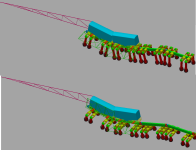
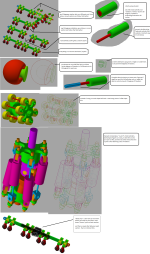
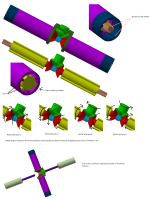
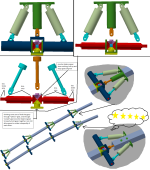
new tractor idea possibly....

   / new tractor idea possibly....
  • Thread Starter
#301  
*hhmmsss*

put some spacers (edited the rotatory union) to add another 30 inches. to raise sprayer up off the ground. so tops of crops would not get mowed down by the frame.

not sure if i like this idea. i suppose it could be possible. and just remove the spacers when ya change the sprayer out. but not sure if that would be feasible.

going to have to re-think the rotatory union and how i deal with the passage ways and physically mounting the rotatory union, to hold everything together.

rotatory union = it allows wires, hyd oil, compressed air, coolant, etc... to go through a joint, that can spin / rotate multi times in either direction.

then again who says i need flat solid bars, between the rotoary vane actuators, that move the wheel up and down. but rather go for 1/4 of a circle shape linkage bar. that might be the ticket there. sprayer rig does not have to deal with implements being lowered right next to tires. so i got some extra breathing room. ya... it may not give 30 inches to already approx 24 to 36 inches below the frame. but... would that be enough...

boggen elec sstt25.png
 
   / new tractor idea possibly....
  • Thread Starter
#302  
need to decided what to do, for connecting each section (section = 15 foot or 20 foot long)

i need the following...
--- hydraulic cylinder to push the 2 sections apart and then pull them back together. say 24 inches.
---say 30 degrees of rotation on 2 different axis. so each section can follow hills and slopes better.
EDIT: 1 axis rotation = twisting wrist left and right, 1 axis of rotation = bending wrist up and down.
EDIT: flatten your hand out, and twist / rotate hand as if it was the SSTT sections driving over hills, that were constantly changing direction of slopes and at different angles.
EDIT: take step further. think how pathing of say a planters connected one section, vs another section and gap between those planters as things rotate and bend.

of the 3 notations. i need to physically lock the hydraulic cylinder, and the 2 30 degrees axis rotations. so everything lines up nice and straight. when some sort of hydraulic cylinder, or rotatory vane actuator, or other moves. so when all said and done all sections line up nice and level / straight with each other. for transportation mode.

locking, could be done via wet disc brakes, or drum brakes, or even some sort of mechanical linkage that clicks into place.

each of the TWO 30 degrees of rotation. needs to be "powered" with a hydraulic cylinder, or electrical actuator, or motor, or rotatory vane actuator, or other like ways.

==============
may seem odd, but i can either place complexity in between each section. or i could require every single implement out there to try and deal with the complexity on its own. instead of multiple repeating across wide variety of implements. i rather just get it done and over width at the SSTT.

most drivers / farmers, most likely will never use manual control, of these connection points, but rather just let things happen automatically.

boggen elec sstt26.png
 
   / new tractor idea possibly....
  • Thread Starter
#303  
rear end of a pickup truck.... engine to transmission, to drive shaft, to rear pumpkin / final drive, to axles, to brakes, to wheels.

removing extra junk...
drive shaft -> rear pumpkin / final drive -> brakes.

instead of engine turning things, wheels in idea turn things....

but how do i attach a hydraulic cylinder.... to obtain that linear motion. of pushing / pulling sections apart / together.

boggen elec sstt27.png
 
   / new tractor idea possibly....
  • Thread Starter
#304  
what makes sense?

i think i am going to go with the very bottom set of diagrams, in attached picture.
ends up giving 3 axis of rotation and 1 linear movement.

--thinking the "central" hyd cylinder. allow it to slide into the main frame itself. and drill a couple holes in top of frame. to drop some quick discount connects onto the central hyd cylinder. and toss a 2 to 4 pins around the cylinder and frame to lock it in place. then the extra (side wing) cylinders, give ability to take on /off, perhaps for some implement or contraption that needs that few extra feet.
OR
--skip all 3 hyd cylinders all together. and use some short brackets and some pins. to save on cash. and lock everything together. ((would only have 2 axis of rotation.
OR
--skip the RVA (rotatory vane actuators), and the 3 hyd cylinders. and just go with brackets. to have virtually a 60 foot solid main frame that does not flex.

cheaper one direction (solid 60 footer frame), to more expensive / complex, to have each section almost operate like a 4 wheeled wagon. and a tongue connecting between.

more expensive / complex setup. could still be treated as a single 60 footer main frame. by locking disc brakes up on the RVA's, and some sort of pin maybe on the hyd cylinders.

==========
hhmmsss locking out hyd cylinders...might add a 2 foot extension on central hyd cylinder. so i can poke some holes through extension, granted it would set central hyd cylinder further back into main frame... but...

===========
alright, think i am done for now, on niddy gritty details. and move on to engine, radiator, hyd oil cooler, hyd pump, generater head. need to get some idea how much actual space they will take up. and how they will fit. before actually getting implements folding up, or turning SSTT into a sprayer or wagon or like.

boggen elec sstt28.png
 
   / new tractor idea possibly....
  • Thread Starter
#305  
engine types... *yikes*

the SSTT. i am limited by 8 foot by 60 foot, by 14 foot height.

wanting to place, fuel tank, cooling (radiator, hyd oil cooling), batteries, generator head / altenator, engine, hyd pump, along the 60 foot . and placed right up against the edge.

so i have say 7 foot open trailer, and then 1 foot taken up by all of above. and above can take up say 6 feet height as well. though i would like to keep height down to a min if possible.

to above.
8 foot dimension of SSTT, is most critcle. less i take up the better of the 8 foot width.
and then the height is next.
and then 60 foot i could less about.

=============
it would be nice to try and balance weight out across the 60 foot.

say fuel tank near end, and at a corner, so tank can be filled form 2 different sides.

engine, hyd pump, generator, most likely going to need to be one almost solid mass of metal. and be placed in a middle section of the 3 to 4 sections of the SSTT.

batteries, fuse box, relay box, most likely want on opposite end of fuel tank and located at corner, so easy access from 2 different sides possibly

radiator/s and hyd oil coolers... and just plan how do i focus things. so air is blown through the radiators/coolers. and across the engine, i am tempted to place radiators / hyd oil coolers either, on same section that has, (batteries, fuse box, relay box, and like), or on there own separate section. to help balance weight. and easy of cleaning the coils out.

==============
still debating if i want to go with a "fixed" frame setup for everything. vs being able to "angle them out" to use as counter weight.

thats right, counter weight, boxer arms. as well.

but getting back to angling the stuff out to the one 60 foot side to use as counter weight. i would need the 2 axis of rotation between sections so that i could, "twist" different sections almost, to allow for more even "weight" across the entire 60 foot. and the tires attached to each section.

granted all wheels lower and raise up and down. and i could control ground pressure per tire. that way, but if one section weighs heavier than another section, i would need the connections between sections powered. so all sections, the frames act like a single solid frame, that can be twisted / bent between sections. . but what good does that do to me on "fulcrums / levelers (tetter totter)" and being able to transfer that counter weight across and between sections.... ya that will still work, in transferring weight.

==========
if i do setup fuel tank, engine, hyd coolers, radiators, batteries, fuse box, etc... up on some linkages, so they can be folded out / angled out, to act as counter balance weight. do i want to turn the linkages into hyd cylinders, or perhaps telescopic hyd cylinders.

*rubs chin* i suppose it could be angled out, during transport mode, and allow for say an extra foot or 2. on top of the SSTT main frame. to fold up an implement, that is having a hard time folding up within say 6 feet. or simply use the folding/angling of the components, to act both as counter balance while in field, and have a bottom plow, chisel, planter, discs, etc... down, but also as counter balance during folding of implement up on top of the SSTT.

hhhmmsss....

i suppose if the engine and fuel tank and rest of components folded/angled out. and were on say telescopic hyd cylinders. i could make nearly entire 8 foot size restraint, and be able to fully use that 8 foot platform. and then lift everything straight up into the air. for stacking round hay bails between main frame of the SSTT, and the engine / fuel tank and resot of the components.

============
i don't know about this folding / angling... how in the world would i physically make those connections, for linkages, hyd cylinders, RVA (rotatory vane actuators).

reducing things, how and were would i make connections, if i skipped the folding out / angling all together...

===========
===========
===========
guess i am going to get wheels attached to the new frame setup for the sections. and place tires and there linkages on. and start marking out "row spacing" for different width rows. and see if i can find areas that i can use for support frame work, for engine, fuel tank, and all the other components.
 
   / new tractor idea possibly....
  • Thread Starter
#306  
have been having problems, that slowly getting worse, with random computer freezes (keyboard, mouse, screen) and requires reset of computer, bios of motherboard resetting on its own. cpu over heating. data corruption due to freezes. slowly been trying to diagnose issues, removing software, reinstalling drivers, running memory tester, cpu tests, last night / today, did format reinstall finally, and still issues, called asus up, and they RMA'ed the motherboard. hopefully all will be settled in first few days of next week. until then, hopefully i can keep on going, without a complete hardware failure.

((see attached picture first))

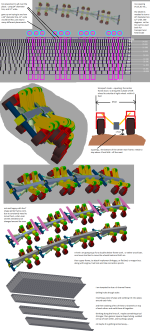
wheel spacing, and trying to meet a wide range of different row spacing. i got defeated. just way to many different row spacings and not enough room.

up to this point been trying to stay with a 12" x 16" main square tube frame that is approx 13 feet long. once i started trying to add different "frame works" for say a hay wagon frame work before the floor is put down, to sprayer rig setup, to simply adjusting linkages to fold/unfold implements. my thoughts have changed....

to some sort of "track setup" kinda like track lighting, were you can slide a light around on the track, but there really is no wheels / rollers / other. just metal to metal sliding. and some sort of bolt / screw to possibly fasten light in place to keep it from moving. though i think i am going to go for some sort of "double track" one lower track, to adjust wheel spacing. then an upper track. to adjust linkages that fold/unfold implements. or were you would attach frame work to turn SSTT into a wagon or like, to linkages to engine / fuel tank / etc...

problem is, not sure what type of track to use or how to even set it up.

========

i suppose for wheels and the linkages for them, i would want to be able to just undo a hand full of bolts, wires, hyd hoses, air hose, and pull entire wheel off. without having to remove a bunch of other wheels from the given track.

i really do not need a big complex track setup. just a "lip" of some sort that would allow things to slide, but not allow things to come crashing down to the ground. figure sliding will require some sort of farm jack, or chain / pulley / snatch block. or someone using a fork lift, with what ever chained to forks, or lifted up into place with a fork lift (forks on FEL as well). perhaps forks used to slide stuff across the tracks as well for adjustment.

i figure some sort of "clamp" pipe clamp, muffler clamp, or there about, or perhaps some actual holes were pins or bolts could be used.

maybe a "wedge" setup instead of clamps and/or bolts. folks been using wedges for years in wood working. hmmmsss bending, wiggling, pounding wedges out, deformed wedges...

i need space for the central hyd cylinder, (that is used for between sections) that takes up 3 to 6 feet of the approx 13 feet length of the main frame / track. so what ever ends up getting used. is going to need to compensate for that, to allow attachments around the hyd cylinder.

i will also need a way to route, wires, hyd hoses, air hoses, etc... through and around the main frame / track. and allow for connections into them wires, hyd hoses, air hoses, etc... i guess what makes sense is making this stuff, run on the outside, maybe in a U channel, or perhaps some way to zip tie everything up. errr ok zip tie bad idea, due to heat. wires on one side, fluids / air that could become extremely hot on other side of frame perhaps.

i wonder... if i went with a 8" outer diameter of the "central hyd cylinder" that is used for between sections. and went with say a 8" inner diameter 8.125" outer diameter pipe. (to allow hyd cylinder to slip in) and then for hyd hoses (say max 3000PSI), used metal pipe, and physically welded the pipe to the outside of the 8"/8.125" pipe. then did same thing for coolant hoses. instead of using rubber hoses, use a metal pipe. and welded the smaller pipes to the 8" x 8.125" pipe. and repeated for air hoses, instead of rubber, go with metal pipes, and weld. and then for Tee connections. cut into the pipe of wanted fluid / air. and then weld on some sort of Tee shaped fitting. maybe using a dremal, or grinder for the cut. "maybe a drill"

bah... as soon as i put a tee fitting / nipple that stuck out. i would be in trouble for trying to slide a wheel or something else over the area, let alone trying to place something over the area.

*rubs chin*, do i just go with "pipe hangers" that fit on the 2 sets of tracks. and hold the wires, hoses, etc... away and off the tracks... well hhmmsss... ya first hose / wire that sags to much, and "snap" there goes entire machine setting dead.

am i going to need a triple decker setup. lower track, for wheels and there linkages, middle layer wires, hyd hoses, air hoses, coolant, etc... and then top track for implement linkages, wagon connection, engine linkages. its starting to turn into a "spine" of some animal... *gulps*

alright lets go off that statement of an animal.... treat wheels like, having 2 legs. other words, wheels would be in sets. wheel directly across from given wheel ... naa... well... hmmmsss.. i need to keep with wheels on each side do not have to line up with another wheel on the other side, along with keeping possibilty of allowing wheels to be lined up (directly across from each other) possible.

would an upper case I, or rather H beam for upper and lower track work? or would i be better off with... shape something like.....

|-O

one side of H beam more of a circle, or perhaps half circle...

|-(

...................
lower frame |-( wires )-| top side of top track.

hhmmmsss i guess i could still do wedges or rather i should say spacers to deal with odd shape H beam. and pipe clamp / muffler clamp. things. but how do i route holes and ends of clamps. around the area for wires and hoses.

hhmmsss.... 2 H beams, welded together with some say 2.5" long, 1" wide, 1/4" thick strips of metal. that overlap 0.5" onto each side of each H beam.

|-|=|-|

well....

|-|-|=|-|-|

hhmmsss

-|-|=|-|-

back to...

|-|=|-|

*decides to turn monitor 90 degrees*

-|=|-

(|=|)

)|=|(

)-|-(

><>< might be something.

>|<

<> simple square tube, turned 45 degrees. maybe..

++
++ 4 pluses turned into a single square pipe in center, and 8 legs stick out.

++
++ above and turned 45 degrees maybe?

<| triangle? point is down, flat on top.

<|
<| triangles point down, flat on top?

>+<

never thought i would end up doing character art, to figure out how to build something.

time to post / save. before i loose info.

==========
boggen elec sstt29.png
 
   / new tractor idea possibly....
  • Thread Starter
#307  
trying to re-invent the wheel again *rolls eyes*

not sure what "correct term" to call it.

i have seen "metal" shaped into a C shape. (rather a more Square shaped C), and then use of a square shape washer, that also doubles as a nut, that slides into the C metal frame. and a spring is used to hold the combo nut/washer to the "front / open side" of the C. the spring is used primarily to make it easier to keep washer positioned during mounting something to the C shape frame. the washer/nut may have a couple little nipples to help hold the spring in place. as you slide the washer/nut and spring down the frame to what ever position is wanted.

while C shape may not be as robust as a square tubing of metal. when ya sandwich the (open side of the C) between washer, and what ever is being mounted. it basically turns the C shape frame into square tubing, right at those mounting points. and you are no longer trying to fasten to some lip.

due to overall length of say 13' if going for 4 sections per 60 foot. or 18.5' if going with 3 sections per 60 foot, going to assume the open face side of the C frame, is going to need a little bit of extra support. i have not been able to think of a easy way to create multi C frames out of a single piece of metal. so most likely the C frames will need to be mounted, to each other or central frame. thinking some of the bolts that are used to fasten C frame to the more central frame. could be double duty. first fasten C frame to central frame. and then extend threads out of the open side of the C. so another washer/nut could be put on. to help sturdy up the C face. if ya need to slide a wheel linkage, or something, and this lip re-enforcement, is in way. just swap the re-forcement out for shorter bolt. and put the longer bolt in some place else.

i would imagine, at manufacture time, or at dealership before delivering to customer. a few extra square shape washer / nut combo's could be slide into the C frames. and a short cheap bolt put in. to just hold everything, and keep the stuff from rattling out. so if farmer ever needed some extra connection points, they would be there, and could easily slide across the C frame, without having to tear multi wheel linkages off, or implement linkages off.

awe heck, above sounds all good, but reality, most likely some folks, will have to pull off a good amount of things off the C frames, just to slide that one extra washer/nut combo into the C frame.....

i would be afraid if making a "slot" or 2 over the entire length of 13' or 18.5 feet. to try and allow insertion of washer/nut combo. without having to pull everything off. would result in C frame wanting to bend and twist and get all deranged. even if i went with say a more rectangular shape washer. that had 2 or more holes in it, that were threaded, to create multiple nuts like doing. even if i used re-enforcement areas over the slots. i don't know. just seems like a bunch of extra, that would require a much beefer C frame setup. not sure if it would be worth while long haul. i guess if C frame being fasten to more of a central frame. a person could always replace a C frame, if they completely boggered it up. though was trying to avoid actual thought of needing to replace C frames, with exception of special cases of rare accidents that would most likely happen.

===========
not happy yet. C shape channels but not how to there put together.
boggen elec sstt30.png
 
   / new tractor idea possibly....
  • Thread Starter
#308  
feel like i building some air plane not sure if that is good or bad.

not real sure if it will work. i want to keep the C channels, to keep everything adjustable. ya i am sure i could go through a bunch of numbers to fine X amount of holes to drill to meet majort of row widths out there. but going to take lazy route.

tempted to go with just square tubing for everything, or pipe and skip C channels all together. but then every thing that attached directly to main frame. would need to have a larger size "plate" with some extra holes. to get around the "ribs".

the 4 central C channels, not sure how to keep them from easily bending outwards. besides putting some sort of clamp or band or something across the 2 sides, i really do not want to weld something place. but not sure how else to go about it. *looks confused*

boggen elec sstt31.png
 
   / new tractor idea possibly....
  • Thread Starter
#309  
dad clue'ed me in on....
01052011_Unistrut_US

for adjustable doings for tracks... but i have not came upon anything beefer, would most likely be needed.

been hung up on how to run, pipes / wires through main frame.

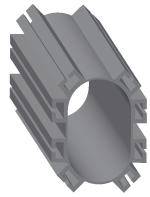
tempted to go with Square tubing vs regular circular shape pipe. even if it means make the outside of a pipe square in shape, and the inside circular. thoughts are square / flat surface, be easier to drill / torch a hole in. and the weld a threaded end of a pipe to. more so when ya having to squeeze through a frame that is rather tight fit to begin with. pipes even on the best of setups to drill a hole through them can be a tad of a pain, example setting a pipe in a vise / clamp on a drill press. get the initial drill bit slightly off a pipe. and ya end up running drill bit down the side of the pipe vs being able to get a good start.

i thought about just using threaded pipe. even with one end threaded clock wise, and other end counter clock wise. so pipe could be undone and sections removed. but it is kinda like REALLY! how in the world do you even get a pipe wrench, let alone just simple channels of various shapes in, and try and tighten / loose pipes and fittings.

i am not real interested in running nothing but rubber hoses. it can be done, and most likely add to highest degree of user friendliness. but the cost of rubber hose, and then so many "cut points" that could happen, and cut or damage the hose is up. example vibration alone, and a hose resting on a sharp piece of metal edge. i could imagine a few instances, were it looks like someone gutting an animal, and in this case, all the rubber hoses for (hyd oil, coolant, air hoses, electrical) would all end up hanging out the bottom. in one cumbersome knotted mess of things. resulting in high amount of frustration, to sort things out and clean up mess, when ever some sort of wheel adjustment was needed, or implement attached. also issue of some rubber hose catching / snagging, something it is not suppose to, and not just tearing up just a single hose, but tearing up a bunch of hoses and connections.

if i can keep the main pipe/s metal. and most likely weld these pipes into place within the main frame. i would like to think i would be able to better control "messes" and "knots" of rubber hoses. and if something did snag, it would only be that given rubber hose. the issue is how to mount the metal pipes.... needing to come off these main metal pipes to both sides. (each side = tires), one side = implement connections, other side = engine connections (hyd pumps, coolant pumps, generator head), along with trailer hookups. all these connections, and just not sure how to handle them.

i thought about trying to run metal pipe. right in line with the C shape tracks *unistrut* setup. but issue of connection points being right in way, and not allowing linkages for wheels to other to slide by. so with that connection points need to be offset deeper into the main frame. to all for the clearance that would be needed.

hmmmsss.... rectangle shape pipes might work. hhmmsss. dealing with between sections.

going need to run rubber hose between main pipes in the main frame. to wheels, to implements, and like. so..... do i just go every few inches with a T fitting, and put a end cap on. or some sort of quick connect fitting. and just deal with odd placement of hoses and there connections.

i guess it would be easier at manufacturing time. to put in the extra T fittings. and place a screw on end cap, and then as farmer needs undo a end cap and replace with some sort of quick connect or swivel connection for hoses. i guess that would work for liquids and gas. but electricity.....

===============

i suppose i could do same then for electrical connections. and using wire harness connetions. and just put "blanks" or end caps over wire harness connection points.

though do i add a pig tail (a foot or so of extra wire length, that tees off main trunk of wires) i guess that might work better. wires can be flexed and bent around things. allowing main trunk of wires more hidden and less accessible. and just rely on dangling pig tail wire harness connections. but how do i keep the extra pig tails not in use for what ever reason from, flopping around, almost need some sort of, "hole" drilled into something, were i could push a cheap plastic pipe/wire hanger into. i am not sure "zip ties" would be ideal. could work i suppose, and more likely end up getting used, vs paying a few cents more and waiting for shipment of the manufacture plastic wire hangers.

do i go with longer pig tails. so they can be wraped around main frame on purpose. and more likely come undone and get torn up. or do i go with shorter pig tails. that really can not be tied up. *just to short* or do i go with say a mount for the wire harness connector much like a plug on rear of truck, for trailers and like. hhhmmmsss, some bozo "other words me" giving a yank at some connector and pulling wires out of the rear end of connector. or damaging connections inside wire harness. if i went with a mount the mount and wire harness more likely take the force.... but the issue would be, reaching over and around tires and linkages. to get to mounted to the wire harness connections.

if i stayed with dangling pig tail wire harness connections, more likely to grab a end turn it for a better direction to put in some grease/oil to keep connections from corroding up. and simply to be able to physical grab a hold of, to see if there is any problems inside the wire harness connection.

i suppose if i went with a longer pig tail wire harness connection, and zip tied the little extra length, up to main wire harness, so if wire harness connection ever did get torn up pretty good, a simple "cut" of wires, could be done with a little extra wire there to deal with things without having to splice in longer wires.

man, it is just all those connections, and good chance not all of them would get used a couple may rarely ever get used. and rest depends on crop and if tilling, planting, harvesting.

be nice to be able to just "shove" non used connections up into some sort of "holder" *grumbles* without creating a place for mice to nest or crawl into. hhmmsss some sort of end cap / cover cap maybe. drill hole through center of it. and bolt it to the frame. it would keep end from dangling and getting caught up into stuff, and hopefully keep dust / rain / water / moisture from getting into the wire harness connection. i suppose act as a "holder" for other end of wire harness connect end cover cap. when ever some wheel or implement connection needs to use up the given wire harness connection.

===========
kinda talking my self into longer pig tail wire harness connections. for electrical connections, but is that a smart move or bad move...

i doubt these connections be changed that much, maybe 2 times maybe 3 times a year. if machine used for different crops with different row spacings. some wheels may only get move a couple inches, and may not need to redo all the hyd hoses, and electrical connections. to another set. while some wheels may...

same goes from changing SSTT (sideways snake train tractor) from tillage / planting mode, into say a sprayer or wagon setup. regular implement connects would be made at end of the linkages, and not to the main frame when swapping implement for another implement. well i say that. but some third party company may end up redesigning completely different concept. that requires physical connection directly to the main frame.
 
   / new tractor idea possibly....
  • Thread Starter
#310  
getting into a more niddy griddy detail...

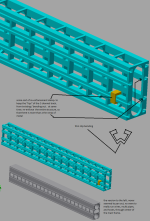
to make use of space between each side, i am down to using "rectangular shape" pipes. problem with square / rectangular shape pipes. vs circle shape pipes. is pressure bulging out square / rectangular shape sides. so.... thinking about using a bunch of L shape pieces of metal. and some flat pieces in the middle. and weld it all up. talking roughly 25 welds approx 13 feet long each.

as much as i do not like idea, of using square shape tubing, for fluid and air flow through them and the friction loss that will occur. only way i can think of, that would make "most use" of space. and still most likely meet required goals. of GPM (gallons per minute) or CFM (cubic feet per minute) the other issue, is trying to compact everything together. and balance flow throughout the piping system. and still get some sort structural support out of it all.

as much as i am for. flexing and allowing things to bend/twist within a certain amount / tolerance. i am trying to avoid, making this massive support beam / main frame. that everything connects to. but rather use everything that will connect and go through the main frame. as a way to structurally re-enforce everything.

with above said, i am still not satisfied with current chicken scratches. ya a good amount for thickness of metal, and distances between ribs/support braces, will come from structural analysis. but just not happy overall, with how hoses and wires will be dealt with. there is still a sense of major frustration. that i get that would happen when changing tires for different row widths and like.

boggen elec sstt32.png
 
   / new tractor idea possibly....
  • Thread Starter
#311  
just not happening, with trying to squeeze everything into 12" width, 24" high main center frame.

deciding to go with a wider width of approx 40 inches, and approx 30 inches high.

moving the engine, hyd pump, generator head, batteries, fuse box, fuel tank/s, all into the center main frame. vs trying to set them off to a 60 foot side.

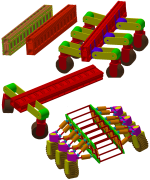
redid linkage/s for wheels so wheels can move up and down a few inches, and extend/contract out away from main frame a few inches. and still allow tires to be used as transport mode or field mode. 3pt hitch like linkages seems to won out. simple and easy.

picture showing 24" tires, but 36" perhaps slightly larger diameter tires should easily be possible.

if ya truly needed extra height, or perhaps lower profile. the (yellow) brackets, between hyd cylinders and main frame, should be easy enough to swap out. to change height of were main frame was off the ground, for both in transport mode or in field mode.

going to stay with the unistrat like tracks. thinking of staying with 3 sets (one on top of the other). for 6 bolts. hope that main center bolts. will take more force. and the other outside bolts. i hope, will keep the center portion of track from really warping badly.

i just boxed myself in though for engine dimensions. if i can keep the engine width down to say 30 inches width, and height below 24" and then how ever long. i should be golden.

boggen elec sstt33.png
 
   / new tractor idea possibly....
  • Thread Starter
#312  
   / new tractor idea possibly....
  • Thread Starter
#313  
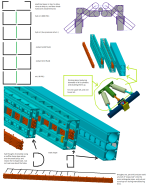
reworked the linkages between sections, not the best ((the big square yellow block)) is my cheat for now. other side of linkages for sections, were the 3 hyd cylinders are. trying to lay some sort of ground work possibly to allow the 3 cylinders and "pinkish/purpleish" support bracket to easily push in / pull out as one single chunk possibily. thinking of using area above and below hyd cylinders. as some sort of place for "quick connect" area for all the hoses and pipes.

with above said, at moment showing 2 approx 15 foot sections (counting section linkages) figure engine, hyd pump, generator head, muffler and anything else that needs direct connection to engine, and can not be placed in another section. is going to max out a single 15 section. then maybe using a 2nd 15 footer section, for fuel tank, batteries, fuse box, fuel pump, fuel filters, hyd oil filters. not sure about hyd oil coolers... most likely going to be counting on a min of 3 15 foot sections and there linkages between each section. to get the basics. 45 max feet for basics? hhmmsss maybe see what happens.

more space i can squeeze the width of the main frame down to. the better for linkages to wheels, and linkages to fold/unfold implements.

boggen elec sstt34.png
 
   / new tractor idea possibly....
  • Thread Starter
#314  
engine time....

what can i find that will fit in a 30 x 30 x 120 inches long. the smaller the 30x30 (width x height) the better. needing something that fills 100 to 1000HP

displays types of engines
Aircraft engines., Page: 8 | UNT Digital Library
and more looking at an axial type of engine, were cylinders are parallel to the drive shaft. make it a swash plate or wobble style engine or like engine.

i am guessing, since i have plenty of length to work with. that there will need to be multi cylinders in a row. that go around a central common drive shaft. other words since piston size will predict overall diameter of engine, and limited to 30x30 inches and wanting smaller if possible. i am going to need to go with some sort of multi smaller cylinders.

below pictures are from....
Axial Internal-Combustion Engines.
wobble%20plate%20motor1.gif

swash%20plate%20motor3.gif

Trebert%20stationary%20cylinders%20anim.gif

Trebert2.gif

Almen%20A-4%201.jpg

04USAFM-AlmenA4Barrelengine.jpg

dynacam%201a.jpg

dynacam%202a.jpg


contacted duke engines, and received email back within a couple hours. and there just not there yet for mass production and not giving out information.
Engine Technology, Vehicle, Marine, Light Aircraft, Multi Fuel

below picture is from...
"AVEC Axial Vector Engine" Video at Engineering TV | ADBDAT
media_https3amazonaws_hIjes.jpg.scaled500.jpg


================
weapons of mass destruction, changed to power the SSTT (sideways snake train tractor)

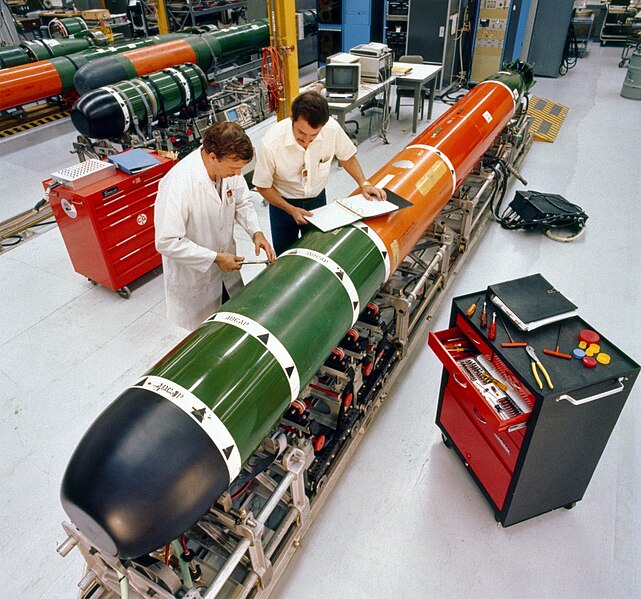
torpedoes!

they have the a design aspect, of small width and height. and then have plenty of length. much like the center frame work setup, i am currently looking at. even if i went back to the 12" wide 24" height. and moved engine and all components to one side of the 60 foot lengths, the torpedo shape engine setups would most likely be what i am looking for.

below image is from...
Mark 48 torpedo - Wikipedia, the free encyclopedia
641px-Mk_48_torpedo_maintenance_1982.JPEG

specs from above site
Weight 3,434 lb (1,558 kg) (original), 3,695 lb (1,676 kg) (ADCAP)
Length 19 ft (5.79 m)[4]
Diameter 21 in (533 mm)[4]

notation that lead me to above website...
Axial engine - Wikipedia, the free encyclopedia ((located clear down page under application))
The most well-known application is in torpedoes, where the cylindrical shape is desirable. The modern Mark 48 torpedo is powered by a 500 hp swashplate engine geared to a pump-jet propulsor. It is fueled by Otto fuel II, a monopropellant that requires no oxygen supply and can propel the torpedo at up to 65 knots (120 km/h) (74.56 mph).[15]

remove the fuel tank, remove the war head, remove sensors, and strip it down, to engine, toss on a hyd pump, and generator head. and away i go. ok more involved than that. but.... concept sounds promising.

=================
i have looked at other engines, from straight, to V, to radial, to other. and i simply do not see them as being possible. they require to much height, or larger in diameter. along with vibration or rather i should say, to much momentum of pistons swinging around that has to be over come, and firing of each cylinder/piston and the vibration caused by it all.

alright enough blah blah blah! i think i have something in mind. for 2 plus swash plate design. that might give what i want out of an engine.
 
   / new tractor idea possibly....
  • Thread Starter
#315  
never much of an engine person, so most likely off on terms...

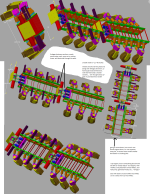
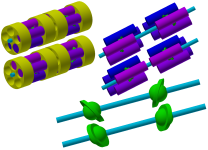
double swash plate.
10 pistons
20 cylinders

primary goal is reduce some vibration. in how i have the "swash plates" matched up. when an explosion of the fuel happens. "weight" and "force" of the pistons, is carried off in opposite direction. to either bring the pistons pointing between swash plates together. or apart from the center of the 2 swash plates.

i suppose, i am technically using 2 engines connected to common drive shaft. not sure how badly the drive shaft would vibrate and want to bend right at the center between the 2 swash plates.

boggen elec sstt35.png

EDIT: Mace Canute thread Internal view of combustion chamber
gave a lead to a video, that gives idea i was thinking about with above engine setup....
http://www.liveleak.com/view?i=d78_1305139595
 
Last edited:
   / new tractor idea possibly....
  • Thread Starter
#316  
re-write 5. getting a tad annoyed with myself, due to lack of indecision. a lot comes from lack of knowledge. and i keep changing my mind as things click.

alright....
started drawing something up, and when i stepped back from it, it was a mix between turbine engine and piston/cylinder engine.

i like the turbine ability of lots of HP and lower weight, but what i do not like is the high "air volume" per min that would need to go through the engine. your talking a tractor here. seeing dust, weed seeds, leaves, snow,ice, water, mud splashing. if i tried to move such a high volume of air. there would most likely be a huge amount of "plugging" of screens and filters. an air plane, a jet, a helicopter, a large boat or should say ship. they have a cleaner environment that the engines most likely would run in. vs a tractor out in fields, and going through dirt roads, and muddy ruts, etc....

the other issue with turbines, is material needed to handle the higher temperatures. which of course, would most likely cost more $$$$

the high RPM's could most likely be dealt with, at the generator head and hyd pump and air pump. even if i needed to use some gear to reduce RPM's of a turbine engine.

i do like the simple shaft/s ability of turbine engines.

-----------
piston/cylinder engines. i just do not like the "vibration" even with the last post picture/s.

i guess what i am looking for.... is some sort of "timed" air/fuel mixture engine. that has mini explosions of air/fuel. vs a constant stream of air/fuel in a turbine engine, that gets away from piston/cylinder. ya a timed air/fuel mixture, like a piston/cylinder engine. would create a vibration. between each explosion. but the ability to adjust air/fuel mixture, and roughly predict RPM's over a wider range, and torque. it would be nice to get to something that has a few more "piston/cylinders" vs concentrated in only a handful of pistons/cylinders. (ggrr need to say combustion areas)

or, i go with a bunch of smaller size turbine engines. that are all built into a common engine. that allowed lower RPM's. but ability to adjust torque. while maintaining RPM's. hhmssss.....

a turbine engine, with idea of such a high volume of air both being positive and negative pressures. and hooked into say an air seeder or like. and if exhaust could be cool down enough. ya right, that would most likely over crowd the engine section of the 3 to 4 sections that make up the SSTT.

=============
hhmmmssss.... turbine engines....

as much as i like the idea of a turbine engine type in the SSTT, the con's are to much.

=============
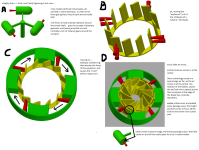
attached diagrams, just me, trying to think things through...

boggen elec sstt36.png

boggen elec sstt37.png
 
   / new tractor idea possibly.... #317  
Ryan the torpedo only makes 1 high speed trip then it is over or sinks.
Consider a turbine from heliocopter . only problem high fuel consuption.
And needing a good gear redeuction box.
keep thinking , good reading.
ken
 
   / new tractor idea possibly....
  • Thread Starter
#318  
"top left change langauge", bottom right, click motoren. and get listings of animation of a bunch of different designs.
ringmotor verbrennungs-motoren pumpen multifunktionsaggregate combustion engines

listings of various types of rotary engines.
Open Directory - Science: Technology: Energy: Devices: Internal Combustion Engines: Rotary

(yikes!) long list
List of aircraft engines - Wikipedia, the free encyclopedia

getting there but not yet...
Pistonless rotary engine - Wikipedia, the free encyclopedia

a bunch of engine types (history)
Rotary Steam Engines.

more for myself, to refresh my memory of how fluid dynamics occur. and the idea of how a shaft like turbine engine might work.
The Altmann Combustion Force Turbine (CFT)

wave disc engine? hope got correct term.
MSU researchers create a new engine prototype (w/ video)
Shock wave puts hybrid engines in a spin - tech - 15 March 2011 - New Scientist

torpedo engine
Russian Military Forces | Aviation | Navy | Infantry firearms | Communications | Ground systems | Weapon photogallery

something to judge things by.
Ward's 10 Best Engines - Wikipedia, the free encyclopedia

peswiki.com has caught me off guard over last few months, and end up seeing a varying different contraptions.
Directory:Engines - PESWiki

a list of manufactures of truck engines but not sure what is required to get listed.
Deprecated Browser Error

==============
fluid dynamics. just seems like aaaa what is that? as i look at some engine types, and i scratch my head. in trying to make the most use, of the explosion of air/fuel mixture. and ensuring the entire air/fuel mixture is used up before leaving the exhaust pipe. along with transferring that explosive energy to wanted component. i see more 2D vs 3D visualizations. and just like aaaaa.... i see more flat surface to flat surface. vs a curved surfaces that might better focus explosion of air/fuel as it expands. kinda like treating the explosion like a solid rod just extending through a combustion chamber or in a piston/cylinder. vs actually identifying eddy currents within the combustion chamber. and focusing things as i look at various engine types.

i see a good amount of movement but there is still trading one vibration, for another vibration. but its not not as noticeable because you can not feel it by just touching the engine.

i gotta question some designs were not the full amount of exhaust can be expelled. (larger area of the combustion chamber or in a piston cylinder, is left with exhaust before next stage)

still soaking it all in.

==================
==================
back and forth, back and forth....

below video...
Gas Turbine Animation - YouTube
and remembering about, how air to fluid pumps and fans work when in series vs parallel. and when pumps/fans are placed in series, pressure is raised, and flow rate stays the same. when pumps/fans are placed in parallel, flow rate raises, but pressure stays the same.

so no i am getting more head strong towards turbine engine.

i would like to stay with min of 3 sections. possibly 4 sections.

1 section, engine, generator, hyd pump, air pump for tires,
1 section, for fuel
1 other section, never really came about anything.

thinking that third section, becoming an "air filter" yep 13 feet long air filter. minus a couple feet, for say batteries, fuse box, and like. small stuff. perhaps combining radiators / hyd oil coolers. into the air filter setup. maybe "heating up" air going into turbine. there would need to be most likely brushes and air jets to do a generic automatic cleaning of air filters. (not perfect cleaning, but enough to keep things going)

as much as i would prefer lower RPM's to deal with bearing life. i need to wrap my mind around, those high RPM's might be a good thing. higher RPM's at generator might be good thing. it is not like i am using a transmission, to put power through drive shafts and gears directly to the wheels. but rather, using electricity most likely, so i really do not need to worry about gear ratio's. a higher RPM would most likely give a higher frequency, of electricity. might be nice in that respect. if i went with D/C vs A/C. D/C would more likely have a much flatter line with less min dips within the line, when having higher RPM's.

hyd pump. i could use smaller size diameter pistons. to get a desired GPM (gallons per minute). due to higher RPM's. most likely faster reaction times. between pump turning on/off or when something that requires hyd fluid to do something.

problem is, the cost of a turbine engine. and parts. more so bearings.

other issue, is such a long main shaft/shafts. if the main frame section, gets nailed. or vibrations come in through the wheels. i would be kissing the engine good bye, as it shatters into pieces. i suppose it would depend on properties of material the main shaft/s is made from. that would allow some deflection / bending slight twisting. without any major ill effects.

*rubs chin*

between, hydraulic pump, generator head, air pump for tires... which ever one produces least amount of heat, and less effected by heat would be 1st. going to guess generator head would be first, due to all the wires and insulation on the wires. then air pump for tires, then hydrualic pump. then compressor/fan blades for engine, then combustion chamber, and then turbine/fan blades.

so how do i deal with wires coming off the generator, and placement of fuse box/s. i say fuse boxes, but most likely have computer chip, fuses, relays, and were main wire harnesses would connect per each section.

================
alright, need to collect my thoughts some. as i have chicken scratching in autodesk.

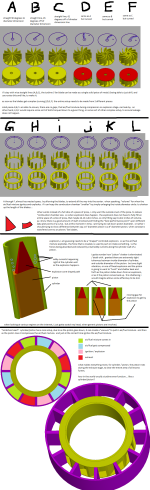
DESCRIPTION OF ATTACH DIAGRAMS!

continuing off of last set of diagrams in last post of mine.....

1. using circles and cutting them up to make "vanes" air enters through the center, the blades/vanes turn. an explosion happens, then blades turn more. and the air coming from center helps push exhaust out, into an outer ring.

2. same as 1, but trying to see how doubling them up would look

3. same as 1, but looking to see if i could change direction. of one of the set of vanes/blades. to act as a better "compressor" to compress air and or air/fuel mixture, before the explosion happens.

4. went from circles to "spirals" to make better use of space.

5. remove extra garbage on the inside and outside of creating the spirals

6. turn the spirals into actual pipes, that are bent into sprials.

7, 8,9 7 and 9 are 2 halves that would have to make up #8. no other way to get around it, for actually machining the pieces out.

10. trying to show "flames" or rather explosions coming out the ends of the 6 spirals.

11. hiding things away, and showing what the blade/vanes would more likely look like with flames / explosions coming out the ends.

12. wanted to see how things would stack up. i really do not like the "straight" notations. and most likely would want to "spiral" the flames/explosions around the entire center drive shaft. to possibly pickup some better explosions efficiency.

13, 14. just trying to see if i could stack more vanes/blades in a more compact form, and if it would pay off or not.

15. thinking about changing spirals from "flat" spiral. to more of a "coil" like a spring. so air coming into the pipes/vanes/blades. it is not having to take a sharp sudden 90 degree change of direction. and in that loose my velocity (think miles per hour) of how fast the air is moving along with "pressure" loss.

16. trying to see if a squirrel cage like fan, might produce a high enough pressure, for everything. and frankly i doubt it is possible. at least in the space i have available. granted i will most likely proven wrong some were down the line. but the issue with squirrel cage fan is, it causes air to change sudden directions multi. times. and it would require extra space, that simply is not there, at least at first glance. and at this moment in time not worth while for me to look into.

==============
a regular turbine engine for say a air plane/jet, helicopter, boat/ship. has something going for vs the squirrel cage fan above. and that is how the "compressor" or i should say "box fans" you might have in your house during summer to cool off.

if you took one box fan in your home, and put say a large 50 gallon trash bag around its sides, and used say ducttape to hole bag in place. so fan would blow air into the trash bag. the bag would inflat. but most likely not stretch or pop.

now if you took TWO box fans same size, and taped both of them together. (front of one fan, to back of other fan, and then into bag). you may see the trash begin to stretch possibly even start to tear a hole.

now if you took say FOUR box fans, (front of 1st fan, to back of 2nd fan, then front of 2nd fan to back of 3rd fan, then front of 3rd to back of 4th fan, the trash bag. as soon as you turn all 4 fans on at the same time. the trash bag would most likely expand and POP! within a fairly short time.

your not creating "extra air flow" you are creating extra pressure by doing this. just like if you blow up a balloon, as balloon gets bigger and bigger it gets harder to blow up the balloon, eventually balloon gets so big it pops.

the extra pressure, when looking at a piston/cylinder. when the piston goes down within the cylinder, it draws in air and/or air/fuel (pending if diesel or gas engine). when the piston comes back up. valves close, and the air and/or air/fuel mixture gets compressed. and some place right before or during or after, as the piston comes all the way up, and right before piston goes down, the air/fuel mixture explodes.

for a turbine engine. there really is no "piston" air needs to be compressed, non stop. there can not be really any sort of pause between non compressed air and compressed air.

alright getting back on the "box fan" example. normally on most house hold box fans. you have low, medium, and high settings. low = lower RPMs, and high = higher RPMs. more RPM's = higher air to flow and a stronger wind that is felt, when dealing with turbine engine, and trying to compress the air. higher RPM's cause a higher compression of the air. (more RPM's = more pressure that gets created and compressing of air happens at a faster rate).

=========
my issue is, how do i control the compression independently of the turbine. (explosions / constant flame). what i am trying to get at. would it be worth while. to say put a transmission between, the compressor (bunch of box fans), and turbine (explosions/constant flame) so that, i can achieve different compression ratios. and also at same time control different amounts of fuel that get pumped into the engine. so that i might be able to achieve a "wider" range of efficiency, both say idle, to 100HP range, 200HP range, 300HP range, 400HP range 600 HP range. ((other words an all in one engine))

or do look at reducing transmission losses. and going with a transmission setup, that might allow better efficiency. say (gear transmission vs HST transmission). and require "engine swaps" to gain those extra few percents of efficiency. when X amount of HP is needed. to gain better fuel use.

things get a tad more complicated....
a turbine engine, needs to stay running at higher RPM's when at idle. and this of course uses more fuel. to obtain that higher RPM. if have fields that are relatively all flat, narrowing down a HP range say between 300 to 350HP might be possible. but if your fields are hilly, and ya going up and down hills. that range maybe more like 250 to 400HP. (250 going down, 400 going up hills). a engine that might be less efficient overall (using HST transmission for compress). might prove more fuel efficient, overall, when dealing with large swings of HP requirements. and when considering multi type of implements. that require less or more HP to pull them through the fields.....

BUT... would it be better setup, for a engine matched to implement type of thing, and going with a gear transmission.

===============
i need to get into a different mind frame. of current age tractors and there implements. right now, it is more of sizing tractor and implement together. but with the SSTT. the frame work, wheels, etc... will be set at a specific overall "width" example 60 foot wide. and that is not going change. SSTT to SSTT. but implements connected would. so i guess. i should look more at easier "engine swapping". and focus more on trying to achieve higher efficiency in selected HP ranges. for the different engines. and for now shooting for the "largest" of the HP engine. to make sure there is room / space for it. and then smaller engines. would be easier to drop in and go.

yikes, talk about a ramble to figure out about going with HST or gear transmission, for dealing with the compressor (box fans). and i am still not really sure what may be best, i guess engines will become like implements for current age tractors. were different manufactures, will offer different engines for the SSTT. vs offering a whole new set of wheels or tracks, and main frame, and cab. they would just be offering "engines". in attempt to gain market share. and perhaps focus on smaller markets, were a different type of engine, or HP range, or like might work better than some other engine. to a point of offering diesel, to gas, to jet engine fuel, to LP / propane gas engines, to pure electrical engine, and set of batteries, other. pending on location in world and what might be cheaper for fuel. or what ever the new "technology is"

===============
alright... turbine engines...

i have a dead space, between the sections that make up the SSTT. that hole "pivoting and rotating" is wasted space. i can not hook up any wheels, or linkages that fold/unfold implements, i can not put any sort of support frame work for a wagon in those areas. thinking about running the "exhaust" pipe in between 2 sections.

the issue is, how do i deal with the heat. and EPA and like regulations.

right now i am looking at using the air, going into the compressor for the turbine engine, as a way to cool down, generator head, hyd pump, air pump for tires. but at the same time. is there a way to recover the heat, that would go out the rear of the turbine....

i am extremely limited on space. and will have wires, to oils, to fuel, running right across the main frame, that the turbine engine will set in. talking 1/2" maybe even directly connected to exhaust port frame work of the turbine engine. i am a little skiddish, of trying to run exhaust that is HOT!, down any sort of length of the SSTT. and at same time, if i raise the air temp going into the turbine. i would be heating up generator head, hyd pump, air pump for tires.

i really can not focus exhaust straight down, (would be dragged through mud and water). i really can not position exhaust to any side, due to interference with an implement, and melting any wires or hoses, so only thing i have left is up. or trying to run some sort of "flat" rectangular shape exhaust piping. across the top of the main frame.

i might be able. to pipe in "cool air" / intake air. from one end of a section down to other end of same section of the SSTT. and maybe. extend both intake (cold air), and outtake air (exhaust) into another section. were i might be able to allow some sort of heat exchange. between the 2 types. if i went this route though. i would most likely be better off. cooling generator head, hyd pump, air pump for tires. with a secondary smaller fan/s. so i am not heating them up. and at same time not having to run as much duct work for the intake air for the turbine engine. and in that possibly achieving a better efficiency from the compressor, and in that better fuel efficiency. granted there would be a slight loss of needing to run another cooling fan. but.... that extra complexity, may make servicing, generator head, hyd pump, air pump for tires. much easier.

--this might actually work out even better. the "screens/filters" for the air intake. most likely going to need brushes, and then some form of pressurized air. to do kinda of an automatic cleaning of air filters and screens to keep them, from plugging up solid. if i could maybe. valve the exhaust, just a little bit. so i could use pressure and air flow from exhaust to clean the screens and filters...
--an idea, but, not sure if it would pan out vary well. more so if different engines get used. i would most likely be better off, with a dedicated small little air pump / blower, like a leaf blower. to make sure everything can work. without need to "re-make/duplicate" everything based on different engines.

============
ok... back to the "box fan, and trash bag" example i been going with.

alright had the idea, and then just got jumbled up...
time to post before loosing everything

boggen elec sstt38.png
 
   / new tractor idea possibly....
  • Thread Starter
#319  
Ryan the torpedo only makes 1 high speed trip then it is over or sinks.
Consider a turbine from heliocopter . only problem high fuel consuption.
And needing a good gear redeuction box.
keep thinking , good reading.
ken

ya, i know high fuel consumption. the entire way of how a Turbine engine runs. and need for constant steady stream of fuel....*cringes* reason of trying to figure out a way, that might allow for a timed "explosions" vs a non stop steady flame.

my comments regarding large amount of "air" that will need to be filtered has me as well. on a typical engine in cars, trucks, current age tractors. the air filter/s only need to handle what is going straight into the cylinders were the pistons are. but with a turbine engine, you are basically forced to filter all the air. including air from the fan that is normally located between radiators / hyd oil coolers, and motor itself in current age stuff.

if i could find something or figure out a way, to reduce amount of air needed, and lower RPMs, and controlled explosions, like a piston/cylinder engine. i might be golden.

=========
gear reduction box. been thinking perhaps not. maybe for hyd pump, or air pump for tires. but generator head, i have to question need for any sort of gear box. if the generator is setup for better, variable RPM's, variable torque setup. trying to break out of the "mind set, of needing a given RPM and/or torque" mind frame. kinda like manual gear transmissions, vs HST transmissions that have unlimited amount of gear ratio ability. but for generators, it does not have to be a transmission / gear box. just running extra sets of wires within generator, and turning them on/off could act as a way to have transmission like ability for generator itself only.
 
   / new tractor idea possibly....
  • Thread Starter
#320  
needing a break of thinking.....

random rough statics....
going up to --> "my home" --> "attachments" (left side at bottom) i can see how many views each pictured has been viewed. going to assume, tractorbynet website, only registers a "view" by someone physically clicking on picture, to see the larger view of a picture.

roughly min view = about 10 to 14 views. and high side of roughly 30 to 50 views. with i would say average (without actually adding up all the numbers, way to many pictures), approx average of 15 views to 20 views for each picture. larger pictures or pictures not easily to understand in thumbnail view size, are opened and viewed more.

if i compare other diagrams i made, and posted else were on TBN, that are not related to this thread. views are near 50 to 200 views. with i would say more near 150 views average.

if i go strictly by what tractorbynet forum displays for statics for thread, it is about 50 views per post. if i take into account, multi posts in the same day, and a person only opening this thread, once to see all those posts of given day, it comes out more near 80 to 140 views per post/s in a given day if there was any post in a given day. range depends on time of day a post is submitted and views obtained.

having some insight of vbulletin software (software TBN uses for forums), and how search engines, (google, yahoo, etc..) search a website for updates. i gotta assume those computer like searches are not registration as physical views, of this thread or any other thread on this forum. and views noted are actual people opening and looking at thread/posts.

most part the above averages / numbers has not really changed, beyond, the initial first few posts of a given start of a thread. were views spike with more views. though i have seen a slight increase of pictures views, since initial starting thread. gaining an extra person viewing pictures (larger version of them), about every 3 to 4 weeks.

i realize this post may be bad form, for this thread, but it is what it is. i realize i should place more focus on better presentation, but to much "extra work" vs spending time trying to figure things out and get it done.
 

Tractor & Equipment Auctions

MASSAGE CHAIR (A58214)
2021 CATERPILLAR D3 LGP CRAWLER DOZER (A60429)
2021 CATERPILLAR...
2023 FORD F-150 XL CREW CAB TRUCK (A59823)
2023 FORD F-150 XL...
2018 Toro Groundsmaster 7200 72in Zero Turn Commercial Mower (A59228)
2018 Toro...
2386 (A60432)
2386 (A60432)
2012 BOBCAT T650 SKID STEER (A60429)
2012 BOBCAT T650...
 
Top