Observation Deck

   / Observation Deck #1  

rdbkr99999

New member
Joined
Aug 6, 2010
Messages
16
Location
San Antonio, TX
Tractor
Kioti DK4510, Bobcat 763
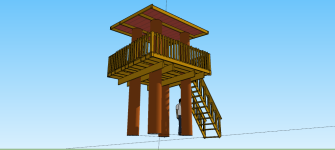
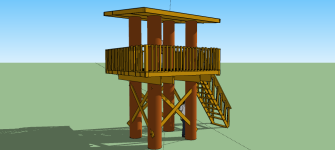
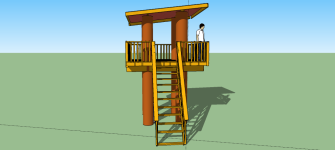
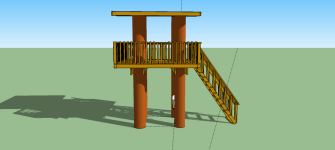
I'm building an observation deck for my motocross track and I wanted to run my ideas past everyone.

Here are the details. The deck will be about 8' off the ground and 12'x12' was going to be outside dimensions. For the legs I am using telephone poles (approx 11" in diameter) that are 20' long. They are buried 3' in the ground.

The holes for the poles are dug, but not set yet. The holes were dug with post hole diggers, so they aren't perfect. I was going to use cement to fill the voids. I know that some people don't like cementing in posts, should I just fill with dirt and compact?

For the beams I was going to use 2x12s sandwiched on each side of the telephone poles and then use 2x6s for the floor joists and decking.

I've attached a couple of images that I drew up in Google SketchUp. What do you think? Do I need to build anything stronger?
 

Attachments

  • tower.png
    tower.png
    33.9 KB · Views: 450
  • tower2.png
    tower2.png
    31.3 KB · Views: 392
  • tower3.png
    tower3.png
    57.4 KB · Views: 518
  • tower4.png
    tower4.png
    67.6 KB · Views: 258
   / Observation Deck #2  
from experience I don't think 3' is near deep enough if the live load is 8" off the ground and there is any considerable dead load above that ...!
just gravel (with some fines) will work best to plum the poles...
 
   / Observation Deck
  • Thread Starter
#3  
That was a concern that I had as well. I was going to see how stable the platform is and add 2x6 x-bracing to the legs if it seems like it moves much.

from experience I don't think 3' is near deep enough if the live load is 8" off the ground and there is any considerable dead load above that ...!
just gravel (with some fines) will work best to plum the poles...
 
   / Observation Deck #4  
I'm building an observation deck for my motocross track and I wanted to run my ideas past everyone.

What do you think? Do I need to build anything stronger?
Yup, I think so. The only thing keeping your design from folding worse than a house of cards is the lateral resistance of the part of the poles in the ground.

Imagine a force pushing sideways on the floor or any of the poles. What opposes it? Nothing but the resistance of the poles in the ground. The mechanical advantage (disadvantage?) given the length of the lever arm (part of the poles out of the ground) versus the little bit in the ground does not inspire confidence.

You need some triangularization (think gussets) to keep the first stiff wind after a soaking rain from folding it up.

Pat

Pat
 
   / Observation Deck
  • Thread Starter
#5  
Does this look better?
 

Attachments

  • tower5.png
    tower5.png
    40.8 KB · Views: 620
   / Observation Deck #6  
this is almost exactly what I did last year. I have included (I hope) a link to the threads. Mine ended up being about 12x12 after all. I braced on 3 sides so we can park the 4-wheelers underneath. My son calls it his garage. I can take more pics if you are interested. The floor is about 8 feet up. The outer two boards are sandwiched 2x12. 2x10 perpendicular and 5/4 x 6 floorboards. I used 2x10 for the outer supports for the slant room and 2x8 perpendicular. At times you will probably pack a bunch of screaming fans up there so I would also worry about overbuilding. That would be a litigation nightmare if it came down during a race.

Best thing I did was to get an impact wrench to put in all those huge bolts.


http://www.tractorbynet.com/forums/projects/139822-utility-pole-fort-begun-pics.html

http://www.tractorbynet.com/forums/projects/139098-utility-pole-tree-fort.html
 
   / Observation Deck #7  
I have a deer stand that is 16' tall (floor is 10' above ground). It is only 4' x 4'. I did not burry it in the ground at all. It sets on cap blocks with each leg braced to 2" x 6"s drove into the ground with 2" x 4"s angled up to the legs. It has been like this for 10 years on top of a hill and has survived multiple stroms. I think proper bracing is the key not setting the post in the ground.
 
   / Observation Deck
  • Thread Starter
#8  
That's awesome! I've been looking for something similar to this for quite a while and wasn't able to find anything. Thanks for sharing!

How is the fort holding up? Is there anything that you would have changed?

I've been debating about whether it would be better for me to have a 2x12 on each side of the poles or to laminate them together with plywood in between.

As far as the load on the deck, that is a concern. Most of the design charts seem to be for a 50 lb/ft2 live load. That should give me a 7200 lb load at 12x12. If I figure 200lbs per person, that is 36 people on the deck. I'm not sure if I could even fit that many people on there. Also, we are a small track and don't get that much traffic... yet.

Thanks for the ideas!
 
   / Observation Deck #9  
...I'm building an observation deck for my motocross track ...


FWIW...if this is a structure that is going to be used by anyone other than friends and family...i.e., the general public...and it is on your property...I suggest getting a licensed engineer to sign off on the "as built" design...and file a copy with your insurance agent...
 
   / Observation Deck #10  
FWIW...if this is a structure that is going to be used by anyone other than friends and family...i.e., the general public...and it is on your property...I suggest getting a licensed engineer to sign off on the "as built" design...and file a copy with your insurance agent...

Excellent advice!
 
   / Observation Deck #11  
Standard embedment for a pole is 10% of the length of the pole + 2 feet. We hang traffic signals across 100+ feet of roadway using this calculation.

Proper backfill and compaction is important also if you don't want to use the cross bracing. Myself, I'd add another 12-18" to the depth of the holes and go for it.

Note: Proper compaction takes one very slow shoveler and two fast tampers.:D Use a good quality crushed rock for backfill.
 
   / Observation Deck #12  
FWIW...if this is a structure that is going to be used by anyone other than friends and family...i.e., the general public...and it is on your property...I suggest getting a licensed engineer to sign off on the "as built" design...and file a copy with your insurance agent...

Dang good advice!

Your telephone poles are plenty stout; but you need to get them deeper in the ground. The cross bracing will stiffen up the structure significantly. I assume you're going to through-bolt the floor joist to the poles. I'd sink the poles deeper, then switch to conventional framing techniques from the deck level on up.
 
   / Observation Deck
  • Thread Starter
#13  
Legal issues are a big problem.

How would I find an engineer to sign off on something like this? Any idea how much it would cost?

If I'm not able to find an engineer, then I'm going to use industry standards for things like beam and joist spacing. I'll also make things stronger where it seems like it will be necessary.

Overall it seems like I should be able to build the deck conventionally. This just leaves the legs and supports as question marks. I can always add additional bracing to the legs later fairly easily.
 
   / Observation Deck #14  
Legal issues are a big problem.

How would I find an engineer to sign off on something like this? Any idea how much it would cost?

Start with the phone book under Engineers - Civil/Structural. The cost will probably be around $80 - $150 per hour depending on whether a junior engineer does the review or a principal of the company. Something this simple will go to a junior engineer. Let's say this costs you 4-hours of review time; that's still cheaper than a lawyer defending you after the fact.
 
   / Observation Deck #15  
For the beams I was going to use 2x12s sandwiched on each side of the telephone poles and then use 2x6s for the floor joists and decking.

Three feet in the ground should be plenty for the poles, but deeper would be better. I don't see how they will come out, and the advantage for more depth depends on how expansive your soil is. In some places, fences come out of the ground that are only three feet deep. Using concrete will help fight this if it's a problem, but how much is a local issue that cannot be determined without knowing what you are dealing with.

The main thing with concrete and posts is to be sure the concrete comes up out of the hole and slopes away from the posts. You never want any standing water around your posts. In ever fence post job that I've done, they all rot out at the base of the post where water settles and remains wet.

Diagnal bracing is always a good idea. Just guessing, 2x6's should be good. Nothing smaller.

When attaching your 2x12, use bolts all the way through all of it. You might have to special order something that long. McMaster-Carr is a good source for fasteners. I would use a minimum of four per post.

With the posts on 8 ft centers, 2x6's are minimal for that span. Even at 12 inch centers, I would want to have 2x8's because you really don't know how many people will be on there. Where they attach to the posts, I would also triple bolt them. Because it's commercial, I would use Simpson brackets to attach the joists and I would block them above the inner 2x12 beam.

Your stairs will be attaching to a cantelevered joists. This will cause some problems down the line with usage and I would add posts to the stairs at the top and middle of stringers. In essense, the stairs will be supported by the posts and just held in location to the floor joists without any real load being applied to the joists. Concrete for your first step to keep the stringers off the ground is also a very good idea and an excellent way to anchor your stairs.

What is code for commercial stairs? 3ft is wide enough for two way traffic and the smallest I would consider.

Your railings need to be kid proof. Besides catastrophic failue where it collapses, your biggest source of danger will be falling off of it. The spindles on your railings need to be close enough together to keep the smallest child from getting through them. I forget what code is off hand, but it's something that you absolutely must know and space your spindles accordingly.

If you design and build it, you are liable for anybody who gets hurt on it. While a friend or family member might not sue you, their insurance company probably will. If you hire an engineer to design it and a contractor to build it, you remove yourself from the lawsuit by some degree. There is no gurantee that you cannot be sued, but by having others do the work, it really just leaves maintenance as your only concern.

Good luck,
Eddie
 
   / Observation Deck
  • Thread Starter
#16  
Three feet in the ground should be plenty for the poles, but deeper would be better. I don't see how they will come out, and the advantage for more depth depends on how expansive your soil is. In some places, fences come out of the ground that are only three feet deep. Using concrete will help fight this if it's a problem, but how much is a local issue that cannot be determined without knowing what you are dealing with.

The soil is solid clay. I live near San Antonio, so frost won't be any issue

The main thing with concrete and posts is to be sure the concrete comes up out of the hole and slopes away from the posts. You never want any standing water around your posts. In ever fence post job that I've done, they all rot out at the base of the post where water settles and remains wet.

Thanks for the reminder, I'll definitely make sure that I do that.

Diagnal bracing is always a good idea. Just guessing, 2x6's should be good. Nothing smaller.

When attaching your 2x12, use bolts all the way through all of it. You might have to special order something that long. McMaster-Carr is a good source for fasteners. I would use a minimum of four per post.

I was planning on 2x6s. For fastener I as going to use galvanized all-thread cut to length. I was thinking 1/2" or 5/8"? Is all-thread graded the same way that bolts are? Any reasons that I shouldn't use all-thread?

With the posts on 8 ft centers, 2x6's are minimal for that span. Even at 12 inch centers, I would want to have 2x8's because you really don't know how many people will be on there. Where they attach to the posts, I would also triple bolt them. Because it's commercial, I would use Simpson brackets to attach the joists and I would block them above the inner 2x12 beam.

Will do. 2x8s on 16" centers seems like what most plans call for. Should that be good or go with 12" centers?

Your stairs will be attaching to a cantelevered joists. This will cause some problems down the line with usage and I would add posts to the stairs at the top and middle of stringers. In essense, the stairs will be supported by the posts and just held in location to the floor joists without any real load being applied to the joists. Concrete for your first step to keep the stringers off the ground is also a very good idea and an excellent way to anchor your stairs.

What is code for commercial stairs? 3ft is wide enough for two way traffic and the smallest I would consider.

Your railings need to be kid proof. Besides catastrophic failue where it collapses, your biggest source of danger will be falling off of it. The spindles on your railings need to be close enough together to keep the smallest child from getting through them. I forget what code is off hand, but it's something that you absolutely must know and space your spindles accordingly.

I definitely need something under the stairs, great catch. Railings have actually been my biggest concern of the entire project. I've been kicking around the idea of using 4x4 posts at each corner all the way to the ground for the railing to attach to. I could do the same thing for supporting the stairs. I think the code for spindles is 4" on center, but I'll double check.

If you design and build it, you are liable for anybody who gets hurt on it. While a friend or family member might not sue you, their insurance company probably will. If you hire an engineer to design it and a contractor to build it, you remove yourself from the lawsuit by some degree. There is no gurantee that you cannot be sued, but by having others do the work, it really just leaves maintenance as your only concern.

I understand. Paying someone to design and build it are out of the question. Everyone that comes onto the property signs liability waivers (mostly useless, but makes me feel better).

I also found a California code that specs 7 ft2 per person for a viewing stand. This will leave me about 20 people max occupancy, which will be placarded and enforced. At an average of 200lbs, that's about 4,000 lbs. load on deck. Most designs are for 50 lb/ft2 live loads, which would support 7,200 lbs at 144 ft2. I have nearly a 100% safety margin, which I think is pretty good.

Also, my family and friends as well as customers will use the deck. I won't have anything that I have any concern about it's safety. If I have to worry about its stability, then I will brace it up better. If it still doesn't feel safe, then it will come down. I want to prevent any legal problems by making it better that it will need to be.
 
   / Observation Deck #17  
I'm not an engineer and kind of doubt that you will notice any real difference from 12 inch centers to 16 inches. For the size of the structure, and that it would only take a few more boards, I might be tempted to spend the extra money for piece of mind over anything else.

For your railing posts, I don't think I would try running a post from the ground, up to the deck and above for a railing. 4x4 posts are terrible about twisting and bowing on you. I think it would probably be better and look a lot nicer if you used 6x6 corner posts that are notched to fit over the deck. Bolt it to the deck on both sides and if you really want some overkill, run diagnal bracing from the deck to the top of the post. Then use a 4x6 for your line posts.

I believe galvanized threaded rod would be plenty strong enough for what you are building. Again, this might be an engineer question and we're just guessing here. With four of them per post, and the bigger the better, I find it pretty hard to believe there would be a problem.

What are you using for decking?

I personally like 2x8's for decks. They are big enough to give it a solid feel, that are small enough to not cup very badly and hold water and they will not shrink on you like 5/4 wood does. I use at least three screws per joist when putting down my decking.

I never use nails on exterior structures. I alwasy use screws and bolts.

What are you going to use for the roof?

Eddie
 
   / Observation Deck
  • Thread Starter
#18  
I may as well use put the joists at 12", very little extra cost.

I think that I will use 6x6s for corners, that will be easier and much better looking. If the edge of the deck needs any more support, then I can always run an angle down to the telephone pole.

I think that a single center post should be good, which will leave me just a 6' span between posts.

I found galvanized bolts for a good price, so I'm just going to use bolts. I will notch the telephone poles so the beams sit flush.

I am deciding between 2x6s or 2x8s for the decking, maybe alternating to give some visual interest to the design.

I plan on using decking screws and galvanized bolts for everything. Nails never hold up on outside structures.

For the roof I was just going to do a simple frame and cheap corrugated tin. I just need something to keep the sun off.

Thanks for all the advise on everything so far! Talking about the design always makes me think about it more. Its nice to be able to work out some problems before the wood starts going up.
 
   / Observation Deck #19  
Your railings need to be kid proof. Besides catastrophic failue where it collapses, your biggest source of danger will be falling off of it. The spindles on your railings need to be close enough together to keep the smallest child from getting through them. I forget what code is off hand, but it's something that you absolutely must know and space your spindles accordingly.

Good luck,
Eddie

Every code I've seen for stair railings say that 'A 4" diameter sphere can not pass through the railings.'

I was planning on 2x6s. For fastener I as going to use galvanized all-thread cut to length. I was thinking 1/2" or 5/8"? Is all-thread graded the same way that bolts are? Any reasons that I shouldn't use all-thread?

All-thread is essentially 'Grade 2' bolt steel.
 
   / Observation Deck #20  
I've been kicking around the idea of using 4x4 posts at each corner all the way to the ground for the railing to attach to.

I believe it would be much better to run your 4 railing corner posts up to the roof for support. That will both help support your railing and your roof too.
 

Tractor & Equipment Auctions

MORBARK WOOD HOG 3400 XT HORIZONTAL GRINDER (A60429)
MORBARK WOOD HOG...
11" QUICK ATTACH EXCAVATOR BUCKET (A60429)
11" QUICK ATTACH...
12ft. Flatbed Truck Body (A59230)
12ft. Flatbed...
2014 Ford F-350 Pickup Truck (A55973)
2014 Ford F-350...
2024 CATERPILLAR 305 CR EXCAVATOR (A60429)
2024 CATERPILLAR...
4 Unused Montreal ST205/75R15 Trailer Tires (A55788)
4 Unused Montreal...
 
Top