Oil Recirculation in closed loop system

   / Oil Recirculation in closed loop system #61  
Took the weekend off from this discussion. And it looks like I'm going to take a few more days off from it. :laughing:
 
   / Oil Recirculation in closed loop system #62  
I'm gonna ask you guys one question....

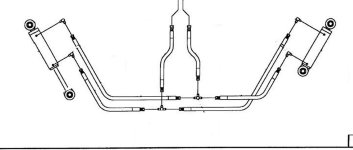
Since the top of one cylinder is draining (flowing out) at the same time the bottom of the other cylinder is filling (flowing in), and the hoses are connected together in the middle with a TEE (which is the single point of fluid movement in that circuit), which way is the fluid flowing, in or out of the teed off hose?

Please explain to me how the fluid can flow in and out of that single hose at the same time.......
 
   / Oil Recirculation in closed loop system #63  
You are filling the base side of one cyl and the rod side of the other side at the same time, using a tee, so the one cyl is pushing and the other cyl is pulling.

When you turn the steering the other way, it does the reverse.

It does not work like the FEL where you are extending both cyl or retracting both cyl at the same.
 
   / Oil Recirculation in closed loop system #64  
You are filling the base side of one cyl and the rod side of the other side at the same time, using a tee, so the one cyl is pushing and the other cyl is pulling.
Yes, but where is the fluid moving to in other side? If you're suggesting that when I turn right, the left side drains, you are mistaken. It doesn't drain. I guarantee it doesn't drain. Crank your steering wheel all the way to the right. Then drain your left circuit and right circuit. You'll get exactly the same amount of oil from both sides. If it was draining to tank, you'd get nothing.

And I agree that it does not work like the FEL circuit. That one drains both tops as you fill both bottoms and vice versa. The steering circuit does not drain anything. It just pressurizes one side or the other and moves fluid between the cylinders, but does not drain them to any significant level. That's why there's discolored oil in your steering cylinders.... it never leaves to any significant amount.
 
   / Oil Recirculation in closed loop system #65  
Have you had your coffee yet?

Where is your thinking.

If you push fluid into one side of a cyl, the fluid on the other side moves out or returns to tank.

You are adding fluid to the base end on one cyl which is pushing, and adding fluid to the rod end on the other cyl which is pulling.

Turn the steering to full lock, and drain the cyl fluid if you want and you will find out that one cyl contains more fluid than the other.

In simplistic terms if, if a cyl is fully retracted and is full of fluid and contains about 20 oz of fluid, you then extend the cyl using 32 oz of fluid.

Where does the 20 oz of rod end fluid go.

It goes back to the valve and then to tank.

In your post #21, I see a return to tank hose.

Your pictorial says it all

Are you testing me or what?

You said in post #64 [ you are mistaken ], smile when you say that.
 
Last edited:
   / Oil Recirculation in closed loop system #66  
My only input on this discussion is to remember that both sides of a double-action hydraulic ram/piston do not hold the same amount of fluid. The shaft/rod displaces fluid on one side of the piston...
 
   / Oil Recirculation in closed loop system #67  
The fluid is still going to fill both cyl and both will have the same stroke.
 
   / Oil Recirculation in closed loop system #68  
Moss, For a given turning direction, the two supply (extend) lines are tied together and ultimately get their fluid from the pump. The two return (retract) lines are tied together and ultimately send their fluid to the tank. You are letting the fact that one cylinder extends and the other retracts confuse you. The cylinders are plumbed in parallel, not in series. Mentally, disconnect the cylinders from the PT but leave the hoses attached. Flip one 180°. If you fixed the lower end of each cylinder, you would in effect have the equivalent of a FEL and you have not done anything to change the hydraulics in this scenario. The only difference is that one cylinder will be moving the rod up because the cylinder is fixed and the other will be moving the cylinder up because the rod is fixed. Switch the hoses on one and it would be identical to a FEL. The hose locations do not change the facts of where the fluid comes from and where it goes. It just changes whether the cylinder retracts or extends for a given valve lever position. Remember that the return on cylinder 1 is not tied to the pressure side of cylinder 2. Which side of the cylinder is pressure depends upon plumbing - it is not a fixed function of the cylinder. (And yes, to further complicate things, which side of the cylinder is the rod side changes how high of a force you can get but not the functionality of the cylinder).

This is sort of like a relay with normally open and normally closed contacts. Both take power from the battery and send it to ground when they function. You could have 2 relays wired in parallel to the same switch with the contacts tied together on the relays. Connections (Tee'd from the switch) to NO on both relays would be like a FEL, both relays would close when the switch was closed. Connections (Tee'd from the switch) to NC on one and NO on the other would be like the steering circuit - one relay would open and the other would close when the switch was closed. Under that scenario, you would not say that the switch is providing voltage (pressure) to relay 2 and that the current (flow) comes from relay 1.

Now that I have totally confused things for you, .......

Ken
 
   / Oil Recirculation in closed loop system #69  
SpringHollow

You said. [ For a given turning direction, the two supply (extend) lines are tied together. ]

Actually, One cyl extends and one cyl retract and are teed together.

If all the steerings circuit for the PT are identical, go back and look at the pictorial on post 21.

It is clearly laid out .
 
Last edited:
   / Oil Recirculation in closed loop system #70  
SpringHollow

You said. [ For a given turning direction, the two supply (extend) lines are tied together. ]

Actually, One cyl extends and one cyl retract and are teed together.

If all the steerings circuit for the PT are identical, go back and look at the pictorial on post 21.

It is clearly laid out .

True, i had the function switched on the one cylinder but the principle is the same.

Ken
 
   / Oil Recirculation in closed loop system #71  
SpringHollow

You said. [ For a given turning direction, the two supply (extend) lines are tied together. ]

Actually, One cyl extends and one cyl retract and are teed together.

If all the steerings circuit for the PT are identical, go back and look at the pictorial on post 21.

It is clearly laid out .

True, i had the function switched on the one cylinder but the principle is the same.

Ken
 
   / Oil Recirculation in closed loop system #72  
If you push fluid into one side of a cyl, the fluid on the other side moves out or returns to tank.

And there's where you are mistaken. When you push the fluid into one side of this steering cylinder the fluid on the other side moves into the other steering cylinder, not the tank.
 
   / Oil Recirculation in closed loop system #73  
If I put fluid into the base end of cyl 1 and put fluid into the rod side of cyl 2, both cyl will operate , with one pushing and the other pulling.

At the same time, fluid is leaving the other side of cyl 1 and other side of cyl 2.

Why don't you go out to your machine and tell me what fluid is where, and how much.

Will you look at the diagram you posted and tell me why there is a return hose from the steering valve to tank.

Tell me again about no fluid on the other side of the piston.

Just ain't gonna happen.

If I turn the steering about half way, will there be fluid on both sides of the piston.

If I am mistaken, so be it, but I don't think so.

By the way, what is the purpose of the tank return line from the steering valve?

Think about it, even the power steering in your car sends the used fluid to tank.

The steering cyl gets new fluid every time you turn the wheel. Does not matter which way you turn.
 
   / Oil Recirculation in closed loop system #74  
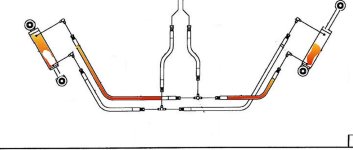
Here's the circuit with the left rod extended and the right rod retracted.
Steering2.jpg
423755d1430958343-oil-recirculation-closed-loop-system-steering2-jpg
 
   / Oil Recirculation in closed loop system #76  
If I push that left rod in, where's the majority of the fluid going to go?
 
   / Oil Recirculation in closed loop system #78  
Yes, the bottom of the cylinder contains more volume than the top of the other cylinder. I know that. The point is, the majority of the fluid just gets shoved back and forth between the two sides of the opposite cylinders. If the oil is getting exchanged completely, why is the oil in the cylinders discolored when the oil in the tank is not? It should be the same color.

And I know I'm sounding pissy, but I'm not trying to. I wish we were all sitting in a room together with some beers, some cylinders, some hoses and some pumps and having a good laugh about this. Typing does not show facial expression or mood. To me, its a discussion, not an argument. :)
 
   / Oil Recirculation in closed loop system #79  
Moss,

If you trace the two vertical lines, one goes to the pump via the valve. The other goes to the tank via the valve.

In a hydraulic cylinder circuit, pressure determines the amount of force you can overcome and flow determines the speed and magnitude of movement. If there is no (or minute) flow to the tank or the return of the pump, then there is no real movement. You are saying no flow to the return of the pump/tank so there can only be minimal movement of the cylinders.

Flip the right cylinder 180° leaving the hose connections as is. If you now mechanically connected those two cylinders as is to your FEL, it would work appropriately except because the rod end are switched, the cylinders would not have equal maximum force.

In this case, I am afraid that everything I know about physics as applied to hydraulics says you are not thinking about this correctly. Doesn't mean that I am not missing something because I am quite capable of having a brain fart but in this instance I do not think I am. If I thought there was an even 1% chance I was wrong on this, I would ask in the hydraulics forum.

Ken
 
   / Oil Recirculation in closed loop system #80  
Or is the schematic this way, which would make more sense?
Steering8.jpg
423762d1430959785-oil-recirculation-closed-loop-system-steering8-jpg
 

Tractor & Equipment Auctions

Nissan Forklift (A55973)
Nissan Forklift...
FORD 545D TRACTOR (A60430)
FORD 545D TRACTOR...
Deere 50D (A60462)
Deere 50D (A60462)
ELECTRIC GOLF CART (A58214)
ELECTRIC GOLF CART...
2018 FREIGHTLINER CASCADIA TANDEM AXLE SLEEPER (A59905)
2018 FREIGHTLINER...
2019 CATERPILLAR 239D3 SKID STEER (A60429)
2019 CATERPILLAR...
 
Top