OPERATIONAL TIPS FOR NEWBIES

   / OPERATIONAL TIPS FOR NEWBIES #61  
Tractor Rollovers

85% are SIDE rollovers

15% are REAR rollovers

Less than 1% are FRONT rollovers


Less than 1% FRONT rollovers is probabally 99.9999% of people pull with the rear so that number is a bit skewed. And of the 15% rear 14.9999999% probabally weren't pulling from the drawbar.

Bottom line best adcive for the new guys, call your tractor manufacture and explain to them in detail what you will be pulling (ie a tree top, stuck truck, etc) and ask them if you should pull from the drawbar or loop a chain around the front axle:rolleyes:
 
   / OPERATIONAL TIPS FOR NEWBIES #62  
I like to lay a blanket or piece of old carpet over a chain being used to pull.. that or a section of old fire hose...

soundguy

46. with all this chatter about towing and where to tow/pull from I thought I should mention what I use to tow/pull/drag with. I use grade 40 to grade 70 3/8" chain, mw small machine only makes 30 hp so that is pleanty big for what I do. I would also like to mention that you should always be prepared for your chain or strap to break and have the correct safety measures in place to prevent sudden brain exposure.

GUYS DONT MAKE THIS INTO A STRAPS -VS- CHAINS DEAL!!!!

someone break out their owners manual and read it, mine clearly says pull from the draw bar good enough for me and my little b3030
 
   / OPERATIONAL TIPS FOR NEWBIES #63  
47. use axle breaks if you get stuck.

This pertains mainly to older 2wd tractors that dont have a diff lock, such as the ever popular n-series of fords. If you get stuck, only one wheel spins due to the open differential, gently start using the break on the wheel that is spinning and it will force the one with the traction to spin and might get you unstuck.
 
   / OPERATIONAL TIPS FOR NEWBIES #64  
It will force both of them to spin.. and might get you out.

soundguy
 
   / OPERATIONAL TIPS FOR NEWBIES #65  
I can't seem to be able to get the back blade to make a smooth finish without digging in too deep or not enough

Have you tried adjusting the top link ? tip forward to dig in (pulling) tip back to smooth...the opposite for pushing backwards...
 
   / OPERATIONAL TIPS FOR NEWBIES
  • Thread Starter
#66  
I understand all the safety tips offerred here and all over TBN, but my problem is I can't seem to be able to get the back blade to make a smooth finish without digging in too deep or not enough. same holds true with using the FEL. Am I missing something or is just practice, practice, practice. Somewaht frustrated dude here. BTW this is an awesome site. just wish I could learn something :D:D:D

I do not have much experience with a back blade but some suggest using gage wheels added to the blade or if your 3pt has float use it, using shallow cuts and slow ground speed should help achieve what you need.
I use the FEL to do this kind of work and have found that a foreward and back motion will give me very good grading results. the lip of the loader in a reverse motion will give a fine smooth grade, the back more of a rough finish, tilt the bucket up and go foreward for the first pass, this helps break up the large chunks.
Just about every loader is built with slightly different angles and what works for me may not work for anyone else but with my machine and the materials i work with this is very effective. Working with gravel or clean soil will help you learn what works for you the quickest. This is hardly a one pass thing, multiple passes, laying your work out as you go, knocking down the hills, and fillin the valleys.
good luck to you.

again this is IMO, what works for me may not work for others and there may be a better way
 
   / OPERATIONAL TIPS FOR NEWBIES #67  
Here's one that took me awhile to learn: If you have both mid- and rear PTO's, you can free up the rear one so that it can be easily turned with your fingers by shifting the control lever to the front PTO setting. This makes hooking up rear PTO-driven equipment a MILLION times easier.

May not work that way on all tractors, but that's how it works on mine.
 
   / OPERATIONAL TIPS FOR NEWBIES #68  
I' sure an exception to this can be found if you look hard enough.. however.. I'm refering to the 'average' farm or utility use situation...
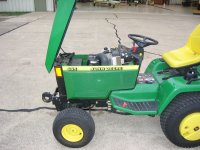
I'll try to provide an exception. Although it's only a GT, in it's former life, my JD 445 was used to tow a helicopter in/out of a hanger using a front mounted pintle hook.
 

Attachments

  • IMG_0377.jpg
    IMG_0377.jpg
    923.6 KB · Views: 142
   / OPERATIONAL TIPS FOR NEWBIES #69  
48. If you need to leave your tractor seat for a minute or two while bushhogging, Disengage the PTO, put your tractor in neutral and apply the parking brake before leaving the tractor seat.
 
   / OPERATIONAL TIPS FOR NEWBIES #70  
I'll try to provide an exception. Although it's only a GT, in it's former life, my JD 445 was used to tow a helicopter in/out of a hanger using a front mounted pintle hook.

Apples to popcorn comparison. That GT doesn't have enough guts to pull itself apart if need be.. whether due to traction or hp... the average farm tractor, with good traction tires and weight can do some severe damage to the front bolster / axle / kingpin pulling like that.. especially since many use the block as the frame.. not a unibody sheetmetal frame with an aluminum engine setting in a cradle like that lawnmower...

soundguy
 
   / OPERATIONAL TIPS FOR NEWBIES #71  
Less than 1% FRONT rollovers is probabally 99.9999% of people pull with the rear so that number is a bit skewed. And of the 15% rear 14.9999999% probabally weren't pulling from the drawbar.

Bottom line best adcive for the new guys, call your tractor manufacture and explain to them in detail what you will be pulling (ie a tree top, stuck truck, etc) and ask them if you should pull from the drawbar or loop a chain around the front axle:rolleyes:


The study I read didn't have any detail info on front or rear rollovers and where the attachment point was in each case. It would be good to know that (or any statistics in that regard) but I haven't been able to find any information on that. I think it would surprise a LOT of people on this forum.

It's not just the horizontal pulling force to be concerned about. You also have to consider the vertical (downward) force on the drawbar. For instance, if you are towing a big, heavy trailer (with round hay bales for instance) and they shift and roll forward, the sheer increase of the weight of the trailer tongue pressing down on the drawbar can raise the front of the tractor up (assuming the drawbar doesn't bend down with the increased weight), or at least make the front end a lot lighter.

The '81 JD 750 I had years ago came with a drawbar that was 2" wide by 1.5" thick and maybe two feet long. Well, one end was bent such that it was about 2 inches off of centerline of the bar. I would like to know the story behind that one!
 
   / OPERATIONAL TIPS FOR NEWBIES #72  
The '81 JD 750 I had years ago came with a drawbar that was 2" wide by 1.5" thick and maybe two feet long. Well, one end was bent such that it was about 2 inches off of centerline of the bar. I would like to know the story behind that one!


Did the tractor look like it had flipped backwards. Probabally not. Just goes to show you just how much force is required to flip a tractor when pulling from a drawbar if it can bend 2" x 1.5" steel and still not flip. That much force isn't something i want do do with the front axle/guard.
 
   / OPERATIONAL TIPS FOR NEWBIES #73  
Did the tractor look like it had flipped backwards. Probabally not. Just goes to show you just how much force is required to flip a tractor when pulling from a drawbar if it can bend 2" x 1.5" steel and still not flip. That much force isn't something i want do do with the front axle/guard.

Nope, it didn't look like it had ever been flipped. But, at the same time we don't know if it scared the bejesus out of whomever was sitting on it either (when it got bent)! :)
 
   / OPERATIONAL TIPS FOR NEWBIES #74  
If your tractor has 4wd then you should USE it when descending any steep slope that is not dry bare pavement. Even with HST it feels funny to let up on the GO pedal then watch one wheel turn forward while the other turns backwards.
There is a vast difference between towing some easily moved object like a stalled vehicle and pulling on one that is stuck
If you have to "jerk" on a chain, then think of a better way, like a nylon strap/rope.
When you are pulling from your FEL and you think that lifting the bucket a bit will give more traction, or get the stuck item out of the mud/snow/ditch easier, be ready to stomp the clutch or get off the go pedal in a hurry. Its harder to balance on the two front wheels than it is the two rears....even if you have HST....
It is almost always easier to pull out a stuck vehicle by hooking to the FRONT of it than the rear, especially if it is in the ditch.
You don't warm up a cold tractor just to lubricate the engine, but also the hydraulic oil. Start the tractor and let it idle while you clear the snow from the seat, get your gear together, etc. Then drive slowly til things warm up.
 
   / OPERATIONAL TIPS FOR NEWBIES #75  
The study I read didn't have any detail info on front or rear rollovers and where the attachment point was in each case. It would be good to know that (or any statistics in that regard) but I haven't been able to find any information on that. I think it would surprise a LOT of people on this forum.

That's why statistics with no contextual details are virtually useless.

It's not just the horizontal pulling force to be concerned about. You also have to consider the vertical (downward) force on the drawbar. For instance, if you are towing a big, heavy trailer (with round hay bales for instance) and they shift and roll forward, the sheer increase of the weight of the trailer tongue pressing down on the drawbar can raise the front of the tractor up (assuming the drawbar doesn't bend down with the increased weight), or at least make the front end a lot lighter.

2 points on this one..

1, this is why they make 4-wheeled hay wagons.

2, at whtever point the drawbar hits the ground.. that's about it.. no more rear roll.. with the height of the drawbar on most utility and smaller tractors being very slose to the ground.. you don't get much altitude on the fronts..

The '81 JD 750 I had years ago came with a drawbar that was 2" wide by 1.5" thick and maybe two feet long. Well, one end was bent such that it was about 2 inches off of centerline of the bar. I would like to know the story behind that one!

[/QUOTE]

Refer to #1 above... tractors have an intended toungue weight just like auto's do...

soundguy
 
   / OPERATIONAL TIPS FOR NEWBIES
  • Thread Starter
#76  
>>> 49. maintenace is the key to the life of your tractor, perform all checks, lubricate before ya head out, change oil and filters as recomended if not sooner.

>>>> 50. dont forget about the lttle lady in the house waiting for your return, and the ones that depend on you!!!
 
   / OPERATIONAL TIPS FOR NEWBIES #77  
51. Use bucket curl to get unstuck.

It is real hard to get a tractor with loader truly stuck. All to many times I see and hear of guys that are new to equipment get stuck and don't know how to use the loader.

Dump the bucket all the way, lower it into the ground, and curl back as you engage reverse. This will push you back a foot or two. If that isn't enough to get you out, hold the brakes so you don't loose what you've gained, and do it again.
 
   / OPERATIONAL TIPS FOR NEWBIES #78  
Hi,as a newbie,I appeciate the suggestions.Closed on my little 4.25 acre hideaway today.Been saving for years to do this.I had to buy a little (by you guy's standards) garden tractor to mow 1 acre and pull a cart around.The 95? CB 1440 that I purchased has a few bugs to work out but seems to be large enough for what I'll be doing.After reading through this thread I figured out what COG was.Even understood FEL,but ROPS has me baffled.I'm sure I'll have more questions as I get more into this but again I want to say Thanks for the suggestions from this newbie.
 
   / OPERATIONAL TIPS FOR NEWBIES #79  
Hi,as a newbie,I appeciate the suggestions.Closed on my little 4.25 acre hideaway today.Been saving for years to do this.I had to buy a little (by you guy's standards) garden tractor to mow 1 acre and pull a cart around.The 95? CB 1440 that I purchased has a few bugs to work out but seems to be large enough for what I'll be doing.After reading through this thread I figured out what COG was.Even understood FEL,but ROPS has me baffled.I'm sure I'll have more questions as I get more into this but again I want to say Thanks for the suggestions from this newbie.


Welcome Frosty2! Congrats on your new property.

Sometimes on these posts there's alot of debating back n forth. Don't let that discourage ya though. People are just passionate about their opinions at times.

Use the "Search" section to find anything specific. There maybe some older posts, but nonetheless the info is great. Hope you got your reading glasses on!
 
   / OPERATIONAL TIPS FOR NEWBIES #80  
Frosty2,

Forgot to tell ya, ROPS is Roll Over Protective Structure (roll bar). All new tractors have it. Alot of the old ones don't.
 

Tractor & Equipment Auctions

2012 DOOSAN G25 GENERATOR (A55745)
2012 DOOSAN G25...
2015 UTILITY VS2RA 53FT REEFER TRAILER (A59905)
2015 UTILITY VS2RA...
DEUTZ MARATHON 60KW GENERATOR (A58214)
DEUTZ MARATHON...
2018 John Deere 1653 (A56438)
2018 John Deere...
(APPROX. 20) 4' X 8' X 3/8" SHEETING (A52706)
(APPROX. 20) 4' X...
Wagon Wheel Rocking Chairs (A55758)
Wagon Wheel...
 
Top