PA160 STH unboxing!

   / PA160 STH unboxing! #21  
Dan, you have an Everlast 140 and you can't get it to run 6011? Which rod are you using? What size. Got a lot of guys running 6011.
 
   / PA160 STH unboxing! #22  
Mark @ Everlast said:
Dan, you have an Everlast 140 and you can't get it to run 6011? Which rod are you using? What size. Got a lot of guys running 6011.

iv'e tried 1/8 linclon, and 3/32 forney. I would like to try others, but haven't found any aroun here.

I can get it to weld, but requires almost zero arc length.
 
   / PA160 STH unboxing! #23  
Forney is really not even a player in the market and is a relatively cheap hardware store rod. I wouldn't even consider it myself. But if you are using it on 110V, the Lincoln fleetweld will work fine, but you will have to use 3/32. Are you using electrode positive? Yes, you have to hold a short arc, but that's the way inverters are designed. If you are used to a transformer, you have to retrain yourself. With the 6011, you don't weave, but step and pause which is often referred to as "whipping".

A few years ago, I ran across a good Miller article that goes into a lot of technical explanation of inverters versus transformers, but it also explains why some people have problems welding some rods with an inverter while others don't. Here it is. Good read, if nothing else.
http://www.millerwelds.com/resources/articles/index.php?page=article108.html
 
   / PA160 STH unboxing! #24  
Mark @ Everlast said:
Forney is really not even a player in the market and is a relatively cheap hardware store rod. I wouldn't even consider it myself. But if you are using it on 110V, the Lincoln fleetweld will work fine, but you will have to use 3/32. Are you using electrode positive? Yes, you have to hold a short arc, but that's the way inverters are designed. If you are used to a transformer, you have to retrain yourself. With the 6011, you don't weave, but step and pause which is often referred to as "whipping".
Yes EP, 110 volt or 220 volt. I've never run 6011 on a transformer machine. Both brands run great on my Miller dynasty 200 DX, also an inveter. Other electrodes (6013, 7018) run fine.
The foward and back whipping motion makes the arc go out.
Its no big deal, it just can't maintain the current at the volts that other welders can. An since it can't hold a long arc, I can't do a standard whip and pause pattern. Still a great litle welder.
 
   / PA160 STH unboxing! #25  
Mark I think you'll agree, every machine has it quirks, no matter the type or brand. A guy just has to roll with it.
I remember when the Lincoln LN-22s came out, about all we had on the job sites for welders were the Miller Big 40 diesel drives. These welders put out more OCV than the LN-22s could take, so there was no wire feed until you struck an arc. Didn't take us long to figure out not to pull the T-handle throttle out all the way on the welder, everything was fine then.
 
   / PA160 STH unboxing!
  • Thread Starter
#26  
I got some stick time today with the unit. I won't post any bead photos because there's no question that the PA160-STH is a far better welder than I am a weldor, so the only thing a bead photo would show is my skill, not the 160's quality. I ran some 3/32" E7018 and 3/32" and 1/8" 6011. I have never been very good at running 6011, so the fact that I had some trouble with it doesn't mean much. I did have a few 6011 beads that were probably some of the best I've ever run, and the average quality of the beads was better than my usual.

I did have some trouble keeping the arc lit with 6011. The unit seems very sensitive to arc gap, especially up until the electrode and the work piece heats up. I only have experience with a transformer-based welder, and have a pretty low skill level, so I'd attribute my trouble more to a difference in character between my old welder and this one than anything else. Once the arc was lit, I had zero sticking; the arc force seemed to be doing its job quite well. However, I did have some sticking when trying to strike; I guess the hot start isn't a panacea.
 
   / PA160 STH unboxing! #27  
Yep. You are right. Short hoods weld differently than long hood red faces, and well anything with an octagon barrel won't weld any thing like the other two, but still plenty of them in use.

As far as the 125 amp stick thing. The spec for the US is indeed 160 amp on stick. We contacted the factory to verify to find out where the confusion was. We received some units that were built with a build card for one of our other distributors located in another country on this side of the pond. The main difference is the addition of a resistor on the top board. Everything seems to be the same. For the US, the resistor is left out. That's what happened. Contacted Joshua and almost quicker than you can say "vasectomy" we snipped it out.(well maybe a little longer than that) Now it's up to full power. It's sort of isolated in its position and easy to identify. If anyone else has received one with only 125 amps output, let me know. It's an easy walk through.
 
   / PA160 STH unboxing! #28  
   / PA160 STH unboxing! #29  
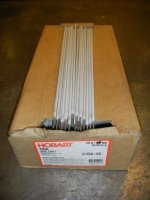
Joshua if you can find some Hobart 335A 6011, that stuff is child's play to run. ;)
 

Attachments

  • 335A.JPG
    335A.JPG
    192.3 KB · Views: 176
   / PA160 STH unboxing! #30  
Forney is really not even a player in the market and is a relatively cheap hardware store rod. I wouldn't even consider it myself.
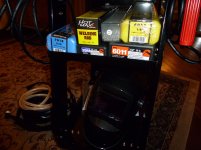
Wish you had written that about a week ago. I think the box on the left is Forney. Had decent ratings in Amazon, made in USA,
and reasonably priced, but within 20% of Hobart. Oh well, live and learn. And the HotMax rods, which seems to be the same company that makes
this very same welding cart, well, their container was cardboard, and already ripping. They had decent ratings also. I got those for practice, as I did the ones I got from HF.

What this might be telling me is that the rod is unlikely to be the determining factor in how well done the weld turns out.
 

Attachments

  • P1010967 (3).jpg
    P1010967 (3).jpg
    768.1 KB · Views: 195
   / PA160 STH unboxing! #31  
It's not wasted...but, well, you got a lot of practice material. I'll stick with the Lincolns. Hobarts aren't bad, and I do use the U.S. Forge when the welding store is closed and the hardware is open.
 
   / PA160 STH unboxing!
  • Thread Starter
#32  
Contacted Joshua and almost quicker than you can say "vasectomy" we snipped it out.(well maybe a little longer than that) Now it's up to full power.

Yup. And thanks to Mark for calling me up, on a Saturday no less, to hold my hand through the entire operation. The issue was first reported on Friday evening and Mark had researched it and resolved it by Saturday afternoon. I call that exceptional customer service.

Sent from my DROID RAZR HD using TractorByNet
 
   / PA160 STH unboxing! #33  
Looks like I'm late for the party. Congrats on the Everlast 160sth purchase. I've been going back and forth trying to decide between the Everlast 140st and the Everlast 160sth since December! I *thought* I had decided on the 140st until I read this thread. LOL :laughing:
 
   / PA160 STH unboxing!
  • Thread Starter
#34  
Looks like I'm late for the party. Congrats on the Everlast 160sth purchase. I've been going back and forth trying to decide between the Everlast 140st and the Everlast 160sth since December! I *thought* I had decided on the 140st until I read this thread. LOL :laughing:

I can sympathize, having been in your exact shoes for about a week before I made my decision. The 140ST is substantially cheaper than the 160STH. One thing to think about is that the 20 extra amps of the 160 will make a difference with some 1/8" 70XX rods, many of which are nominally rated to run at 110-165 amps. The Blackstone 7018 that I have says 90-155 on the box, so there's some variance between brands, and of course you don't always have to run the rod at the top end of the range, but I don't think there's any question that the 140 will fall short on some 70XX rods, in some circumstances, whereas the 160 will be able to run any 1/8" rod, in most circumstances.

Of course, what makes the 160STH stand out is the pedal and the HF start, and only you can decide how valuable that is to you. As Shield Arc pointed out to me when I was shopping, X-ray quality welds are made every day with lift-start. Welding in the field, many weldors who have access to a pedal forego it because how are you going to run a pedal laying on your back up underneath a pipe, or hanging off a catwalk, or what have you. At the same time, no one who I talked to said that a pedal was a bad thing, and most/all said that, at the bench, they considered the pedal to be a must. When you think about what it would cost you to get into an Everlast TIG machine, the PA160STH starts to look like a real bargain. It lacks many of the features of the dedicated TIG machines, like pulse, variable balance, and so forth, but I think that's kind of icing on the TIG cake. A pedal, a gas solenoid, and HF start are the bread and butter, IMO.

At roughly the same price as the 160STH, you can get a PA300. The PA300 has far more output than I ever anticipate needing. It can run up to 1/4" rods. Woo hoo! That's nice, but it's kind of pointless for me, because I seldom weld material thicker than 3/8". What makes the PA300 stand out is the adjustable arc force and hot start. Given that it's roughly the same price as the 160STH, you can ask yourself which you'd rather have: HF/pedal TIG or adjustable arc force/hot start (and an extra 140 amps output sure, but like I said, that's kind of pointless for me, and maybe it is for you too). I wasn't sure whether those features really ought to be worth very much. Surely the automatic arc force/hot start on the lower units is fine, right? But others were adamant that those features were more than worth their price compared to, say, the PA200, which doesn't have them. So if I was going to think of myself as a "pure stick" guy, I might choose the 300 over the 160STH. And if I wanted to, I could always go scratch-start TIG.

Of all these units, the PA200 seems a bit like the red-headed stepchild. It's more powerful than the 140 and has a dedicated 6010 port, but it doesn't have the fancy TIG features of the 160STH, nor the adjustability of the PA300. Sure, it's cheaper than the PA300 or the 160STH, but not by that much (IMO, of course), and it seems like somebody who was considering the PA200 might just as well drop down to the PA140ST and save a few bucks or scrimp a little more and step up to the PA160STH or the PA300. The fact that the PA140ST has lift start and the PA200 doesn't gives the PA140ST a little extra in its favor, to make up its lack of output compared to the PA200.

Even further complicating the issue is the fact that Mark tells me they're coming out with a PA200ST and a PA300ST soon. If I understand correctly, these units will be comparable to the current 200 and 300, but they will have lift start. Now that is pretty sweet. The ability to have the extra output/duty cycle of the 200 without having to give up lift-start? Nice. I don't know what your purchase timeframe is, or when these units are expected to be available, but they may be worth waiting for.
 
   / PA160 STH unboxing!
  • Thread Starter
#35  
With an inverter, when the instinct tells you to pull out, you push in...that's for guys who have been on transformers.

Sounds like what you're saying is, instead of pulling out to increase volts/heat (on a transformer), push in to decrease volts and activate the arc force (increase amps). The end effect is that you put more heat (watts) into the work piece, you just accomplish it a different way.
 
   / PA160 STH unboxing! #36  
The PA 200 is anything but the red headed step child. It does what it's supposed to do. It started it all as the first stick welder we offered. We've sold a lot of them to true professionals. No we aren't coming out with a 300 st, I think you may have misunderstood...The 200st will come out, but it will only be 35% duty cycle. The 200 is a pure and hard core stick welder. It is the best balanced stick welder out of the three smallest!

Yes, Joshua, that's what I am saying about the inverters.
 
   / PA160 STH unboxing!
  • Thread Starter
#37  
The PA 200 is anything but the red headed step child. It does what it's supposed to do.

Sorry, Mark. I didn't mean to put the 200 down in any way. For me at least, it seemed like if I was going to get the 200, there was no reason not to just step up to the 300.
 
   / PA160 STH unboxing! #38  
No problem Joshua. There are several reasons though. One is because it is a good bit better priced. Another is because it is more compact. And yet another is that the unit features automatic management of the arc where the PA 300 requires knowledge and skill of arc force and hot start to optimize setting at each amp level.
 
   / PA160 STH unboxing! #39  
Forney is really not even a player in the market and is a relatively cheap hardware store rod. I wouldn't even consider it myself.
Wish you had written that about a week ago. I think the box on the left is Forney. Had decent ratings in Amazon, made in USA,
and reasonably priced, but within 20% of Hobart. Oh well, live and learn. And the HotMax rods, which seems to be the same company that makes
this very same welding cart, well, their container was cardboard, and already ripping. They had decent ratings also. I got those for practice, as I did the ones I got from HF.

What this might be telling me is that the rod is unlikely to be the determining factor in how well done the weld turns out.


Do not be too disappointed as you may or may not have gotten some quality welding rods. Forney still exists, but they closed their last US based welding rod manufacturing facility 3-4 years ago. Today they still sell rods that they buy from other venders and simply slap their sticker on them.

So What you might have gotten is
a) Good Quality: If an original Forney Cardboard box it is from their factory from 3-4 years ago and these are fine rods.
b) Rebadged Hobart's as Forney: The only place that sells Forney near me has been getting Hobart's in lately with a Forney sticker placed over the Hobart Label. These are easy to tell by the unique storage container that Hobart uses. (Hobart is usually considered a fine rod for the home user).
c) Forney sticker placed over an unknown vendor: I am sure other vendors are sourced too by Forney so quality will be a crapshoot based on the vendor sourced.

Most HF rods are terrible and their flux core mig wire by far the worst I have ever used - unless you like replacing your plugged up liner frequently. Anything you pick is likely to be better than HF.

Regardless, My experience is that once you find a brand that you like that runs well on the machine that you own, supplied with electricity from your electrical source (some homes have good electrical service and some have marginal service), and on a setting that is actually available on your machine (real important on a tapped machine) then that brand rod is a keeper for you. Seldom do I always prefer the same brand universally for every rod type either. For example, I prefer Hobart 6011 335A (1/8" diameter only) by far over every other 6011 that I have ever used, but that does not mean that I prefer Hobart for other rod types.
 
   / PA160 STH unboxing! #40  
Some people have said that they have had good luck with Harbor Freight rods, but the ones I have tried have been junk. Chinese Sparklers:). I have used a lot of US Forge with good luck, and of course Lincoln.
 

Marketplace Items

PJ  32 FLATBED GOOSENECK (A58214)
PJ 32 FLATBED...
2012 Ram 2500 4x4 Crew Cab Pickup Truck (A59230)
2012 Ram 2500 4x4...
2014 FREIGHTLINER CASCADIA TANDEM AXLE SLEEPER (A59905)
2014 FREIGHTLINER...
2012 Dodge Avenger Sedan (A59231)
2012 Dodge Avenger...
VR59 Hydraulic Vibratory Roller Skid Steer Attachment (A59228)
VR59 Hydraulic...
2016 Ford Taurus AWD Sedan (A59231)
2016 Ford Taurus...
 
Top