Perma-Columns

   / Perma-Columns #1  

jcook5003

Bronze Member
Joined
Jun 25, 2010
Messages
70
Hey Guys-

I was wondering those of you who have had pole barns built with or have used Perma-Columns in D.I.Y. pole barn build could share how you added shear bracing for the Perma-Column to post connection point.

From my light engineering (no degree) background, obviously a pole barn gets most of it's shear strength from the poles being buried 4' in the ground. When using a Perma-Column you've effectively moved the "moment loading" (I think that's the right term) point to ground level. The pole now acts more like a stud wall where it needs some kind of shear bracing. On a stud wall this is accomplished through the sheathing. Since it is common to add purlins with metal siding with a couple nails between the posts with metal siding screwed to the purlin, you don't get the same shear that you would with common stud framing. As a side note, the wind loading is 90MPH in my building department code book, pole barns dont get inspections though, but I do want to do it right.

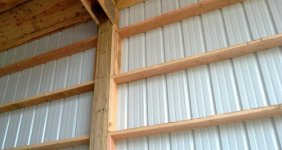
My question is, how do you add enough bracing to make the structure sound again? Obviously not looking for an engineering report but some actual builds of things that work. I had though about using "commercial" or "ladder" style purlins in between my posts with the metal screwed through the flats into them. Then the metal acts much more like typical sheathing. Added side benefit of easy insulation and interior wall finishing.
girts-commercial-2.jpg

Thoughts? Opinions?
 
   / Perma-Columns #2  
I think with the perma-columns, the bolted connection at the bottom is to transfer that moment to the ground you are talking about. If you just set posts on sonotubes, then yes, it acts more like a hinge. But I think that fancy bracket is supposed to help transfer moment, too.
 
   / Perma-Columns #3  
Some eleven years ago I hauled pole barn materials for a firm that had a "sister" company Perma-Column franchise. First off, I suggest reviewing the Perma-Column website then calling for more info. But, as I recall, the engineering data suggested that the resistance to windload was as good as or better than a pole in the ground. At that time I think the quoted cost would have been 25% more than traditional.

This particular company had several crews in the field so I was privy to a number of installations. The horizontal wall purlins were the same as standard. No special cross bracing as I recall.

The crews ended up to be the only ones negatively affected by them. They ended up setting them by hand with the posts attached due to the expense of crane setting them even with our own crane. In order to have a smooth workload, the P-C plant crew would air nail 2x stock together and bolt them to the column. Heavy is the word.

The columns themselves were well made under controlled conditions. I personally was impressed by them though they did take some "finessing" to haul, wooden columns attached or not.
 
   / Perma-Columns #4  
Couple data points I can relay to you.

I was required to add diagonal bracing between all poles in my barn to satisfy the building inspector. Those poles were in the ground 3-4' but he wanted diagonals for more shear resistance.

The other thing I had to do was get an engineer to sign-off on the footings. One thing he determined is that the poles should be backfilled with concrete (dry mix). If backfilled with the spoils from digging the hole, there would not have been sufficient wind resistance -- a wind load could have pushed the walls over because the backfill soil would not be able to resist the moment.
 
   / Perma-Columns #5  
I've read in "Frame building", a post/frame (pole building) trade magazine that up-lift was the greatest concern in high wind areas. I think that the perma column is tapered and provides better uplift resistance than a normal post. I too would suggest that contact them with your concerns.
But there is always diagonal bracing, enough of that will cure anything:laughing:
 
   / Perma-Columns #6  
I had always thought uplift was the biggest concern too, but it turns out it was walls blowing over sideways because of posts moving in the soil (in my case with our local clay soil). I suppose once that is eliminated by backfilling with concrete mix, uplift would be next.
 
   / Perma-Columns #7  
Closed cell spray foam is a great way to add rigidity to a buildings walls... And uplift/peel resistance to a roof.
 
   / Perma-Columns #8  
The majority of shear resistance in a typical pole building comes from the metal roof and siding. You can experience this first hand as you apply the metal and screw it down. Before any metal is added the entire structure is pretty flimsy and can move around just by a man walking on the trusses and roof purlins. As more and more metal is added, it becomes very rigid. Take a look at pole barn plans available online to get an idea of wind ratings. Diagonal bracing is a good idea to insure squareness during construction, but it does not contribute as much to shear resistance as it might seem - until the metal ties everything together.

My "pole" building does not have any portion of the poles in the ground, they are all attached to the concrete slab at floor level. They are made of three 2 x 6's nailed together to support the trusses. Wall girts are face nailed to the outside of the posts.

The moment loading of the posts has little to do with the shear resistance of the entire building once it's all constructed, the wall covering provides the majority of it. As described above the uplift resistance is more fulfilled by the post attachment method.
 
Last edited:
   / Perma-Columns #9  
Ivan, the problem there is that metal siding has limited shear resistance only where it is under tension, and only until the corrugations give. Compared to something like OSB wall sheathing, the shear resistance is nowhere near as uniform. Anywhere the siding is in compression it will want to buckle. And tension load won't ever hit the metal's tensile strength limits before the corrugations give. So with a metal structure, what shear resistance you have is somewhat "accordion" in nature and you will see permanent deformation of the metal if it has to resist a heavy wind load.

The engineer who did the wind load calculations for my barn showed me a few of the plots that come out of their software, which graphically exaggerates the movement of the structure so you can easily visualize how it wants to fail. On a big long wall, the middle bows in, and shear resistance of the end walls won't help a lot there because they are so far away. If the only cross bracing to the opposite wall is the roof trusses, they don't help any either, as they are weak in that direction. But having poles sunk into the ground really helps in the middle of the wall.
 
   / Perma-Columns #10  
The majority of shear resistance in a typical pole building comes from the metal roof and siding. You can experience this first hand as you apply the metal and screw it down. Before any metal is added the entire structure is pretty flimsy and can move around just by a man walking on the trusses and roof purlins. As more and more metal is added, it becomes very rigid. Take a look at pole barn plans available online to get an idea of wind ratings. Diagonal bracing is a good idea to insure squareness during construction, but it does not contribute as much to shear resistance as it might seem - until the metal ties everything together.

My "pole" building does not have any portion of the poles in the ground, they are all attached to the concrete slab at floor level. They are made of three 2 x 6's nailed together to support the trusses. Wall purlins are face nailed to the outside of the posts.

The moment loading of the posts has little to do with the shear resistance of the entire building once it's all constructed, the wall covering provides the majority of it. As described above the uplift resistance is more fulfilled by the post attachment method.

Do you have any diagonal bracing at the corners of your barn? The bracing will give you more strength then the metal, which is limited to the thickness of the metal and the ability of the screws to hold it secure. Most screws are just snug so the rubber will keep out water, they do not secure the metal to the wood beneath it enough to actually be structural.
 
   / Perma-Columns #11  
Do you have any diagonal bracing at the corners of your barn? The bracing will give you more strength then the metal, which is limited to the thickness of the metal and the ability of the screws to hold it secure. Most screws are just snug so the rubber will keep out water, they do not secure the metal to the wood beneath it enough to actually be structural.

I do have diagonal bracing in the corners and I'm not saying the bracing is not needed, just that the higher significant shear resistance is provided by the metal. Rubber washers don't prevent the metal from being structural. The shear load is perpendicular to the screw and the screw shank is in contact with the metal for it's full circumference - that's the resistance to movement in the shear plane.

There are plenty of pole barns out there that rely on the metal siding for shear resistance even though building codes may not fully recognize that fact. The OP should contact an engineer specializing in post frame construction if he is in doubt. I'd also talk to Perma-Coulmn to see what they say. A lot depends on building dimensions (wall heights and lengths especially), exposure to prevailing wind, wind direction, door opening size and location. There are a lot of variables in play.

I've researched this a fair bit and there is a number of folks that are professionals in post frame engineering who will substantiate the diaphragm influence of steel panels as light as 29ga. They state that the columns do about 10% of the work in resisting lateral loads. My building was on my property when I moved here 11 years ago (it's about 22 years old now) and I was concerned about the construction method. I've since added some strapping from the bottom plate to the posts to prevent uplift just to be safe. We have recently redone all the metal to match the color of the house and that's when I experienced first hand the stiffening effect of the metal after we stripped the building completely and redid the metal coverings.

s219: Was your engineer a specialist in post frame construction? If not, it's likely he's not familiar with the nuances of this construction method, nor is his software specialized to handle these conditions. A lot of engineers that are not intimately familiar with a specific construction method will over specify just to protect their judgment - CYA. Their licence is VERY important to their livelihood and they if they aren't intimately familiar with a construction method, they won't spend the time to fully understand it, it's easier and quicker to over specify. They need to get done quickly and move to the next paying customer, they don't want you to be upset with their fees, so they transfer the costs to the construction method. I've seen this way to many times in many different engineering disciplines. I won't argue that OSB or plywood provide better shear resistance, but if they are ultimately not needed why would we absorb the additional costs?

I've seen plans where an engineer wanted 5/8" plywood nailed on 3" centers on a barn end wall (crazy over kill). Further evaluation by a post frame specialist determined that NO sheathing was required, the girts and metal siding provided the necessary shear resistance. The National Frame Builders Association has done extensive testing on the type of roof and wall panels which we are discussing, and they show good diaphragm and shear wall capacity. They have analyzed this extensively and provided a free calculator: DAFI Calculator | content

I copied this from an engineering forum:

"there is SIGNIFICANT diaphragm strength and stiffness out of simple 29ga corrugated steel roofing when screwed through the flats into 2x4 SPF purlins setting on top of wood trusses. I've also done simulated wall diaphragm tests as well where we've screwed through the steel into the wide face of 2x4 SPF girts. I'm talking "Pole barns" here as many call them, but those types of structures are very highly engineered buildings.........when done right "
 
Last edited:
   / Perma-Columns #12  
A lot of engineers that are not intimately familiar with a specific construction method will over specify just to protect their judgment - CYA. Their licence is VERY important to their livelihood and they if they aren't intimately familiar with a construction method, they won't spend the time to fully understand it, it's easier and quicker to over specify. They need to get done quickly and move to the next paying customer, they don't want you to be upset with their fees, so they transfer the costs to the construction method. I've seen this way to many times in many different engineering disciplines.

That's the truth!. They'll spend the customers money with little reguard to rediculously overbuilding something just cover their butt. Butcha gotta have that stamp on it! I've seen this alot also.
 
   / Perma-Columns #13  
s219: Was your engineer a specialist in post frame construction? If not, it's likely he's not familiar with the nuances of this construction method, nor is his software specialized to handle these conditions.

He does a lot of barns and farm structures, but I don't know that he is specialized in anything. The thing is, the software doesn't have any "specialization" -- it's completely general. You put in all the structural members and their material into a "mesh", including things like the soil and footing type, and it does the rest. It's like when I do aerodynamic analysis -- the software doesn't know anything about airplanes or wings or pipes, but with the proper mesh and initial/boundary conditions, it simulates the relevant physics equations and computes a flow.

So anyway, that's a long way to say that I trust the structural analysis they did because they did a good job meshing/modeling the structure and the loads on it. Was clear as day that in the middle of a long wall, a wind load pushes in the top of the wall and the main thing resisting that are the posts in the wall. The analysis showed that if the posts were backfilled with the spoils from digging the hole, the posts would not have sufficient resistance to the bending moment from the wind load. That's where the requirement to back fill with dry mix came from. The siding, girts, etc, help tie the posts together, but ultimately it came down to the posts/footings and how well they could resist the bending moment due to the wind load on the wall.
 
   / Perma-Columns #14  
What if one side of the Pole barn was connected to a 40' Shipping container? Would the wind shear be reduced if Perma Columns were used for the opposite side?
 
   / Perma-Columns #15  
The container would provide substantial sheer load if the building was attached to the container securely. I would still brace the outside corners and if it was a 40 foot container, add additional diagonal bracing in the middle of the long wall. I would not rely on metal siding for structural support, or sheer strength.
 

Tractor & Equipment Auctions

78" ROCK BUCKET (A52706)
78" ROCK BUCKET...
2016 Chevrolet Tahoe SUV (A59231)
2016 Chevrolet...
43023 (A59228)
43023 (A59228)
(INOP) JLG E300AJP ARTICLATED MANLIFT (A60429)
(INOP) JLG E300AJP...
2020 CATERPILLAR 302.7D CR EXCAVATOR (A60429)
2020 CATERPILLAR...
500 BBL FRAC TANK (A58214)
500 BBL FRAC TANK...
 
Top