Planting corn questions

   / Planting corn questions #1  

JDeerekid

Platinum Member
Joined
Sep 8, 2004
Messages
878
Location
P-Town, Upstate New York
Tractor
Montana 4340C w/Loader, JD GX345 w/54in. mower
My neighbor has approached me about growing corn on his land. This because I now have a large tractor and he has about 60-80 acres that he thinks he is going to make money on. The land has just been bush hogged for as long as I know of which is about 20 years.
His plans are to grow corn and sell it to the new ethonol plant that is suppose to be opening soon.
What my question is he told me he is going to by whole corn that they sell for feed. Will this grow the same as buying actual seed corn. Price difference is $7-$8 a bag versus $100-$200 a bag.

Also I heard alot of farmers are putting in soybeans this year instead of corn. Mainly the cost difference. Input on soybeans is less and get more money than corn???

I am willing to try anything if he is paying for it.

thanks
 
   / Planting corn questions #2  
You get what you pay for! The $200/bag corn will out-yield the $10/bag corn, his inputs should be the same whatever bag he decides to purchase, however the yield will be where he sees the $$.
 
   / Planting corn questions #3  
Corn seed is a hybrid, remember back to genetics class when Mendel crossed his peas (grean, yellow, short tall, etc) buying whole corn will just have a mix of the good bad stuff that will cross with more bad stuff. Do not, I repeat do not plant crap corn-have him spend the money or else save the money and don't plant anything.
 
   / Planting corn questions #4  
Tritonman said:
Corn seed is a hybrid, remember back to genetics class when Mendel crossed his peas (grean, yellow, short tall, etc) buying whole corn will just have a mix of the good bad stuff that will cross with more bad stuff. Do not, I repeat do not plant crap corn-have him spend the money or else save the money and don't plant anything.

I totally agree. Since both of you were considering using feed corn for seed corn, I get the idea that neither of you has ever planted corn. Get some good advice from someone with experience. Corn is not just a plant it and watch it grow crop. You need a soil test to determine your lime and fertilizer needs. Corn takes lots of fertilizer and you need a good way to apply it. Till or no-till? Roundup Ready or non Roundup Ready seed corn? What type of planter? Weed control, very important. These are only a few things to consider. Again, get some good advice form someone who has "been there, done that."
 
   / Planting corn questions
  • Thread Starter
#5  
Yes I have grown corn before mostly sweet corn for my garden and some for the feild corn for the deer that I plant and if it come up it does and if it doesn't I dont worry about it. I work at a fertilizer blend plant and also sell all the seed from some of the big names such as Seedway, FS Seed, NK, Pioneer to name a few, also sell all the liquid chemicals. I know that I have to take soil samples and possibly put down lime. I do know the basics of what type of corn to plant and how much fertilizer and such. Usually if the land has been idle for many years you can get a way with putting minimal fertilizer down as long as the PH is good for the first year.
I just have never thought of planting a bag of feed corn and was just wondering if anyone has had good or bad things to say about it.
I myself would put in soybeans becuase they bring in more money and you spend less putting them in the ground. In my neck of the wood farmers usually put 2 ton/acre lime down and plant beans. Then you just go in with a spray program for weeds and inscects. Beans are roughly $30 a bag verse at least $130 a bag for corn, plus lime, plus fertilizer, plus spray.
Right now corn is bringing about $5.45/bushel and soybeans are about $13.40/bushel.
So in all was just wondering if anyone planted feed corn with good results.
 
   / Planting corn questions #6  
Nothing good will come of this.

80 acres is real land, you will spend a lot of fuel & time on this. If you go ahead, get paid for each step as you go. This fella will lose every penny he puts into it. There will be zero income in the fall.

Bagged corn will yield about 25 bu per acre if lucky. Seed corn for $100 a bag will yield 200 bu per acre.

Grass fields typically have a lot of insect problems for corn. As well very hard to kill the grass off & get a good seedbed for corn.

Corn is very sensitive to weeds. You 2 likely will wait until you see weeds before doing anything about them - way, way too late. Yields will be cut in 1/2.

Corn needs a lot of fert, esp N after a grass crop.

Corn following grass is a very difficult thing to do - much easier to grow soybeans into grass sod. Many details you have to do extra right to make corn work in this situation.

You are looking at a total & complete disaster.

If you have the time, do what he asks and have fun. Expect zero corn to be grown by fall. Get paid for each trip you make as you go - he will not have any income in the end and will stiff you if you wait until 'harvest' to get paid.

Do not do it for a portion of the income - there will be none.

Corn prices are dropping. Seed, fert, fuel, & herbicide has about doubled. Many buyers are no longer pricing corn ahead.

This could be fun for you if you understand what you are getting into, but there is no way the fella will ever make a nickle on this with his level of experience. No way.

--->Paul
 
   / Planting corn questions #7  
Not about corn, but I've been reading about how some eth plants are favoring poplar.
Poplar is long term ( 6 to 10 y) but is very low maintenence compaired to corn ( so I've read).
Any comments?
 
   / Planting corn questions #8  
I heard switchgrass showed much beter eth production vs the cost and amount you can grow. along with sugar beets, etc....i think there are so many people doing research on it now that each person wants to show they have the best system for producing it. Man if poplars where able to produce a lot i would have them take all mine. im in the process of girdling them now to stop them from taking over my hardwood lot. They are like weeds, between them and the thornapples i have a hard time figureing out which ones i hate more. (i think its the thornapples, they bite and scratch)

I have also seen where wheat and barley and not being planted. Many homebrewers are worried that the big boys will be gobbling up all the available malted barley.
 
   / Planting corn questions #9  
I have heard the same about switchgrass, I think corn has become popular is the availability to produce it, but it takes more bushels of corn to produce a gallon of ethanol than other sources. I am VERY concerned about the use of ethanol, so far one plant in Illinois has shut down and I feel we are producing more gallons of this stuff than we will use (ie flex-fuel vehicles), they are blending 10% with existing gasoline but increase that percentage and most vehicles in the US start running too rich and won't burn it clean. Also read where fire departments aren't crazy about ethanol because they can't put out a fire (water spreads it, foam heats it up, or something to that effect).

Now on the other hand- I am planting 38 acres of triple stacked corn this spring, fertilized (if weather co-operates) to potentially yield 200 bu/acre or more. Yep, its the $200/bag stuff, but figure at $3.50/bu at harvest, we should do ok.

Back to the original post and a question poses earlier- has anyone planted feed corn and how did it do?......I did plant (play) with a handful a few years ago, I had a JD 246? 2 row planter that I wasn't sure how it would do, so I tried feed corn, it emerged, grew, eared, then deer ate it. That was my experience...successful? At least I knew the planter worked.
 
   / Planting corn questions #10  
A few questions about seed corn...(since I am like JDeerKid, and don't know much about growing it)...

I have read that most of the newer strains of seed corn are sterile...that is you just can't harvest and save some, then plant it next year, right? Where/how is the seed grown for the farmers to plant? That is, how do they make the seed viable if the parents make sterile offspring? If you wanted to grow corn that is not sterile, what varieties are good, (and good to eat)? I know that you have to be careful with cross pollanization between varieties. How far away do they have to be safe from cross pollanization, (so you could get a good sampling of seed for the next season)...
 
   / Planting corn questions #11  
Field corn & sweet corn are 2 different things. Some folks eat field corn at just the right milky stage, but - it is not the same, you will be disappointed if you are used to super-sweet sweet corn & not used to the dull tast of field corn. Very different.....

They produce hybred field corn seed by planting different rows of male & female plants. All the tassels need to be removed from the female plants. This allows the tasseled type of corn to fertilize the silk (detasseled) corn, and you get a hybred with the traits of both parents. The children of this corn will have very different traits tho, and will not be pure, so you can't use the seed you produce. It will not be anything like it's parents.

Heirloom seeds, or open pollinated corn you can save the seed & it will produce like it's parents. However, these often yield 50% less than a good hybred. This is a small market, with the organic supplies usually....

--->Paul
 
   / Planting corn questions #12  
Switchgrass, popular trees, cornstalks, wood pulp wastes, corncobs, wheat straw - all have been preposed for use in ethanol production, and I personally hope some or most work out!

However, today, in 2008, they do not actually work. You are being hit with all kinds of uninformed media stories, and they have painted a wrong picture.

These types of materials need the lignin strands to be broken down to release the sugar from the woody part of the plant. This is _terribly_ inefficient today.

The hope is in 5-10 years more research they will develop better enzymes & processes to get the sugar to release out of the pulp much better.

It also takes _huge_ piles of material to make ethanol from them. The amount of material that has to be collected, stored, and transported is staggering. Much, much more volume than corn.

Currently, these woody pulp products are an energy loser - it takes more energy to get the sugar out than you can possibly get from the sugar.

Corn - we can easily break down the starch in corn into sugar & get a positive energy return from that (yes, including the energy used to fertilize & grow the crop....). The remaining mash is a high protien livestock feed. Corn is reaily available, is easy to store & transport, and until the USA ecconomic meltdown it was too high-priced for any other country to buy it all, so we had piles of the stuff. Had to give farmers money to keep producing it, or the whole farm industry would have collapsed corn was so worthless. Makes good sense to use it for energy. Of course, with the dropping USA dollar all of a sudden the rest of the world is buying our corn & making it valuable.

Ethanol is a pretty small part of our corn consumption, while the press has latched onto it being the root of all high food prices, that really isn't accurate. It is our poor ecconomy vs the rest of the world having a good ecconomy & high demand for corn, wheat, & soybeans, and the money to buy it.

Research has shown that ethanol blends of 20-30% actually offer better efficiency in modern engines; while there is less btu per gallon, there is better burn efficiencies & one can get better or equal mpg from a 25% or so blend. Higher blends would need a dedicated engine that takes advantage of the very high octane and even burn of ethanol - it has much more power, and a dedicated engine could turn this into good mpg, if you wouldn't have to also burn gasoline in the same engine....

Ethanol is pretty new yet, even tho my state has been using it for 20 years now, still a lot of growing pains, and there are good & bad with anything.

On the whole, ethanol gives us a little better air to breathe, a little less crude used, and a lot better ecconomy. Certainly seems worth the effort.

I do hope those new options - switchgrass, corncobs, wood waste - work out, but they are a long ways from becoming viable, a decade before the research kicks in & longer to get plants online. They need a lot of research & breakthroughs to be net energy providers.

Sorry for the thread drift.

--->Paul
 
   / Planting corn questions #13  
With Poplar, it can also be used in pulp mills and if the tree is big enough and "clean" enough, used for wood products.
So its not all about the eth.
 
   / Planting corn questions #14  
Thanks Paul, that's very interesting. I would guess the boom of small backyard gardeners will cause heirlooms to become more common.
 
   / Planting corn questions #15  
As well, open pollinated corn is popular by some who grow corn silage (the whole plant is chopped & sotred wet in silos for cattle feed) because it yields about the same as hybred corn, and costs less for the seed.

--->Paul
 
   / Planting corn questions #16  
rambler said:
Switchgrass, popular trees, cornstalks, wood pulp wastes, corncobs, wheat straw - all have been preposed for use in ethanol production, and I personally hope some or most work out!

However, today, in 2008, they do not actually work. You are being hit with all kinds of uninformed media stories, and they have painted a wrong picture.

These types of materials need the lignin strands to be broken down to release the sugar from the woody part of the plant. This is _terribly_ inefficient today.

The hope is in 5-10 years more research they will develop better enzymes & processes to get the sugar to release out of the pulp much better.

It also takes _huge_ piles of material to make ethanol from them. The amount of material that has to be collected, stored, and transported is staggering. Much, much more volume than corn.

Currently, these woody pulp products are an energy loser - it takes more energy to get the sugar out than you can possibly get from the sugar.

Corn - we can easily break down the starch in corn into sugar & get a positive energy return from that (yes, including the energy used to fertilize & grow the crop....). The remaining mash is a high protien livestock feed. Corn is reaily available, is easy to store & transport, and until the USA ecconomic meltdown it was too high-priced for any other country to buy it all, so we had piles of the stuff. Had to give farmers money to keep producing it, or the whole farm industry would have collapsed corn was so worthless. Makes good sense to use it for energy. Of course, with the dropping USA dollar all of a sudden the rest of the world is buying our corn & making it valuable.

Ethanol is a pretty small part of our corn consumption, while the press has latched onto it being the root of all high food prices, that really isn't accurate. It is our poor ecconomy vs the rest of the world having a good ecconomy & high demand for corn, wheat, & soybeans, and the money to buy it.

Research has shown that ethanol blends of 20-30% actually offer better efficiency in modern engines; while there is less btu per gallon, there is better burn efficiencies & one can get better or equal mpg from a 25% or so blend. Higher blends would need a dedicated engine that takes advantage of the very high octane and even burn of ethanol - it has much more power, and a dedicated engine could turn this into good mpg, if you wouldn't have to also burn gasoline in the same engine....

Ethanol is pretty new yet, even tho my state has been using it for 20 years now, still a lot of growing pains, and there are good & bad with anything.

On the whole, ethanol gives us a little better air to breathe, a little less crude used, and a lot better ecconomy. Certainly seems worth the effort.

I do hope those new options - switchgrass, corncobs, wood waste - work out, but they are a long ways from becoming viable, a decade before the research kicks in & longer to get plants online. They need a lot of research & breakthroughs to be net energy providers.

Sorry for the thread drift.

--->Paul
Hi Paul,
I hope you don't take this the wrong way. I was just wondering where you get your information from? You seem very knowledgeable on this subject and have been one of the few people saying that the new material being suggested for use in ethanol production isn't all that the media says it is. I know that you need to take everything the media says with a grain of salt, but I haven't heard of any of these issues being talked about in main stream media.

-Scot
 
   / Planting corn questions #17  
Paul has addressed most of the "growing issues". But there's more bad news for this plan. Do you have a planter? Do you have a way to harvest? (combine? Picker? ) Do you have a way to haul it to the elevator? Or is the "Plan" to hire out combining and hauling? (There goes ANOTHER big slice of the pie) What about drying? Any ideas as to where/how to store and dry it? Weeds? Do you have proper certification in your state to purchase and use restricted use chemicals? Since the "plan" (such as it is) includes using feed corn for seed, this obviously won't be "roundup ready" corn. Weed control becomes a chemical issue OR a LOT of cultivating. (There goes the fuel inputs through what's left of a roof) Fertilizer cost is outrageous now. For a small scale attempt, I'd suspect one would be better off putting the money in a savings account or even a free-falling stock market than investing in fuel, fertilizer, and equipment for a learn-as-you-go attempt at "The American Dream".

200 bushel corn is a real possibility in some locales. Not all though. Under the best of conditions, that MAY be possible, but not likely. With the inclusion of "bagged feed corn" as seed, no real plan to fertilize properly, no weed control plan, a blind stab in the dark as far as harvesting/hauling/drying the finished crop, a more reasonable expectation would be 0 to 25 or 30 bushel crop. That won't even cover fuel inputs, even with a no-till crop, muchless conventional tillage.

If your neighbor has the expendable cash, it sounds like a fun way to spend a summer FOR YOU, and a good way for both of you to get a better picture of why the American farmer is the hardest working, lowest paid, most under-appreciated small business man in the land and the risk he takes every time he puts a crop in the ground.
 
   / Planting corn questions #18  
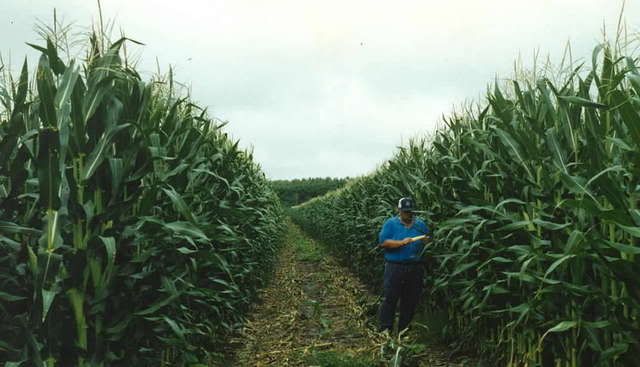
Here is what 175-200 bushel/acre corn looks like.

I plowed down about 4000 lbs of chicken litter per acre, and top dressed with another 75 units of nitrogen. Additional lime wasn't necessary, as the ph checked about 6.5. Pioneer hybrid, I forget what number. Probably 10-12 inches of irrigation water added. Planted with JD-71 planters. Sprayed with atrazine for weed control. This was on some very rich soil. The corn in the picture was the best of about 75 acres. I averaged about 140 bushels overall. There were about 15 acres the irrigation system couldn't reach, and another 10 or so acres on some not-so-rich soil, and that pulled the average down. I got a good deal on custom harvest, and a fair deal on hauling. One thing to consider; 150 bushel corn is going to fill up a truck in a hurry. You better have some good transportation lined up, or your picker is liable to sit waiting for a truck more than it runs. This is one of the factors that make soybeans an attractive alternative.

corn.jpg
 
   / Planting corn questions #19  
srossman said:
Hi Paul,
I hope you don't take this the wrong way. I was just wondering where you get your information from? You seem very knowledgeable on this subject and


Thanks. I was in little kid's school back when the last energy crisis happened, read my Weekly Readers & such. Got really interested in alternative energy, I think i still have a folder around (did I mention packrat too....) with clippings in it on solar, wind, & ethanol power from the 1970's. Even went to some seminars back then, nearby community collage was doing a home-brew ethanol plant on the farm, converting gas tractors to run on E100.

The state I live in has very poor corn basis (price discount less than CBOT) because we produce about 2x as much corn as we use; and we are as far from all 3 coastal ports as possible. Out corn is _cheap_. So, a bunch of farmers got together back in the '80s, and built their own ethanol plants. Got the state to mandate 10% ethanol in all the gas. Built the plants with their own money, as a coop - owned by the farmers. It's becoming an old industry around here - corn ethanol. One of the first plants went up 20 miles from me. Took a lot of study & such to decide if you should invest in it or not, so learned a lot about the ethanol industry. We decided not to invest, but was interesting.

I'm in the shadow of many ethanol plants now. Still going up, one broke ground this fall. Most are farmer-owned around here still. Those fellas put their money where their mouth is. Found a use for the cheap corn we have here.

Minnesota spawned the ethanol industry back in the '80s, and the U of M and others here have done a lot of research & continue to do so into ethanol. It's in the news all the time, & I like news.....

I have a lot of low land on my farm. Might lend itself to switchgrass production. I have about 1/2 my farm in corn every year - might have a lot of corncobs or cornstalks if those items are ever turned into ethanol.

Farm papers & magazines cover this topic all the time, & I get about 6 of them every month. Bound to be an ethanol or biodiesel article in several of them every month..... And I like to read, I like the topic....

So, I've kinda filtered out what I read from a farming & early research on ethanol background.

I'm all for corncob or switchgrass ethanol - I hope & expect those techonolgies to work out in the future. There are _huge_ issues to overcome tho. So far all of it isw just theory - good theory, but needs a lot of work & research.

I remember the big news when the corn ethanol plant near me got to 2.3 gallons of ethanol from each bu of corn - it was milestone. Today (less than 10 years later) they are getting 3.1 gallon per bu, and using less energy (natural gas) to do it. They have expanded 3 times to be 7x larger than they used to be. Still farmer owned....

Anyhow, sorry again for going off topic. I don't have all the answers, but I do know some about the process & can see gross errors when they appear. Been interested in it & studying it for 30 years.

I don't think corn ethanol is _the_ answer, but it is a stepping stone to get us there, and it does provide better air & some small increase in fuels available. I don't think celulose ethanol is _the_ answer either, but it might be a much bigger step, and I welcome it when they get it working right.

--->Paul
 
   / Planting corn questions #20  
Paul,
Sent you a pm since this is off the topic of the original post.

-Scot
 

Tractor & Equipment Auctions

2004 GMC Sierra 3500 Pickup Truck (A55973)
2004 GMC Sierra...
2005 Peterbilt 357 Truck (A55973)
2005 Peterbilt 357...
iDrive TDS-2010H ProJack M2 Electric Trailer Dolly (A59228)
iDrive TDS-2010H...
Eagle Weathervane (A55853)
Eagle Weathervane...
2006 Acura RL Sedan (A59231)
2006 Acura RL...
2005 Isuzu NQR 4 door box truck with folding gate (A56438)
2005 Isuzu NQR 4...
 
Top