Pond Help

/ Pond Help #1  

dj1701

Veteran Member
Joined
Nov 30, 2002
Messages
1,242
Location
East Concord, NY
Tractor
John Deere 4320, Kubota BX2680
Hi everyone,

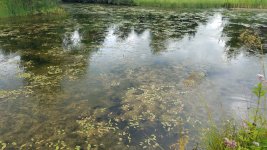
I have a weed problem in my pond.

I have two ponds, this is the upper one. It feeds the lower pond which is deeper and does not have a weed problem.
This pond is spring fed as well as runoff from the upper field. The field is wild, and not used for livestock or agriculture.

I put 7 grass carp in about 5 years ago. They have not made any noticeable difference. This section of pond is around 4' deep.
The other end is much deeper with less problems.

When I bought the place, the ponds were pristine. Muskrats moved in and destroyed all my cattails, and it went down hill from
there. I believe they are gone, and the cattails are coming back.

Just need some advice to make the pond look like it used to.

Thanks
Dave

20190816_125553.jpg
 
/ Pond Help #2  
A pond with life in it is a good pond. Are you wanting to swim in it? Or do you just want it to look nice to you. Add more fish is what I recommend. I am not a proponent of chemically killing the weeds. But it is not my pond. I hope you find the answer you are looking for.

Looks nice to me.
 
/ Pond Help #3  
Shallow water allows weed growth. You could treat once you identify the weed. Airation helps. Go to pond boss .com and ask. A lot of knowledge over there.
 
/ Pond Help #4  
Add cows, and allow them in the pond. They will destroy most anything !
 
/ Pond Help #5  
pull some of that growth out of there and post a pic of it
 
/ Pond Help #6  
OP, I'm looking at a few acres of the same sight, supposedly good if <25% of pond is covered as pictured. We have 'creeping fertility' and your grass carp have done what they can, or will. They favor some plants, ignore others. They can clean out a pond, going too far. They're not legal in most states, and triploided carp (neutered in hatchery) are preferred to prevent planted or escaped specimens from reproducing. What yours haven't eaten by now, they likely won't.

Many times, when people have a pond, they encourage waterfowl use; and this should be avoided as waterfowl add excessive nutrients when on the pond. Do not feed the fish in your pond artificially formulated diets, as these are rich in nutrients and promote aquatic plant growth. When ponds are constructed, keep deciduous trees away from the pond because when they lose their leaves, many end up in the pond as another source of nutrients to promote excessive plant growth.

Once excessive aquatic plant growth occurs in a pond, the pond owner has to make a decision on what control methods to take to correct the situation. Many think that the use of an aquatic herbicide is an easy approach to this problem. There are specific aquatic herbicides that are effective on certain aquatic plants and, for the most part, they are expensive. Some aquatic herbicides require that you hire a certified applicator to use a specific chemical. The use of aquatic herbicides is only a temporary approach, as they will kill the aquatic plant that will die and ultimately release its nutrients and start the growth cycle over again. When one aquatic plant is controlled, usually another one will take its place as the nutrients are in place to continue to drive this aquatic plant growth.

We need to increase oxygen levels to improve a balance within the ecosystem. Weeds consume oxygen at night, offsetting what they produce during daylight. Windmill aerators are given short shrift because many ponds are just too big for one or two. Like with many electric-powered systems 1-2 emitters per acre is commonly recommended. I plan to use just one windmill, and to rotate between several emitters on a daily basis over three+ ac. Like aquarium bubblers their purpose is misunderstood. They don't aerate as much as they circulate water, allowing O2 to be absorbed at the surface which happens more slowly than the bubbles can rise.

Muskrats suck, eat cattail roots and leave 95% of each plant to rot/compost. When I can't set traps by canoe I stalk and shoot them from shore. Nothing will remove bait-fish cover more quickly, or leave more mess. I use Weed Gator to gather other wet green mat'l to inoculate/moisten compost, but while it's probably the best such device it will clear swimming areas, but not large ponds. (~25' reach from shore, brings in vs leaves floating what it rips loose.) What we kill in situ becomes a catalyst for more 'composting' of weeds if not removed.

Geese seem to be the worst accelerators of pond fertility, adding much to natural decomposition on the pond bottom. That process can poison fish with gasses trapped below the most solidly-frozen surfaces. Get the floating gator head with glowing eye and put it out in Spring & Fall. Yell and wave arms at those it doesn't scare off. :laughing:

Any boil that keeps a few dozen square feet of ice 'open' in Winter will do wonders to dissipate gas output from 'composting', esp compared to doing nothing. If used in shallow-enough circumstance, a septic-aerating pump may suffice as a cheap shortcut but IIRC 3-4" is a max depth. It takes a good deal of flow and pressure to get a productive boil, but that's our best remedy for larger ponds (>1/2ac). A fountain pump (got solar?) is another aerator whose visual effect masks it's functional purpose. (see retention ponds for high density housing, where fountains are doing what we want.)
 
/ Pond Help #7  
Tilapia will wipe out plants and clean up anything on the bottom. They will die once the water temp gets too cold.
 
/ Pond Help #8  
Just for kicks - ask the previous owner what he did to keep the pond "pristine".
 
/ Pond Help #9  
By any chance are you fertilizing your pastures above that pond and could that added nourishment be going into your pond?
 
/ Pond Help #10  
A shallow body of water grows weeds. Elimination/eradication will be an on-going process. If you are serious about getting rid of the weeds, seek professional advice/assistance.
 
/ Pond Help #11  
Hydrilla: Invasive plant is invading local waterways Grant Segall gsegall@plaind.com MONTVILLE TOWNSHIP — Thigh- deep in bucolic Wadsworth Road Pond, a park worker climbs onto a sort of pogo stick dubbed ''Tammy the tuber corer'' and jumps up and down on it.

Then he steps down, rips Tammy from the pond bed, and empties muck from her hollow bottom onto a small screen known as a ''hydrilla killa.''

Sifting through the mess, another worker finds a couple of tiny tubers and a few thin, slightly leafy branches that look a little like pipe cleaners.

Both the tubers and the branches are bits of hydrilla, a prolific invasive plant that has begun clogging local waters.

A couple of other workers tote a blower and two bags of herbicide pellets onto a motorboat and spray much of the pond's nearly two acres.

Scientists call Hydrilla verticillata the worst invasive plant in U.S. waters. It can grow a few feet tall and up to 25 feet long. It can lay across ponds, cloaking and clogging them, killing other plants and sometimes fish.

With federal and state grants, the Cleveland Metroparks have helped other agencies and local property owners fight back. Staffers will inspect and help manage any reported hydrilla and other invasive plants in private waters for free in Ohio's share of Lake Erie's watershed.

''If we can discover populations early,'' says Mark Warman, who leads the fight against water invasives, ''we may save our region headaches and money down the road.''

Hydrilla is native to Africa, Australia and parts of Asia. It was imported to the United States for aquariums and began infesting Florida waters in the 1960s.

Starting in 2011, workers have found hydrilla at a few Cleveland Metroparks sites: the Greathouse Wetlands in West Creek Reservation, Wallace Lake in Mill Stream Run Reservation, Blue Heron Marsh at the Ohio and Erie Canal Reservation and Sunset Pond and Sanctuary Marsh in North Chagrin Reservation. But Warman says a few years of spraying have apparently cleaned up all of his agency's sites.

More hydrilla has turned up in a local greenhouse and a private pond but has been treated with apparent success.

Montville Township's Wadsworth Road Pond belongs to the Medina Park District but has not been opened for public use yet. Last year, workers found lots of hydrilla covering the pond and sprayed it. This year, just a few fragments have returned so far. Officials are considering putting in a public trail someday in the site's 20 acres.

The Metroparks have also helped Pennsylvania park workers attack thick hydrilla in Pymatuning State Park, though it lies south of the Lake Erie watershed.

Hydrilla grows from tubers less than half an inch long that resemble peas or very small potatoes. They're offwhite or yellowish when the muck's cleaned off. A few thousand tubers can turn up in a square meter of a pond bed.

The plant has spiky little green leaves, usually five per cluster. It also sends out spiny green buds about a quarter-inch long.

Bits of hydrilla can break off and put down new roots. They can also travel on the sides of boats from one waterway to another. Officials urge boaters to clean their vessels, clothes and boots on the shoreline before heading away.

Cleveland started helping other agencies fight hydrilla in 2016, thanks to $316,830 from the federal Great Lakes Restoration Initiative. For 2019, the Metroparks have received $93,900 from the Ohio Department of Natural Resources to fight any invasive water species in the Lake Erie watershed and another $50,000 for herbicide for Pymatuning.

Warman says the herbicide harms other plants but not people or wildlife.

For help with suspected water invasives or more information, see tinyurl.com/hydrilla19 or call Mark Warman at 216-635-3200.

About hydrilla

Species: Hydrilla verticillata › Considered the worst invasive plant in U.S. waters

› Can grow up a few feet tall and up to 25 feet long

› Can clog ponds, killing other plants and sometimes fish

› Found in Florida in 1960s › Found in some Cleveland Metroparks this decade
 
/ Pond Help #12  
Around this part of the world it's - Eurasian WaterMillfoil. It has the exact same characteristics as the culprit that Murph describes. ALL watercraft are subject to mandatory inspection prior to departing waters where the Millfoil is known to be. ALL watercraft are subject to mandatory inspection when crossing state lines(WA to ID or OR or reverse). There are dry, pelletized herbicides that can be used to control this bugger also.

However - far better to prevent than control. I have slight growth around the two ends of my little lake - in the shallow waters. So far it's not Millfoil. The big lake is far too alkaline to support any kind of "water weeds".
 
/ Pond Help #13  
That Weed Gator I mentioned only does what it does, esp once you're clogging up, but is a hand vs powered tool. (pant, pant, wheeze) But it is superior to knife-edged v-cutters because you haul out weeds vs slice tops and leave them floating. This 'band-aid' is very effective tool if prevention efforts haven't been enough. It's one big limitation is some human effort that gets old rather quickly. (shake, shake, see the vid ..)

It's tough to throw it much farther that the 25' rope that comes with it allows, and it can be a real bear to haul onto shore if tossed into the thickest spot, but you'd love how how well it works, only disdain the elbow-grease and want to biggie-size it somehow. Good luck. ;) Anyway, if you need to clear a spot to swim, dock, or launch, or for under water service access this is the ticket.

Two minutes to watch this vid if you stay thru it all for curios. Y'know, the gent seem to be pulling up the same stuff I do. I can use this to cover maybe 1/10 of my water some due to limited shore access. I get lots of muddy stir right away when using, but see clear water and mere scruff the next day where I finished with a few extra, lighter passes. (for Sight-fishing to reduce channel cats )

 
/ Pond Help #14  
Dye the pond, the sooner the better, but especially as soon as the ice melts in winter...before spring and the weeds start growing. The dye will block sunlight from feeding the weeds. Ask me how I know. ;)

Also, your pond will look really nice dyed. 2 birds, 1 stone.
 

Marketplace Items

2022 TEXAS PRIDE DUMP TRAILER (A65643)
2022 TEXAS PRIDE...
2015 CATERPILLAR TH255C TELESCOPIC FORKLIFT (A65053)
2015 CATERPILLAR...
2015 Ford E-350 Shuttle Bus (A64556)
2015 Ford E-350...
2015 Kawasaki Prairie 400 ATV (A64557)
2015 Kawasaki...
2025 Unused SDLGC80 60v Electric Golf Cart (A64194)
2025 Unused...
Case 2090 Tractor (A66285)
Case 2090 Tractor...
 
Top