Poor cab heat

   / Poor cab heat #61  
Excellent. So did the guy have any ideas for a fix ?

As somebody else noted, your model has a oil cooler or the option for one anyway.
Wonder if they could route it into the block via that oil cooler return port ?
 
   / Poor cab heat
  • Thread Starter
#62  
Willl said:
Excellent. So did the guy have any ideas for a fix ?

As somebody else noted, your model has a oil cooler or the option for one anyway.
Wonder if they could route it into the block via that oil cooler return port ?
No. He will get a report to JD. See if that goes anywhere. I don't even know if the yanmar engine has a port for directing this into the block. Route it into the water pump directly? Put a one way flow device (back flow device) on the lower radiator hose?
 
   / Poor cab heat
  • Thread Starter
#63  
BTDT said:
Which engine do you have? The one they list on website actually has 2 physical thermostats in housing, not just 1 therm. with 2 different part numbers. One is open all the time (for restricted flow I guess, the other closed and opens when temp. calls for it. You may have already searched their website, but they have a search feature where you type in your problem and it gives units and explanations for problems.

Heard from dealer lately?
I asked the dealer about the possibility of 2 thermostats. He said some of the larger ag tractors have 2. My tractor just has one.
 
   / Poor cab heat #64  
Just following this saga which has been very interesting. FYI for BTDT 12.7 Liters is 775 cubic inches. The 3720 is 1.5 L or 91 cubic inches... or a much smaller cousin. Are these cabs factory installed? Here's hoping for a successful conclusion.
 
   / Poor cab heat #65  
I've read all the posts and I suggest the mechanic focuses on the heater supply hose connection at the engine. Usually on cooling systems, the heater supply hose is connected at the cylinder head before coolant gets to the thermostat area(not the water pump). The cylinder head is one of the hottest areas AND it has/or should have water pump pressure to push it to the heater core. The return heater core hose MUST return to the SUCTION side of the water pump circuit. This may be the bottom radiator hose or a special port on the suction side of the water pump itself. (This would create maximum pressure difference between heater core "supply" and heater core "return") This equals more flow. As far as temperature of the engine block goes; I have seen diesel engines that have direct-drive coolant fans that spin constantly remove enough "heat" that the engine can't get up to operating temperature due to the amount of surface area of the engine block exposed to the cold air rushing by it and with engine only under light load.(This doesn't explain why your tractor is different than others thou). I wonder if John Deere sells a low-leak style thermostat. These don't allow small amounts of coolant/air to leak by during running. The disadvantage to this style is during and initial fill of coolant: one MUST bleed the air out at the cylinder head /t-stat area or you will get an air pocket and possibly crack a cylinder head due to lack of cooling. I change my Dad"s JD 4440 farm tractor t-stats every two years and they have built-in air bleeds in the t-stats themselves(little V notch in the sealing area). The disadvantage to the "V" notch style in cold climates is that a small tickle of coolant ALWAYS is going to the radiator thru the upper radiator hose, then being cooled thru the radiator and coming back into the engine as cold coolant via the bottom radiator hose. Only a problem when the engine is under light load conditions, then the engine can't maintain operating temperature or even close to it in areas like Canada and Alaska. Caterpillar makes special air bleed check valves to be used with low-leak style thermostats for cold climate applications that bleed out the air during initial fill, but then a marble floats inside this fitting when coolant has the cylinder head full (think auto air bleed, but with a tight seal) Let us know what the final culprit is when you get to the bottom of this problem. Hang in there, you know there is a solution coming.
 
   / Poor cab heat
  • Thread Starter
#66  
hankus said:
Just following this saga which has been very interesting. FYI for BTDT 12.7 Liters is 775 cubic inches. The 3720 is 1.5 L or 91 cubic inches... or a much smaller cousin. Are these cabs factory installed? Here's hoping for a successful conclusion.
Cabs are factory installed.
 
   / Poor cab heat #67  
This won't help you but I have a brand new 4320 and the heater works GREAT. Here in the middle of North Dakota winter is already upon us. Our daily highs are in the 20's. We got 5" of snow on Monday and I woked all night through the storm with 30 mile an hour winds and 15 degree temps. the heater was on low and the fan was on low.
My return line goes back to the water pump I see. There is also a factory installed pet cock to bleed the line below the right post. There is also a splice right below the left post. I would say somebody made sure there was no air in the line at the factory.
 
   / Poor cab heat
  • Thread Starter
#69  
dwmaster said:
This won't help you but I have a brand new 4320 and the heater works GREAT. Here in the middle of North Dakota winter is already upon us. Our daily highs are in the 20's. We got 5" of snow on Monday and I woked all night through the storm with 30 mile an hour winds and 15 degree temps. the heater was on low and the fan was on low.
My return line goes back to the water pump I see. There is also a factory installed pet cock to bleed the line below the right post. There is also a splice right below the left post. I would say somebody made sure there was no air in the line at the factory.
My feed line runs from the top of the water pump and enters the left post of the cab. The return line goes to the lower radiator hose. Are you sure your return line is to the water pump?
 
   / Poor cab heat #70  
I would say you have more than a poor cab heat problem, your engine is not getting up to working temperature. That is very bad for a diesel. They are designed to run with a load at operating temperature. Not having enough heat in the engine leads to nasty deposits and shortens engine life.

Joe


radman1 said:
Service manager from JD just left after checking out tractor. I think we made so important discoveries today. Today was 40F and sunny. Started the tractor. Ran for about 20-30 minutes. Max engine heat at 1400 rpm was 113F measured at the top of the water pump where the heater hose exits. Temp gauge needle on tractor was 3mm off the bottom peg. Cab heat at the vent was 94-97. Ran tractor faster and engine heat raised a couple of degrees.
Next, we clamped off the heater hose return just before the radiator with a vise grip. Engine temp climbed to 146F at the water pump within about 5-10 minutes. (Cab heater temp 51, as expected). Removed the vise grip and watched the engine temp start to drop within 15-20 seconds and after 10-15 minutes back to about 113F.
We both think there is a design flaw in the return of the heater hose. On cars and trucks, the return water from the heater typically enters the engine block directly. JD has the return going to the lower radiator hose near the radiator. The service manager said this is not how it is done on larger ag tractors which have the return directly to the block. We think the return heater hose flow is mixing with and back flowing into the radiator and getting cooled. The returned heater flow is now much cooler than directly going into the engine. The cold heater water now returns to the water pump and is circulated through the engine. The engine now has much cooler water flowing through the engine and can't heat it enough before recirculating back to the cab heater. The flaw seems to be the return from the heater to the lower radiator hose instead of the block. With the cab heater control valve shut off, the engine heater will rise somewhat in temp but not near as high as when the return hose is clamped.
This would explain, why I get good cab heat when working the tractor hard but not when under no load.
Service guy said a customer came in to possibly buy a cab tractor and asked them if JD still has problems with the heater. Customer said he heard this from another dealer. Service guy said they have only sold 3 tractors with cabs. All this summer and fall and all 3 (including me) are complaining about the poor cab heat. Was there a design change or do all 3000 cab series have the heater return hose going to the lower radiator hose?
 
   / Poor cab heat #71  

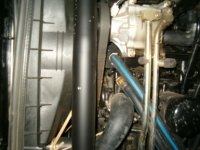
Ya it comes out of the top of the water pump up the left post down the right post then back to an inlet on the side of the water pump. Tried to post a picture but I looks like i need help with that.
HPIM0537.JPG
 
   / Poor cab heat #73  
Radmam1, My 3720 looks to be the same as your,out of the water pump and up the left post and down the right post to a "t" and into the bottom of the radiator.There is only one hose with a blue strip on it at the water pump on mine.If you look on JD parts at the water pump there are 2 plugs on the breakdown and they are #24 I think the plug comes out to put the fitting in for the heater feed hose could the fitting been put in the wrong plug hole, so the heater hose supply be on the return side on of the pump so the only water makeing it to the heater core is cold water??????

minimax
 
   / Poor cab heat
  • Thread Starter
#74  
minimax said:
Radmam1, My 3720 looks to be the same as your,out of the water pump and up the left post and down the right post to a "t" and into the bottom of the radiator.There is only one hose with a blue strip on it at the water pump on mine.If you look on JD parts at the water pump there are 2 plugs on the breakdown and they are #24 I think the plug comes out to put the fitting in for the heater feed hose could the fitting been put in the wrong plug hole, so the heater hose supply be on the return side on of the pump so the only water makeing it to the heater core is cold water??????

minimax
I don't think that is the case. We measured the return hose temp and it was cooler than the feed hose which comes off the top of the water pump. The feed hose temp was also near that of the engine temp. The flow seems to be in the proper direction.
If there is another port in the water pump as you suggest, then maybe that is the port for the return hose. Then it would be like the picture posted by dwmaster - outflow and inflow ports are at the water pump. This may cure the problem.
 
   / Poor cab heat
  • Thread Starter
#75  
joe_ferrari said:
I would say you have more than a poor cab heat problem, your engine is not getting up to working temperature. That is very bad for a diesel. They are designed to run with a load at operating temperature. Not having enough heat in the engine leads to nasty deposits and shortens engine life.

Joe
I'm with you. Engines aren't designed to run that cool. I also notice the exhaust fumes are quite irritating to breath and bother my eyes when when it is running cold. This is more than just normal diesel fumes which don't normally bother me. I think the combustion is suboptimal. This seems to go away a higher operating temps.
 
   / Poor cab heat #76  
dwmaster's water pump photos don't like like the JD parts to me. His bottom radiator hose at the water pump is on the left side of the tractor(If I am viewing it correctly), but JD Parts shows your water pump bottom hose inlet on the right side of the tractor. If correct, then a design change has been made by John Deere and might explain different results in heater performance between customers/owners of the same model.
 
   / Poor cab heat #77  
outlets are on the left side. Their is a plastic tee with a cap on it just below the right side of the cab on the return line which must be for bleeding the line.
HPIM0536.JPG
 
   / Poor cab heat #78  
Thanks dwmaster for the expanded photo. I see your oil filter is on the left side also. JD Parts shows the oil filter on the right side in their graphics for a 3720 compact utility tractor model. Something it definitely different, if I can trust their graphics.
 
   / Poor cab heat #80  
Check to make sure the control actually opens the valve all the way.

I too have a heater problem with my Kubota. You have to be careful to only just barely move the heat control off of the coldest setting or it will drive you out of the cab. They must have designed the thing for arctic use.

Pat
 

Marketplace Items

2016 Dodge Grand Caravan Van (A59231)
2016 Dodge Grand...
2008 Bobcat S250 Compact Wheel Loader Skid Steer (A59228)
2008 Bobcat S250...
2013 Ford Edge Limited AWD SUV (A59231)
2013 Ford Edge...
2014 GENIE GTH-5519 TELESCOPIC FORKLIFT (A60429)
2014 GENIE...
2017 Ford F-550 4x4 Ext. Cab Mason Dump Truck (A59230)
2017 Ford F-550...
John Deere 2640 2WD Tractor with 146 Front Loader (A57024)
John Deere 2640...
 
Top