Preventing tractor back flip

   / Preventing tractor back flip #141  
sorry to repeat; check out 50 seconds into Backflip With Tractor - YouTube
That is a tractor flipping over on an incline. He essentially popped a wheelie and got his Center of Mass behind his rear axle. He wasnt pulling anything from the drawbar, but even if he was, steep inclines can overcome the backtip stabilization offered by a drawbar. Use a long drawbar and a steady slow pull if youre pulling on a greater than ~10ー incline
larry
 
   / Preventing tractor back flip #142  
Note, in the video Backflip With Tractor - YouTube that the tractor that flips has a drawbar ...and, given the momentum generated, it simply digs in lifts the rear wheels a little but doesn't stop the flip.
Different situation - steep hill popping wheelies. Its NOT a wheelie bar. Just because it is possible to make informedly negatively optimized choices in drawbar length and situation does not categorically defeat the effectiveness of the concept. The tractor wasnt pulling anything so the drawbar didnt come into play for its intended function at all. If it had extended further backward and had a bearing plate on the end it could have acted as a wheelie bar. In that case - with that operator the tractor would have rared up and tipped sideways or hed still be trying.
larry
 
   / Preventing tractor back flip #143  
Larry...do you design tractors? Do you...other then theory, know anything about tractor design and the dynamics involved?
Although I'm in Quality Assurance (not design...automotive and (currently) aerospace, but not tractor specifically), I did a fair amount of study on safe usage of a tractor as I didn't want to become an unfortunate statistic. Does that make me an expert on tractor design...nope...but it does make me a very knowledgeable owner of tractors.

As far as your previous threads...once they're off the first page of a forum...I doubt anyone reads or has knowledge of them (BTW, that applies to all posters, not just you). This topic has gone on (now and then) for at least 10 years...sort of like the "HST vs. Gear" debates.
Are you arguing logic or innuendo? The topic has gone on and been solved. For those who actually understand it to laboriously sort the top of the head statements anew and defuse every important missed nuance takes time, again, that was invested previously. Thats why links are given -- FREE; no searching. It is Physics ... and its correct interpretation is important to everyone as a realistic safety and capability tool. -- Unlike HST vs Gear which is based loosely on a hodgepodge of preference, attitude, and fact. There is no answer there.
larry
 
   / Preventing tractor back flip #144  
RoyJackson said:
No such thing as 100% safety. Too many variables (such as topography).

Anyway, the drawbar, as designed below the rear differential, is the lowest part of the tractor....and the safest place to hitch for pulling.
There is no way for the restraining force can be below the contact patch of the tires. Physically impossible...we're discussing real life considerations, not theory, correct?

Correct. I pointed out that the drawbar being underground prevents front end lift. You now point out that this configuration isn't normally possible. Put those two facts together and you're left with front end lift.

To be more accurate the position of the drawbar is not directly a concern. Rather it is indirectly a concern only inasmuch as it effects the vector of the restraining force. It IS possible to get that vector to point under the tires' contact patch without the drawbar going underground itself. This is the condition described by your second link in the section titled Drawbar Leverage, where it talks about the fact that the drawbar position is normally designed to get closer to the ground as the nose of the tractor rises. The design intent is such that as the nose lifts, the angle of your chain will end up pointing below the tires' contact patch before the tractor has tilted so far back that it will flip. So it's a self limiting danger.

Self limiting danger of flipping, but NOT preventing the tractor from raising its nose just because the drawbar is below the axle, which is what you claimed. So as civilly as possible, and without any personal judgment, you are wrong.

And speaking towards the larger question of whether the tractor could flip... Yes it could. There are a lot of factors working against it, but if one were to get the nose shooting up with enough momentum one could have enough rotational force to overwhelm those forces working against it.
 
   / Preventing tractor back flip #145  
The only way to completely prevent rearing up is you have a drawbar on the ground at the level of the tires but that isn't practical.


I'm with this answer . . .

assuming you have unlimited power to deliver to the rear drive wheels at some point the force will be reached that will overcome the moment force keeping the tractor front down.
 
   / Preventing tractor back flip #146  
"If the rear axle should be unable to rotate, the tractor chassis
rotates about the axle. This reverse rotation results in the
front-end of the tractor lifting off the ground until the
tractor's CG passes the rear stability baseline. At this
point the tractor will continue rearward from its own
weight until it crashes into the ground or other obstacle."

"It is also possible to flip a tractor
rearward when the load is properly hitched to the drawbar."

Direct quotes taken from Roy's posted link to the University of Wyoming:http://agecon.uwyo.edu/RiskMgt/humanrisk/TractorOverturnhazardspdf.pdf

The section starting on page two titled "Rear-Axle Torque" pretty well answers the question.
 
   / Preventing tractor back flip #147  
"If the rear axle should be unable to rotate, the tractor chassis
rotates about the axle. This reverse rotation results in the
front-end of the tractor lifting off the ground until the
tractor's CG passes the rear stability baseline. At this
point the tractor will continue rearward from its own
weight until it crashes into the ground or other obstacle."

"It is also possible to flip a tractor
rearward when the load is properly hitched to the drawbar."

Direct quotes taken from Roy's posted link to the University of Wyoming:http://agecon.uwyo.edu/RiskMgt/humanrisk/TractorOverturnhazardspdf.pdf

The section starting on page two titled "Rear-Axle Torque" pretty well answers the question.
If you are pulling against a load attached to a fixed drawbar extending beyond the tire circle the end of the drawbar will touch down ... at which point the pull point will be at ground level and stop driving the tip. Unless the tractor is rearing up fast the tip will stop and the engine will stall.
larry
 
   / Preventing tractor back flip #148  
Self limiting danger of flipping, but NOT preventing the tractor from raising its nose just because the drawbar is below the axle, which is what you claimed. So as civilly as possible, and without any personal judgment, you are wrong.

Not wrong...just pursuing the real life scenarios rather then the theoretical.

So, to put it in a way that works better...hitching to the drawbar reduces the possibility of a rear rollover as much as possible with the current design of tractors (as we define tractors on TBN).
 
   / Preventing tractor back flip #149  
Are you arguing logic or innuendo? The topic has gone on and been solved.
larry

Not arguing with anything...and I'm sure this subject will arise again on TBN. Might be different players involved, that's all...

So, has the issue been resolved? Well, read some history on TBN and you'll find it was "resolved" years ago. But like most forums, some topics come up repeatedly and this is one of them.
 
   / Preventing tractor back flip #150  
RoyJackson said:
Not wrong...just pursuing the real life scenarios rather then the theoretical.

So, to put it in a way that works better...hitching to the drawbar reduces the possibility of a rear rollover as much as possible with the current design of tractors (as we define tractors on TBN).

That assessment is generally correct. But you were wrong to say that the drawbar being lower than the axle means the front end is forced down, and you were wrong to tell me I was wrong when I explained why it isn't true.
 
   / Preventing tractor back flip #151  
That assessment is generally correct. But you were wrong to say that the drawbar being lower than the axle means the front end is forced down, and you were wrong to tell me I was wrong when I explained why it isn't true.

Visualize this:
Drawbar bracket below the rear differential entending to the front of the differential.
Although the drawbar itself may extend quite a ways aft of the bracket, it still transfers any loads to the bracket (which, in turn, transfers the load to the tractor's frame).
The load pulls on the drawbar, which pulls on the drawbar bracket. The drawbar bracket pulls on the frame, however the load is transferred up an inch or so by the hardware (most of the load on the hardware (bolts and nuts, perhaps washers) is shear, but there's a degree of tensile loading too due to the nuts and washers (restraining the bolts which will "stretch", otherwise. That's what pulling the frame "down" and preventing a rear rollover.
Now, I'm writing about standard tractors, not equipment built for competitive tractor pulls.
This would be a lot easier to illustrate if I could do a CAD animation.

Do you see what I'm trying to explain here?
 
   / Preventing tractor back flip #152  
Visualize this:
Drawbar bracket below the rear differential entending to the front of the differential.
Although the drawbar itself may extend quite a ways aft of the bracket, it still transfers any loads to the bracket (which, in turn, transfers the load to the tractor's frame).
The load pulls on the drawbar, which pulls on the drawbar bracket. The drawbar bracket pulls on the frame, however the load is transferred up an inch or so by the hardware (most of the load on the hardware (bolts and nuts, perhaps washers) is shear, but there's a degree of tensile loading too due to the nuts and washers (restraining the bolts which will "stretch", otherwise. That's what pulling the frame "down" and preventing a rear rollover.
Now, I'm writing about standard tractors, not equipment built for competitive tractor pulls.
This would be a lot easier to illustrate if I could do a CAD animation.

Do you see what I'm trying to explain here?

I think so, yes. Indeed a load pulling at any vector below the cg of the tractor imparts some component of downward pull on the tractor. This component surely acts to hold the frame of the tractor down.

Your mistake is suggesting that this component will somehow outweigh all the other component forces in action during the pull and prevent the front of the tractor lifting. It just won't, unless the overall load vector points below the contact patch of the tires as I've described already. This fact is true no matter the exact length or height of the drawbar or the connection details of how and where it mounts to the frame of the tractor.

Only the total net forces acting on the tractor control its motion. All the little forces of ring gear to pinion gear interface, exact shear or tension on mounting bolts, etc., are certainly there, but can be considered useless data because they are all summed in the expressions of the tire pushing back against the contact patch and the load pulling at some angle against the drawbar connection.

Saying that a component must be considered in addition to those two master forces is wrong, because every component you might decide to bring up is already contained withing those two master forces, so to speak.

You can have any rigid assembly you want; tractor, tinker toys, giant ball of connected nuts and bolts, or whatever. If it is pushed forward at the bottom, and is subject to a restraining force vectored above the bottom, it will tilt back. Sure, there are lots of component forces scattered throughout the assembly and you can analyze every one if you like, but the total net forces equal tilting back.

xtn
 
   / Preventing tractor back flip #153  
Visualize this:
Drawbar bracket below the rear differential entending to the front of the differential.
Although the drawbar itself may extend quite a ways aft of the bracket, it still transfers any loads to the bracket (which, in turn, transfers the load to the tractor's frame).
The load pulls on the drawbar, which pulls on the drawbar bracket. The drawbar bracket pulls on the frame, however the load is transferred up an inch or so by the hardware (most of the load on the hardware (bolts and nuts, perhaps washers) is shear, but there's a degree of tensile loading too due to the nuts and washers (restraining the bolts which will "stretch", otherwise. That's what pulling the frame "down" and preventing a rear rollover.
Now, I'm writing about standard tractors, not equipment built for competitive tractor pulls.
This would be a lot easier to illustrate if I could do a CAD animation.

Do you see what I'm trying to explain here?

No.

B'cawze the LOAD doesn't DO any "Pulling".

Now don't go all "apparent force" on me and start blithering about "centrifugal" nonsense, coz I don't b'leeve in that either.
Maybe I can go along with "Centripetal" though (-:
But I'm just bustin' yer chops (-:

Hey, the North West passage opened up two or three weeks earlier this year YET AGAIN, despite widespread disbelief by TBN'ers in global warming - how 'bout that ?
 
   / Preventing tractor back flip #154  
Traction is the key, If your tractor can get enough traction it will flip, if the tires spin it will not. The lower the attach point the more traction required to overcome.
 
   / Preventing tractor back flip #155  
Reg said:
No.

B'cawze the LOAD doesn't DO any "Pulling. "

Blah blah blah. I know you're just busting his chops, but he is right. The load, and indeed every point in the assembly between the load and the actual pulling force, experiences the strain as some variety of components.

His only mistake is drawing a conclusion based on one or some limited selection of those components instead of the net sums, which necessarily must be equal to the driving force at the contact patch of the tires pulling against a load that resists forward motion in a vector that points above said contact patch.
 
   / Preventing tractor back flip #156  
Could we just say "The sum of the forces around a point" and define a positive and negative direction???:thumbsup:
 
   / Preventing tractor back flip #157  
The second link was in fact 'idiots' that probably said "hold my beer and watch this".

Hey, I take offense to that statement:D

Anyway, I have been following this thread, and have been reluctant to post, But for some reason, today I feel compelled to do so:confused2:

I am going to say with 99% certainty, that pulling from a drawbar BELOW the axle, EVEN if it is shorter than the tire radius, WILL preven a backflip.

The 1% is because there are a TON of variables, like momentum, chain breakage, speed, terrain, etc.

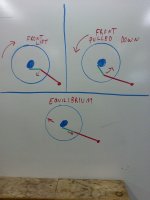
BUT, IF you have an immovable object AND an unbreakable chain, AND unlimited traction, and hook to the drawbar, you will NOT flip. Reasons to follow as well as pics.

Sorry for the crude pics hand drawn on the white board in the shop. But the Blue represents the tires, the green is the drawbar, and the red is the chain.

As you can see, in the 1st pic (top left) that the chain is at a pretty stllp angle. ~30 degrees. As you pull, the front WILL raise up in the air, but ONLY to the equillibruim where the chain and the drawbar form a straight line. SEE the BOTTOM pic.

Once equillibrium is reached, the front can NO longer raise. At this point, several things can happen.
1.You will break traction, and the front will come back down
2.The object will begin to move and no longer have enough resistance to hold the front up and the front will come down
3. The chain will break. And depending on wheel speed(if spinning) and momentum, the front will either settle back down, or you could go on over backwards.

As you can see in the second pic (top right) why you will never go beyone the equillibrium point. Because beyond that, it WILL try to pull the front back down, or force the object to move. Because the higher the tractor goes, the drawbar rotates under the axle and forward. And it CANNOT go forward it the object is truly immovable regardless of traction and power.

Remember the shortest distance between two points is a straight line. And by pulling on the chain, that is what the chain-drawbar connection is trying to achieve.

The steeper the chain angle, the more downward force/traction on the rears, and also the higher the front will go to achieve equillibrium. That is why a lot of these videos on youtube the look "scary" really arent, and why you see tractors at the pull slowly bouncing the front up and down. Because as the front lifts, maximum traction and pulling power is attained at equillibrium point, the object will begin to move, the front will settle back down until you can no longer pull the object, and then the front will rear up again and the process is repeated over and over.

This is also why it is NOT advised to pull from the 3PH, even if you lower it all the way. Because it acts like a floating drawbar. There is NOTHING holding it down. So equillibrium wont be reached until the 3PH has ran out of upward travel, and by that time (depending on how short you chain) you could already be vertical:confused2:

And to everyone who disagrees because they have "seen or heard of it happening" when hooking to a drawbar, that is probabally the 1% I mentioned earlier, and probabally operator error. Like jerking and breaking a chain (a lot of momentum) or Being at equilibrium with the fronts up a foot or two in the air and spinning the tires 90 MPH, or popping the clutch. There are no safeguards that can protect aginst stupidity.
 

Attachments

  • flip.jpeg
    flip.jpeg
    530.7 KB · Views: 167
   / Preventing tractor back flip #158  
Could we just say "The sum of the forces around a point" and define a positive and negative direction???:thumbsup:

No. The actual pivot point of the tractor will be moving during the pull, and may only be defined as a point that is fixed relative (via a radius length) to any other three fixed points on the tractor; or I guess any other two fixed points on the tractor if we're only looking at a side view and can avoid worrying about depth left and right, which we can do if we're assuming a flat and level ground and a straight pull.

Many people seem to think the pivot point is the rear axle, but it isn't. If you begin the exercise with a straight and level chain with no slack whatsoever, as you start to apply power in an attempt to pull the load, the pinion gear will begin to climb the ring gear since no forward motion of the tractor is permissible. As the nose of the tractor lifts, the tip of the drawbar must go down. As the drawbar goes down, it must by necessity also move rearward since the arc of the chain requires it to do so. As it moves rearward, so must the rest of the tractor come rearward with it. So as the tractors movement will be a combination of twisting up and back, along with a slight overall movement to the rear, the actual pivot point is a point in space that is itself moving in a slight arc to the rear and downward throughout the exercise as the nose of the tractor rises higher and higher. It only passes through the axle center line during that moment in the beginning when the chain is level and tight. In other words, the motion of the tractor cannot be defined by a simple arc around a point that's fixed in space, but instead requires a decently complex calculus function to describe. Even that would need to assume some constants that aren't constant in real life, such as tire sidewall flex etc.

My first thought was that if you actually plotted the overall pivot point it would be a small portion of the ellipse defined by the contact patch of the tires and the end of the drawbar and passes through the axle, but that cannot be right because the ellipse itself is moving as the drawbar goes down, so that's only part of the equation. Getting beyond what I can envision and deduce in my head without external aid. It would be complex.

Anyway it wouldn't ever be too far from the axle, and it's kind of silly to actually worry about it for this discussion, but there you go.

xtn
 
   / Preventing tractor back flip #159  
Tractor will not flip (assuming unlimited traction) only when pulled at or lower than ground contact. The higher the point of attachment the easier is to flip the tractor. If you draw bar extends behind the rear axle and the front of the tractor goes up the attachment point goes lower and makes it harder to flip the tractor. In other words it is self stabilizing system. In the same time the traction increases because all the weight is on rear axle. There are many movies on YouTube showing wheelies while puling heavy load without actually flipping the tractor. If the attachment point is placed at or in front of rear axle the tractor will flip instantly once the front of tractor starts lifting.
 
   / Preventing tractor back flip #160  
As you can see, in the 1st pic (top left) that the chain is at a pretty stllp angle. ~30 degrees. As you pull, the front WILL raise up in the air, but ONLY to the equillibruim where the chain and the drawbar form a straight line. SEE the BOTTOM pic.

Once equillibrium is reached, the front can NO longer raise. At this point, several things can happen.
1.You will break traction, and the front will come back down
2.The object will begin to move and no longer have enough resistance to hold the front up and the front will come down
3. The chain will break. And depending on wheel speed(if spinning) and momentum, the front will either settle back down, or you could go on over backwards.

As you can see in the second pic (top right) why you will never go beyone the equillibrium point. Because beyond that, it WILL try to pull the front back down, or force the object to move. Because the higher the tractor goes, the drawbar rotates under the axle and forward. And it CANNOT go forward it the object is truly immovable regardless of traction and power.

Very good thought process, but I believe you are missing something. You are missing the fact that the engine's power can cause forces to be exerted in directions other than forward.

The tractor (as long as it get's traction) is trying to wrap itself backwards around the restrained drawbar. Assuming enough power and traction, the pinion gear can continue to climb the ring gear, even pulling the whole thing backwards as it wraps up and over the drawbar. The only exception is having a drawbar long/low enough (or an load attachment high enough) that as it moves downward it reaches a point at which the vector of the restraining force/chain points below the tires' contact patch.

Please see the attached jpg image.... Note that the chain length is exactly the same in each stage. Also note that if the tractor has the power and traction to lift it's nose at all, it MUST be wrapping itself BACKWARDS towards the load. If it can do this from the horizontal when the nose of the tractor imparts the most leverage component, then it only gets easier the higher the nose gets. There is nothing in this configuration that will stop the tractor continuing to wind itself up backwards. Yes, it gets harder to do as it passes the point of "quilibrium" (not really) you describe, but assuming enough power, it will continue to wrap.
 

Attachments

  • TRACTOR.jpg
    TRACTOR.jpg
    154.5 KB · Views: 155
Last edited:

Tractor & Equipment Auctions

Tandem Axle Rear Truck Frame (A59230)
Tandem Axle Rear...
Takeuchi TL150 Compact Track Loader Skid Steer (A59228)
Takeuchi TL150...
(9) 55 GALLON METAL DRUMS (A60432)
(9) 55 GALLON...
2020 Westfield MKX 100-83 Auger with Swing Hopper (A61307)
2020 Westfield MKX...
Kubota M4700 4WD 51HP Utility Loader Tractor (A56857)
Kubota M4700 4WD...
MARATHON 20KW GENERATOR (A58214)
MARATHON 20KW...
 
Top