Generator PTO Generator

   / PTO Generator #41  
That is an interesting idea. Never thought of that one, I will have to try it. The wheel is graduated and along with a watch, you should be able to time it's rate of turn for a fixed ammount of time and get something that can be multiplied into the load in KW/HR at that particular load. This of course won't show surge loads very well, but you should be able to get a reasonably accurate average. Your electric bill should also help in getting an average use reading.
 
   / PTO Generator #42  
I don't know if there is a formula for converting kilowatt hours to watts or amps, never heard of it. Be a good idea if it worked.

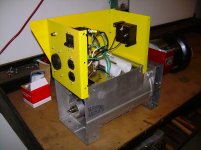
Regarding the voltage regulation, on my 10 KW pto gen I opted for the capacitors over the AVR. I wanted to keep it simple, and after speaking to the manufacturers engineer, though I don't remember the reason exactly, they recommended the capacitors for reliability in the unit I was buying. they said anything 15 KW and up only came with AVR.
I had them send me an extra pair of capacitors so I could be better prepared for a real emergency. Also like Ron recommended, I've got the killowatt meter plus a couple of other plug in watts/hertz meters and an in line watt meter to balance/monitor the load.
JB.
 

Attachments

  • DSCN0524.jpg
    DSCN0524.jpg
    281.6 KB · Views: 192
   / PTO Generator #43  
That is an interesting idea. Never thought of that one, I will have to try it. The wheel is graduated and along with a watch, you should be able to time it's rate of turn for a fixed ammount of time and get something that can be multiplied into the load in KW/HR at that particular load. This of course won't show surge loads very well, but you should be able to get a reasonably accurate average. Your electric bill should also help in getting an average use reading.

Right! Theoretically if you watched your meter for an hour of using all of your household appliances, the difference in Kilowatt/hours would be the same as your home's electrical usage in kilowatts. If you watched for half and hour you'd double the number. If you timed it for 15 minutes, you'd multiply by four.

I'd think that 15 minutes would give you a pretty good idea, and it's conceivable that you could do a maximum amp draw for 15 minutes...

"Honey if you'll put a load of laundry in the dryer, get a cake in the oven, and then go take a hot shower; I'll crank the thermostat all the way, turn on all the lights, and watch a movie with the refrigerator door open."

There may be some way to calculate it from an electrical bill, but there's going to be some kind of a conversion factor. I'd imagine it would be highly variable too. Someone who uses high loads only occasionally is going to need a bigger generator than someone with a constant medium load even though their monthly average may be the same. Of course you may come closer based on an electricity bill than the canned formulas based on the size of your house, etc.
 
   / PTO Generator #46  

Interesting with the stopwatch, but then you would have to run around the house like IPF said turning everything on as well as the math calcs. IMO it would be easier and more practical to do it on paper with the name plate info.
Almost no one is going to have everything on at once and will manage their load according to the gen capacity and more importantly the governors ability to keep it in the green.

it would come in handy for some one with special consistent power needs.
 
   / PTO Generator #47  
I don't know if this is the same generator

https://www.ruralking.com/Store/detail.aspx?ID=15098

kind of looks the same..... but I've talked to people in the area that have gotten one and one of the guys in the store that I talk to on a regular basis and he said they sell a ton of these. they were out at the time I inquired and said he had another 50 stored at the warehouse ready to ship in.

I'm meeting with an electrician tomorrow to go over a few things and to see how amps my "necessities" pull.
 
   / PTO Generator #48  
I'd look into a line conditioner for your electronics, your not going to find one that can handle the amperage for the whole house at a good price. you'd be better off just buying an AVR regulated generator.

But with a line conditioner attached to your power panel you are protected from the local power company's power as well. I live at the end of the line in a rural area where the power company has fluctuating power.
 
   / PTO Generator #49  
1Kwhr=1000 watts used in one hour.
1Kw=1000 Watts
Watts divided by volts=Amps.
Last time I worked out the average power consumed was for a survey for going solar. I used a clamp on ammeter and took many readings throughout the day, added all the readings, divided by the amount of readings taken and that was average current being drawn.
Another way is to take a meter reading at say 8-00am and the do the same the following morning at 8-00am, subtract the lower reading from the higher, and that gives you the Kwhr's consumed for 24 hours.
Take several readings over a month, divide your answer by the amount of readings and you have your average consumption for the period.
 
   / PTO Generator
  • Thread Starter
#51  
I don't know if this is the same generator

https://www.ruralking.com/Store/detail.aspx?ID=15098

kind of looks the same..... but I've talked to people in the area that have gotten one and one of the guys in the store that I talk to on a regular basis and he said they sell a ton of these. they were out at the time I inquired and said he had another 50 stored at the warehouse ready to ship in.

I'm meeting with an electrician tomorrow to go over a few things and to see how amps my "necessities" pull.

Looks exactly the same, however the HF one is cheaper with shipping for me.
 
   / PTO Generator #52  
1Kwhr=1000 watts used in one hour.
1Kw=1000 Watts
Watts divided by volts=Amps.
Last time I worked out the average power consumed was for a survey for going solar. I used a clamp on ammeter and took many readings throughout the day, added all the readings, divided by the amount of readings taken and that was average current being drawn.
Another way is to take a meter reading at say 8-00am and the do the same the following morning at 8-00am, subtract the lower reading from the higher, and that gives you the Kwhr's consumed for 24 hours.
Take several readings over a month, divide your answer by the amount of readings and you have your average consumption for the period.

That would work for solar, because most solar set-ups are still connected to the grid, and you are just trying to offset your usage. With a back-up generator the real number you need to work with would be the peak usage instead of average usage.

As an example, my last power bill says I used 1260 Kwh. The bill covers 31 days, so that's 744 hours or 1.69 Kilowatts per hour. I'm very doubtfull that even a 2 kw generator would come close to powering my house. I have a well, an electric water heater, an electric oven, and an electric dryer, not to mention all the lights, computers, refrigerator, etc.

Last time I pushed the numbers to see what I needed for a backup generator, I came up with 6 kw minimum, and that would require some power management tactics like only running one 220 volt appliance at a time (dryer, water heater, oven). I think I'd need a 10 kw to run the house like we normally do.

It would be interesting to take a poll here where we all put in our calculation based on the power bill vs. our calculation based on one of the more popular generator wattage calculators and see if we come up with a consistent conversion factor.
 
   / PTO Generator #53  
I agree, it's all about power management. unless you really don't want to know, and spend well over $20,000. for a auto stand by system that a Doctor I recently worked for had installed, and guess what the first time the power went out it didn't kick in, when he called them they told him to go down the basement and push the reset button on the refrigerator sized control box!

The hourly average over a months time is just that, average, and worthless for calculating what size gen you would need. as it's taking into account the over night periods when nothing is on.
If you really wanted to run everything at once with a gen then you need to know peek demand and you'd have to do like you said and turn every possible load on for some set period of time and do the math using the numbers off the meter.
I think it would be easier to walk thru the house and add up all the possible loads, it would be tricky figuring those 3X start surges of motors using the meter method, I would think.
JB.
 
   / PTO Generator #54  
That is the problem with using the electric bill. All those night time hours when you are asleep, all the lights are off and the meter is barely moving, drive the overall average down.

As for reading your mechanical power meter, it is way easy. This info from Wikipedia:

The amount of energy represented by one revolution of the disc is denoted by the symbol Kh which is given in units of watt-hours per revolution. The value 7.2 is commonly seen. Using the value of Kh, one can determine their power consumption at any given time by timing the disc with a stopwatch. If the time in seconds taken by the disc to complete one revolution is t, then the power in watts(P)= 3600 X KH Divided by "t".

For example, if Kh = 7.2, and one revolution took place in 14.4 seconds, the power is 1800 watts. This method can be used to determine the power consumption of household devices by switching them on one by one.

I tried this and it seems to work pretty well. 3600 represents the number of seconds in an hour. This is similar to the formula I use for checking a speedometer. 3600 divided by the number of seconds required to cover a measured mile = speed in MPH. The value for Kh should be on the face of The meter somewhere. Mine was 7.2. Just time the wheel thru one complete revolution. and use this number to divide 3600 X Kh...
 
   / PTO Generator #56  
The trouble with taking the ratings of all the appliances off of the rating plates is that they are maximum ratings, so you will end up over-sizing your generator a bit compared to what the appliances will actually draw. Of course, if you want to guarantee you have enough juice to run all of the appliances, simply adding up the plate ratings would be sure to accomplish that.

Don't forget any lighting circuits you might want. Easy enough to add up the wattage of all the bulbs in the light fixtures.

Timing and then doing the math on the electric meter is the cheapest way to measure your actual power consumption - the power company has already purchased and installed a perfectly good and certified accurate meter!

The same time the meter trick can be used for setting the fuel rate of gas appliances - adjust the pressure regulator until timing the gas meter says you are burning the right number of BTU's per hour that the ap[pliance is rated for.

If you use a clamp-on meter, be sure to measure both branches - most of your 110v stuff could all be on one branch.

Here in MN, one of the top concerns is having enough juice to run heating equipment. One of the things I did to mitigate that concern is that I have a couple of gas fire places that run without any electricity. They can keep the house warm enough for a long time if necessary. If I lose gas supply, that would be a whole different story.

- Rick
 
   / PTO Generator #57  
I agree, it's all about power management. unless you really don't want to know, and spend well over $20,000. for a auto stand by system that a Doctor I recently worked for had installed, and guess what the first time the power went out it didn't kick in, when he called them they told him to go down the basement and push the reset button on the refrigerator sized control box!

The hourly average over a months time is just that, average, and worthless for calculating what size gen you would need. as it's taking into account the over night periods when nothing is on.
If you really wanted to run everything at once with a gen then you need to know peek demand and you'd have to do like you said and turn every possible load on for some set period of time and do the math using the numbers off the meter.
I think it would be easier to walk thru the house and add up all the possible loads, it would be tricky figuring those 3X start surges of motors using the meter method, I would think.
JB.

Right. I can get by without a clothes dryer or an oven for a day or so if needed to save me a few thousand dollars on a full size generator. My biggest concern is the well pump, a few lights, and maybe the furnace fan. I have a gas fireplace that runs without electricity, but it heats a lot better if the fans can run.

I would think that the most accurate determination of needs (vs. wants) would be to run essential appliances that you deem necessary in the event of a power outage. Run them for a set time and use the meter trick to check the wattage. Get a generator sized to meet the need.

As for surge, aren't most generators built to handle a surge? Most generators I've seen have a rated watts and a surge watts spec.
 
   / PTO Generator #58  
I went with the 10kw so in our household of 5, I could use the oven OR the dryer in an extended outage, but I definitely don't need to use both at the same time.


"As for surge, aren't most generators built to handle a surge? Most generators I've seen have a rated watts and a surge watts spec."

I guess that's true but I think they take great liberty in the surge ratings, the manufacturer of mine states surge rating of 2 times the reg constant output, but mine had a good deal of trouble starting a large air compressor, had to let most of the air out first, don't remember exactly what the amp rating was but I was thinking the gen should start this easily.

As far as timing the meter, anytime you start using letters in math equations, like in that wykpedia account, it's time for someone to bring me home!
 
   / PTO Generator #59  
That would work for solar, because most solar set-ups are still connected to the grid, and you are just trying to offset your usage. With a back-up generator the real number you need to work with would be the peak usage instead of average usage.

As an example, my last power bill says I used 1260 Kwh. The bill covers 31 days, so that's 744 hours or 1.69 Kilowatts per hour. I'm very doubtfull that even a 2 kw generator would come close to powering my house. I have a well, an electric water heater, an electric oven, and an electric dryer, not to mention all the lights, computers, refrigerator, etc.

Last time I pushed the numbers to see what I needed for a backup generator, I came up with 6 kw minimum, and that would require some power management tactics like only running one 220 volt appliance at a time (dryer, water heater, oven). I think I'd need a 10 kw to run the house like we normally do.

It would be interesting to take a poll here where we all put in our calculation based on the power bill vs. our calculation based on one of the more popular generator wattage calculators and see if we come up with a consistent conversion factor.



My survey WAS for a complete solar generator, too far from mains for a connection.
I've done two complete surveys some years back. No backup, total solar.
When I lived in California, my standby generator only just handled the well pump on startup with nothing else running. Made the old Briggs and scrapiron grunt a bit!
 
   / PTO Generator #60  
My survey WAS for a complete solar generator, too far from mains for a connection.
I've done two complete surveys some years back. No backup, total solar.
When I lived in California, my standby generator only just handled the well pump on startup with nothing else running. Made the old Briggs and scrapiron grunt a bit!

Did you have a battery bank?


Tractor & Equipment Auctions

2012 Freightliner M2 106 Altec TA37M 37ft Insulated Material Handling Bucket Truck (A60460)
2012 Freightliner...
DEUTZ MARATHON 60KW GENERATOR (A58214)
DEUTZ MARATHON...
KBH 25T Tender (A56438)
KBH 25T Tender...
2022 Transcend Xplor 245RL 30ft. T/A Travel Trailer (A59231)
2022 Transcend...
2017 Ford F-250 (A55973)
2017 Ford F-250...
2020 Peterbilt 367 Weldco Hydra-Lift WHL45TC100 45 Ton Tri Axle Telescopic Crane Truck (A55973)
2020 Peterbilt 367...
 
Top