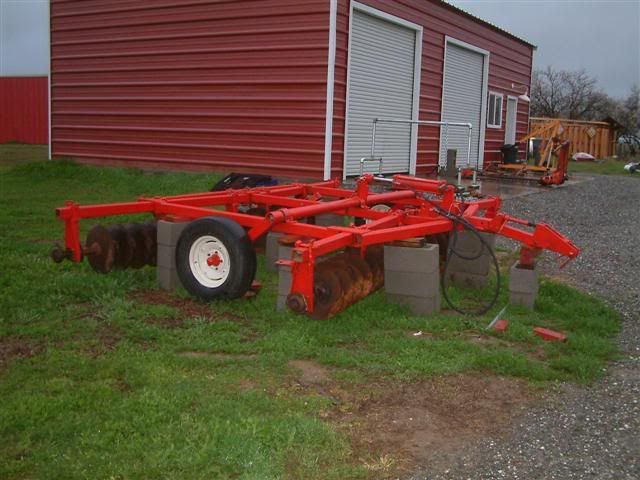
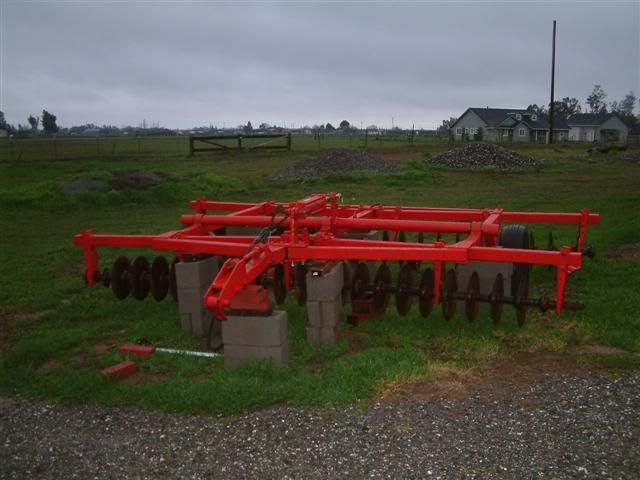
FWJ, I think the main point you are overlooking is ground contact. A 3-pt disk remains relatively flat as it moves over uneven ground, unlike a pull-type or transport where each section is more free to move independently. That is why an equal width 3 pt can pull just as hard or harder, and not do as effective of job on each passs, even if has more weight on each blade. One section cutting real deep while (3) others are constrained away from the soil is not real effective use of power. Go out and look at both types if you get a chance, and you will see what I am talking about. I have used many discs over the years and more than one of every type mentioned (3 pt, pull-type, transport). Each type has a place. As I said, 3-pts are best for small acreage when transport is required. For those of us working a little more acreage without the need to transport, a pull type is a good option because they dont tie up much cash (I got my old, JD 8 footer for under $100 this spring). For big acreage, a transport is the only way to go. All three types have drawbacks (3 pt - less effective use of power, pull-type - transport issues, transport - cost and need for aux hydraulics), but each also has advantages and one of the three types may be best for any individual application. It sounds like FWJ believes the pull-type is not the best for anyone, regardless of thier situation. He is wrong for me at least as there is no type I would rather use. There are certainly some pull types that work better than others. My grandad swore by the Bissels, and they did cut real good but always left some ridging on the field. The JD I use now cuts just as good as the Bissels I have used, yet leaves no noticeable ridging. As far as 3 pts, both the 6.5 ft Ford and adjustable 7 FT MF that I have used were equally ineffective compared to transport or pull types. They are nice for when I run down the road to work up my uncle's garden or other small jobs like that however.