pull behind discs

   / pull behind discs #1  

tmarks

New member
Joined
Aug 7, 2009
Messages
3
Location
Fort Worth, TX
Tractor
Kubota MX 5100 2WD
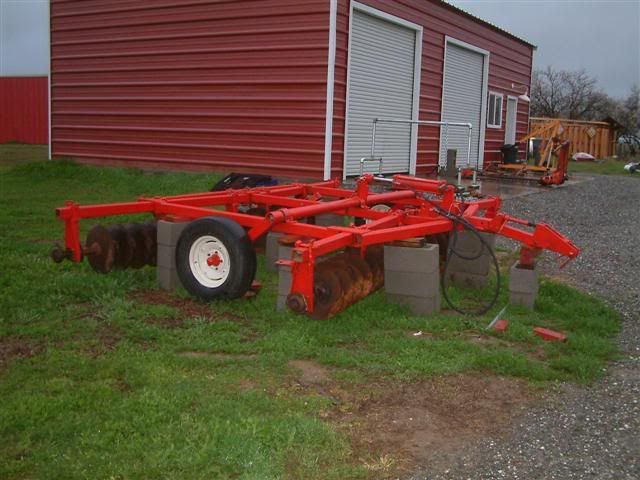
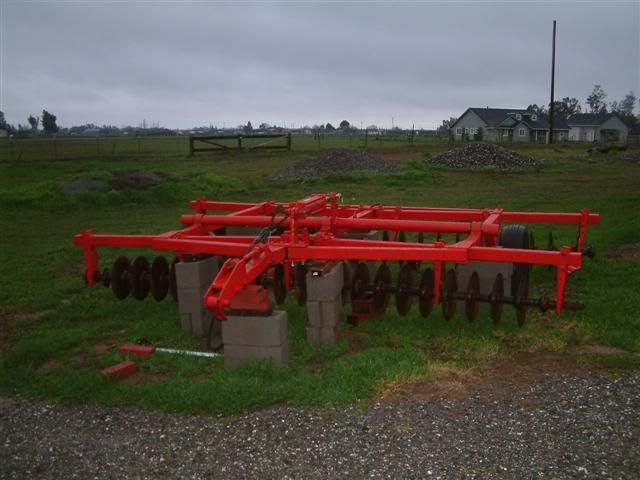
I've got a Kubota MX 5100 2WD with a Hay King 5 ft discs that attach to the 3pt hitch. I would like to get bigger discs that could cover more ground faster and that also have more weight. I want to get pull behind discs with the hydralic wheel lift, I'm not sure what they're actually called. I want to know how big I can go with this type of discs with my size tractor. Please let me know!

-Taylor
 
   / pull behind discs #2  
52 engin hp? hmm.. alot depends on soil type, and type of disc you get.. but I would think you coul pull an 8' remote lift style.

soundguy
 
   / pull behind discs #3  
I've got a Kubota MX 5100 2WD with a Hay King 5 ft discs that attach to the 3pt hitch. I would like to get bigger discs that could cover more ground faster and that also have more weight. I want to get pull behind discs with the hydralic wheel lift, I'm not sure what they're actually called. I want to know how big I can go with this type of discs with my size tractor. Please let me know!

-Taylor

Heard 'em called "wheel disc", "transport disc", ect. 52hp, 2wd will pull 8' to 10' in just about all conditions. (I routinely pull an 8'er behind a 2wd/47hp tractor with no problems)
 
   / pull behind discs #5  
One other big advantage of the pull, or transport type disc over the 3-pt is that they maintain much better ground contact and do a better job on each pass with less weight and using less power/fuel. 3-pts are ok for small gardens or other tight spots but if you have anything more than 1/2 acre or so, you are far better off with these other types. A old, 8 ft, JD pull-type works good for me, even on a 2wd tractor with just 20 hp, but I dont have any transport issues. I also have a 6.5 ft, Ford 3pt, which has larger wheels but is far less effective due to the contact problem. That one takes about 30 hp to operate and takes a few more passes to get the job done. If you do significant acreage and need to move over roads, then a transport type is the best way to go and anything in the 8-12 ft range will work well for you. Those 3 pts types are easy to sell as most foodplotters and such dont know that they are about the least effective type of disc that there is for all but the small time gardener. It sounds like you learned that lesson already.
 
   / pull behind discs #6  
One other big advantage of the pull, or transport type disc over the 3-pt is that they maintain much better ground contact and do a better job on each pass with less weight and using less power/fuel. 3-pts are ok for small gardens or other tight spots but if you have anything more than 1/2 acre or so, you are far better off with these other types. A old, 8 ft, JD pull-type works good for me, even on a 2wd tractor with just 20 hp, but I dont have any transport issues. I also have a 6.5 ft, Ford 3pt, which has larger wheels but is far less effective due to the contact problem. That one takes about 30 hp to operate and takes a few more passes to get the job done. If you do significant acreage and need to move over roads, then a transport type is the best way to go and anything in the 8-12 ft range will work well for you. Those 3 pts types are easy to sell as most foodplotters and such dont know that they are about the least effective type of disc that there is for all but the small time gardener. It sounds like you learned that lesson already.

I agree. I pull a fairly heavy 20", 20 disc Leinbach for food plots and am usually disappointed on the penetration unless the conditions are perfect (recent rains). It's frustrating to have to make 6 passes and it really can be slow. I just bought a plow and am anxious to see how the disc works when the ground has already been plowed. I don't ever see the pull type around here. What makes it work better? Is it just the weight? I am sure they cost mote than a 3 pt. model.
 
   / pull behind discs #7  
HCJ, what part of the upstate you from? I live in Hickory Tavern. [Gray Court]
 
   / pull behind discs #8  
I've got a Kubota MX 5100 2WD with a Hay King 5 ft discs that attach to the 3pt hitch. I would like to get bigger discs that could cover more ground faster and that also have more weight. I want to get pull behind discs with the hydralic wheel lift, I'm not sure what they're actually called. I want to know how big I can go with this type of discs with my size tractor. Please let me know!

-Taylor

Wheel disc.
Here's mine. It's a 1960s era Minneapolis Moline KA-1300, actually made by Krause, one of the big names in farm implements. Paid $600 for it last Dec.

DSCF0134Small.jpg


DSCF0133Small.jpg


It's 13-ft wide, but I removed several of the outer pans to reduce it to about 10-ft wide so I can pull it with my 2008 Mahindra 5525 (54 hp engine, 45 hp pto). It has a double-action hydraulic cylinder to raise and lower the wheels.

I use it to prepare my hayfield in late Sep-Oct. The soil is pretty dry so it only digs in 4-5 inches which is OK for oat hay. I doubt that my 5525 could pull that disc in damp, soft soil without removing more pans to reduce the width.
 
   / pull behind discs #9  
HCJ, what part of the upstate you from? I live in Hickory Tavern. [Gray Court]

Zman, I live in Greenville but my property is near Fork Shoals on the Reedy River. I also am a member of a hunt club with 2000 acres near Princeton. I use my tractor at both places. How about you? Are you a hunter?
 
   / pull behind discs #11  
The claim that a pull type disc saves fuel over a lift disc is just....BOGUS.

Absolutely ridiculous.

The ONLY reason a disc would use less fuel is because it's doing LESS work. Changes in fuel consumption on the same tractor are due to changes in drawbar load. If the disc is worn out, has small diameter disc blades (which also reduces dish in the disc), and isn't mixing the soil, sure.....It'll pull easier and use less fuel per pass, but you'll EITHER make more passes, or do an inadaquate job. So long as you aren't interested in getting the job done right, or you're just doing a little patch that allows you to make multiple passes without tying up too much time, those antiques are OK. But if you want real performance, and don't like wasting time doing so, a transport disc, either wheel type OR 3-point, is the ONLY way to go.

There's a perfectly good reason why the old pull type disc's went out of production more than a half century ago. No one would waste their money on a new one when BETTER performance with LESS work was available. Their performance is mediocre compared to wheel types and 3-pointers. They don't level as well as a rigid frame disc, and they are ridiculously difficult to transport.

Wheel disc's tend to have more built in weight than most 3-pointers, giving them an edge, but a GOOD 3-pointer IN THE HANDS OF SOMEONE WHO KNOWS WHAT THEY'RE DOING is more than capable of laying down a nice seedbed. That said, I don't even count many of todays lighweight economy 3-point disc's as a valid piece. Just too light. Get a GOOD one and they're MORE than capable.

Worth considering also, some of the earliest 3-pointers were built EXTREMELY light to allow use on tractors that were a bit too small to handle a heavy disc. That rules them out in my book. Disc performance is 90% about the weight.

I farmed for near 40 years. When I first started, I owned a couple pull types. As soon as I could afford BETTER, they went to the auction. Maybe some wannabe upstart farmer still has 'em. But I wouldn't revert back to that pathetically slow, poor performing method for any reason. Maybe if you believe the moon is made of green cheese, the world is flat, and Santa lives at the North Pole, you can trick yourself into believing those old relics from a bygone era are better.
 
Last edited:
   / pull behind discs #12  
Did you loose a toe to a pull type when you were a kid or something? As I said, I have an 8 ft pull type that does a better job on each, wider pass than a 6.5 ft, 3 pt. It also can be pulled with a tractor having just 20 drawbar hp, while the 6.5 overloads a tractor with 25 drawbar hp and takes about 30 for proper operation. That is proof enough for me that at least for the models I use, (Ford 3pt, Adjustable JD pull-type), that less power and fuel are required by the pull type to do equal work. Now I do admit that this may not be true for all models but I know for sure that it is for the (2) I have. Remember that fuel usage is proprtional to horsepower required for a given task, and the 8 footer also covers more width on each pass besides taking less passes to get the feild smooth. How do you believe a pull type is less effective than a transport if there is not a need to move the disk over the road and you have plenty of turn around area at the end of you fields like I do?
 
   / pull behind discs #13  
Did you loose a toe to a pull type when you were a kid or something? As I said, I have an 8 ft pull type that does a better job on each, wider pass than a 6.5 ft, 3 pt. It also can be pulled with a tractor having just 20 drawbar hp, while the 6.5 overloads a tractor with 25 drawbar hp and takes about 30 for proper operation. That is proof enough for me that at least for the models I use, (Ford 3pt, Adjustable JD pull-type), that less power and fuel are required by the pull type to do equal work. Now I do admit that this may not be true for all models but I know for sure that it is for the (2) I have. Remember that fuel usage is proprtional to horsepower required for a given task, and the 8 footer also covers more width on each pass besides taking less passes to get the feild smooth. How do you believe a pull type is less effective than a transport if there is not a need to move the disk over the road and you have plenty of turn around area at the end of you fields like I do?


Still have all my toes.

Are you foolish enough to believe NO ONE ever moves a disc? And where I'm at, we don't believe in wasting land by leaving huge "turn-around areas" at the end of every field. We farm from fencerow to fencerow. If wasting time, land, and money is your goal, you're right on target.

You just proved MY point. If that 8'er pulls easier with less power, it's OBVIOUSLY doing less work. There's more to discing than just covering ground. If you aren't working the soil adaquately, you're just WASTING fuel. Worn out junk that doesn't get the job done isn't valid in ANY comparison.
 
   / pull behind discs #14  
FWJ, I think the main point you are overlooking is ground contact. A 3-pt disk remains relatively flat as it moves over uneven ground, unlike a pull-type or transport where each section is more free to move independently. That is why an equal width 3 pt can pull just as hard or harder, and not do as effective of job on each passs, even if has more weight on each blade. One section cutting real deep while (3) others are constrained away from the soil is not real effective use of power. Go out and look at both types if you get a chance, and you will see what I am talking about. I have used many discs over the years and more than one of every type mentioned (3 pt, pull-type, transport). Each type has a place. As I said, 3-pts are best for small acreage when transport is required. For those of us working a little more acreage without the need to transport, a pull type is a good option because they dont tie up much cash (I got my old, JD 8 footer for under $100 this spring). For big acreage, a transport is the only way to go. All three types have drawbacks (3 pt - less effective use of power, pull-type - transport issues, transport - cost and need for aux hydraulics), but each also has advantages and one of the three types may be best for any individual application. It sounds like FWJ believes the pull-type is not the best for anyone, regardless of thier situation. He is wrong for me at least as there is no type I would rather use. There are certainly some pull types that work better than others. My grandad swore by the Bissels, and they did cut real good but always left some ridging on the field. The JD I use now cuts just as good as the Bissels I have used, yet leaves no noticeable ridging. As far as 3 pts, both the 6.5 ft Ford and adjustable 7 FT MF that I have used were equally ineffective compared to transport or pull types. They are nice for when I run down the road to work up my uncle's garden or other small jobs like that however.

 
   / pull behind discs #15  
FWJ, I think the main point you are overlooking is ground contact. A 3-pt disk remains relatively flat as it moves over uneven ground, unlike a pull-type or transport where each section is more free to move independently. That is why an equal width 3 pt can pull just as hard or harder, and not do as effective of job on each passs, even if has more weight on each blade. One section cutting real deep while (3) others are constrained away from the soil is not real effective use of power. Go out and look at both types if you get a chance, and you will see what I am talking about. I have used many discs over the years and more than one of every type mentioned (3 pt, pull-type, transport). Each type has a place. As I said, 3-pts are best for small acreage when transport is required. For those of us working a little more acreage without the need to transport, a pull type is a good option because they dont tie up much cash (I got my old, JD 8 footer for under $100 this spring). For big acreage, a transport is the only way to go. All three types have drawbacks (3 pt - less effective use of power, pull-type - transport issues, transport - cost and need for aux hydraulics), but each also has advantages and one of the three types may be best for any individual application. It sounds like FWJ believes the pull-type is not the best for anyone, regardless of thier situation. He is wrong for me at least as there is no type I would rather use. There are certainly some pull types that work better than others. My grandad swore by the Bissels, and they did cut real good but always left some ridging on the field. The JD I use now cuts just as good as the Bissels I have used, yet leaves no noticeable ridging. As far as 3 pts, both the 6.5 ft Ford and adjustable 7 FT MF that I have used were equally ineffective compared to transport or pull types. They are nice for when I run down the road to work up my uncle's garden or other small jobs like that however.


Well....Looks like you missed the boat.....AGAIN.... Unless you're trying to disc over the top of a pile of boulders, a 3-point disc doesn't lose "contact" with the ground. No more so than any other disc. (Provided you actually know how to use a disc) Those old antique, obsolete, ancient pull types would float more, but that was their downfall in most cases. They didn't do anything to LEVEL a rough field. They'd just float up and down with every undulation instead of working the field into some semblance of level.

I can't do anything about your inability to use a 3-point disc correctly. That's on you. I have no problems with mine. It performs just as well as my IH #370 wheel disc (12'er). Both leave a perfectly level, well tilled seedbed. Both will operate to the hubs in plowed ground. The ONLY difference is the width.

There hasn't been a floating gang wheel disc made since the Deere KBA vanished from the market in the late 1950's. Reason? No one was satisfied with the results. They faded away because they just weren't anywhere near as good as rigid frame models from Deere and other brands. They left fields full of hills, valleys, ridges, and clods. You need to look at facts. They quit making those outdated relics because there were far better choices available.

Anyone who's spent much time around various brands of discs will tell you Deere made some of the WORST examples ever built. They tend to ridge worse than any brand. I know of several die hard Deere owners who wouldn't own a Deere disc if they were paid to. If yours ISN'T ridging, most likely it's related to the fact that yours pulls so easy, which is on account of the fact it isn't working very well. It won't ridge if it isn't moving soil because of being worn out. More proof? If it were working at any reasonable depth, an 8'er would stop a 20 or 25 hp tractor in it's shadow. Again, there's quite a bit more to it than just running over ground. If you aren't accomplishing anything, you're just wasting time and fuel.

Oh, and by the way, you're wrong about another instance. Those old drawn disc's do have one group they are best for...... Someone who doesn't care what their field turns out like, has all sorts of time to waste, and can't afford something better, or just doesn't have anything more than a tiny little patch out in the middle of a bigger field may be satisfied with the second rate results they'll net you.
 
Last edited:
   / pull behind discs #16  
I definitely like my JD pull-type a whole lot. So much that I almost forked over another $250 for one that recently popped up on caigslist. I consider that $100 the best money I ever spent on a farming tool. I bet I have already paid for it in fuel savings alone this year. The corn growing in a field I worked exclusively with that disc is also growing better than another field, planted the same day, that I worked with the 3 pt model. Like I said, they may not be the best for everyone, and they may be the worst type possible for a particular individual, but they are great for some of us who dont have money to burn or a need to travel. Sorry if I hurt your feelings again FWJ, this is it for me on this thread, and once again, you may have the last word. Think about it and make it a good one.
 
   / pull behind discs #17  
I definitely like my JD pull-type a whole lot. So much that I almost forked over another $250 for one that recently popped up on caigslist. I consider that $100 the best money I ever spent on a farming tool. I bet I have already paid for it in fuel savings alone this year. The corn growing in a field I worked exclusively with that disc is also growing better than another field, planted the same day, that I worked with the 3 pt model. Like I said, they may not be the best for everyone, and they may be the worst type possible for a particular individual, but they are great for some of us who dont have money to burn or a need to travel. Sorry if I hurt your feelings again FWJ, this is it for me on this thread, and once again, you may have the last word. Think about it and make it a good one.

First off, you haven't "hurt my feelings". (This time or any OTHER time) Quite the contrary. I got a very big laugh out of most of what you've posted. I appreciate the comedy entertainment. Since most of what you posted only served to validate my opinions, I'd have to say this was fun AND rewarding.

I find it somewhat hard to believe that you would still use that 3-point disc in another field on the same day if your pull type was anywhere near as wonderful as you claim. Especially so in light of the fact you mentioned you don't have to do any traveling between fields. Why would you purposly use something you claim doesn't work very well? Something about that doesn't sound quite legit.....

If you can disc AND plant TWO fields in one day with a 20hp tractor and an 8' disc, what are they???? About an acre each! My tiny little sweet corn patch in my garden is 5 times that size! Around here we wouldn't even consider that farming. That's almost container gardening!
 
   / pull behind discs #18  
If you can disc AND plant TWO fields in one day with a 20hp tractor and an 8' disc, what are they???? About an acre each! My tiny little sweet corn patch in my garden is 5 times that size! Around here we wouldn't even consider that farming. That's almost container gardening!

That's just like comparing an average sized Kentucky Farm to One in Montana or Alberta.:D

Most of them would have trouble turning their equipment around on a Kentucky Farm.:D
 
   / pull behind discs #19  
I think there maybe some confusion of the definition of a pull type disc. The pull type discs I see have a set of wheels raised by hydraulic cylinder. There are some very old type pull discs that had no wheels. FWJ are you refering to the type with no wheels?
Discs (wheeled) in the farming world are not near as common anymore. Very good 21' discs with 22" blades and hydraulic wings can be bought for $2-3K. Pull type discs are larger, have more wt and cover more width. 3 pt discs just are too heavy with too much wt far back to be practical for larger tractors. Not sure if I have ever seen a 3 pt bigger than 10'. A wide 3pt large disc would require a lot of front end wt. Weight that doesn't help much but cause compaction when the 3pt is lowered. Much more no till farming today and in my area I don't see a disc in the field very often. A disc will actually increase compaction due to the wt of the tractor going back and forth over the field. Vertical tillage implements are now kind of fashionable in farming. They look like a disc but the discs are more vertical rather than angled like a disc. They can go deep and take a realativley lot of hp even if 18-21' wide.
A pull type disc is much easier to make turns and can follow the land coutour better if have ditches, terraces etc.
FWJ, there is no waste of land on the ends with a pull type, wheel disc. When finished discing, the turn around areas are disced last with pull type. Same as you would do with a 3 pt disc.


Tractor & Equipment Auctions

405 (A52706)
405 (A52706)
2017 Ram 5500 Bucket Truck (A56438)
2017 Ram 5500...
UNUSED FUTURE 350 HYD BREAKER HAMMER (A52706)
UNUSED FUTURE 350...
500 BBL FRAC TANK (A58214)
500 BBL FRAC TANK...
iDrive TDS-2010H ProJack M2 Electric Trailer Dolly (A59228)
iDrive TDS-2010H...
KBH Tank Trailer (A56438)
KBH Tank Trailer...
 
Top