Pulling tres from front or back

/ Pulling tres from front or back #22  
What I am trying to do is to direct the fall. I hook the rope to the tree and tractor and put tension on the line. I then cut a notch on the side of the tree in the direction that I want it to fall and then I make the relief cut so that the tree will fall over towards the tractor. Sometimes the tree will not fall and then I go get on the tractor and put it in reverse to apply enough force so that the tree will go ahead and fall.

I am talking about sweet gum trees probably 12-15 inches in diameter and 30 to 50 feet tall. He rope I am using is a arborist bull rope that is rate for 8000 lbs. I feel like I am safer being In
The tractor than I am standing under a tree that for whatever reason doesn't want to fall over. Sometimes you cut the notch and the felling cut and the tree just stands there. I don't want to cut through the hinge while trying to get the tree to fall. am I doing this wrong?.

Thanks
Good - more data gum tree < 15" D(BH?) is on the small side.
I cut down several 20" to 24" about 2 years ago. Had one split from the cut to about 15' up. They are mostly shelving on my pallet racks now.

Use at least enough rope/chain so when the tree is down you've got 10 extra feet.
With a NH 3930 you've got a fairly heavy tractor about the size of my M4700. If you've got enough weight in the back (so it doesn't lift when you pull) try and get the fastening device about 10 or so feet up the tree, the higher the better. DON'T put tension on the tree TOWARDS the fall direction where you are cutting the notch (https://www.osha.gov/SLTC/etools/logging/manual/felling/cuts/notches.html) wait until the notch is cut. I sometimes even give it a slight pull the other way, helps prevent the saw from getting stuck.

After the notch is cut put just a slight tension on the tree while you make the back cut. If your falling notch is half the tree (< 15" DBH) as soon as you are satisfied with what you have for a back cut you should be able to pull it over, even with a large hinge. Using wedges alone is maybe more "professional" but I've had to take down about 5 trees on my lots where there is a house, a fence, or some other structure where damage is a no no and tension on the tree helped ensure success and lessened the tension on me. And always be careful of interactions with other trees, especially if there are any vines involved.
 
/ Pulling tres from front or back #23  
What I am trying to do is to direct the fall. I hook the rope to the tree and tractor and put tension on the line. I then cut a notch on the side of the tree in the direction that I want it to fall and then I make the relief cut so that the tree will fall over towards the tractor. Sometimes the tree will not fall and then I go get on the tractor and put it in reverse to apply enough force so that the tree will go ahead and fall.

I am talking about sweet gum trees probably 12-15 inches in diameter and 30 to 50 feet tall. He rope I am using is a arborist bull rope that is rate for 8000 lbs. I feel like I am safer being In
The tractor than I am standing under a tree that for whatever reason doesn't want to fall over. Sometimes you cut the notch and the felling cut and the tree just stands there. I don't want to cut through the hinge while trying to get the tree to fall. am I doing this wrong?.

Thanks


Get some felling wedges. They will take care of 90% of the cases like this.

If the tree is truly leaning away from the notch and won't go in the direction you want, but is not leaning so much that it can still go in the direction you want, sure, use a rope to the tractor. Most tractor tires are uni-directional, so they have better traction going forward. But you shouldn't be pulling so hard that traction is an issue (otherwise you're trying to fell the tree in the wrong direction). I'd also suggest using a long enough rope that you can change the pull direction with a pulley block, so that you are not pulling the tree towards you. That is dangerous for several reasons, including what happens if the rope snaps. I like using a pulley block so that the tractor is moving 90 degrees or 180 degrees to the direction of the fall.
 
/ Pulling tres from front or back #24  
IMO...cutting trees is all about experience...you should learn something from almost every tree you cut...unless it's a tree farm they are all a little different...
...if there is full, clear range for trees to fall you can practice "steering" a fall by leaving just a bit more meat on the side of the tree where you want to "steer" it...regardless of your notch/natural lean etc..

IMO before cutting any tree...you should stand at the base and "really" look at the way it stands (sight upwards from the trunk)...it can be very deceiving from different perspectives as to which way a tree naturally wants to fall...
 
/ Pulling tres from front or back #25  
IMO...cutting trees is all about experience...you should learn something from almost every tree you cut...unless it's a tree farm they are all a little different...
...if there is full, clear range for trees to fall you can practice "steering" a fall by leaving just a bit more meat on the side of the tree where you want to "steer" it...regardless of your notch/natural lean etc..

IMO before cutting any tree...you should stand at the base and "really" look at the way it stands (sight upwards from the trunk)...it can be very deceiving from different perspectives as to which way a tree naturally wants to fall...
And interacting with other forces of nature such as wind and disease (rot) can quickly change a tree's "inclination" to fall in a certain direction.
 
/ Pulling tres from front or back #27  
I agree with a lot of the above. Another problem, besides risk of barber chairing, with putting tension on tree to direct / change the fall direction , is that as when you are doing the back cut and the tree starts to move , you then lose all the tension in the rope and then gravity directs the fall, which may be up to 90degrees away from the intended direction with the rope now slacked.
Cutting without tension, with a wedge so your saw doesn't get pinched, leaving the hinge, and then using the tractor to pull the tree "over center" , using the hinge, to where gravity then takes over again as it falls in intended direction is ok (IMO)
Likes others said, every tree should be a learning lesson.
 
/ Pulling tres from front or back #28  
Don't pull from your front axle - it was never designed for those forces.
Pull from the drawbar (the one that's under your rear axle, not on the 3pt hitch) with a clevis, as Coby suggested.
Use Polyester Double Braided rope for grunt work - low stretch (& snap-back), good UV & abrasion resistance, fair price and easy to tie knots in.
I'm assuming that the tree has been properly notch cut & hinged, prior to the pull with the rope.
Use a bowline hitch to attach the rope to the clevis and you will be able to untie it when you're done pulling.
With this arrangement, the rope will most likely rise from the drawbar to the tree where you've tied off for your pull.
This will create a vertical force component that wants to lift your rear tires off the ground and reduces your traction.
For this reason, and to minimize the risk of snap-back, get a snatch block and use it!
Fasten the snatch block to a solid tree trunk, as low as you can, so you can neutralize or even reverse that vertical force component and actually get some added down force on your rear axle.
The snatch block will redirect your pull, putting you out of the line of action, thereby reducing the risk (to you) of snap-back.
By redirecting your pull, you will better be able to watch the tree during the pull.
In addition, redirection will allow you to select a path that provides the best traction, while pulling in the optimum direction to get the desired fall.
 
/ Pulling tres from front or back #30  
I'm with the others who say pull from the drawbar - the front axle is not made to pull. I have a Wallenstein log winch and it has a screen to protect you in case of a cable break. Sounds like you have a good rope but pulling with a tractor could put more weight than the rope is rated for - if it snaps you have a lethal weapons headed your way.
You might get some additional and specific information by checking out forestry forum.com and asking the same question.

Nobody is trying to put you down, we just want you around a lot longer. Safety is what it is all about.
 
/ Pulling tres from front or back #31  
I won't comment on whether what you are dng is right or wrong. What I do is run the line down to the base of a tree that is in the direction you want it to fall. Then run it through a snatch block to the drawbar, and drive in the opposite direction away from the falling tree.

Agreed, 100%, if you're going to use a rope or cable.

If I recall correctly, Sweet Gums have a straight trunk and unless it's going to hang up in adjacent trees, if you know how to fell a tree you shouldn't need the tractor at all. Look on the internets for how to fell a tree with a chain saw.
 
/ Pulling tres from front or back #32  
I'll add that you should check out felling by boring through the tree after establishing the face. By doing this you can make a perfect hinge of the ideal width before cutting out through the back of the tree to fell it. You can also leave a "trigger" at the back to double check the area nearby and your escape route. I learned this method from FISTA, a logging safety educator in WI. You should look it up, once I learned to do that and properly use wedges, I became much more confident felling trees.

I agree about not pulling by your axle, though. If you need to pull, the frame is better.

MB this is a technique I hesitate to give to someone who I do not know their prowess with a chainsaw. I started my reply with a similar technique of plunging into the tree and then wrapping the cut around the tree. This is a useful technique for a bar smaller than the trunk width but I cancelled it before I sent it not knowing the operator, his chainsaw and how experienced he was with one. In this case I felt "simple" was best.
 
/ Pulling tres from front or back #33  
A 30' to 40' tree, I look for widow makers and then push with the loader. Put the loader up against the tree putting a little force on it. Make your direction notch and felling cut leaving about an 1" or so of wood. Then use the tractor to push the tree over. If the root ball isn't big you might be able to skip cutting all together and uproot the tree as you push it over. But I also have uneven land and will never tie my tractor to a tree that's going to fall. I've seen what happens when a tree decides it wants to pull a tractor tied to it down the side of a hill, it's not pretty.
 
/ Pulling tres from front or back #34  
When I am felling large trees, I tie a rope to the tree and the other end to the front axle of my new holland 3930. Then put the tractor in reverse and back up to pull the tree over. I attach the rope to the front axle because I have better visibility from the front than the rear.

Is it OK to put the tractor in reverse to pull or should I attach to drawbar and pull from rear. Another reason I attach to front axle is because it is a larger circumference to wrap the rope around whereas if I tie to the drawbar all I can do is wrap abound the ball that is attached to the drawbar.

Just want to make sure that I'm not harming my tractor by putting tension on it by having it pull in reverse.

Thanks
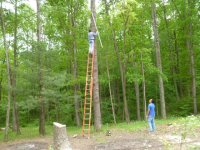
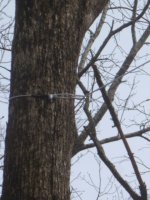
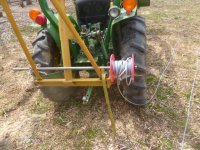
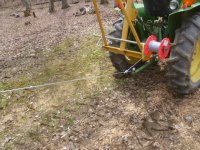
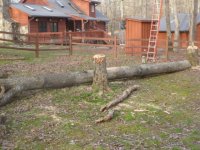
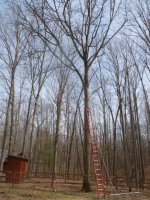
Albert, while I am no expert, I have felled about 150 trees on my property in the past 18 mos. Some of the smaller, like <5" dia, I can just push over with the FEL on my tractor. But for some of the larger, say 24" dia and some over 100' tall (mostly wht or red oak) this is my method: Using a 24' ext ladder, I climb to about 20', then use a 10' PVC pipe with a notch cut in it. I put my 1/4' shielded cable lasso around the tree and push it as high as I can with the PVC pipe. Usually get it about 32' up there. I put the tractor farther than the ht of the tree, and attach the other end of the cable to the ball on the drawbar. I tighten it up straight but done exert any force on it. Next I do the wedge cut and then the back cut. And sometimes I will add a center bore cut. Then I go back to the tractor (4WD) and use about 3rd gear (of 8) and just pull it over. Gravity takes over. Has worked flawlessly for me. I have the luxury of room to do this. I am not trying to 'thread the needle' re felling direction. I may be trying to avoid other fruit or "keeper" trees, but thats it.
Straight $ Tall ree Felling + Movie 5=26-13 007.jpg
Timberjack Photos 04-06-2013 006.jpgTimberjack Photos 04-06-2013 015.jpgTimberjack Photos 04-06-2013 012.jpgTimberjack Photos 04-06-2013 013.jpgTimberjack Photos 04-06-2013 023.jpgTimberjack Photos 04-06-2013 032.jpgTimberjack Photos 04-06-2013 043.jpg
 

Attachments

  • Timberjack Photos 04-06-2013 005.jpg
    Timberjack Photos 04-06-2013 005.jpg
    155.4 KB · Views: 105
Last edited:

Marketplace Items

2011 John Deere X540 Lawn Mower (A63116)
2011 John Deere...
John Deere 5090GN (A60462)
John Deere 5090GN...
Case 580K Backhoe (A64047)
Case 580K Backhoe...
SET OF (20) ACE CATTLE PANELS W/CONNECTION JOINTS (A63569)
SET OF (20) ACE...
2006 Toro SandPro 2020 Bunker Rake (A61572)
2006 Toro SandPro...
RoGator RG1100C (A63118)
RoGator RG1100C...
 
Top