Pumps, flow and restrictions.....

   / Pumps, flow and restrictions..... #21  
The best way to see this in action is watching Flow/pressure thru a High Pressure Flow Meter with Load valve inline on a positive displacement hyd pump......you can vary the resistance load while tweaking the valve watching flow basically stay the same (excluding efficiency factor of the pump )....:thumbsup:
 
   / Pumps, flow and restrictions.....
  • Thread Starter
#22  
If we are assuming pressure will be the same, flow would have to decrease cause restriction would either have to cause a pressure increase to get through the same amount of flow to do the same amount of work.
That is all correct!! But in my example flow cant decrease....it is "fixed", so increased pressure is what it takes.....


I will make an analogy for you.....you are pushing your car on the pavement.....not very hard to do.....car rolls into deep loose gravel....what does it take to keep pushing with the same speed (fixed pump flow)??.......just push harder !!! Higher pressure is what it will take to push fluid through a decreased orifice (restriction)....
Constant flow systems have variable pressure to regulate/control out put power...
Constant pressure systems (like the water supply to our garden hose), have constant pressure and variable flow to regulate/control the out put power

(A load sensing system can vary both flow and pressure to regulate/control out put power)

When the PRV, in the constant flow system, start by-passing/diverting flow, a constant flow system will start acting like a constant pressure system, and it will be possible the decrease flow with a restriction/orifice...

Of course in reality, there is internal leakage in pumps, valves seals etc....that will divert some smaller amount of flow, if a restriction increases pressure. Prime mover might also bog down a few rpm's from pressure load....but over all... in constant flow systems, my point is still, that it is not accurate to say flow increases if we use larger fittings, hoses etc....but we will indeed increase supply pressure, to keep flow constant....

There is a common misunderstanding that a hydraulic flow, at any time, can be varied with a variable restriction/orifice....that can actually only happen when part of flow can be diverted.....(internal leakage, PRV by-pass etc
The diverted flow by the pressure is all entirely a power loss.

 
   / Pumps, flow and restrictions.....
  • Thread Starter
#23  
The best way to see this in action is watching Flow/pressure thru a High Pressure Flow Meter with Load valve inline on a positive displacement hyd pump......you can vary the resistance load while tweaking the valve watching flow basically stay the same (excluding efficiency factor of the pump )....:thumbsup:

Great idea!!
If some one have a Hedland inline flow meter and a pressure gauge, it would be pretty nice to see a live video clip on this.....:thumbsup::thumbsup:
 
   / Pumps, flow and restrictions..... #24  
If I could get off my duff and figure out how to use "Youtube" then I'd do it....think my largest one is 100 gpm/6000psi.....

Maybe a Youtube/Google Search will find one:anyone:
 
   / Pumps, flow and restrictions.....
  • Thread Starter
#25  
If I could get off my duff and figure out how to use "Youtube" then I'd do it....think my largest one is 100 gpm/6000psi.....

Maybe a Youtube/Google Search will find one:anyone:
Well you start shooting the video, and I will help you with Youtube later....you also probably will need to edit and save video in a Youtube friendly size and format....I use Windows Movie Maker, WMM, for that...It is included in later version of Windows....I use win7 now, and I had WMM in my Windows Vista....do not remember about earlier versions just now...
But 100GPM is a BIG flow meter, to belong here at TBN....LOL....how did you come across that one???

Hedland flow meter on Youtube
 
Last edited:
   / Pumps, flow and restrictions..... #26  
how do you know temperature and viscosity is very critical at calculations of flow, when you do not know how to make the calculations?? LOL

Some 45 or so years ago I saw a book on "Fluid Dynamics" in the library. Even the symbols they used had me confused. I was using the book to sit on so I was higher and had a better view around the library!:thumbsup:

AKK: Think I have answered your question at least twice now.:laughing: Maybe an empirical test is in order.:thumbsup:
 
   / Pumps, flow and restrictions.....
  • Thread Starter
#28  
Some 45 or so years ago I saw a book on "Fluid Dynamics" in the library. Even the symbols they used had me confused. I was using the book to sit on so I was higher and had a better view around the library!:thumbsup:
So you mean you almost stuffed it up your bu**??
I think you read that book front to back multiple times, and then slept with it under your pillow.....Hhahaahah
AKK: Think I have answered your question at least twice now.:laughing: Maybe an empirical test is in order.:thumbsup:
I hope one of the younger "shop guys" will accept the challenge and make a video documented test....How about Sweden-Art, Design Engineer??


You did good Egon!
I know you have done your home work many times....:thumbsup:
You deserve a break now!!

I think I can "trigg" you soon again though....hahahaha:D
 
   / Pumps, flow and restrictions..... #29  
That is all correct!! But in my example flow cant decrease....it is "fixed", so increased pressure is what it takes.....


I will make an analogy for you.....you are pushing your car on the pavement.....not very hard to do.....car rolls into deep loose gravel....what does it take to keep pushing with the same speed (fixed pump flow)??.......just push harder !!! Higher pressure is what it will take to push fluid through a decreased orifice (restriction)....
Constant flow systems have variable pressure to regulate/control out put power...
Constant pressure systems (like the water supply to our garden hose), have constant pressure and variable flow to regulate/control the out put power

(A load sensing system can vary both flow and pressure to regulate/control out put power)

When the PRV, in the constant flow system, start by-passing/diverting flow, a constant flow system will start acting like a constant pressure system, and it will be possible the decrease flow with a restriction/orifice...

Of course in reality, there is internal leakage in pumps, valves seals etc....that will divert some smaller amount of flow, if a restriction increases pressure. Prime mover might also bog down a few rpm's from pressure load....but over all... in constant flow systems, my point is still, that it is not accurate to say flow increases if we use larger fittings, hoses etc....but we will indeed increase supply pressure, to keep flow constant....

There is a common misunderstanding that a hydraulic flow, at any time, can be varied with a variable restriction/orifice....that can actually only happen when part of flow can be diverted.....(internal leakage, PRV by-pass etc
The diverted flow by the pressure is all entirely a power loss.

Gotcha!!:thumbsup:
 
   / Pumps, flow and restrictions..... #30  
But 100GPM is a BIG flow meter, to belong here at TBN....LOL....how did you come across that one??

One of a few in my collection that started years ago when the guessing game of "Eyeball Detective" dictated a need for positive proof for troubleshooting these wonderfull things called hydraulic pumps.....Nothing beats seeing flow rates and pressures with your eyes and not your "Best Educated Guess".....:laughing:
 
   / Pumps, flow and restrictions..... #31  
You dont list the pressure capacity of the pump so an absolute answer cannot be given. The flow will either stay the same or decrease to zero as the pump blows up due the added pressure needed to maintain the positive displacement 10 gpm flow. At 500psi to drive 10gpm thru a 1/2sqin orifice we are talking some pretty viscous fluid. ... thats like -- 3/4" dia :eek:
larry

Sorry larry, you are making this more complicated than it is....you do not even have to think about fitting sizes....OK...any pressure can be considered way below your "pump capacity"....
In that case you have the answer. I just covered both possibilities. Sorry for the confusion.

The fitting/orifice size does not affect the answer. It was just a comment on the boundary conditions. You must be pumping molasses in January.
larry
 
   / Pumps, flow and restrictions.....
  • Thread Starter
#32  
In that case you have the answer. I just covered both possibilities. Sorry for the confusion.

The fitting/orifice size does not affect the answer. It was just a comment on the boundary conditions. You must be pumping molasses in January.
larry

You were fine Larry!:thumbsup:
 
   / Pumps, flow and restrictions..... #33  
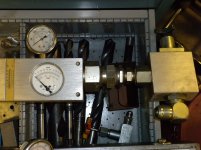
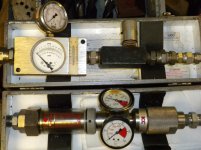
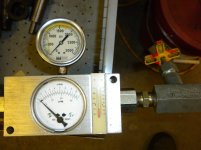
Here's a look see at these wonderful things we call "Flow Meters".....simple yes, but they do the trick.....notice they all have some sort of load valve...

Funny how most all of the posts here on TBN mention using pressure guages to troubleshoot but, hardly ever hear of a Flow/Pressure Test being done.....Best way to see AKKAMAN's reasoning's for this thread without all the Engineering/Mathematical Analysis .....(Not that it's not important:thumbsup:)
 

Attachments

  • Shop tools 001.jpg
    Shop tools 001.jpg
    734.2 KB · Views: 284
  • Shop tools 002.jpg
    Shop tools 002.jpg
    818.8 KB · Views: 228
  • Shop tools 003.jpg
    Shop tools 003.jpg
    737.5 KB · Views: 197
   / Pumps, flow and restrictions..... #36  
Here's a look see at these wonderful things we call "Flow Meters".....simple yes, but they do the trick.....notice they all have some sort of load valve...

Funny how most all of the posts here on TBN mention using pressure guages to troubleshoot but, hardly ever hear of a Flow/Pressure Test being done.....Best way to see AKKAMAN's reasoning's for this thread without all the Engineering/Mathematical Analysis .....(Not that it's not important:thumbsup:)

Nice setup!

I think the reason (mine anyway) that you don't hear mention of them here on TBN is simple, Pressure gauges are cheap-you can get a 0-3000 PSI gauge, short piece of hose, and a QD nipple to plug into a existing port on the tractor for $30 to $40 and virtually anyone with basic mechanical skills can use it accurately and effectively.

As you well know, flow gauges are expensive (cheapest I have seen is $150 and up), and you must plumb it in to the system, often requiring many fitting and/or adapters-plus a set of manuals to tell where the test ports are if there even is any.

The average backyard mechanic can test for pressure, and even adjust PRV's with very basic skills and tools, but to test for flow is a whole 'nother story!
 
   / Pumps, flow and restrictions..... #37  
So, now the question becomes ... What is the pressure needed to drive that same flow thru an orifice having half the area?
larry
 
   / Pumps, flow and restrictions.....
  • Thread Starter
#38  
So, now the question becomes ... What is the pressure needed to drive that same flow thru an orifice having half the area?
larry

becuz pump keep delivering the same flow
 
Last edited:
   / Pumps, flow and restrictions..... #39  
Something is still not right here. With a constant rpm, on a gear type pump, the volume through a tube will be the GPM's for the pump, with no or little pressure. If you start decreasing the output of the hose/line, with smaller orifice, the pressure will increase, and the velocity through the orifice will increase. The smaller the orifice, more pressure is developed, until you close it off completely, and the pump develops burst pressure. Is this correct?
 
   / Pumps, flow and restrictions..... #40  
Something is still not right here. With a constant rpm, on a gear type pump, the volume through a tube will be the GPM's for the pump, with no or little pressure. If you start decreasing the output of the hose/line, with smaller orifice, the pressure will increase, and the velocity through the orifice will increase. The smaller the orifice, more pressure is developed, until you close it off completely, and the pump develops burst pressure. Is this correct?

Yes.:)

Also in a closed loop system as the aperture gets smaller the fluid may heat up, change characteristics, and result in a loss of NPSH to the point no fluid is being pumped.:thumbsup:
 

Tractor & Equipment Auctions

2017 FREIGHTLINER M2 26FT NON CDL BOX TRUCK (A59905)
2017 FREIGHTLINER...
John Deere 3025E (A53317)
John Deere 3025E...
Chevrolet 2500 Flat bed (A56438)
Chevrolet 2500...
2017 Jacobsen 3551 HOURS (A56859)
2017 Jacobsen 3551...
2010 Honda CR-V SUV (A59231)
2010 Honda CR-V...
2022 John Deere 4052M MFWD Compact Utility Tractor with 400E loader - Bucket, Forks and Grapple (A55314)
2022 John Deere...
 
Top