Pushing the budget..

/ Pushing the budget.. #21  
Let me give some feedback and clarification- this pole barn uses one type of truss, and the true height from the crete floor to the bottom of the truss is their advertised wall height. So, it would indeed be 12ft or 14ft clear height. The footprint can't really get any larger, so that is why I'm wanting to go higher. I think a likely route will be that I will do the 14ft increase now, and just not do any concrete until after the barn is finished.

2 reasons: One is that the ground hasn't been cleared due to weather in SC. I think it would be wise to let the ground settle for a solid month before the concrete is applied. The second reason, is that I'll cut the middle man out (why the crete is so $$?), and give me a chance to know what thickness I need. But it does sound like 5in would give me a 'warm and fuzzy' that I should be able to place anything on the floor in the future.

Anyone disagree to just hold off on the crete until after the build, and deal directly with the crete company? The other issue is that prices on crete are supposed to increase in the new year?

Concrete won't shouldn't increase much fuel prices are still real low. I wouldn't worry about letting the ground sit before pouring concrete you'll have to compact it regardless. It is harder to pour concrete inside a building just from the standpoint of getting a truck around it and screeding
 
/ Pushing the budget.. #22  
In my experiences site preparation is much more important than the thickness of the concrete. I wouldn't consider pouring on fill unless it has been properly compacted.
 
/ Pushing the budget.. #23  
I would tell them to stick the fiber where the sun doesn't shine!
I had a 40' X 65' slab poured 15 years ago and they bragged that with fiber I didn't need re-bar or road mesh.
I can show places where the concrete has cracked and heaved over 1" and the ground was compacted.
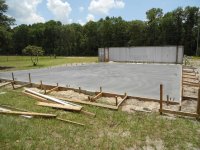
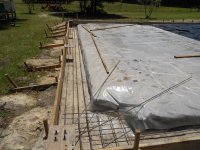
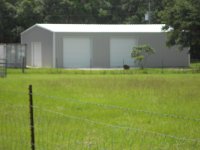
Pics are of slab and 40' X 60' X 14' building I had put up in May. Concrete guys were FIRST CLASS! Slab is perfect, I have done concrete work and have even driven the trucks.
Pic was taken before they added mesh placed on chairs then poured.
 

Attachments

  • DSCN0718.JPG
    DSCN0718.JPG
    716.8 KB · Views: 236
  • DSCN0711.JPG
    DSCN0711.JPG
    717.9 KB · Views: 258
  • DSCN0773.JPG
    DSCN0773.JPG
    808.7 KB · Views: 233
/ Pushing the budget.. #24  
I would tell them to stick the fiber where the sun doesn't shine!
I had a 40' X 65' slab poured 15 years ago and they bragged that with fiber I didn't need re-bar or road mesh.
I can show places where the concrete has cracked and heaved over 1" and the ground was compacted.
Pics are of slab and 40' X 60' X 14' building I had put up in May. Concrete guys were FIRST CLASS! Slab is perfect, I have done concrete work and have even driven the trucks.

Pic was taken before they added mesh placed on chairs then poured.

Stimw
If your slab heaved over an inch , you have either a subgrade or drainage problem.
Fiber is great for stopping cracks in thin concrete slabs
 
/ Pushing the budget.. #25  
Stimw
If your slab heaved over an inch , you have either a subgrade or drainage problem.
Fiber is great for stopping cracks in thin concrete slabs

I was thinking the same thing, about heaving or settlement.

Fiber is for controlling cracks from curing, which should be minimal if you cut with in 24 hours of pour, and don't soup it up with too much extra water
 
/ Pushing the budget.. #26  
If this is a pole barn with standard skirt, they wouldn't pour the floor until after the barn is up anyhow, so it can't hurt to wait. However, make sure you have a dependable concrete guy lined up to do the work. I had a heck of a time getting someone to do my barn floor. It was to the point where I was ready to have the concrete truck show up and and do the finishing myself, because I was sick of dealing with flakey contractors. Finally called the contractor who had given me an early, timely, but high bid, and they came out and did it. I paid about 25% more just to get someone who would show up when agreed and do the job.

One holdup was that I couldn't finalize installation of the sliding doors until the floor was in, so the concrete baloney was screwing up the rest of my plans. The barn was built in about 3 days, and then I wasted weeks waiting for the concrete floor.

All that is a way to say that if you have a reliable, trustworthy, dependable plan to get the floor put in at a time that fits in well with the barn construction and its completion and future use, do it, and don't wait. Once the floor cures you can move into the barn and start using it. Would be a pain to have to move everything out to pour a floor later on.

Also, going back to the pole barn, normally you want to have the site leveled and prepped before they begin construction. In most cases, the grade needs to be within about 6-9" of level across the whole site. While doing the grading, you're also laying the groundwork for the floor. In my case, I built up the grade and compacted it over a couple weeks well in advance of the barn construction. When the barn builders showed up, they drilled their post holes and built the barn. Afterwards, I used my tractor to carefully level out the post hole spoils inside the barn, put down gravel to bring the grade level up to 4" below the final floor height, and use a plate compactor to settle everything into place.
 
/ Pushing the budget.. #27  
If the fiber concrete is in stead of rebar from my experience that would be a poor choice. I would have a rebar grid and up the strength of the concrete and stick with a 4" floor.

Second that. The micro fiber is only good for shrinkage cracking. I'd spend the money on getting a 3x3 grid of #4 bars in the 4" 4,000 psi slab. If the mat is too expensive because of the labor, then look at a macro fiber or steel fiber. The problem with those products is that they stick out of the slab and make finishing difficult.

I'd go higher with the building. 12' of clearance really isn't enough because it forces you down to a 10' door. Also, with additional height you have a chance to put wing additions on at a later date. Yes, if you build it you'll fill it. A 30x50 building fills up pretty quick.
 
/ Pushing the budget..
  • Thread Starter
#28  
Guys, I think I'm going to pull the trigger and get both done at the same time. I've always received sound advice from the gents at TBN, so when guys say to do it the way you want the first time, I better listen! Whether needed or not, I reckon I'm going to go with the 5in concrete (never know what I'm going to store in the future:cool:. The 14ft height is not just for me, but a dedicated storage place for my Dad who lives about 300yds from me. I think I'm squabbling about $3.5K over a $40K building, so I'm sure I'll forget the cost once the last check is written.
 
/ Pushing the budget.. #29  
I'm not a fan of fiber. It's ok for what it does, but it does not replace rebar. When added to the mix and you are using rebar, it will help even more at reducing cracking, but nothing stops cracking. Concrete will get hard and it will crack. Nothing will stop this. Rebar holds the concrete in place so when it does crack, you don't notice it. For this to happen, rebar needs to be inside the concrete. Not on the ground, which is why chairs are used to keep it in the middle of the pour. Wire mesh does the same thing if it's kept in the middle, unfortunately 100% of the time that I've seen it, and in ever single picture that I've seen it done on here, it's laying on the ground and next to worthless. You cannot walk on mesh and pull it up into the middle of the pad, and walk on it some more and expect it to stay in the middle. Totally impossible to do this. Mesh should only be used on small pours when nobody walks on it like sidewalks.

The difference in strength from in thickness isn't going to be very significant. I'd just as soon add another sack to the mix and raise the psi higher that way.
 
/ Pushing the budget.. #30  
I'm not a fan of fiber. It's ok for what it does, but it does not replace rebar. When added to the mix and you are using rebar, it will help even more at reducing cracking, but nothing stops cracking. Concrete will get hard and it will crack. Nothing will stop this. Rebar holds the concrete in place so when it does crack, you don't notice it. For this to happen, rebar needs to be inside the concrete. Not on the ground, which is why chairs are used to keep it in the middle of the pour. Wire mesh does the same thing if it's kept in the middle, unfortunately 100% of the time that I've seen it, and in ever single picture that I've seen it done on here, it's laying on the ground and next to worthless. You cannot walk on mesh and pull it up into the middle of the pad, and walk on it some more and expect it to stay in the middle. Totally impossible to do this. Mesh should only be used on small pours when nobody walks on it like sidewalks.

The difference in strength from in thickness isn't going to be very significant. I'd just as soon add another sack to the mix and raise the psi higher that way.


I hate to even mention this as it will jinx me and my floor will crack like glass!!! :)

My 7 year old 6" 42'x50' rebarred shop floor has no cracks big enough to be visible. I power wash it a couple times a year so would see any visible cracks. It's cut in 10' squares. The cut lines are filled. So I guess it could be cracked in them and I wouldn't know it.

As to adding an inch to a 4" floor, wouldn't that increase it's strength by 20%?? If not, then why pour more than 4" in any floor?
 
/ Pushing the budget.. #31  
I can't say for sure if concrete works that way or not. More volume adding more strength as a direct measurement. My understanding is that a 3 1/2 inch slab with the right mix can be rated for 4,000 psi pretty easily. A 20 percent increase in thickness might raise the psi, but I don't know if it's a 20 percent increase or not. What is more important is what it is resting on, how much water was added to the mix so you don't weaken the psi strength of it, and how well it's held together. If you do everything right, then you can get away with something lesser then rebar. I've seen plenty of slabs poured without any rebar in it, or anything else holding it together. When I poured the slab for my house, either I, or my guy who did the finish work, got the math wrong and I had about five yards too much left over. I dumped it where I could create a parking pad close to the house without any prep work, or anything to hold it together. It's not consistant in it's thickness either, but close to 3 inches in some places, maybe a bit over in others. In the last ten years, I've driven my backhoe over it a couple dozen times. It weighs 14,000 pounds. I have two cracks in that pad that are big enough for grass to grow in it in a couple of places, but overall, it's not bad. The concrete is plenty strong enough to support that much weight, but without anything holding it together, it cracked, I think it would have cracked with rebar anyway. That's what concrete does.

Instead of paying for more material to be hauled on a cement truck, and paying more for labor to work it, and build taller forms, I would ensure that the concrete is poured at the ideal temperature. Do not add anything to it to work it in cold temps because that will make it a lot weaker. I would also make sure that it is so dry it barely comes down the chute. Most guys who do this for a living know that water makes it easier for them to spread it, but also that it makes it weaker. If you are not there to watch them, odds are good that they will add water to the mix. I always watch them to make sure this doesn't happen.

And of course, make sure your soil underneath the pad is compacted. I used to work for a guy driving a water truck in CA after getting out of the Marines. One of my jobs was to add water to the dirt being used to build up a pad. Not enough and it wouldn't compact, too much and it was mud. Getting it just right was fairly simple, but it was a process that required me to spray the pile while a guy in a wheel loader mixed it up before loading it into the dump truck and hauled to the pad. Then it was spread and compacted with a sheepsfoot roller. Once built up, the inspector would put a machine on top of the pad that measured compactness. I think it was supposed to be 98% or better to pass. Most of the time we got it on the first try. Twice they had to dig it out and do it again. In those cases, we didn't have enough water in the mix. So it was hauled back to where we where mixing it, and I sprayed it again while the operator picked it up, dumped it, picked it up and dumped it over and over again until he felt it was ready.
 
/ Pushing the budget.. #32  
Really, I think the best way to manage cracks in concrete is to eliminate the reasons they happen. Re-bar and screen are there to provide tensile strength, not manage cracks. Fiber is there to increase structural integrity on a fine scale. It doesn't add much overall strength but can help re-bar and screen do a better job, and it can help corners and edges from developing stress concentrations. It can prevent small cracks and help the concrete cure crack free, but it won't avoid big cracks that happen due to settling, or improper slab size. None of the "reinforcements" will do that. The only surefire way to avoid cracks is to have a properly compacted base and to put in keyways or use a saw to cut expansion joints, and allow room around the edges for the concrete to move independently from other structures that settle or move.

For my barn, we used keyway to divide the slab into 10x10' sections. Though I don't often see it done, I made sure to put expansion strips around all the poles, that way if the poles settled or moved seasonally, they wouldn't pull on the floor slab. So really, I have a bunch of 10x10 squares that are more or less free floating and sitting on a compacted fill and gravel base. If they do crack, it will be within the 10' sections and it will invariably be due to the base support. All the other sources of cracking have been eliminated.
 
/ Pushing the budget.. #33  
As Eddy said. I've poured concrete, supervised crews pouring, and inspected concrete work. The typical residential crew, if no one is watching, will normally try to pour at a 8" slump. It's not At All uncommon for the to add 20 gallons to a 5" mix, before even starting a pour, and add another 5-10 gallons as they go. I've poured concrete, and sure, I like a 6" slump, but really anything beyond that is Lazy.

Typical, 3000 psi mud, is normally ordered at 5" slump, and there is a margin of error from the plant, so anywhere from 4 to 6" could be on the truck. I've got no issue with adding 10 gallons to some 4" mud for slab work.

4" of good mud, poured over a good, compacted, no organics or clay base will be better than 6" of 4000 psi with wire and rebar, poured on mud, or muck.
 
/ Pushing the budget..
  • Thread Starter
#34  
I'm checking with the contractor now to see what the psi rating is of the 4in mix. That may be the deciding factor on whether to bump it up to 5in or not. I do believe that site prep/compaction will be the key, either way.
 
/ Pushing the budget.. #35  
I do believe that site prep/compaction will be the key, either way.

I agree. My newer shop is a 50x50x16 red iron building. It has a 6" concrete floor with fiber only, there is no rebar in my floor and after 7 years there are no cracks anywhere. We did pour 24"x24" footers under each door to reinforce the edges of the pad against the weight of heavy equipment driving on and off it.

i don't have a hobby shop, mine is mainly used for the farm. We normally drive tractors, combines, backhoes, skid steers, and semi trucks in and out of it.

It's also true that you can never seem to build it big enough. I'm already looking at adding on to mine. Good thing I spent the extra money on the expandable end wall.

Will there be any fill under your floor? It so, how much?
 
/ Pushing the budget..
  • Thread Starter
#36  
Builder says that the 4in is a 3,000psi mix.

Is it safe to say, that if the earth is compacted the same either way, that 4in concrete with fiber would have less life longevity than 5in with fiber? Or not enough to justify the financial difference?
 
Last edited:
/ Pushing the budget.. #37  
Builder says that the 4in is a 3,000psi mix.

Is it safe to say, that if the earth is compacted the same either way, that 4in concrete with fiber would have less life longevity than 5in with fiber? Or not enough to justify the financial difference?

I am a bit leary of this question. 6" is of coarse stronger than 4"; that's why we always spec it for drive ways, and 4" for sidewalks and house slabs. Is it 'worth it' that is a hard one to answer. Many many drive ways and garages use 4" and are just fine, but that doesn't mean the 6" wouldn't have been better. If you where to do 4" and it cracks up, then I would say 5" or 6" would have been better, but no proof it wouldn't have busted up as well.
 
/ Pushing the budget..
  • Thread Starter
#38  
If you where to do 4" and it cracks up, then I would say 5" or 6" would have been better, but no proof it wouldn't have busted up as well.

But at least if I went with correct compaction, solid control cuts, and 5in concrete, I could at least tell myself that I tried as much as possible...
 
/ Pushing the budget.. #39  
For me, I want a smooth floor free of cracks and imperfections if possible. So I did everything reasonable to improve my odds of ending up with that kind of floor. So far it's paid off.

Think about this for a second, then answer....... What is the most used part of a building???
 
/ Pushing the budget.. #40  
For me, I want a smooth floor free of cracks and imperfections if possible. So I did everything reasonable to improve my odds of ending up with that kind of floor. So far it's paid off. Think about this for a second, then answer....... What is the most used part of a building???

Floor?
 

Marketplace Items

2005 SBX-5 Box Blade Tractor Attachment (A61572)
2005 SBX-5 Box...
2018 INTERNATIONAL LT SERIES (A65643)
2018 INTERNATIONAL...
Westerns 8.5 Pro Plus w/Quad, Ultra Mount 2 (A62679)
Westerns 8.5 Pro...
JMR TREE BOOM (A61572)
2016 Kubota RTV X1140 (A65563)
2016 Kubota RTV...
1999 Nabors Chip Trailer (A62613)
1999 Nabors Chip...
 
Top