Sodo
Elite Member
- Joined
- Apr 21, 2012
- Messages
- 3,322
- Location
- Cascade Mtns of WA state
- Tractor
- Kubota B-series & Mini Excavator
go sit on LD1's 1100 lb bush hog that'll clear it up! :laughing::laughing::laughing:

I may have to change my opinion! I think I will do a little more work on it first before I do so, just to be absolutely sure. (I'm stubborn!) Either way, I'll be back to either gloat or eat crow.


think about how a forklift mast works. shifting the load farther out on the forks doesnt increase the downward force on the hydraulic cylinder. But does increase the forces on the rollers.
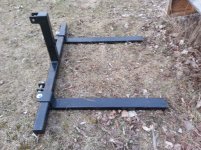
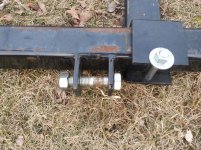
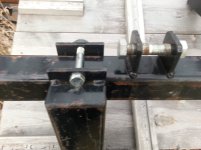
This looks like a lot time spent on something fairly simple. A couple of years ago I had a shop build me a toolbar with a pair of forks. the toolbar is overbuilt but I wasn't totally sure of what all i would use it for. It is T-shaped of 4x4x0.25" steel tubing and 60" wide. The forks are 3x2x3/16" steel 42" long. They have a C-shaped 1/4" thick plate welded on the base end with a 3/4" hole drilled through on the front side of the toolbar for a bolt to clamp them in place. Now I can have the forks almost 60" wide if I want to or whatever width I want to. Just loosen the 1/4" bolt and slide them. I have had enough load on it that the 3PH would not lift it - no issue for the forks. I have had over 2000#s on the forks and lifted it and carried it.
With this design I use the toolbar for making the raised beds in my garden. I am sure I will come up with other uses in the future but have not yet.
With all this being said the 3X2X3/16" tubing for the forks is plenty as my tractor has more lifting capacity than what the OP has. The question is how the forks are attached to the toolbar or frame. I do not like the receiver concept because of the tendency to concentrate the load at the back edge of the receiver tube. Your forks will bend much quicker with this concentrated loading. that is why I opted for tight clevis with a bolt for attaching the forks. The stress is in shear on the bolts and fully distributed bending.
LD1-
"Top link, I would go for parallel in the top hole. Then using a lower hole will cause the fork tips to pitch up more. "
Think you referring to the top hole-machine side?
Sorry, I was asking about the holes to use on the upper mounting plates, on the attacment.
The attachment upper mounting plates will have 2 drilled holes. I was thinking that when the top link is parallel to the lower links,
I should attach the upper link into the lower hole on the mounting plate?
Changing to the upper hole would have the same effect as if I was changing to the lower hole on the machine side?
Am I correct in saying a piece of 1/4" flat steel that is folded around in a u-shape would be a lot stronger than a comparable piece of channel?
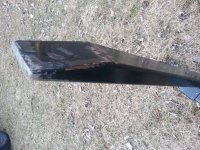
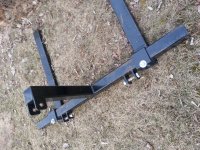
Flat plate bent into a channel is probably weaker than the comparable channel. Open sections (channel, angle) are not nearly as strong as closed sections (tubing) for any given weight.
 . Not to mention higher grade steel. And engineered amnt of torsional flex.
I am not sure I agree. That's why truck frames are not channel, they are bent and formed from flat material. I am sure tubing is stronger than channel, but I was comparing store bought channel to formed channel just as a comparison.
Chevy was using hydroforming to make part of their truck frames(they used to). From what I understand they took a piece of pipe, put it inside a big form, and blew it up with water pressure, expanding the pipe to the form. Besides bending it and forming the frame like you need it, working the metal cold makes it work harden and makes it much stronger than a comparable piece of steel that was "hot rolled".