You are using an out of date browser. It may not display this or other websites correctly.
You should upgrade or use an alternative browser.
You should upgrade or use an alternative browser.
raising pole barn posts
- Thread starter acausey1
- Start date
- Views: 32009
More options
Who Replied?
/ raising pole barn posts
#1
BryanM
Gold Member
This might sound stupid but what do mean raise the posts? Did they rot off or did they sink doo too too heavy weight?
20 20
Elite Member
I believe the person is trying to raise them from a lying position to a standing one???
You can make a jig that will raise them, but it is hard for me to explain. Are they going to be going into the ground, if so how far? Give us a little more info, like what types of tools etc you have handy?
You can make a jig that will raise them, but it is hard for me to explain. Are they going to be going into the ground, if so how far? Give us a little more info, like what types of tools etc you have handy?

magicheater
Veteran Member
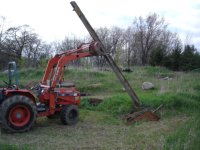
This is how I do it with my tractor and Loader Buddy. This pole is 16" at the butt end and 16' long. I can't imagine doing it w/o any equipment.
Attachments

JB4310
Super Member
I'm pretty sure you'll be able to just lift them up, the 16 footer anyway. get one end right over the hole and start lifting the other end, once the end starts sliding in the hole you should be able to walk it up. You might need another set of hands for the 20 footer and to hold them in place so you could brace them.
I've never done it myself but seems like it would be doable.
By yourself with no equipment might not be possible though.
JB.
I've never done it myself but seems like it would be doable.
By yourself with no equipment might not be possible though.
JB.
20 20
Elite Member
It can be done with what you have. The jig would look something like < . I've tried 3 times to explain and I can't{not very good with words} deleted what I started. I'll do a search and see what I can find.
MikeD74T
Veteran Member
Make a tripod with three 12'-16' 4x4's. Center tripod over hole. Slide post under tripod until centered horizontally over the hole. Attach block & tackle to tripod & attach other end to the post just off center. Lift post until butt will rotate into the hole then lower. Move tripod to next hole & repeat. Labor intensive but doable by one person. MikeD74T

George2615
Super Member
I'd say to ask for help from a strong young buck. Don't be afraid to ask for help. I'm sure you must know somebody who can help for a day or two. I think working alone with 16 - 20' poles is asking for an accident to happen. I put my 12' and 16' 6 x 6 posts in by hand. I had no young bucks to help but did have a couple older bulls like me that helped. In two days we had dug all the holes with a post hole digger and set 12 posts. Two of us carried the post to the hole then set one end in the hole and the two of us raised it by walking it up with no problem. Two of us held it level while the 3rd staked it in place. When we originally started we strapped the post to my loader bucket and set it in place. We decided that took too long and the posts weren't that heavy and we set the rest much quicker by hand.
I've done it w/16s. Using a couple 12' 2X4s and cross-braces, screw together a simple a-frame. Spike the apex of the frame to opposite sides of post 4' from top. Put 4' scrap of 1X6 or 2X6 in hole to give bottom of post something to slide against going in. With post lying on ground, place bottom against scrap in hole with a-frame extending away from hole. Starting at top end, raise post over your head, walking toward hole. As you continue to raise, A-frame will support post as it goes up. Remove A-frame from post and repeat...
I used a variation of this technique to erect 2 posts at a time (12' 2X4 on each post). Posts were tied together by top and bottom stringers, which extended in opposite directions to next pair of posts...made squaring up much easier...
Now that I have a BX, I would use FEL to put them up...
I used a variation of this technique to erect 2 posts at a time (12' 2X4 on each post). Posts were tied together by top and bottom stringers, which extended in opposite directions to next pair of posts...made squaring up much easier...
Now that I have a BX, I would use FEL to put them up...
Tex5String
Member
My wife and I set 20 utility poles, 12 to 15 feet, in 3-foot holes, using a small tractor, chain and an ancient design for lifting poles. First we set a greased 2x6 in the far side of the hole for the butt end of the pole to slide down(instead of tearing up that side of the hole). Our lifting device was a pair of 12-ft 2x6 boards, bolted together in a distorted X shape: a cross brace in the middle made it look like an giant A, but another 6" to a foot of 2x6 extended above the top of the A. To lift, we set the feet of the A a-straddle the hole, held the top of the A about 3 feet above the pole, fixed the chain around the pole near the top, then through the X at the top of the A, then over the hole to the tractor. As the tractor pulled horizontally, the A-frame converted the horizontal motion into a vertical lift on the top of the pole. The butt slid into place against the 2x6 waiting in the hole, and pretty quick the pole was high enough to slide into the hole. The chain does not slide through the crotch of the A-frame; rather the A-frame rises ahead of the pole and ends up leaning against the chain about a 30° angle towards the tractor. I suppose we moved the tractor a bit more than the length of the pole; I don't know if a come-along has that long a cable. A big hazard was mis-estimating the layout, in which case the pole tried to sweep around about 2 feet off the ground looking for somebody's leg to break. When I got on the tractor, the wife's job was to stand at the top end of the pole to steady it as it started up, but never inside the possible radius of a sweeping pole. These were 10-12" creosoted utility poles and quite heavy; your 6x6 stock is surely a lot lighter.
Good luck, and let us know how your job progresses!
Good luck, and let us know how your job progresses!
20 20
Elite Member
Looks like a couple of folks explained it to you I did a search and found some pictures but they weren't very good. As long as your jig is solid and you pay attention to what is happening this is an easy safe way to raise the beams.
I did a search and found some pictures but they weren't very good. As long as your jig is solid and you pay attention to what is happening this is an easy safe way to raise the beams.I follow you with the A frame. I am a little unclear when you say " spike it to the post on the opposite side". Thanks for all the advice.
Basically, you're creating a pivot point between the a-frame and post with the spikes...with pole and a-frame lying on ground, spikes go thru a-frame into post sides that are perpendicular to ground...
"Spikes" = large nails
Caveats: With 20-footers, you may need longer legs on a-frame. A "wet" PT 20-footer may require 2 people...
Last edited:

buckeyefarmer
Epic Contributor
I did 16' by myself by hand, was pretty easy. put one end over the hole, grab it about 2/3 of the way down and walk it up and let it slide in the hole.

Here are some similar links:

- Replies
- 19
- Views
- 3K

