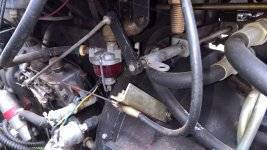
Replace sediment bowl with inline filter

   / Replace sediment bowl with inline filter #1  

angelugs

Bronze Member
Joined
Sep 19, 2005
Messages
63
Location
Central Illinois
Tractor
Jinma 284
I'm tired of screwing around emptying the sediment bowl on my 2005 Jinma 284 after trying to clean the inside of the fuel tank. Still getting rust and paint granuals showing up in the bottom of the bowl and probably will for sometime since the fuel tank is IMPOSSIBLE to remove without "digging a deeper hole" than I want to dig. I want to get rid of the sediment bowl and go to an inline filter set up. Does anyone know what the thread size is where the sediment bowl assembly attaches to the fuel tank? Also, if anyone has done this mod in the past I'd appreciate knowing what inline filter they used. I'd like to install something with a clear housing so I could see when the filter needs changing and if I could find a set up that uses a "reusable" filter that would be great.
 
   / Replace sediment bowl with inline filter #2  
I'm surprised you didn't vacuum out the tank when you had the chance. It isn't necessary to clean the bowl every time it collects some debris, that's what it's supposed to do. Let it get at least a quarter full before you clean it. Another thing the sediment bowl will do that a paper inline filter won't do is decant the fuel. Any water or moisture will collect in the bottom of the bowl. Also make sure that 100 mesh screen in the top of the glass bowl is in good condition. 1/4" NPT.
 
   / Replace sediment bowl with inline filter #3  
Get yourself a Racor style fuel polishing filter and put it between the fuel tank and the sediment bowl.
 
   / Replace sediment bowl with inline filter #4  
The OEM fuel bowl on my 2006 284 had a plastic bowl that quickly clouded and was difficult to monitor the contents. I bought one with a glass bowl from Ranch Hand Supply. Still crystal clear all these years later.

I did discover that the OEM fuel line with the banjo fittings is close enough to 1/4" ID that you can use 1/4" hose barbs. You can carefully slice through the ferrell at the factory crimp and pull the old fitting out and replace with any S.A.E. size and style you need.

I've probably had the glass bowl off twice in the 10+ years since the upgrade. Always comes off easy and re-seals with no fuss. I mostly use it to monitor for water and have never found any. The canister spin-on filter will pick up any debris should it get through. The spin-on is between the lift pump and the injection pump.
 
   / Replace sediment bowl with inline filter #5  
A Racor style polishing unit (I use a Conus base with a Genuine Racor spin on Water Bloc filter) will remove 99% of any entrained water and filter the incoming fuel from the tank down to 30 microns. Your primary OEM filter only filters to 80 microns and the sediment bowl won't even do that. The Racor water bloc filter has a screw in clear base with a drain in the bottom so you can dump the contents (water and debris) easily plus you can readily see what is collected in the bottom. Since I installed the Racor style base and genuine Racor filter, I've collected nothing in my sediment bowl because it don't get that far.

The Conus bases are under 30 bucks on Amazon. I consider them a very worthwhile investment. The genuine Racor spin on filters are about 30 bucks each at the Racor store.
 
   / Replace sediment bowl with inline filter
  • Thread Starter
#6  
I'm surprised you didn't vacuum out the tank when you had the chance. It isn't necessary to clean the bowl every time it collects some debris, that's what it's supposed to do. Let it get at least a quarter full before you clean it. Another thing the sediment bowl will do that a paper inline filter won't do is decant the fuel. Any water or moisture will collect in the bottom of the bowl. Also make sure that 100 mesh screen in the top of the glass bowl is in good condition. 1/4" NPT.
Well unfortunately I'm still fighting the "bio bug" so I figured I'd clean the inside of the tank as best I could. As you well know, vacuuming the tank doesn't do SQUAT to kill the "bug". The engineering on the fuel tank serves its purpose BUT it is NOT user friendly if you need to remove it. After draining the fuel, rinsing with water, filling with distilled white vinegar and allowing to soak for 72 hours, and rinsing again with water I'm still getting granules of what looks to be rust and paint. I was just wanting to alleviate the task of cleaning out the sediment bowl everytime I saw particles in it. Guess I was hoping for no more particles, at least after cleaning the tank. As for decanting the fuel, I thought about that after posting my request. If nothing else I may look for a sediment bowl with a drain on the bottom. Thanks for your reply. I figured I'd hear from you.
 
   / Replace sediment bowl with inline filter #7  
Well unfortunately I'm still fighting the "bio bug" so I figured I'd clean the inside of the tank as best I could. As you well know, vacuuming the tank doesn't do SQUAT to kill the "bug". The engineering on the fuel tank serves its purpose BUT it is NOT user friendly if you need to remove it. After draining the fuel, rinsing with water, filling with distilled white vinegar and allowing to soak for 72 hours, and rinsing again with water I'm still getting granules of what looks to be rust and paint. I was just wanting to alleviate the task of cleaning out the sediment bowl everytime I saw particles in it. Guess I was hoping for no more particles, at least after cleaning the tank. As for decanting the fuel, I thought about that after posting my request. If nothing else I may look for a sediment bowl with a drain on the bottom. Thanks for your reply. I figured I'd hear from you.
Ok, then I assume you're treating the fuel with a biocide. Hindsight being 20/20, after you flushed and washed your tank I think you left a lot of moisture behind, enough to create another interface where the process started all over again. So let me offer this advice with sequence for next time -
1) Drain all fuel from the tank, check screens in the banjo fittings, remove and clean all fuel lines (except hard lines) replace secondary fuel filter.
2) Pressure wash all insides and bottom of the tank, allow to drain.
3) Vacuum as much debris as possible from the tank.
4) Dry the tank thoroughly using a heat gun or hair dryer aimed into the filler neck. Do not use anything with a flame (compressed air has moisture in it).
5) Reconnect all fuel lines.
6) Add an appropriate amount of biocide to the tank according to tank size/instructions.
7) Top up tank with fresh fuel.
8) Continue with recommended dosing for at least three tankfuls. Follow up checking for "bugs".

Good luck!
 
   / Replace sediment bowl with inline filter #8  
One thing to keep in mind and that is, if you add a certified biocide like Powerservice Bio-Kleen and kill the algae, you still have to deal with the dead carcasses no matter what. The dead bodies will clog filters and cause fuel injection issues no matter what. One thing about a fuel polishing filter is, it will totally remove those dead bodies before they reach the engine and the Racor filter has a huge capacity for collection. As the filter collects the 'bodies' they will drop into the bottom bowl and you can open the drain and 'flush' them out before they can clog your primary filter or your sediment bowl strainer.

Hopefully you are using a real biocide and not some elixir that claims it kills microbial algae. The real thing will always have an MSDS label attached to the bottle.
 
   / Replace sediment bowl with inline filter #9  
My issue with sediment bowls is their limited capacity. With my tractors, because they are bigger, I have a lot of fuel flow when they are working and the fuel polishing unit captures everything. I have not changed a primary filter or the sediment bowl since I installed them. Put one on my diesel pickup truck as well, not that I drive it a lot with fuel at 6 bucks a gallon. I do have Power Kleen in the fuel tank on it as well. Some years back I had an algae issue with it and it cost me over a grand in replacement parts.
 
   / Replace sediment bowl with inline filter
  • Thread Starter
#10  
The OEM fuel bowl on my 2006 284 had a plastic bowl that quickly clouded and was difficult to monitor the contents. I bought one with a glass bowl from Ranch Hand Supply. Still crystal clear all these years later.

I did discover that the OEM fuel line with the banjo fittings is close enough to 1/4" ID that you can use 1/4" hose barbs. You can carefully slice through the ferrell at the factory crimp and pull the old fitting out and replace with any S.A.E. size and style you need.

I've probably had the glass bowl off twice in the 10+ years since the upgrade. Always comes off easy and re-seals with no fuss. I mostly use it to monitor for water and have never found any. The canister spin-on filter will pick up any debris should it get through. The spin-on is between the lift pump and the injection pump.
Thanks for your reply. Wonder if the set up is the same on the 2006 model as the 2005 model? I broke the bowl on mine and couldn't find anything with the right thread to fit the tank so had to purchase a complete unit from a Jinma supplier. Do you remember the part number for the Ranch Hand Supply unit? I did some checking around and found the thread specs on the OEM bowl assembly is 16mm x 1.50 fine. Did your replacement unit thread directly into the tank or did you have to change something?
 
   / Replace sediment bowl with inline filter
  • Thread Starter
#11  
Ok, then I assume you're treating the fuel with a biocide. Hindsight being 20/20, after you flushed and washed your tank I think you left a lot of moisture behind, enough to create another interface where the process started all over again. So let me offer this advice with sequence for next time -
1) Drain all fuel from the tank, check screens in the banjo fittings, remove and clean all fuel lines (except hard lines) replace secondary fuel filter.
2) Pressure wash all insides and bottom of the tank, allow to drain.
3) Vacuum as much debris as possible from the tank.
4) Dry the tank thoroughly using a heat gun or hair dryer aimed into the filler neck. Do not use anything with a flame (compressed air has moisture in it).
5) Reconnect all fuel lines.
6) Add an appropriate amount of biocide to the tank according to tank size/instructions.
7) Top up tank with fresh fuel.
8) Continue with recommended dosing for at least three tankfuls. Follow up checking for "bugs".

Good luck!
I've been using Power Service Bio Kleen everytime I've added fuel since my initial problem. There's no way of cleaning the tank without removing it, which would be a REAL nightmare, and then cutting it in two. I might as well purchase a new tank if I do that. This is why I thought of changing out the OEM sediment bowl and replacing with a unit I could watch for "crap" in the bowl and change the internal element or remove the element and clean it.
 
   / Replace sediment bowl with inline filter #12  
Thanks for your reply. Wonder if the set up is the same on the 2006 model as the 2005 model? I broke the bowl on mine and couldn't find anything with the right thread to fit the tank so had to purchase a complete unit from a Jinma supplier. Do you remember the part number for the Ranch Hand Supply unit? I did some checking around and found the thread specs on the OEM bowl assembly is 16mm x 1.50 fine. Did your replacement unit thread directly into the tank or did you have to change something?
My fuel tank had a 1/4" NPT fitting on the bottom of the tank. The original bowl had a threaded nipple on the top that screwed directly into the tank.
The replacement from Ranch Hand (second photo) also had the nipple on the top but I took the opportunity to use a couple of elbows to offset the fuel bowl to be a little more forward and a little lower for easier access. You can see where I removed the original fitting on the end of the hose and just used a regular hose barb to connect to the new bowl.

My parts manual lists the fuel tank as type II indicating that there was a revision somewhere before mine was built. It wouldn't surprise me a bit that they modified it to have SAE fittings to make it more acceptable to the US market. Most of the tapped fluid fittings in the block are SAE, not metric, although all the bolts are metric. This makes it really easy to work on the fuel, oil and coolant systems.

I can try to get some better photos tomorrow if you would like. Does your tank look like mine with the return fitting screwing into the front face? I can give you some pointers on getting the tank out from under the hood if you want. Provided your hood looks like mine. There were changes in hoods as well over the years. Post a picture or two of yours so we know if they are the same.
 

Attachments

  • 100_0272 (2019_02_19 01_42_27 UTC).JPG
    100_0272 (2019_02_19 01_42_27 UTC).JPG
    1.2 MB · Views: 157
  • WP_20200826_12_03_02_Pro (2020_08_26 18_04_50 UTC).jpg
    WP_20200826_12_03_02_Pro (2020_08_26 18_04_50 UTC).jpg
    1.7 MB · Views: 301
   / Replace sediment bowl with inline filter #13  
I've been using Power Service Bio Kleen everytime I've added fuel since my initial problem. There's no way of cleaning the tank without removing it, which would be a REAL nightmare, and then cutting it in two. I might as well purchase a new tank if I do that. This is why I thought of changing out the OEM sediment bowl and replacing with a unit I could watch for "crap" in the bowl and change the internal element or remove the element and clean it.
Power Service Bio Kleen is a good reputable product. I use https://www.amazon.com/Biobor-HUMBU...&sprefix=Hum+Bug+detector,aps,117&sr=8-1&th=1 to check my bulk storage tank.
I don't understand why you can't clean your tank in situ. It can't be any worse than my dozer. I only had a 2-1/2" fill tube to work from. I was able to wiggle around a pressure washer wand, and used a piece of 3/4" PVC pipe adapted to a Shop-Vac hose. The heat gun was no problem - I used a piece of 1" metal tubing to blow the hot air to the bottom of the tank, but an afterthought told me I could just use a couple of magnet heaters. Haven't had any issues since.
 
   / Replace sediment bowl with inline filter #14  
I just looked at the replacement bowl setups from Ranch Hand Supply and they show two different styles. You can see them here: Jinma Fuel Sediment Bowl

Also checked an online parts catalog and they list two different styles, one with a straight thread (metric) using a jam nut and seal and one with a tapered (NPT) thread. Both are still available and for less money than the after market replacement. I still would recommend the after market, as an upgrade.

Other after market replacement systems will probably require some kind of plumbing adapter and mounting bracket. I believe the metric fitting you have is referred to as a STOR BOSS fitting. If you look around a hydraulic fitting web site such as Clearwater or DIscount Hydraulics you can probably find an adapter or combination of adapters to get from what you have to what you will need for some of the other solutions.

The original setup on my tractor was: Tank - Sediment Bowl with screen - Lift pump - Secondary filter (NAPA Gold # 3195 at 10 Microns) - Injection Pump. As stated before the factory plastic bowl got cloudy and was leaking so I upgraded. The lift pump started leaking at the plunger seal which was just an o-ring. I couldn't keep it sealed so removed the lift pump and made a cover for the mounting boss. Then installed an electric lift pump and have never looked back. I bought my tractor in a crate and assembled it myself. At that time there was a really good document about how to do this and it recommended replacing all the factory fluids and filters with quality domestic products, which I did before it was ever started. 900 hours and 16 years later it still has the same fuel filter on it.

The only fuel related issue I have ever had is one winter I got caught with # 2 in the tank and while plowing snow at -18F it would run fine in the yard but when I got to the road at the top of the hill the wind blew the heat away from the engine faster than it could produce it and the fuel jelled up on me. Fortunately I was able to get it back to the yard and left it running at a very high idle while I ran to the truck stop for a bottle of 911. That worked and I didn't even have to replace the filter then.

Hope this helps
 
   / Replace sediment bowl with inline filter
  • Thread Starter
#15  
I just looked at the replacement bowl setups from Ranch Hand Supply and they show two different styles. You can see them here: Jinma Fuel Sediment Bowl

Also checked an online parts catalog and they list two different styles, one with a straight thread (metric) using a jam nut and seal and one with a tapered (NPT) thread. Both are still available and for less money than the after market replacement. I still would recommend the after market, as an upgrade.

Other after market replacement systems will probably require some kind of plumbing adapter and mounting bracket. I believe the metric fitting you have is referred to as a STOR BOSS fitting. If you look around a hydraulic fitting web site such as Clearwater or DIscount Hydraulics you can probably find an adapter or combination of adapters to get from what you have to what you will need for some of the other solutions.

The original setup on my tractor was: Tank - Sediment Bowl with screen - Lift pump - Secondary filter (NAPA Gold # 3195 at 10 Microns) - Injection Pump. As stated before the factory plastic bowl got cloudy and was leaking so I upgraded. The lift pump started leaking at the plunger seal which was just an o-ring. I couldn't keep it sealed so removed the lift pump and made a cover for the mounting boss. Then installed an electric lift pump and have never looked back. I bought my tractor in a crate and assembled it myself. At that time there was a really good document about how to do this and it recommended replacing all the factory fluids and filters with quality domestic products, which I did before it was ever started. 900 hours and 16 years later it still has the same fuel filter on it.

The only fuel related issue I have ever had is one winter I got caught with # 2 in the tank and while plowing snow at -18F it would run fine in the yard but when I got to the road at the top of the hill the wind blew the heat away from the engine faster than it could produce it and the fuel jelled up on me. Fortunately I was able to get it back to the yard and left it running at a very high idle while I ran to the truck stop for a bottle of 911. That worked and I didn't even have to replace the filter then.

Hope this helps
I'M POOPED!!! The family SUV needed a brake job so no "tractor time" today. I did take a couple of pictures of the tank and sediment bowl positions but truthfully I don't want to mess with downloading them from my phone to the computer tonight. After looking at the pictures you posted and comparing them with mine I think the set ups are the same. I don't know if I'll get back to the tractor tomorrow (Sunday) or not. When I do I guess I'll just bleed the air out of the lines and hope to get through the winter the way it sets. I would like to hear those "pointers" you mentioned about how to get the tank out. Don't want to tackle it now. It would be my luck we'd get a foot of snow and I'm too old to shovel my 200+ foot drive or too "proud" to ask anyone to do it for me.
 
   / Replace sediment bowl with inline filter
  • Thread Starter
#16  
Power Service Bio Kleen is a good reputable product. I use https://www.amazon.com/Biobor-HUMBUG01-HUM-BUG-Detector-Kit/dp/B007W0QK28/ref=sr_1_1?crid=1IADMNH7H8BRL&keywords=biobor+hum-bug+detector+kit&qid=1669446836&sprefix=Hum+Bug+detector,aps,117&sr=8-1&th=1 to check my bulk storage tank.
I don't understand why you can't clean your tank in situ. It can't be any worse than my dozer. I only had a 2-1/2" fill tube to work from. I was able to wiggle around a pressure washer wand, and used a piece of 3/4" PVC pipe adapted to a Shop-Vac hose. The heat gun was no problem - I used a piece of 1" metal tubing to blow the hot air to the bottom of the tank, but an afterthought told me I could just use a couple of magnet heaters. Haven't had any issues since.
I only buy 5 gal. of diesel at a time so I don't have to worry about storage tanks. It's kind of a crap shoot knowing how much Bio Kleen to use for just 5 gal. so maybe I've been a little stingy with it. Each time the tractor quits on me I remove the cover plate off the fuel gate and clean out the crap I find in there. After that she fires up again and runs for a while, probably less than 10 hours, then it's time for another cleaning. As far as why I can't get a GOOD cleaning on the inside of the tank, the fill tube extends about half way down INSIDE the tank and the diameter is 1 1/2 in., SUCKS BIGTIME!!! I'm assuming you've been reading the posts from piper184 on this thread and he's saying the tank removal chore isn't impossible. With winter coming on I don't want to get caught without my tractor running so I think I'll put "digging that hole" off till spring.
 
   / Replace sediment bowl with inline filter #17  
Just curious as to exactly what you are referring too when you say "remove the cover plate off the fuel gate". These are terms I am not familiar with.

The factory sediment bowl assembly is made up of the housing (which holds the shut off valve), the plastic (sort of see through) bowl, a seal and an ring that screws onto the bowl. I don't recall if there was an internal screen in the OEM assembly or not.

The replacement assembly I have uses a bail and thumb screw to hold the glass bowl up tight against the seal and the housing. There is an internal (and replaceable) fine mesh screen inside and the part that looks like a petcock is actually the shut off valve. To clean, turn off the fuel, loosen the bail thumb nut and move that to the side while holding the glass bowl. Carefully lower the bowl out and away for cleaning. Reverse the process and check for leaks. Takes only a minute or two.

The sediment bowl is for course material and water separation and the secondary filter is for fine particulate.

Are you getting so much crud out of your tank that it is completely filling the sediment bowl and blocking fuel flow at that point? If so, I have some ideas on how you can flush out the majority of that without removing the tank.

Do you know if there is a finger screen that sticks up into the tank where the sediment bowl screws on?

Are you familiar with a brake service tool called a vacuum bleeder?

Digging through my photos I have found a few others that might be of interest. One project was making external hold down clamps for the instrument cluster so I no longer have to fight the hidden brackets and the other was making nut plates for the hood hinges.

We are butchering the next couple of days but if there is interest in these subjects I could make some new thread posts about them in a few days.
 
   / Replace sediment bowl with inline filter #18  
Just curious as to exactly what you are referring too when you say "remove the cover plate off the fuel gate". These are terms I am not familiar with.
Ditto. New to me too.
 
   / Replace sediment bowl with inline filter
  • Thread Starter
#19  
Just curious as to exactly what you are referring too when you say "remove the cover plate off the fuel gate". These are terms I am not familiar with.

The factory sediment bowl assembly is made up of the housing (which holds the shut off valve), the plastic (sort of see through) bowl, a seal and an ring that screws onto the bowl. I don't recall if there was an internal screen in the OEM assembly or not.

The replacement assembly I have uses a bail and thumb screw to hold the glass bowl up tight against the seal and the housing. There is an internal (and replaceable) fine mesh screen inside and the part that looks like a petcock is actually the shut off valve. To clean, turn off the fuel, loosen the bail thumb nut and move that to the side while holding the glass bowl. Carefully lower the bowl out and away for cleaning. Reverse the process and check for leaks. Takes only a minute or two.

The sediment bowl is for course material and water separation and the secondary filter is for fine particulate.

Are you getting so much crud out of your tank that it is completely filling the sediment bowl and blocking fuel flow at that point? If so, I have some ideas on how you can flush out the majority of that without removing the tank.

Do you know if there is a finger screen that sticks up into the tank where the sediment bowl screws on?

Are you familiar with a brake service tool called a vacuum bleeder?

Digging through my photos I have found a few others that might be of interest. One project was making external hold down clamps for the instrument cluster so I no longer have to fight the hidden brackets and the other was making nut plates for the hood hinges.

We are butchering the next couple of days but if there is interest in these subjects I could make some new thread posts about them in a few days.
I thought for sure I read the term "fuel gate" somewhere on TractorByNet. If not then I'll own it. What I'm referring to is the mechanism that shuts off the fuel when you pull the control knob. The cover plate I'm referring to is located just above the fuel primer and mounts with four machine screws. When my tractor starts to sputter or won't start, I remove the cover plate and find gunk inside. I clean it out, put the plate back on and she starts up and runs fine for 8 - 10 hrs. then starts sputtering. I hightail it for the shed, due the deed and presto .... back in business. As for the "finger screen", yes there was one on the replacement bowl I installed but I cut it off too save the headache of having to drain my tank, remove the sediment bowl unit and clean the filter every time I had problems. Also, there is a metal screen filter tucked away in the top of the bowl unit. I wasn't getting a lot of sediment in the bowl but figured as long as I could see something in there I was going to have the gunk showing up in the fuel gate. Yes I know what a vacuum bleeder is but don't see how it would help me get the inside of my tank cleaned out. Appreciate the offer about other mods but not worrying about anything but the present problem I'm having. Hopefully, with your input, in the spring I can get the fuel tank off and give it a good cleaning.
 

Tractor & Equipment Auctions

John Deere 3025E (A53317)
John Deere 3025E...
2022 NEW HOLLAND 266BMM 66-INCH BELLY MOUNT FINISHING MOWER WITH SIDE DISCHARGE (A57024)
2022 NEW HOLLAND...
500 BBL FRAC TANK (A58214)
500 BBL FRAC TANK...
2015 Peterbilt Dump Truck (A55973)
2015 Peterbilt...
2015 GENIE GTH-1056 TELESCOPIC FORKLIFT (A59823)
2015 GENIE...
2017 Ford F-550 Service Truck (A59230)
2017 Ford F-550...
 
Top