Residential beam sizing question

   / Residential beam sizing question #1  

ejb

Platinum Member
Joined
May 2, 2000
Messages
734
OK, I'll ask it here first, but before anyone tells me to hire an engineer or call the building inspecttor, don't worry I will...but I like to go with a lot of info in hand...my building inspector especially doesn't like to answer to many questions..especially if they are not well thought out and back up with a lot of fore-thought. I am just in the budgetting/designing/planning phase now anyway, and don't want to shell out the cash to an engineer to OK a beam size that I may not use....

Anyway...

I am going to remove a load bearing wall in my house, a 20ft section of it, and would like to span the entire 20ft with a beam perpendicular to the celing joists which are 2x6's 12 in oc...the space above the room is unfloored attic...there is no load on the celing other than the weight of the wood and the drywall (and light fixtures). The roof load all goes out to the exterior walls...so there really is not all that much weight to be carried.

In calculating the size of the beam I need, does one simply add up the weight of the drywall and wood to come up with a total load and then find a beam that can support that load at the center point? At 20' I know I am going to be looking at either steel IBeam or an LVL/hi-tech beam.

I have a technical background, but not engineering, so the calcs are all foreign to me...anyone care to point me in the right direction?
 
   / Residential beam sizing question #2  
Check out the Weyerhauser/Trusjoist site and start going thru the literature. If you look thru the specs in the LVL and beam sheets there are span tables in there that might answer your question.

Trusjoist Site
 
   / Residential beam sizing question #3  
If you're buying the LVL beam from a lumber yard, they will size it for you. Bring the dimensions of the room with you, ie; length of supporting wall being removed as well as the length of the ceiling joists being supported. On one occasion, I found the chart to be incorrect but, the software was updated and provided the correct sizing. I verified it by cross-checking with another vendor's software.
 
   / Residential beam sizing question #4  
ejb; Does the house have trusses, or are those cieling joists really cieling joists? Do the "cieling joists overlap on what you are calling a bearing wall? I'm asking these questions because I don't know what kind of building experience you have, and I've known people to refer to the truss lower chord as a cieling joist. If in fact you have trusses, you may get by with no header at all. BTW, it sounds like you are referring to a header and not a beam. Please give me a little more info and I may be able to help somewhat. Width of the house such as the distance between bearing walls would be helpful also.

I'll only be able, at any rate, to tell you what we use in my area, you already said you'd check with your locals, and that's a good thing. I'm waiting on pins and needles to help. /forums/images/graemlins/grin.gif
 
   / Residential beam sizing question #5  
Perhaps include the ceiling height. It may influence the choice of beam.

Course short fellows like me have no problems as everything passes over them /forums/images/graemlins/grin.gif

Egon
 
   / Residential beam sizing question #6  
Hi Egon; Being of shorter stature has nothing to with things going over ones head. I'm 5'11", and just read some of my replies. /forums/images/graemlins/tongue.gif /forums/images/graemlins/smirk.gif
 
   / Residential beam sizing question
  • Thread Starter
#7  
Hello, I am no expert on home construction, but pretty handy, so I know most of what I am talking about...

Anyway, to answer the questions, they are defintely not trusses. Basically the house (at least the box we are working in) is 42x25, with a center wall at 9 from from one side (so a 42x16 room on one side and a 9x42 room on the other). The center wall is 2x4 construction, with 2x6 joists sitting on top of the plate where they overlap. I want to remove a 20' section of that wall, and replace it with a beam, or a header.

A beam, if I understand correctly, would sit below the 2x6 joists support them because it would be sitting on it;

A header, I guess I would cut into the joists and slide up the header and add joist hangers to support the 2x6 joists.

A third option, which appeals to me because of simplicity of install, is to get a big 20' long "beam" into the attic, have it sit on (new) posts at either end so the 2x6's are just touching it, and then "hang" the 2x6 joists off of the new beam in the attic.
I like this concept, have seen it reffered to one other place, but have not been able to find any hangers specifically made for that application.

But, the load, is the same I beleive no matter which method I use. I figured (roughly) that a sq ft of drywall weighs about 1.7lbs, and the section I need to support is 500 sf so about 800 lbs of drywall. Plus 20ish 2x6x26 runs of joists (a 10' and a 16' footer) weigh about 50lbs per run, so thats another 1000lbs...plus insulation, electrical fixtures etc, and the occasional person (me) crawling around in the attic. But as far as I can tell, there is no other forces that come into play.

So probably less than 2500lbs total (plus the weight of the beam itself), not a tremendous amout.

Hope that helps give you enough information to see what it is I am thinking about.

Thanks!

PS: To answer Egon, the finish ceiling height is 8 feet.
 
   / Residential beam sizing question #8  
ejb; Yes, that helps me to help you. I put in a beam as you are describing a couple years ago to cure a sagging cieling in a post war econohouse. Rebuilt everything except a gable end wall and the roof in that one.
What we did is rest a doubledup 1 3/4"X 11 1/4" LVL on the top plate of the new gable wall and the other on the new bearing wall at the centerline of the house. I used top strap joist hangers, I think they were something on the order of 18" depth. This pulled the sagging joists up to where the cieling would be flat. My building inspector commented that he'd never seen that before, but saw no reason it wouldn't work fine. I think in your case though, you might be better off to support your joists the conventional way with a header, supporting the joists from below. With the loads your talking, a doubled up 1 3/4"X11 1/4" LVL's would probably be enough, supported by 4 studs at each end, supported by the carrier beam under the house. Well, I'll bet that's clear as mud, but with that said, maybe you can speak with your inspector on a little more even keel. Like you, I can't stand to not be able to speak intelligently about a subject. That's why I try to limit myself to just a few subjects. /forums/images/graemlins/smirk.gif
Please let us know how you make out, never too old to learn something, ya know? /forums/images/graemlins/grin.gif

Do a search on the internet for Simpson Strongtie. They have an online catalog, but the one you can request is much easier to use, and it's free. /forums/images/graemlins/cool.gifOther manufacturer I use is Kantsag and USP. Goodluck.
 
   / Residential beam sizing question #9  
I'd really look at the beam in the attic idea. It could be installed prior to removing the interior wall.

Perhaps access from a gable end.

Any method that does not lower the ceiling height /forums/images/graemlins/grin.gif

John: short is perhaps a relative term with no positive definition.

Egon
 
   / Residential beam sizing question #10  
<font color="blue"> John: short is perhaps a relative term with no positive definition. </font>

Egon,

Since she does not visit TBN, I can share one definition, which I AM positive of:

Short = One Japanese-wife-lenght... /forums/images/graemlins/grin.gif

YMMV.... /forums/images/graemlins/blush.gif
 
   / Residential beam sizing question #11  
ejb,

One of my job titles is Software Engineer. I have read up on structural design but I ain't no PE that is for sure. Since you get what you pay for and I'm not charging anything.... /forums/images/graemlins/grin.gif

Look up tributary loads which is the situation I think you are having to handle. A picture explains this easier than text but I'll try. I think you need to calculate the area that the load bearing wall/beam to be supports. Then you need to figure out the dead and live load in the space above the wall. I think the rule of thumb is that dead wieght of the structure i.e., the wood, nails, etc. is 7 pounds per square foot. I just use 10 for extra measure and making the math easier. The live load depends on what you want to do with that space. Live loads for living space in houses runs from 30-40 pounds per square foot assuming my memory is working and my class from years ago was right. For attic space you might be able to go with a lower pounds per square foot.

The tributary load is the area that runs the length of the wall/beam times half the distance on each side of the wall/beam to the next load bearing wall.

A picture would help but I don't have one. /forums/images/graemlins/grin.gif

Take the area supported by the beam times the live and dead loads and you have the wieght that needs to be supported and you can then figure out the beam size.

Later,
Dan
 
   / Residential beam sizing question #12  
Good advice, I'll just add this since I didn't see it mentioned:

If I understand it right, the joists you mention run perpendicular to the roof ridge. If that is the case, the joists also carry a horizontal load in keeping the outer walls/roof from spreading out due to the pitch of the roof. If you let the beam/header into the joists you'll have to account for that load in the fastening (if that's even possible/allowable).

Good luck and be sure to post your solution /forums/images/graemlins/smile.gif
 
   / Residential beam sizing question #13  
Ceiling load is what we are talking about right? If so it only is more like 10 psf assuming drywall was used....maybe a little more for plaster. Plaster has a much higher deflection requirement. Anyone that sales the beams can figure what you need is less than 5 mins.


for hangers look for the simpson site. I am sure they have something
 
   / Residential beam sizing question #14  
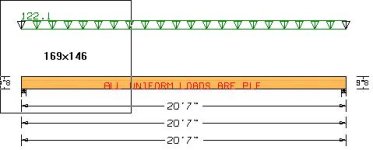
ok if I understood right your beam will need to hold
122.1 PLF
 

Attachments

  • 606062-cap20.JPG
    606062-cap20.JPG
    15.8 KB · Views: 134
   / Residential beam sizing question #15  
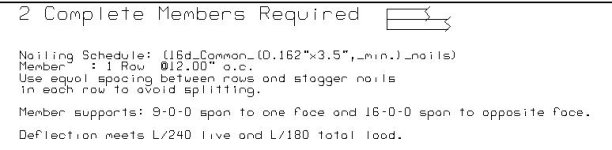
1 (2 ply) 1.75 x 9.5 Versa-lam (that is all i have in my software at this time) will work.

(have the beam company duble check this before using)
 

Attachments

  • 606066-cap21.JPG
    606066-cap21.JPG
    28 KB · Views: 113
   / Residential beam sizing question
  • Thread Starter
#16  
Hi all again..thanks for all the responses...I did go to the lumber yard where they sell the LVL and he recommended a 2 LVL beams sandwiched together; the beams he recommended were 1 3/4 width by 9in height...he felt pretty confident that it would work fine....good enough.

So I went home and just for kicks called up Georgia pacific, (the company that makes the beams). After getting transferred around a bit I got the engireering dept who were very helpful.

He told me that I would need 3, 14inch LVL beams or 2 16 inch beams to carry the load.....

Great, so I talk to two different people, both of whom are supposed to know the answer and get two VERY different answers...

One guys say 2ply 9 inch beam, the other 3ply 14 inch beam....good help sure is hard to find.

I think I'll end up going with the 2ply 9inch beam AND put a column towards the middle, so I'll have 2 10 foot spans instead of one 20....better safe than sorry; didn't want a column, but it will be OK in my situation...you would think these guys could give me the same answer...I gave them both the exact same info.
/forums/images/graemlins/tongue.gif
 
   / Residential beam sizing question #17  
I did a similar job for a friend a few years ago, only a 19' span. I used an 8x12 for the header/girt, with 3 8x8 posts and 4 knee braces, (all white pine). A post on either end and 1 in the middle. I do some timberframing on the side, it took 24 hours to plane, sand, notch and seal the beams. A friend and I showed up at noon, 2 other guys had done the demo and a temporary shore up job in the AM and left when we showed up. The beam and posts were in place by 6PM.

The 8x12 was serious overkill, but the job was a freebie for a friend and that's what I had laying around.

If it were me, I'd go with solid wood and leave it exposed.
 
   / Residential beam sizing question #18  
Seems to me the guy at GP thought it had the whole roof load and not just the ceiling.
Seems the lumber yard came up with almost the exact beam I did

It is holding the cieling only right?
 
   / Residential beam sizing question
  • Thread Starter
#19  
>>It is holding the cieling only right?

Yep...and I told him that, but I think you are right, he probably ran it the wrong way. 3x14 seems like overkill to me.
 

Tractor & Equipment Auctions

207280 (A52708)
207280 (A52708)
2019 CATERPILLAR 313FL GC EXCAVATOR (A60429)
2019 CATERPILLAR...
2021 BOBCAT T870 SKID STEER (A60429)
2021 BOBCAT T870...
2018 INTERNATIONAL 4300 26FT NON CDL BOX TRUCK (A58017)
2018 INTERNATIONAL...
2024 PRO FABRICATION RTM-5.2K-Y REEL TRAILER (A59905)
2024 PRO...
2005 Sterling Acterra Tender Truck (A56438)
2005 Sterling...
 
Top