Residential Code Question ???

/ Residential Code Question ??? #21  
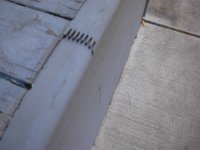
I spoke to the father of the person having the house built this morning, and told him that I was going to call the inspector to find out if those topcons are code or not. Plust ask about the other things that I'm not sure about, but might just be my persnonal issues. He suprised me be asking me not to. He said that he appreciated me taking the time to take a look at the building, but would prefer to let the inspector find anything on their own. I'm not sure what happened, but I got the impression that he wasn't happy with what I told him and that he didn't want to hear anything else. He then said that he didn't want to put me out to any more trouble or take up my time by going out there again. I guess I just got fired. LOL

Eddie

Maybe the rookie contractor drove by or someone told him you were there and he had a few words with the owner.
 
/ Residential Code Question ??? #22  
More likely it was a rookie mistake. Forgot the bolts/straps and this was a "quick fix".

My preference for a "quick fix" would be to drill and Simpson epoxy in threaded rod. Not that hard to do, and the next best thing to the preset foundation bolts.

Tapcon screws wouldn't even be a consideration.


Eddie
What size tapcon screws is he using and how far apart?
 
/ Residential Code Question ??? #23  
Maybe you need to write the Father a letter thanking him for the opportunity to look at the house and confirming that you have closed your file on the house without determining if the house meets code or the contract specifications at his request effective as of such and such date. Or at least write a memo summarizing your findings for your files.

Something is up here and I''m not sure what it is.
 
/ Residential Code Question ??? #24  
Maybe it was just timing...

I was very conscientious when the Hospital was building a new addition... I was the go between between the contractors, mostly the general, and the Board of Directors...

My enthusiasm tended to disrupt the schedule at times while everyone would try to determine who was right and whose responsibility something was...

About the second week I had a meeting with the General and we agreed that I would submit my concerns in writing every Thursday afternoon or for pressing matters call him on his Cell...

The job did go much smoother after that... More than 80% of the time I was right and a couple were big items... the job took many months so most things did not have to be addressed on the spot...

A couple of times the architect or engineer had missed things that had nothing to do with the General Contractor...

The chief city inspector also turned out to be a lot of help... he was never demanding and stressed he wanted nothing more than a propert job... he was firm in his decisions and offered alternatives on occasion.
 
/ Residential Code Question ??? #25  
Maybe you need to write the Father a letter thanking him for the opportunity to look at the house and confirming that you have closed your file on the house without determining if the house meets code or the contract specifications at his request effective as of such and such date. Or at least write a memo summarizing your findings for your files.

Something is up here and I''m not sure what it is.

I second this suggestion,
in this day and age you might be held resposible,

Just can hear arguments down the road, "we did ask you to keep an eye on things etc....

Nice friendly letter ending in "Complimentary visit, (confirming dismissal)----no charge"
 
/ Residential Code Question ??? #26  
OK I have to ask.........
A couple of people mentioned that they would never use a finger jointed stud. Is this based on a bad experience with them. If so do tell.
Charles, they are actually the same price as sawn stud not 25 cents cheaper and I still use them. You mentioned labor as being a large expense. These save a lot of labor.
I find them superior and have not had any problems only many benefits.
No worries about a knot being where you want to toe nail or run a plumbing pipe.
No twisting with humidity thus fewer nail pops.
No need to order 25% extra so that you can search for the straight studs.
 
/ Residential Code Question ??? #27  
OK I have to ask.........
A couple of people mentioned that they would never use a finger jointed stud. Is this based on a bad experience with them. If so do tell.

I don't know about finger jointed studs, but I have experience with finger jointed trim and I will avoid buying it again in the future. I installed it many years ago (can't remember how long) and it has come apart at the joints.

I went to buy more trim to replace the bad stuff so I went back where I bought the first batch (only place that I can get that design trim) and was trying to find it without finger joints. The guy that works in the trim section was helping me asked why I didn't want the finger jointed trim and I told him about how all the joints came apart and that maybe I didn't paint it properly. He told me it had exterior glue and for it to come apart like I described just shouldn't happen. OK it isn't supposed to but it did.
 

Attachments

  • apt_460_house 158-rs.jpg
    apt_460_house 158-rs.jpg
    144 KB · Views: 101
  • apt_460_house 161-rs.jpg
    apt_460_house 161-rs.jpg
    181.1 KB · Views: 98
/ Residential Code Question ??? #28  
Really stinks to be a 'volunteer' and get fired.
Could someone explain the california corners? Ive never heard of them in my area. Thanks
 
/ Residential Code Question ??? #29  
I don't know about finger jointed studs, but I have experience with finger jointed trim and I will avoid buying it again in the future. I installed it many years ago (can't remember how long) and it has come apart at the joints.

I went to buy more trim to replace the bad stuff so I went back where I bought the first batch (only place that I can get that design trim) and was trying to find it without finger joints. The guy that works in the trim section was helping me asked why I didn't want the finger jointed trim and I told him about how all the joints came apart and that maybe I didn't paint it properly. He told me it had exterior glue and for it to come apart like I described just shouldn't happen. OK it isn't supposed to but it did.

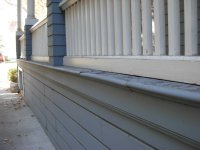
Sorry to say, but using the fingerjointed trim in a place like the porch shown in the pics, is not a good place for softwood, regardless if it is fingerjointed or not. Moisture soaking into the wood is the problem. Something like cedar or redwood is the woods to use for this application. Such softwood trim is really not meant for outdoor use, and the rest of the porch railing and parts show that problem.

Fingerjointed studs are for walls used in a vertical (compression load) application. The only real purpose of a stud in the wall is to hold two membranes/surfaces (usually drywall on the inside and sheathing on the outside) at a fixed distance apart. The combination of surfaces and the stud forms a straight, strong wall. The stud is just the web in the middle and needs very little strength but is important that it stays straight. Not having the knots to lower strength and to cause warping of the studs, is a real benefit to having a straight wall.

Now, for something to worry about, is when they cut out the knots and then fingerjoint all the knots together to make door jambs. :) It is true. They glue on a thin sheet of veneer to make the surface look like clear, straight grain wood. Think about trying to drill a hole for a door lock, and running into a 3" hard knot just below the surface. :) That'll make your day.
 
/ Residential Code Question ??? #30  
After Hurricane Floyd flooded a good bit of Eastern NC I went down to help with the cleanup on a couple of occasions.

The first trip was when the water was just going down in some areas. We went into a town that was still closed to the public. It was, well, a disaster. :(

Driving to this one town we had to go into an area flooded by the Neuse River. We found large fish in the road. The flotsam was 10-20 feet in the trees. :eek: Wooden stairs from mobile homes where in the middle of farm fields with now homes nearby. Farm fields were BLACK. A diary farmer had lost 100 cows that had drowned. No way to save them a few of them had busted in the door of a mobile home to get out of the rising water.

That did not last long and the water went over the top of the home. The cows drowned inside. FEMA burned the homes down. Nothing else to do. I have a photo somewhere of cow ribs sticking up out of the ashes near the axle. :eek:

We got to one town that was hit real bad. Cars had floated up on to cars in some sort of weird Detroit mating game. Caskets and vaults had popped out of the ground in grave yards. It looked like a horror film. Smelled bad. Real bad.

It was very surreal. We had stopped to look at the caskets and vaults in a grave yard. The street was empty of cars since most of them had been flooded and the town was closed anyway. Across the street was a large lot. There was a foundation close to the street with a house towards the back of the lot against the woods...

It did not look quite right...

Eventually I figured it out. The house had been built with no anchor bolts and it had floated "downstream" until the trees had stopped the house "boat". The water had not "destroyed" the house but had set it down very gently so that it looked like it had always been next to the trees when in fact it had floated a 100 feet or so.

Course the house was destroyed but it was very strange that the house was built with no anchors....

Later,
Dan
 
/ Residential Code Question ??? #31  
Sorry to say, but using the fingerjointed trim in a place like the porch shown in the pics, is not a good place for softwood, regardless if it is fingerjointed or not. Moisture soaking into the wood is the problem. Something like cedar or redwood is the woods to use for this application. Such softwood trim is really not meant for outdoor use, and the rest of the porch railing and parts show that problem.

Yea I agree with all that, the problem is that what they had was what they had and I needed to match the original design. So when I replaced the trim originally I was just happy to find the trim that match the old stuff.

When I went back this last time I didn't want to replace it this time with the same thing, solid sticks of softwood whould have been better then the fingerjointed. The other choice that they had in stock that was design appropriate was MDF, not going to use that. So I asked about custom milled cedar and that was going to cost like 4 or 5 time as much. Then I thought I would just make it up myself. So far haven't gotten a round tuit.
 
/ Residential Code Question ??? #32  
Yup, I think you will be most happy and best off to make some yourself. :) Wish I had an extra "roundtuit" to loan you, but I've so many on a string now....can't. :)
 
/ Residential Code Question ???
  • Thread Starter
#33  
Really stinks to be a 'volunteer' and get fired.
Could someone explain the california corners? Ive never heard of them in my area. Thanks

A California Corner is when you use two studs at the end of the wall. The end one is normal, just like all the other studs, but then the next one is turned 90 degrees and nails so it's on the inside of the wall. This gives you the inside corner to nail up your sheetrock, but also allows you to put insulation in that corner.

Some places require it, others probably will in time. It's not a strength issue so much as an improved way to insulate the wall.

Eddie
 
/ Residential Code Question ??? #34  
I was looking for some plain ole brickmold trim at the box store and all I could find was stuff made of pvc for about $11 for an 8' stick. So I guess I should have bought that molding head attachment for the table saw after all.
 
/ Residential Code Question ??? #35  
Thanks Eddie I did mine like that years ago and didnt know it.
 
/ Residential Code Question ??? #36  
I've seen finger joints come apart, and just don't trust them. I'm conservative. And haven't found regular studs from a good lumberyard to be an issue. Not to mention, they are delivered free, and picked up free, so no skin off my nose to send back the bowed studs.

Granted in compression with a plywood skin they are probably fine. Without a skin I'd worry a lot about racking stress.

Cali corners will probably become mandatory, no doubt. My attitude is corners matter a lot, I'd rather overbuild them. You can put an insulation pocket in their with a U corner. I figure if that little bridging is the worst, I've done pretty well.

I actually think ICFs are the way of the future, skips the whole issue.
 
/ Residential Code Question ??? #37  
That California corner thing doesn't sound like a great way to fasten your sheathing in the corner? especially with 2x6 frame. If I'm following this correctly.
Why not just have 1 more stud in the outer corner? even with 2x4 you would still have a couple of inches to insulate.

About the insulated concrete forms (ICF's) I thought they would have taken off by now but they are really not getting many takers. I first saw them at trade shows 20+ years ago.
Cost a little more but man you got a solid energy efficient house.
 
/ Residential Code Question ???
  • Thread Starter
#38  
I think the problem with ICF walls are just too expensive to really get going. Stick framing has a big appeal in int's flexibility and low cost. Framing is such a small part of building a house, and even sealing in a house, it's not that big of a percentage in the build.

While I agree that there are stronger ways to build a corner, and I think the insulation issue is easily taken care of with planning, it's not that big of a difference to really care either way. With so much of Green becoming a part of Code, it's not so much about strength anymore, but about insulating and energy efficiency. I can see the day when we spend more on insulating a home then we save by spending that money just to satisfy the politicians who are pushing this latest trend.

Of course, with windows being less then R4, having walls that are R13 isn't really an issue anyway. The more windows you have, the bigger they are and what side of the house they are on is where you lose your heat or cooling energy anyway. A corner with or without insulation in it doesn't even come close to how much you lose through your window.

And in this house, they have 6ft tall windows in all the rooms. Even the small 10x10 bedroom as two 60x30 windows in it!!!

I'm glad to not be involved with that house. It's a small starter home that's costing almost twice what it should to build. I wasn't part of the planning, and only saw the floorplan after the framing was almost done. The builder is a married to a family member with one other house to his credit. He never worked the trades, or even owned any tools until he built his first house. Even then, he didn't need any tools, since he just hired it all out and supervised. That house never sold, but somehow, family hired him to build this house. He's way overspending on stupid things, and cutting corners on important things. I explained to the dad these issues that I saw, the corners that are being cut, and how they are thowing money away on things that will not hold value for resale on a small, starter home. I honestly don't think the house will appraise for anywhere near what they are spending to build this house, and told him this too. My best guess is they will lose 30% of the money it costs to build this house if they try to sell it. Nobody checked the comps and there hasn't been any appraisal of the plan before they started the build. The contractor told them what it would sell for, but he's an idiot and in my opinion, just makes up these numbers.

I'm sure I'll hear more about this, but since it's out of my way, and I find it very frustrating to see what's happening, I wont go by there again unless I have to.

Eddie
 
/ Residential Code Question ??? #39  
Concerning the 7/16" OSB side wall sheathing, if the approved set of plans call it "SHEAR", there will be a SHEARWALL SCHEDULE in the plan set which will list the types of approved fasteners and their appropriate spacing for each specified wall area. This means that one wall might be engineered and calced out at 8" OC fastener spacing and another my be calced at 4" OC. The type and thickness of the sheathing will also be listed. You have to read and follow the plan specs. As far as staples, I have never seen them used. 8d full head common, box or sinker are the norm and again-refer to the SHEAR SCHEDULE.
While on the subject of fasteners, each piece of builder's hardware (Simpson or whomever) requires a certain criteria of nail, screw or bolt. Again, look in the manufacturer's free catalog and you will find them listed for every design they sell. Many times I have inspected them and found that they have been installed with whatever happens to be in the installer's bags at that given moment.
Shearwall is defined as plan speced sheathing that covers a given wall from the bottom of the bottom plate to the top of the top plate and attached per plan, thus the areas above and below a window are considered a break and therefore not shear. If you have a condition where you must stack the sheathing, blocking must be placed in the stud bays for horizontal edge nailing. Again, consult the SHEARWALL SCHEDULE for the block size, 2X, 4X or 6X will be called out.
The sill plates should also have their own schedule as to treatment, size, placement and fastener type and spacing.
It really kills me to encounter so called piecers, framers, builders, generals etc. who do not know how to read and follow a plan.
I am a retired division estimating manager for a large national home builder. I now do residential and commercial wood framed plan take-offs from my home office for anyone, anywhere who needs my service.
 
/ Residential Code Question ??? #40  
I think the problem with ICF walls are just too expensive to really get going. Stick framing has a big appeal in int's flexibility and low cost. Framing is such a small part of building a house, and even sealing in a house, it's not that big of a percentage in the build.

Eddie, your last statement contradicts your first.

It is true that in a custom house in CA, more money is often spent on the
kitchen than the whole frame of the house. The frame of the house is
rarely more than 10% of the whole cost of the house!

So even if the cost to build the shell of the house using ICFs was 2x what
it cost to do it in 2x4s or 2x6s, this would add only 10% to the total cost
of the build. If a contractor familiar with efficiently doing ICF constuction
is used, the additional cost over wood construction is considerably less than
2x. And it is dropping all the time. Any premium in building cost is recovered
by energy savings that are as much as 30-50% vs. wood frame.

Here in CA, ICFs are used considerably less than in the other 49 states. The
difficulty that ICFs have in terms of catching on is that their benefits
accrue to the owner, not the builder. The builder does not benefit by
decreased energy use or fire/earthquake/wind/termite resisitance, so if
an established builder chooses the materials, he chooses what he is familiar
with.
 

Marketplace Items

UNUSED 2026 INDUSTRIAS AMERICA 750 GAL TANK (A62130)
UNUSED 2026...
2023 John Deere 8R 370 Tractor (A63109)
2023 John Deere 8R...
2015 Ford F750 Service Crane Truck (A62613)
2015 Ford F750...
2009 Honda Civic Sedan (A61569)
2009 Honda Civic...
(2) 580/70R38 TIRES W/8 LUG RIM (A62130)
(2) 580/70R38...
Pallet of Miscellaneous Duplex Polyester Webbing Slings (A61567)
Pallet of...
 
Top