Retaining Wall Post Question

   / Retaining Wall Post Question
  • Thread Starter
#21  
One of the worst things I've had happen is for the deadmen to rot or become loose from decay. That requires an ENTIRE redig and rebuild of the wall. You might want to consider making the deadmen out of pipe instead. If the wall rots, you can replace the pieces without having to dig up and replace the deadmen. If you think you may be consistently wet and that you might have to replace the wall at some point, you might want to consider making the deadmen "permanent" and "re-attachable" to ease future repairs.

I've used a setup like this in wet areas in the past and it worked VERY well. Ultimately, we had to replaced the retaining wall 4x4s due to decay (after about 15 years) but we could just reattach them to the existing deadmen with no new digging.

View attachment 425693

That's a slick idea. :thumbsup:
 
   / Retaining Wall Post Question #22  
That's a slick idea. :thumbsup:

Thanks, dieselscout. I HIGHLY recommend something like this if your wall is going to be damp. Makes it MUCH easier to replace the wall timbers, and it is just as strong, if not stronger, than traditional wooden deadmen. We used this all the time for walls around our farm ponds growing up, and the walls never buckled in, and replacing the face timbers was easy as could be. After 15-20 years, the pipes didn't have any rust damage that we could see.

I can't take credit for the idea, though. My dad was pretty darn ingenious when it came to building fixable things that didn't have to be "destroyed" to be "repaired."
 
   / Retaining Wall Post Question
  • Thread Starter
#23  
Thanks, dieselscout. I HIGHLY recommend something like this if your wall is going to be damp. Makes it MUCH easier to replace the wall timbers, and it is just as strong, if not stronger, than traditional wooden deadmen. We used this all the time for walls around our farm ponds growing up, and the walls never buckled in, and replacing the face timbers was easy as could be. After 15-20 years, the pipes didn't have any rust damage that we could see.

I can't take credit for the idea, though. My dad was pretty darn ingenious when it came to building fixable things that didn't have to be "destroyed" to be "repaired."

For a 30" wall how far would you go between each deadman?
 
   / Retaining Wall Post Question #24  
For a 30" wall how far would you go between each deadman?

Depends on the soil type and the expected load. If the ground is going to be damp, that means "heavy" so I would probably do every 6 feet, but maybe 8 at only 30" high. According to one of my books, a 4-foot-high, 15-foot-long wall could be holding back as much as 20 tons, so you do the math. I tend to over-engineer things, but I would probably go every 6 feet, and make the "T" section of the deadman 4 feet (i.e., stick out 2 feet on each side of the center post) That gives enough undisturbed earth between each deadman, and should provide plenty of anchorage.

For our retaining walls around the ponds, we would also stagger each deadman so that every-other-one is 1-2 feet higher or lower than your starting deadman so you get support across both longitudinal and horizontal buckling, but that might be overkill in your case with only a 30" height. If it was taller, I'd suggest something like the pic below.

deadman staggering.jpg
 
   / Retaining Wall Post Question #25  
Also, make sure to use LARGE bolts for bolting the flanges to the wall and make sure they are water resistant (stainless or high-grade grade weather-proofed.) Those will be your weak points, so don't cut corners on the fasteners.

And DO NOT forget to add a drainage tile at the bottom to let the water run off instead of accumulating at the base of the wall. A few weep holes are a good idea, too.
 
   / Retaining Wall Post Question #26  
Are you refering to concrete block for building or retaining wall blocks and do you have a link to them?

Retaining wall block.

No links, just what enards, home depot, etc carry.
 
   / Retaining Wall Post Question #28  
Depends on the soil type and the expected load. If the ground is going to be damp, that means "heavy" so I would probably do every 6 feet, but maybe 8 at only 30" high. According to one of my books, a 4-foot-high, 15-foot-long wall could be holding back as much as 20 tons, so you do the math. I tend to over-engineer things, but I would probably go every 6 feet, and make the "T" section of the deadman 4 feet (i.e., stick out 2 feet on each side of the center post) That gives enough undisturbed earth between each deadman, and should provide plenty of anchorage.

For our retaining walls around the ponds, we would also stagger each deadman so that every-other-one is 1-2 feet higher or lower than your starting deadman so you get support across both longitudinal and horizontal buckling, but that might be overkill in your case with only a 30" height. If it was taller, I'd suggest something like the pic below.

View attachment 425719
Remember that your board will need to span the distance between your deadman.
At six foot spacing your wall will bow out with boards, you would need six inch or thicker lumber
 
   / Retaining Wall Post Question #29  
Retaining walls are no joke. Alot of people dont understand the forces dirt can put on a vertical wall when settling. Thats why they make the block. And use a fabric between a layer of block back into to dirt instead of deadmen.
 
   / Retaining Wall Post Question #30  
I helped my brother do one with railroad ties... good one that were hand selected... that was 15 years ago and some are no longer sound... it is not a critical area... just the same I'm sure if he had used block they would still be as good as new...
 
   / Retaining Wall Post Question #31  
Man i wish I could remember the spec's of my retaining wall.
I wanna say it was 88,000 lbs of blocks. Cost $5500.
Gotta be at least a couple hundred linear feat. 5 layers tall, so 2.5 feet.

The site where I used to have pics of the project is gone. But the moral of the story is that retaining wall blocks are your most permanent solution.
The type I used has a lip on the back that hooks on the row below. So the lip either has to break off or the block has to lift up to move. I mention because some only rely on adhesive. Kinda/sorta like this one (shown upside down, as far as I can tell): http://tinyurl.com/l2xsz54
 
   / Retaining Wall Post Question #32  
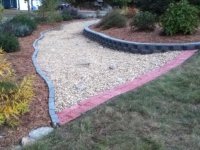
Once you get your base set, stacking the blocks goes very fast, and I think makes a better looking wall than timber. The lip on the back makes it easy. I had the pallets dropped off, then moved into the work area in stacks with a hand truck, so I wasn't running back and forth carrying stones.

So many of the timber walls I see are partially rotted, leaning, etc. Heck, even the one the wife built around the mailbox flowerbed has issues.

As an option, you can stack a layer of 8x16 pavers on the top row, held down with masonry adhesive. I trimmed the ends on an angle with an angle grinder and masonry cutoff wheels to follow the curve...if your runs are mostly straight or have gentler curves you might not even need to do that.

10628538_10203661342467461_6675609323695325759_n.jpg

The stakes and lines were used with a line level to figure out my base depths. Fortunately, my soil is sandy gravel and well drained, so I just set on undisturbed soil. If I was on loam or clay, I would have done a proper gravel footing.

10351804_10203773898961303_5356068857345951321_n.jpg
 
   / Retaining Wall Post Question #33  
GL, ye work looks real nice! A good point about the soil, here where old OP is, southeast, it's mostly clay north of the Fall Line in GA and SC. It's solid, but needs the base I think.
 
   / Retaining Wall Post Question #34  
Did I already say retaining wall blocks? Why yes I did. Now looking at the additional details supplied, I think this is for sure the way to go... Keystone, Anchor, or myriad of local suppliers.
 
   / Retaining Wall Post Question #35  
I have done pretty much what you are talking about.

I had a 33" high landscape wall of 2" x 6" PT boards. I built it about 30 years ago and when I sold the house 3 years ago it was still in place and working well.

This was in the SF Bay Area, in hard adobe clay. I drove T-posts on about 36" centers and used no deadmen at all. The real key is that I had what engineers call "batter", which means that I sloped the wall back toward the uphill side by about 2" per 12" of rise.

Just before I sold the house, I replaced the T-posts with PT 4" x 6" posts in concrete, which made it much better looking.

The only real difference between what I had and your proposed wall is that the earth at the base of your wall is going to be wet, which will make it less firm. You may need to move the T-posts closer together, say 24" on centers. I would start there and if the wall is not stable over time, increase the batter. This will require new T-Posts, but will not require more boards.
 
   / Retaining Wall Post Question
  • Thread Starter
#36  
I have done pretty much what you are talking about.

I had a 33" high landscape wall of 2" x 6" PT boards. I built it about 30 years ago and when I sold the house 3 years ago it was still in place and working well.

This was in the SF Bay Area, in hard adobe clay. I drove T-posts on about 36" centers and used no deadmen at all. The real key is that I had what engineers call "batter", which means that I sloped the wall back toward the uphill side by about 2" per 12" of rise.

Just before I sold the house, I replaced the T-posts with PT 4" x 6" posts in concrete, which made it much better looking.

The only real difference between what I had and your proposed wall is that the earth at the base of your wall is going to be wet, which will make it less firm. You may need to move the T-posts closer together, say 24" on centers. I would start there and if the wall is not stable over time, increase the batter. This will require new T-Posts, but will not require more boards.

Thank Curry.

Going 30" high will provide sixty some inches of level ground behind the wall.
 
   / Retaining Wall Post Question #37  
image-826212240.jpg

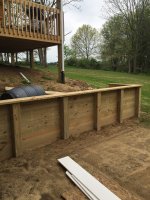
Do it right the first time. T posts will not hold. I debated between blocks and treated lumber with my 24' retaining wall at my walkout. I liked the look of the wood better and was 30% the cost of the block that I was looking at. The treated lumber that I used is for wood basements. They have a supposed 75 yr warranty.
 

Tractor & Equipment Auctions

1959 DODGE D510 DUALLY FLATBED TRUCK (A60430)
1959 DODGE D510...
25 TANDEM DUAL GOOSENECK TRAILER (A58214)
25 TANDEM DUAL...
2017 Scag Cheetah 61in Zero Turn Commercial Mower (A59228)
2017 Scag Cheetah...
2008 Bobcat S250 Compact Wheel Loader Skid Steer (A59228)
2008 Bobcat S250...
500 BBL FRAC TANK (A58214)
500 BBL FRAC TANK...
2014 Ford F-250 Ext. Cab Service Truck (A59230)
2014 Ford F-250...
 
Top