Retaining wall question

/ Retaining wall question #1  

CTyler

Veteran Member
Joined
Dec 20, 2002
Messages
1,553
Location
Blair, Ne.
Tractor
L3130
I am building a retaining wall and am wondering if what I'm seeing is normal. Guess I never really paid attention or looked very close at other retaining walls.

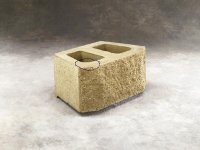
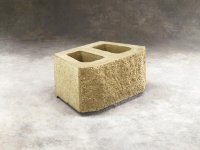
The wall is coming off the corner of the house and turing 90 deg. making and inside corner. The block used is the Achor block pro diamond. Attached is a pic of the block. The minimum inside radius is 4 feet, which is what my inside corner is.

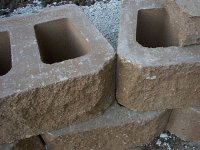
As you build up the corses the batter gets off a little bit. I understand that this will happen and why. However the holes in the block are showing a little bit on the curve on the third corse up.

So is it normal to have a little bit of the hole showing?

Everything is really close as it is and the batter only has to get off and inch+ and you just start to see the edge of the hole.

I was also wondering of there was a minimum size for the partial block to offset/correct the batter.

I can post pics tonight.
 
/ Retaining wall question
  • Thread Starter
#2  
Here is the block.
 

Attachments

  • 472064-block.jpeg
    472064-block.jpeg
    49.5 KB · Views: 971
/ Retaining wall question
  • Thread Starter
#3  
Circled is the area that shows a little bit.
 

Attachments

  • 472068-block1.JPG
    472068-block1.JPG
    32.9 KB · Views: 453
/ Retaining wall question
  • Thread Starter
#4  
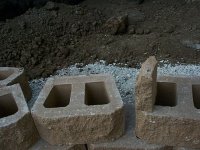
Here is a pic of the wall where the batter is just starting to get of far enough that the hole starts to show. Every block laid after this one reveals the hole more and more.
 

Attachments

  • 472255-RetainingWall1.jpg
    472255-RetainingWall1.jpg
    73 KB · Views: 378
/ Retaining wall question
  • Thread Starter
#5  
This pic shows how much the block needs to be moved/spaced over to correct the batter again. I have a scrap piece sitting there thats about the right size.

I had it my mind, right or wrong, that there was a minimum size that should be used to offset the batter. I'm starting to convince myself that you just offset whatever you need to and glue it in place. Then stagger the partial block on the next corse.
 

Attachments

  • 472258-RetainingWall2.jpg
    472258-RetainingWall2.jpg
    67 KB · Views: 366
/ Retaining wall question
  • Thread Starter
#6  
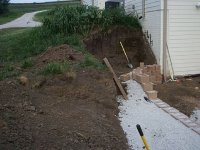
Part of the reason I'm concerned is because I am no expert on retaining walls. This part of the wall will be 7 1/2' tall for the inside curve and taper down from there.

I've dug the base so the first corse will be completely buried. Actually the first 2" of the next corse will be buried as well. The base is 3/4 crusher run 10" deep and packed by hand in several layers then all 10" packed with a vibrating plate.

The geo grid fabric has been laid between the first and second corse of block going back 5', per Mfg recomendation. I've already laid the drain tile and filled with screened 3/4 rock ~17-18" deep, the min per mfg was 12". Everything is being hang tamped in 3-4" layers....uggg.

I just want to be SURE I'm doing the block correctly.
 

Attachments

  • 472271-RetainingWall3.jpg
    472271-RetainingWall3.jpg
    66.2 KB · Views: 329
/ Retaining wall question
  • Thread Starter
#7  
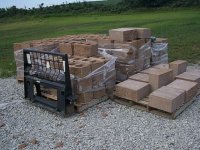
Here is a pic of the rest of the block and my new set of pallet forks. /forums/images/graemlins/grin.gif /forums/images/graemlins/grin.gif /forums/images/graemlins/grin.gif Unfortunatly that is all I could afford.
Beleive you me...paying someone the Big $$$ they charge to build this would be worth EVERY cent!

The large blocks are for the steps that will be incorperated into the wall. The area in the last pic that had lots of rock is where the large/wide steps will go.
 

Attachments

  • 472283-RetainingWallBlocks.jpg
    472283-RetainingWallBlocks.jpg
    74.3 KB · Views: 379
/ Retaining wall question #8  
First off, I'm no retaining wall expert. But you are seeing the offset because you are off-setting each course--it looks like about an inch. The two courses are different [radius] sizes of circles. The bigger the circle the more blocks it takes to make a complete circle. Since your radius difference is slight (the inch or two shown) the offset just seems to creep in and makes you think something is wrong. Well, it isn't. You just need to make accomodations like you have with wedge pieces, or just allow the joints to move. But if the curve is long enough, you'll eventually have to make some accomodation as you don't want the block joints to line up.

I just re-read this, I hope this makes some sense. I tried to reword it but I'm not sure it helped.

Anyway, I have some of the same alignment movement on my block retaining walls. It isn't really that noticeable in the finished product. To my eye the odd size wedges stand out more than the joint alignment between concourses. Your eye may find it differently.
 
/ Retaining wall question #9  
Ctyler,

Here is a link to a wall I just did, albeit with different blocks.
Retaining Wall

It looks like you're getting a little too far off center. The holes make it trickier. On mine, I occassionally broke off part of the lip in the back on one side to make my tighter radius turns, especially on inside curves.

A suggestion- run landscape fabric up the whole face of your wall, behind the block, then lay it over the top of your fill before covering with a finish layer of stone, dirt, or whatever.

Here's why- when it rains, muddy water will flow through your gravel backfill, as designed. That's good, but some water can come through the face of the wall, and the last thing you want to see is mud/dirt running down the face of your nice, new wall.

Also, always work from one side or the other. Don't work from both sides towards the middle. Occassionally, you will have to make adjustments for alignment, as shown in your picture. You can leave small (SMALL) gaps between the edges of the blocks if you are using the fabric as I suggested. I used the brown colored stuff (25yr from Lowes), and you can't notice it at all. You will see light between the blocks until you fill it, but don't worry.

If I get a chance, I'll go out tomorrow in the daylight and take a picture of a gap for you to see.

Keep in mid that with each layer, an inside radius gets larger, requiring small gaps between the blocks if you want to keep your stagger even, else they will get off center as in your pictures.

This is because as each layer is set back an inch or so for the retaining lip, the "circle" (or portion thereof) gets a bit larger. Sort of like a racetrack. Cars in the outside lanes have to go farther in each lap. The farther from the center, the greater the distance.

Hope this helps.

-JC
 
/ Retaining wall question #10  
Hi CTyler,

My, that's an ambitious project you are undertaking! I thought about doing one myself, and then buckled under and hired it out. We built a somewhat free-form serpentine retaining wall, behind which we built a tumbled concrete paver patio. I have mentioned both in other threads on this Forum.

I can see exactly what you describe, and can only note that in our free-form wall we would have had the same problem big-time were it not for the fact that we (dumb luck) used beveled Pavestone Anchor Diamond blocks which are solid, not cored. Given that, the installers could "cheat" a little on positioning each block in each course, without producing any gaps. At it highest point, our wall was 8 blocks tall, gradually tapering down to the lowest height of 3 blocks tall.

Our wall had to be sturdy enough to be backfilled and support a paver patio. Our installer recommended the Anchor Diamond solid blocks, as opposed to the Anchor Diamond <font color="green"> Pro </font> cored blocks. Though these are manufactured by a number of companies, they are all manufactured under license from Anchor Wall Systems, Inc. You can compare them at the Pavestone site:

Pavestone Segmental Retaining Walls

You can click on each product and a new page will open to describe the physical dimensions and characteristics, as well as installation overview. Basically, the "Pro" block is a little taller and a little heavier than the comparable standard Anchor Diamond product. My understanding from our installer was that the "Pro" had more of a commercial application for tall walls siding river beds, canals, roadways, etc., and that the coring allowed for rebar and concrete reinforcement that these larger walls would require. How tall is your wall, and what is it retaining?

One consideration might be to switch to the standard Anchor Diamond blocks for your project. I would anticipate they would be somewhat less expensive. Of course, you would have to see if you could return the unused Pro blocks for credit. If you have simply dry stacked many of them, and they are clean and new, they could be re-palletized.

Just some thoughts and ideas. Keep us posted...
 
/ Retaining wall question #11  
Anchor recomends cutting blocks to keep your running bond. However, in the Anchor book I have, they show the solid block... From thier book:
Step-1 Proper installation of the Anchor reetaining wall requires that running bond be maintained. Running bond occurs when the blocks are centered over the vertical joints of the previous course. This adds to wall stability.

Step-2 Any wall that is not straight will eventaully run off bond. When this happens, skip a block position, and place the next block where it is back in bond. Measure the remaining gap, and cut a block to fit.

Setp-3 Once the partial unit is in place, adhere with a concrete adhesive. Partial units should not be less than 5"(five inches) and should not be placed atop each other. If the gap is larger than the length of one block, divide the measurement by two and put two partial units in place.

The small wedge you show would not be affect, and would affect the stability of a large wall. Since you are using the open center blocks, it may be best to order at least some solid core blocks for cutting and using for this purpose.

Too, try contacting Anchor direct. You might also check out thier web page; they have pretty good info there.
 
/ Retaining wall question
  • Thread Starter
#12  
Thanks everyone for your replies.
This is in no specific order...

I understand why the batter gets off but it only has to be off by about 2" and the edge of the hole starts to show up. I can see now that this block would be good for straight runs and 90 deg corners. The solid block would be better/easier anyway for this curve.

The thing I kinda liked about this block was the rock being packed into the holes providing additional shear strength. I will give Anchor a call today and see if there are any issues mixing the blocks. Wouldn't think so but want to be sure. Besides the other side of the house will be getting a small garden wall about 2' tall. So the extra block will get used anyway.

I thought about cheating the blocks up a little bit by knocking the corners off a tad. However would this affect the strength of the wall? Remember this has to be 7 1/2' tall for the first ~9-10 linear feet.

I must have missed the part about a 5" minimum or it didn't register the glue part did. Something in the back of my head kept saying there had to be a minimum size.

Yea, I'm going to just work on the one side of the wall from the house out until the first row of steps are in place. After putting a few blocks down at the other end the adjustment factor/realization set in...dohhh!

Will also get the landscape fabric in there.

Thanks
Chris
 
/ Retaining wall question #13  
Hi Chris,

Just a quick thought on mixing the cored with the solid Anchor blocks. As I recall, the solid blocks are 6" in height, while the cored blocks are 8" tall. The website URL I put in my post on this thread yesterday will take you to the specs for each type to confirm. Also, I don't know about color availability/match of the two types. You might be able to camouflage a 2" height difference by running a full course of one type. A color mis-match would be harder to conceal.

Keep us posted...
 
/ Retaining wall question #14  
Make sure the block you are using is designed for that height of wall. The pavestone block we used was only recommended for a 3' wall so we built ours in steps.
Front flowerbed wall project
 
/ Retaining wall question
  • Thread Starter
#15  
Hi, yes that block can go much higher than 7 1/2'.

I called Watkins, the place I bought the block from, and asked to speak with one of thier engineers. He stated that there wasn't a minimum size for the partial block. Perhaps this is specific to the block being used? He said you could cheat a little knocking the corners down a little and it would not affect stability.

I think I'll have more piece of mind using a larger block piece to correct the batter. The center structure of the block may well be 2 1/2". Will measure it. So with a 5" piece this would split the difference. Guess I'll have to fiddle with it and see what works.

fwiw...My Wife thinks I'm being over critical about this like everything else I do.
 
/ Retaining wall question
  • Thread Starter
#16  
I went and re-read the installation manual and specs etc.. and sure enough it says 5" minimum partial block. Gives me a warm fuzzy about the "engineer?" I spoke with.

Thanks again everyone for your input.
 

Marketplace Items

2021 Redirective Crash Cushion Guardrail (A61573)
2021 Redirective...
Komatsu PC138USLC Excavator (A64047)
Komatsu PC138USLC...
2020 FREIGHTLINER M2 106 4X2 S/A 26FT TARP SIDE BOX TRUCK (A59912)
2020 FREIGHTLINER...
2011 Ford F-550 Bucket Truck - Power Stroke Diesel, Altec AT40G Boom, 45 ft Working Height (A61306)
2011 Ford F-550...
2006 MINI Cooper Convertible Coupe (A61574)
2006 MINI Cooper...
2023 73in Vibratory Roller Skid Steer Attachment (A61572)
2023 73in...
 
Top