You are using an out of date browser. It may not display this or other websites correctly.
You should upgrade or use an alternative browser.
You should upgrade or use an alternative browser.
Retaining wall
- Thread starter BX Tex
- Start date
- Views: 16071
More options
Who Replied?
/ Retaining wall
#21


woodlandfarms
Super Member
- Joined
- Jul 31, 2006
- Messages
- 6,151
- Location
- Los Angeles / SW Washington
- Tractor
- PowerTrac 1850, Kubota RTV x900
So the whole thing with the BX? I think I remember a backhoe?
So what was your dirt cutting techniques, especially with the slope.
It is really impressive work, especially considering you did it yourself. I am not sure I am capable of such a project, although I dream of it. I would be too impatient to take all summer.... Product of the instant gratification generation I guess....
So what was your dirt cutting techniques, especially with the slope.
It is really impressive work, especially considering you did it yourself. I am not sure I am capable of such a project, although I dream of it. I would be too impatient to take all summer.... Product of the instant gratification generation I guess....

I'm thinking it took longer!I would be too impatient to take all summer.
Thanks BX, Took us about 3 days to do the one corner cut block, put up, take down, cut more block, put up, take down I guess you already know. I sent a picture of the wall and steps before it was finished to Anchor Block (manufacture of the block) and asked for two hats, one for me and one for my wife. They sent me all kinds of stuff, including two hats. A year later the picture showed up in one of their brochures. I know what it took for me and my wife to complete our wall and I cannot imagine the work that went into yours. Doing a wall like ours at 53 years old really kicked our butts. The block weigh in at about 75 lbs per. One thing that touches me is the fact that you refer to your project as "The Wall" as we did. People would ask what I have been up to and I would say, working on The Wall.Gizmo2, don't kid yourself ....that looks really nice !
I had hope for using a similar block, but I'm cheap and went with a lower cost system.
The corners and steps 'bout ate my lunch, yours look clean ....Good job !
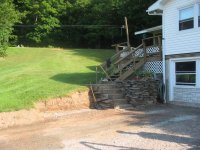
Before
So the whole thing with the BX? I think I remember a backhoe?
So what was your dirt cutting techniques, especially with the slope.
It is really impressive work, especially considering you did it yourself. I am not sure I am capable of such a project, although I dream of it. I would be too impatient to take all summer.... Product of the instant gratification generation I guess....
Yep, just me and little 'ol BX spent from mid May to end of November. Let me tell ya, after getting the upper wall done, I wasn't feeling that ambitious anymore
 , but there weren't no stopping now, I was committed. I think another 3 or 4 of weekends and I'll be able to say "Mission Accomplished"
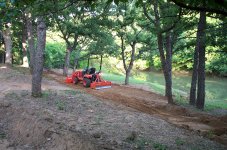
I had an narrow area on one end that was somewhat level, at least level enough that I could get the BX turned across the slope without fear of tipping over.
Once I got the BX positioned I used the box blade (moving in reverse) to cut off a little at a time and piled the spoils on the downhill side building up a larger area where I could safely maneuver the BX ... kept working across the slope till I reach the other end. After that, I could work in either direction and benefit from the box blades scarifiers to break the hard ground loose. The level area I created with the spoils ended up extending out about 15', which gave ample room to maneuver as I continued to scrape dirt until I had it to the grade I needed. The backhoe's role was mostly for straightening up the area that established the walls' boundary. On the lower tier it looks like I really dug into the existing ground a good depth with the backhoe, but in reality that is mostly the excess dirt from my scraping technique.
Gizmo, I can related to the age factor kickin' yore butt
I'm always wanting something free .... maybe I can get me a hat too
Attachments
patrick_g
Elite Member
I used a little over 900 blocks @ $4.62 ea. and 200 caps @ $3.82 ea.
I can't say that I got any discount for volume but the price is about what I expected if not a bit less.
The blocks Anchor Brighton Stone came from Pavestone Company and I had my local lumberyard order them for me.
They weren't the block I really wanted to use, but they were more than a dollar cheaper.... plus my guy let me store them at his yard and would load me 2 pallets on my trailer every weekend (while I was at work). Beside the price difference, the blocks I first wanted covered less area, which meant more blocks, higher price.
I thinks these look just fine
Were these blocks about 74 lbs each and the caps a bit heavier? They look like the same blocks I used for a retaining all. It nearly makes my back sore to look at the wall I built.
Good job, hope it lasts forever.
Pat
Very nice wall BX, what part of Texas is this? Kinda looks like the Frio River behind you where I learned to swim. Hope those blocks don't swim down stream when that river rises.
Quite a ways from your 'ol swimming hole ..... Lake Nocona in Montague County, just below the Texas/Oklahoma border (Red River).
patrick_g, these blocks are 52 lbs .... caps are less.

SuperDuty335
Silver Member
Great job. I've done some retaining walls, but never out of blocks. My greatest concern in construction of the wall is hydraulic pressure, and its ability to deconstruct the wall. That is accomplished with proper drainage lines for water diversion, and a deadman installed at the appropriate spacing. Your wall looks very solid.
Segmented block walls have a tendency to shed or let water weep through the joints mitigating hydraulic pressure. Generally speaking, a wall under 4' tall will hold without extra drainage. However, BX Tex did a great job and added the drainage pipe, stone and filter fabric.
With block walls the most effective "deadman" is adding a layer of geo-grid between a course of block and compacting that into the fill behind the wall. Some blocks have a hollow core which is filled with washed stone and compacted, thereby locking each course together ("rock lock") and any grid that was added. Rock lock is very effective and incredibly strong.
Good job BX Tex.

workmytractor
Bronze Member
Wow, what a transformation.

JoelD
Veteran Member
- Joined
- Jan 27, 2005
- Messages
- 2,343
- Location
- Windham, NH and York, ME
- Tractor
- Kioti LK3054xs TLB, 2004
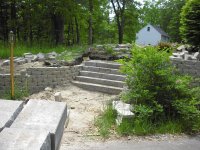
Fell on this thread, I spen the day installing steps (7, I think I'll add one more, the picture is at 5 or 6) in my retaining wall.
The wall is between 4.5 and 3 foot, I used 4 inch block (cheap and available at HD) for the wall and 8 inch step blocks (100lbs each) for the steps.
I used geogrid half way up the call on the 4.5 foot sections, weathered an intense winter without budging, I've got at least 6 inches of crushed stone under and behind everything with landscape fabric behind the crushed stone.
I went through somewhere around 1000 blocks plus.
This was the project where I brought home three pallets of block in my tri-axle, with one pallet being solid block and I ripped the trailer hitch off of my truck trying to back up into the driveway.
I now do a pallet at a time in the bed of my F250.
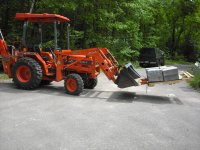
Here's a picture of the steps in progress and my homemade forks with around 1100 lbs on them.
Will be great when this project is done.
Joel
The wall is between 4.5 and 3 foot, I used 4 inch block (cheap and available at HD) for the wall and 8 inch step blocks (100lbs each) for the steps.
I used geogrid half way up the call on the 4.5 foot sections, weathered an intense winter without budging, I've got at least 6 inches of crushed stone under and behind everything with landscape fabric behind the crushed stone.
I went through somewhere around 1000 blocks plus.
This was the project where I brought home three pallets of block in my tri-axle, with one pallet being solid block and I ripped the trailer hitch off of my truck trying to back up into the driveway.
I now do a pallet at a time in the bed of my F250.
Here's a picture of the steps in progress and my homemade forks with around 1100 lbs on them.
Will be great when this project is done.
Joel
Attachments
I have to say I cheated on my steps, poured the concrete. I could not get the step blocks as level as I wanted. Found out later I should have poured a level concrete floor for the steps and then stacked the blocks on that. I had blue stone cut to fit for the top 3 steps. A topic like this is good just a little late for me. The "WALL" topic. Between BX Tex and JoelD I am looking more the rookie by each post.
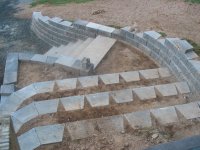
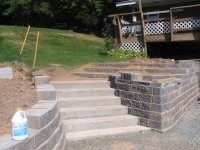
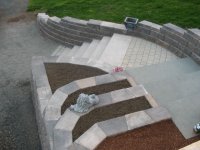
JoelD
Veteran Member
- Joined
- Jan 27, 2005
- Messages
- 2,343
- Location
- Windham, NH and York, ME
- Tractor
- Kioti LK3054xs TLB, 2004
Gizmo, you've got it nailed, mine looks amaturish compared.
I thought about pouring, bit I think in the long run, with enough crushed stone it was just easier using the block.
You did an amazing job at laying your work out.
Really looks nice, there is no comparison to what was there originally.
Congratulations on a job your future generations will continue to get enjoyment from.
Joel
I thought about pouring, bit I think in the long run, with enough crushed stone it was just easier using the block.
You did an amazing job at laying your work out.
Really looks nice, there is no comparison to what was there originally.
Congratulations on a job your future generations will continue to get enjoyment from.
Joel

streamin
Gold Member
Everybody's work here is excellent!! Great Job
JoelD, make sure you post pictures of the finished project. I've got two pallets of step blocks sitting here collecting dust and I would have much rather had the steps you and BX have. I also wanted to have blue stone where I have the cobblestone but the guy wanted $600.00 for the custom cut triangular piece and that was over budget.
L
LarryRB
Guest
BX Tex
hello, from one 57th Gladiator to another,,, Great wall project.
hello, from one 57th Gladiator to another,,, Great wall project.
JoelD and Gizmo2,
It took me almost as long to build my steps as it did for the straight run on the walls. Might have been better if I'd used a block specifically for steps, but doubt that it would have easy.
You guys' did a fantastic job !
Thanks LarryRB, and Welcome Home
It took me almost as long to build my steps as it did for the straight run on the walls. Might have been better if I'd used a block specifically for steps, but doubt that it would have easy.
You guys' did a fantastic job !
BX Tex
hello, from one 57th Gladiator to another,,, Great wall project.
Thanks LarryRB, and Welcome Home
asylum575
Platinum Member
When I regraded my backyard, I came up with a two tier yard with a wall 92' long and 48" at it's highest point, running 36" for the majority of the wall. It runs down to nothing on both ends. I originally just piled rocks on it, but the fabric backing kept moving,now I have alot of push-out.
I have so many other projects, I don't think I'll get around to fixing the wall this year, so I had a mason come by and give me an estimate to pull the rock, straighten them out and mortar a nice wall. The estimate was $7000 for the labor. Yikes. There is also a second short wall about 24" tall and 20' long. This was included in the estimate.
Now this is a guy, who works for a mason shop and would be doing the work at night and weekends.
I estimate If I bought retaining wall blocks, I would need about 1000 of the
12" long by 4" high blocks. Lowes has some that look very nice for about $2.25.
I've done these types of walls before.
So the question is, do I pay $7000+mortar for a guy to come in or do I move the rock, pile them out back and pay $3000 or so in materials and break my back over the summer.
Mind you, this would cut significantly into my boating and fishing time.
BTW, your wall looks great, you're my inspiration to break my back. That and $5000 in savings.
I have so many other projects, I don't think I'll get around to fixing the wall this year, so I had a mason come by and give me an estimate to pull the rock, straighten them out and mortar a nice wall. The estimate was $7000 for the labor. Yikes. There is also a second short wall about 24" tall and 20' long. This was included in the estimate.
Now this is a guy, who works for a mason shop and would be doing the work at night and weekends.
I estimate If I bought retaining wall blocks, I would need about 1000 of the
12" long by 4" high blocks. Lowes has some that look very nice for about $2.25.
I've done these types of walls before.
So the question is, do I pay $7000+mortar for a guy to come in or do I move the rock, pile them out back and pay $3000 or so in materials and break my back over the summer.
Mind you, this would cut significantly into my boating and fishing time.
BTW, your wall looks great, you're my inspiration to break my back. That and $5000 in savings.
patrick_g
Elite Member
I've done these types of walls before.
So the question is, do I pay $7000+mortar for a guy to come in or do I move the rock, pile them out back and pay $3000 or so in materials and break my back over the summer.
Mind you, this would cut significantly into my boating and fishing time.
BTW, your wall looks great, you're my inspiration to break my back. That and $5000 in savings.
Do not be over limiting in assessing your alternatives, there may be other choices you would like.
I built a retaining wall a few feet from the porch slab (to give a flower bed in between) to maintain the grade change between a nice pecan tree and the porch. The block I used had two hollow cavities in them and a small cleat in the back that made each course "lean back" a little into the uphill side. The top course had hollow cavities too but the tops were solid so the cavities were not visible.
The regular blocks weighed 84 lbs each and the top ones a few pounds more. I hired a couple high school kids (got recommendations from the local chief of police as I have little connection with the nearest town.) I paid them each $10/hr and worked with them. I used the tractor with FEL to haul blocks from my util trailer to the current active location. The pallet loads of block exceeded my tractors lift capability so the forks came off and I used the bucket to tote blocks till the pallet was light enough to handle with the FEL/pallet forks.
Since I was working with them it was easy to keep the pace up. I mean really... they had to try to keep up with the old gray bearded guy! The wall went up quickly and as I had splurged on bagged gravel for speed and convenience, filling the cavities of each course went fast. The wall is about 4 years old and is doing fine.
I didn't pour a concrete footer but used the optional method suggested by the block supplier where you dig a slight trench, pack in some gravel and bury the first course below grade (actually about flush) to "anchor" it. At one end the wall turns on a radius and gets shorter. It was easy to get a good looking effect.
Some people who pour a footer set the first course while the footer is quite wet and stick rebar through the holes in the block into the footer and continue the rebar up all the courses. I didn't do that. Imagine lifting 84 lb blocks up over your head to thread them onto the rebar!
My wall was short enough (about 4 ft or so) that I didn't need to tie it back into the high side dirt. The wall naturally (due to the cleats) leans back into the high side.
Surrounding the pecan tree on two sides on the downhill side is a cast concrete retaining wall that is 12 inches thick and runs from about 12 ft high to 6 ft or so. I put a French drain at the base of that. I didn't need a French drain for the wall made of blocks as hydraulic pressure is easily relieved by all the moderately loose fitting blocks.
I suggest you consider hiring some help to save a lot of wear and tear on your frame. By working with them and not just supervising you can easily keep the pace up and get your money's worth out of the help. The job will go much faster leaving you more boating and fishing time. The helpers you keep throughout the job will gain some useful experience and make some $ through their own industry, not a gift from mom and dad. (A good thing for them.) I recommend hiring at least as many helpers as you think you can keep busy logistics wise and don't be afraid to excuse any of them if the helper fails to maintain the pace, just doesn't fit in, or whatever behavior frustrates you.
Whatever you decide, I wish you the best of luck on your project. I get a little twinge in my back just thinking about handling those 84 lb blocks I used.
Pat



