Rigging 101 needed please

/ Rigging 101 needed please #1  

daugen

Epic Contributor
Joined
Feb 27, 2012
Messages
22,422
Location
New Hope PA
Tractor
in between now
I have a large supply of retractable web straps that have worked well when I have transported mowers and implements locally.
But now I want to rent a 9900 pound trailer from Sunbelt Rentals, 185 a week, and move my Kubota to another location locally that is too far to drive it.
Also, within the next year I have to move two tractors plus implements, lots of implements..., to a new home likely in NC.

I've never tied down heavy equipment before. I'd like to learn from those of you who know how to do it from experience. To start, I purchased two 5400 pound ratchet binders and two 14 foot lengths of 3/8 chain. Pretty heavy stuff. Knowing that I would need another heavy tie down, two would not be enough.
But I'm guessing.

here's the scenario. At least the FEL bucket will be down in the front. Maybe the grapple on it, but same idea. Up against the front. Thousand pound 7 foot Land Pride field mower on the back. Guess I'd better put a tape on this whole thing first... Anyway, I will get a suitable trailer that I will pull with a new diesel dually rated for 22-24K likely.

Boy do I have a lot of questions.
Just to transport stuff to a new home, do I need a special drivers' license? My understanding was that 26K was the limit but is that for both truck and trailer?

Secondly, I would put the axle straps around the axles in the rear, and go out on a 45 degree angle to the sides of the trailer with the chains and tighten everything close by at the trailer side? My assumption is that the thing I'm most concerned over is keeping the tractor from going forward in a panic braking situation. So heavy straps on heavy axles, about as secure as one can get, right? Or to the drawbar below?

Third, the front, tie down the FEL bucket with a strap going from side to side of the trailer? Would that need to be chain?
Are there DOT requirements for three or more attachment points? I usually put twice as many straps on as needed, particularly if I'm going on major highways.
But I've never pulled a tractor before. And I'm feeling dangerously ignorant.

I'm sure I am required to, and I sure desire to, safely tie down my load.
I've tied down many things, including lots of boats at piers, so I understand
equipment tie down, but not heavy equipment. No more fabric straps. Time for steel.
But I've never used a chain rig before.

Could those of you who have experience chime in here with suggestions?
I know I need more equipment. I really know I need more knowledge...
many thanks, and I hope that this discussion helps many of us who have never done this before.
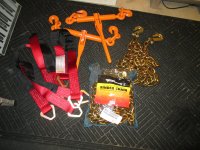
 

Attachments

  • IMG_0604.JPG
    IMG_0604.JPG
    689 KB · Views: 190
/ Rigging 101 needed please #2  
Perhaps a drive through at a local truck stop to gain some information just by taking a look at how certain loads are secured, I generally cross chain both rear and front of anything with wheels on it. I always drop my tie down hooks through the pin pocket on trailer and then hook back up to pin-pocket. It also may be beneficial to ask local highway patrolman or DOT Rep. they may even have a set of guide-lines in print available.

Cheers

Roger
 
/ Rigging 101 needed please #3  
Hi Daugen, I can offer limited insight for the PA vehicle code, you want to look at PA VC chapter 4903 Securing loads in vehicles. Basically you have to prevent moving, shifting or loosing your load. Any hydraulic arm must be secured to the trailer with steel tie downs. Hope this is helpful as far a securement. As far as weight, make sure your not exceeding the trailer or truck GVWR and as long as your transporting your own equipment for private use you should not need a CDL.

I don't haul tractors often, but do haul coal, stone, etc and scrap metal loads that can get heavy (cut up used machinery, etc). My rule of thumb is that if I'm checking load, when checked the whole truck should move, with the load as one (shaking load side to side and ith moves with the truck as one, etc)
 
/ Rigging 101 needed please #4  
A simple safe rule of thumb - vehicles get chained, implements get strapped.

For the little stuff like your L5740 or my M4700 one chain and one ratchet binder per corner and a strap across the FEL. They can be crossed if required for getting a straight pull.

LOT's of discussion has been had on this.

/edit - I hadn't heard of chaining hydraulic arms.

And make sure your trailer is wider than your tractor, my M4700 wasn't and I had to move the tires in.

Read this little thread and report back :) http://www.tractorbynet.com/forums/trailers-transportation/228829-how-do-you-tie-down.html
 
/ Rigging 101 needed please #5  
It can be difficult to get the slack out of 3/8" chain. When I trailered my tractor I would get the front-end just snug with the ratchet binders, then pull them tight with the rear binders. I rested the heel of the FEL bucket on the front trailer crossbar/fence thing. Don't over-tighten chains. A ratchet binder with 3/8 chain can do some destruction.

Always stop and check your chains after driving 3-5 miles. Sometimes they are still tight, and sometimes they aren't. I like to position the binders to the outside edge of the trailer as much as possible so I can see them in the mirrors. It pretty easy to see some bounce or slack in those if they are loose.
 
/ Rigging 101 needed please #6  
Try to make sure your tie downs actually tie something down to the trailer that normally rests on the trailer. I am thinking about someone who threw the chain across the middle of a tractor around the gear shift and proceeded to tight the chain with a chain binder to the trailer. The middle of the tractor was unsuppported and the casting broke right in this area.
 
/ Rigging 101 needed please
  • Thread Starter
#7  
Read this little thread and report back :) http://www.tractorbynet.com/forums/trailers-transportation/228829-how-do-you-tie-down.html[/QUOTE]

bingo. what a great thread and if I had read it, well, it isn't short but there are a few guys who tied down their tractors beautifully ,with pics.
Ok, I'm going to do it the conservative way. Even though my Kubota is well under 10K weight, I will get two more chains and binders and go out from each corner, trying to connect to the tractor at a 45 degree angle. As low as possible. Then a strap over top of any implement in front or the rear, looped around somewhere, and make sure nothing can go side to side or more straps. I imagine when I'm done it will look like a Lilliputian holiday.

thanks very much for the link. I looked, but did not find it before I started.
I think I'm doing ok. I have the axle/attachment straps, i learned to drop the chain hook down the hole, out the side and then back on top, where it will rest "facing down" on the top edge, where even if it gets loose it won't fall off. All kinds of nifty things to learn here.

and yes, when I'm done, the very, very best thing to do is take a bunch of pics and post them here, and then ask the group to comment.

3/8 chain is overkill for me now, but if I buy a 8-10,000 pound tractor later, I'll need it.
Need to get some of those heavy duty fabric straps, have one but it's awfully long. Most of my runs won't exceed six feet...

lastly:

393.130: What are the rules for securing heavy vehicles, equipment and machinery?

(a) Applicability. The rules in this section apply to the transportation of heavy vehicles, equipment and machinery which operate on wheels or tracks, such as front end loaders, bulldozers, tractors, and power shovels and which individually weigh 4,536 kg (10,000 lb.) or more. Vehicles, equipment and machinery which is lighter than 4,536 kg (10,000 lb.) may also be secured in accordance with the provisions of this section, with ァ 393.128, or in accordance with the provisions of ァァ 393.100 through 393.114.
(b) Preparation of equipment being transported. (1) Accessory equipment, such as hydraulic shovels, must be completely lowered and secured to the vehicle.
(2) Articulated vehicles shall be restrained in a manner that prevents articulation while in transit.
(c) Securement of heavy vehicles, equipment or machinery with crawler tracks or wheels. (1) In addition to the requirements of paragraph (b) of this section, heavy equipment or machinery with crawler tracks or wheels must be restrained against movement in the lateral, forward, rearward, and vertical direction using a minimum of four tiedowns.
(2) Each of the tiedowns must be affixed as close as practicable to the front and rear of the vehicle, or mounting points on the vehicle that have been specifically designed for that purpose.
 

Attachments

  • Lilliputians.jpg
    Lilliputians.jpg
    248 KB · Views: 117
Last edited:
/ Rigging 101 needed please
  • Thread Starter
#8  
btw, every last item in that beginning picture has a made in China tag on it. Amazon. However...beautifully finished chain, nice chafe protection on the straps, four for twenty bucks..., but somewhere in the back of my mind is the persistent concern over things not being what they are. Like chain that may say DOT but maybe only talked the talk. That's why I went a size higher than I likely needed.

In the other thread is a pic of a pretty neat improved functionality binder that was only about five bucks more than the basic ones I bought. Which came highly recommended...I rarely buy anything from Amazon that has not been reviewed by many people. The same forty dollar chain at my door is sixty plus tax and gas at my local Kubota dealer. I buy so much stuff on Amazon for convenience and savings that I also need to wander into the Kubota parts dept, which has not changed since I think they opened eighty years ago, and I know where everything is. Well, the part outside the counter of course. I know where the chain is, I know where the binders are, just wasn't sure what to get. Have a better idea now, and thanks sincerely for all the education. besides, one less chain or part of it hopefully that won't come through your windshield... loop that hook. loop that hook. assuming the head fits through the hole. I'm sure the big rental trailers have plenty of good attachment points. The local Sunbelt rental place uses a top brand trailer (Hudson) which impressed me.

with permission I should download the pic of a nice JD with FEL that was properly tied down; well of course there were suggestions.
I looked at it carefully, and thought, I can do that...

No matter what, I think a rear camera watching over things would be a nice addition to the cab.
 
/ Rigging 101 needed please #9  
If you are not already aware of it. there are different grades of chain and hooks. 3/8" unmarked chain is weaker than 5/16 G70 (grade 70) chain. G70 costs a bit more but saves you in weight and convenience.

The federal motor carrier regulations usually only apply to commercial trucks. If you are hauling non commercially, they may not be a requirement (see your state regs) BUT they are great guidance.

As for license requirements, that varies from state to state. As mentioned in another recent thread, the enforcement officers sometimes have their own rules or interpretation.
 
/ Rigging 101 needed please
  • Thread Starter
#10  
Ken, thank you, yes the chains I bought I made sure were G70. Or that's what the label says...which gets me back to who tests this imported stuff.

one of the interesting requirements for the commercial end is apparently that the equipment cannot fall off the trailer when overturned, because they want vertical restriction also. Now that is one requirement I won't worry about. left right forward backwards fine, but up?
 
/ Rigging 101 needed please #11  
^^^ A few years back, a truck and trailer were stolen locally with a dozer on the trailer. They missed a stop sign at US68 and went over the enbankment and rolled the rig. The dozer remained attached to the trailer (or the trailer remained attached to the dozer?) I guess the original operator had it properly secured ;-)
 
/ Rigging 101 needed please
  • Thread Starter
#12  
well, if you think about it, if it overturns it's likely just to land on its side, not do an end over end like a car might. :shocked:
So it's skidding down the road, and unless it turns over far enough the top of the tractor hits, which wouldn't be hard, well at least on a modern tractor one has a ROPS which might protect it a little. Cab tractors might need a little polishing...

yeah, give that operator an attaboy. I bet it greatly reduced the damage to the dozer.
I wonder how many chains he had on that dozer...four, six?
 
/ Rigging 101 needed please #13  
<snip>
(2) Each of the tiedowns must be affixed as close as practicable to the front and rear of the vehicle, or mounting points on the vehicle that have been specifically designed for that purpose.

Is that a quote or a retype? How do you affix as close as practicable to the "front AND rear"? Shouldn't that be "OR"?
 
/ Rigging 101 needed please #14  
Is that a quote or a retype? How do you affix as close as practicable to the "front AND rear"? Shouldn't that be "OR"?

.... as close as practicable to the front and rear of the vehicle, ...

I think AND is correct. It could be re-written this way: as close as practicable to the front and as close as possible to the rear of the vehicle

OR would imply one end or the other. They obviously want both ends tied down and it makes sense to do the tying as close to the ends as possible.
 
/ Rigging 101 needed please
  • Thread Starter
#15  
Is that a quote or a retype? How do you affix as close as practicable to the "front AND rear"? Shouldn't that be "OR"?


CFR › Title 49 › Subtitle B › Chapter III › Subchapter B › Part 393 › Subpart I › Section 393.130
49 CFR 393.130 - What are the rules for securing heavy vehicles, equipment and machinery?
 
/ Rigging 101 needed please #16  
I had similar questions last year getting ready to move from Virginia to California. Studied DOT regs, California regs, Virginia regs. Read everything I could find here on TBN, which is the most practical and thoughtful source of information I found. Made the trip with B21 and implements on a 14k 20ft equipment trailer (total 8600 lbs). Tow vehicle was 2012 F150 and I used a weight distributing hitch. I was within spec on payload, pulled weight, combined vehicle weight, and tire loading. On the load, I used new G70 5/16 chain throughout and new 5400 lb binders too (I didn't have that stuff before, never needed it). Two chains crossed on the front of the tractor. Two chains, at a 45 degree angle, on the back of the tractor. One chain on the backhoe bucket to keep it from flopping sideways, one chain on the loader (not sure why). One old logging chain wrapped around the two stabilizers to keep them from drooping. Then one chain on each implement. Straps on tool boxes, spare tires, some other stuff. It was a full load and well secured. I was scrutinized by passing highway patrol officers in every state on the six day trip, but never stopped. I did get a walk around inspection at the California border station but no issues were raised there either. I checked the chains every couple hours for the first two days of the trip and had to re-tighten frequently. After two days everything stayed tight for the rest the trip.
 
/ Rigging 101 needed please
  • Thread Starter
#17  
downsizing, sounds like you did your homework and did a nice job on the move. I have the same thing coming up for me at some point, likely a ten hour interstate drive through at least three states. I need to go down and look over the rental trailer to see what it provides for fastening equipment. I now have four 3/8 chains and four 5400 and higher binders, but I only have light duty straps. Hesitant to buy them, they seem to come with different ends, before I look at the trailer. I also have a nice single axle utility trailer and that will get used too for moving, but that I have a ton of good straps for.

not only does it have to work, but it has to look like it will work too...or Officer Bob will see a revenue opportunity.
 
/ Rigging 101 needed please #18  
Exactly. And why I crossed all the Ts etc. if your rig and load look good Officer Bob will go for easier pickings.
 
/ Rigging 101 needed please #19  
just get a few good 2" straps and make sure you have something to use as a "strap protector" for the inevitable sharp edge. I just use folded pieces of cardboard, though I've heard sections of fire hose are ideal.
Get at least one spare strap. I've had a load shift slightly and the new angle on the strap started it wearing badly. Immediately put a spare strap on.
And ALWAYS bring rope and duct tape.
/edit - that's
just get a few good 2" straps
IN ADDITION to all of your other equipment.
Also figure out how you are going to figure out tongue weight.

I'm CHEAP so I use bathroom scale and lever. Since you are going to be running a 5'ver you might just want to get a dedicated tongue weight scale. I think they can work on 5'vers.
 
Last edited:
/ Rigging 101 needed please #20  
I had similar questions last year getting ready to move from Virginia to California. Studied DOT regs, California regs, Virginia regs. Read everything I could find here on TBN, which is the most practical and thoughtful source of information I found. Made the trip with B21 and implements on a 14k 20ft equipment trailer (total 8600 lbs). Tow vehicle was 2012 F150 and I used a weight distributing hitch. I was within spec on payload, pulled weight, combined vehicle weight, and tire loading. On the load, I used new G70 5/16 chain throughout and new 5400 lb binders too (I didn't have that stuff before, never needed it). Two chains crossed on the front of the tractor. Two chains, at a 45 degree angle, on the back of the tractor. One chain on the backhoe bucket to keep it from flopping sideways, one chain on the loader (not sure why). One old logging chain wrapped around the two stabilizers to keep them from drooping. Then one chain on each implement. Straps on tool boxes, spare tires, some other stuff. It was a full load and well secured. I was scrutinized by passing highway patrol officers in every state on the six day trip, but never stopped. I did get a walk around inspection at the California border station but no issues were raised there either. I checked the chains every couple hours for the first two days of the trip and had to re-tighten frequently. After two days everything stayed tight for the rest the trip.

This what everyone should do even if your just going down the road and for what we all have spent on the trailer, tractor, and truck. Spending an extra 100 on your chains/straps is about price of the tank of fuel you will waist if you had to go back and pick up something if it fell off, never mind the cost if it hit someone.
 

Marketplace Items

DEUTZ MARATHON 60KW GENERATOR (A55745)
DEUTZ MARATHON...
Rooster Weathervane (A55853)
Rooster...
2005 Chevrolet C4500 Altec Bucket Truck (A56858)
2005 Chevrolet...
2003 FORD F150 HARLEY DAVIDSON TRUCK (A59575)
2003 FORD F150...
2019 Ford F-150 Pickup Truck (A59230)
2019 Ford F-150...
Brock 48'x16' Flat Bottom Grain Storage Tank (A57148)
Brock 48'x16' Flat...
 
Top