
jedjoe
Silver Member
'nuff said! I would MUCH prefer a bit of rutting to a toppled tractor (with a driver under it)....Even in Kansas and Iowa there are slopes that can get you into serious trouble...
Could you post a picture please.Ballast barrel here. Just some of the same reasons as given by others. Much easier to maneuver in my mostly wooded acreage. It also carries all of my hand implements in the 2 inch PVC tubes as well as several chains. Also has a 2 inch receiver on the back, and hooks on the sides for carrying things. But I can see the other side of using an implement on the back for weight. it is a useful thing on the tractor when you need it. But my rotary cutter sticks out far to much to use at my place. If I had open ground, that might be a different story.
Methanol mix in the tires, as I often need the extra weight for traction when using my rear blade to get up and down the hills and pull the blade. I would not be without the liquid in the tires. But each to their own and depending on what they do with their tractor. There is no best. There is only best for you and what you do. I have found MY best, but that might not be the greatest idea for your operation.

I use my Woodland Mills stump grinder. It's compact and I've never needed more ballastI see a lot of people buying 3 point ballast boxes or making ballast containers out of drums to attach to their 3 point hitch.
I have never really grasped why not just keep a box blade on the back so you could have not just a weight, but something that can be used should you wish to drag something? I have seen some weld a section of railroad rail onto the top of a box blade to make it heavier.
Also, rimguard is something I have considered, but I am also not sure about this because it seems I can do everything I need to do without rimguard and it will just increase the amount of weight when I trailer the tractor or perhaps increase ruts when on soft lawns.. I have thought rimguard would be good when using my ditch bank flail mower, but so far, I haven't found myself in any situation I would consider to have been tippy.
So, is there anyone here that added rimguard to their tires and regretted it?

8 foot box blade usually does a good job if your tractor can handle it. If your loader has enough power to pickup rear of tractor with 8 ft box blade you may be overloading your front axle on a four wheel drive tractor. 8 ft box blade with loaded rear tires offsets front loader NH621 on Workmaster 50. When the rear wheels loose traction you are stressing equipment, as well as operator to the limit.
Eample: Forks loaded to maximum and going down a hill. You find out what your front axle is made of plus how much your britches will hold. You will only do that once in your life.
My BB weighs 1100-1200 lbs. I have 1500 lbs of rear tire fluid. I'm guessing the BB hanging off the 3pt adds more weight than the fluid. But I'm not going to take the time to mathematically prove it.

I've got 1,500lbs of liquid weight at .15 cents per pound. $220.Forget liquid ballast, bolt on cast iron wheel weights.


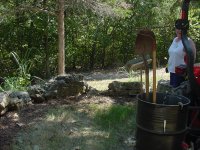
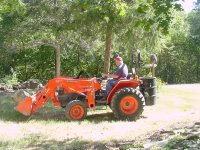
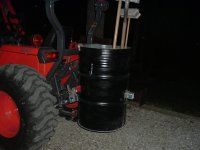
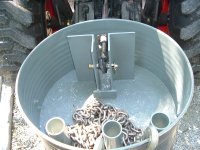
Who's that old man you got workin for ya????Ok. lets see what I can com up with for pictures as requested.
View attachment 726772View attachment 726773View attachment 726774View attachment 726776
I did, and still plan to load them when I get new tires.Forget liquid ballast, bolt on cast iron wheel weights.
Each to their own, but a ballast box for me has less space allowing maneuvering and also has room for hauling chains, clevises, some tools, etc.I agree, but I also agree with the OP regarding a ballast box. I have never understood why attach a ballast box instead of a useful implement. I use an implement and filled tires for ballast.
Make sure you check the axle ratings of your tractor, you dont want to overload it.I did, and still plan to load them when I get new tires.


I have a Heavy Hitch with about 250lbs of suitcase weights, so ~300lbs total, and since it functions as a hitch I guess it's a degree more functional than a ballast box. To remove it I can easily lift each suitcase weight off and then the hitch itself, so that's handy. The HH wasn't cheap, but it does seem to be made very well, and as you mentioned it's compact - good counterweight and I almost forget it's back there.
No weight here, nor are tires loaded. The 1635 seems to do the job nicely, especially on new R1 Tires.1200# of cast iron and no liquid in my tires, I am considering a bit more but she is pretty stable as it is.
Any one that wants it is welcome to load their tires, mine are not and will not be.
Over the years I have had flats with filled tires no more for me.

Keep in mind that liquid weight mostly is supported by the ground and not the axle. That’s what is different about loaded tires.Make sure you check the axle ratings of your tractor, you dont want to overload it.
But you cannot safely lift the full weight capacity of your FEL without counterweight.No weight here, nor are tires loaded. The 1635 seems to do the job nicely, especially on new R1 Tires.
That's about what I paid from my Kubota dealer and I looked a long time for wheel weights. If I had to do it over again I would go to EA and buy 1000 lbs... more than I need but I doubt I would have problems selling the excess. I also would not buy a bolt kit... all that it consisted of was some long, overpriced carriage bolts and I only used 1/2 of them.I've got 1,500lbs of liquid weight at .15 cents per pound. $220.
What does an iron wheel weight cost per pound? Around here it's $1 per pound. So 1,500lb of cast iron wheel weights would have cost me $1,500.
