Backhoe Ripper tooth design - need your advice

   / Ripper tooth design - need your advice #1  

bluehog

Bronze Member
Joined
Nov 13, 2010
Messages
89
Location
Glendale, AZ & Quemado Lake Estates, NM
Tractor
New Holland TC35D 2001
I have followed several of the great threads here on rippers for some time. I know many of you have purchased or fabricated your rippers. I thought that starting a new thread would be advisable. I actually started asking this in another thread and felt that I was "high jacking" as I know I'll have more questions. Any and all input as to what has worked as well as not is what I'm looking for.

I find myself in situation that I need to remove a couple dozen stumps from my property in the New Mexico mountains. The trees are pine so I am not dealing with the hardwoods... but I still want something that is not going to need replacing. The ground is loaded with volcanic basketball sized rock in a sort of clay/caliche (sp?)soil.
My equipment is a NewHolland TC35D with Woods BH9000 backhoe.

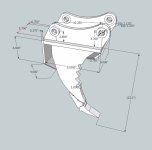
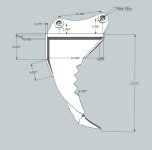
In reviewing what has been posted here and those pics that were provided, I have noticed that the relationship of the point to the locator pins seems to be different than that of the actual digging bucket.

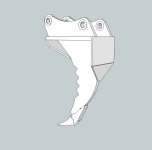
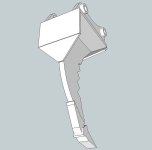
See the photos attached to see what I am describing. In these pics I have extended my backhoe to it's fullest reach and placed the dipperstick against the ground, also the bucket is in full open position. The front teeth of the bucket do not touch the ground <1/8" above. What are the advantages or disadvantages of maintaining the point location to actual bucket design?

Pic 1 shows duplicating bucket location
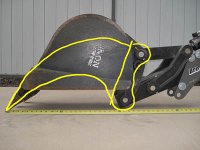
ripper_view.jpg

Pic 2 shows what MIE style point to locators
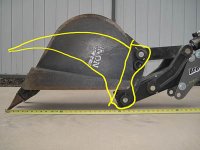
ripper_view-2.jpg
 
Last edited:
   / Ripper tooth design - need your advice
  • Thread Starter
#2  
Next item of concern:
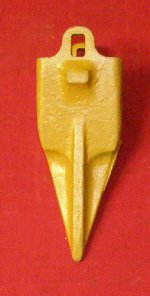
What did you use for your tip? How is it holding up? I was thinking that it would be wise to use a replaceable tip for the ripper point. Something like Esco 18VIP Tiger tooth.
18VIP.jpg

Is this a good idea? Where can I obtain the weld-on adapter for use on a ripper? The ones I have seen online are all designed for buckets and look like the orientation is off 90 degrees.
 
   / Ripper tooth design - need your advice #3  
I don't think a ripper is going to be much use in the fully extended boom/dipper position, no matter what its orientation is. When you curl it, there's not much is holding it down. Your pic2 orientation may be an orientation that is effective in a more useful part of the boom/dipper range of motion.

It seems that on Islandtractor's thread, there was some question about multiple holes on the bucket and which one to use. My Case 480F manual mentions this. If you pick the hole that lets you reach way out to dig, it doesn't allow you to curl the bucket far enough not to spill when you lift the bucket up and load a truck, for example. Conversely, the other hole won't allow maximum reach but will curl further for loading a truck. Pick your poison.
 
   / Ripper tooth design - need your advice #4  
I have never compared the actual reach and curl limits with standard Woods bucket versus my MIE ripper. The ripper fully extended extends the reach of the BH but still curls in enough that it cuts most roots on the first try. However, as I've never had a ripper that extended less but curled more I don't know if that is the best configuration or not. The MIE ripper design was worked out by myself and MIE based on a design I saw of a ripper made by a British company for much larger excavators so the overall shape and proportions resemble that one but scaled down.

Regarding the tip, I do not have a replaceable tip and I wouldn't want one. You want the tip to be narrow enough to slice easily through both ground and roots unless your primary purpose is to tear up rocky ground. The narrower the tip and blade, the easier it will cut roots. For my purposes a narrow knife edged (well 45% or so) seemed best and I have no complaints. It hasn't worn noticeably in several seasons of use. If it ever does, I'll just build up the worn area with new weld.
 
   / Ripper tooth design - need your advice
  • Thread Starter
#5  
Regarding the tip, I do not have a replaceable tip and I wouldn't want one. You want the tip to be narrow enough to slice easily through both ground and roots unless your primary purpose is to tear up rocky ground. The narrower the tip and blade, the easier it will cut roots. For my purposes a narrow knife edged (well 45% or so) seemed best and I have no complaints. It hasn't worn noticeably in several seasons of use. If it ever does, I'll just build up the worn area with new weld.

What is the width of your tip? 1.25"?
What is the width of the tip support? 0.75" ?
 
   / Ripper tooth design - need your advice #6  
   / Ripper tooth design - need your advice #7  
It won't make a whole lot of difference since you have lots of rotation with the bucket cylinder. If you have adjustable linkage holes on the bucket, the further apart gives the most digging force and the closest together gives the most curl but less digging force. A word of caution though, I wouldn't be reaching all the way out and ripping in hard ground or difficult tree roots. Way more stress on the boom and pivot points. I say this from experience. While hooking on some frost with my boom almost fully extended, I ripped the top swing mount right off my Cat backhoe and also bent the lower 1 1/2" thick bottom mount. A very poorly placed grease fitting significantly added to the failure(that's where the crack started) but the pivot pins are 2 1/2" diameter. It was a pretty big job welding it back up and I'm sure it would have cost a few thousand $$$ to have someone else fix it. Sometimes being a welder is a good thing. If you're ripping, you want to have the stick basically vertical so there's less stress on the swing pivot. You never see a big excavator fully extended when ripping or doing heavy digging.

Series 23 teeth with the rubber mount pins in the side would be good for a ripper. The pointed teeth won't last as long as the straight ones. If your backhoe has any power at all it will rip out roots. You could put a double bevel on the shank for cutting roots but the tip will still wear the most and it's nice to be able to replace it easily in a couple minutes. Any heavy equipment or industrial supply that has ground engaging tools will have teeth and adapters.
 
   / Ripper tooth design - need your advice
  • Thread Starter
#8  
   / Ripper tooth design - need your advice
  • Thread Starter
#9  
It won't make a whole lot of difference since you have lots of rotation with the bucket cylinder. If you have adjustable linkage holes on the bucket, the further apart gives the most digging force and the closest together gives the most curl but less digging force. A word of caution though, I wouldn't be reaching all the way out and ripping in hard ground or difficult tree roots. Way more stress on the boom and pivot points. I say this from experience. While hooking on some frost with my boom almost fully extended, I ripped the top swing mount right off my Cat backhoe and also bent the lower 1 1/2" thick bottom mount. A very poorly placed grease fitting significantly added to the failure(that's where the crack started) but the pivot pins are 2 1/2" diameter. It was a pretty big job welding it back up and I'm sure it would have cost a few thousand $$$ to have someone else fix it. Sometimes being a welder is a good thing. If you're ripping, you want to have the stick basically vertical so there's less stress on the swing pivot. You never see a big excavator fully extended when ripping or doing heavy digging. .

Points well taken! I will change my design so the ripper point is more central to the bucket pins. This should allow a closer distance to the item to remove (stump, rock, etc.) with the dipper more vertical and allow for more bucket curl motion rather than loading the dipper or boom. Makes it easier to see work at hand as well. :thumbsup: Wish I had the welding experience... I know an awesome welder at work that I hope will help on my project.

Series 23 teeth with the rubber mount pins in the side would be good for a ripper. The pointed teeth won't last as long as the straight ones. If your backhoe has any power at all it will rip out roots. You could put a double bevel on the shank for cutting roots but the tip will still wear the most and it's nice to be able to replace it easily in a couple minutes. Any heavy equipment or industrial supply that has ground engaging tools will have teeth and adapters.

I appreciate the recommendations on the tip and adapter. I found a local supply house HEM (Heavy Equipment Machinery )in North Phoenix that I will visit and take your suggestions to see what they have available. I am seriously planning on the replaceable tip as the majority of my projects after the initial stump removal is all going to be exposed rock removal and narrow trenching. I think having the option to smack out a pin and replace a tip is a better choice for me and my location. Thanks again!
 
   / Ripper tooth design - need your advice #10  
I welded on a piece of AR400 to my ripper which is a very abrasion resistant steel. It won't hardly cut with a grinder. If i had it to do over again i'd try putting the cutting teeth on the inside instead of the outside. The 1" thick plate was a bit too wide for my hoe but would be probably about right for yours. When I curl it under a root with the boom extended I can pull the front wheels off of the ground. The limitation is not curl force, but lifting in the boom and crowding in the stick. I want to make a quick attach for my bucket and the ripper because the ripper is hard to get on and off. It's much heavier than the bucket. I found that overall it's best to use the ripper in conjunction with a sawzall that has a 12" pruning blade.
 
   / Ripper tooth design - need your advice #11  
I welded on a piece of AR400 to my ripper which is a very abrasion resistant steel. It won't hardly cut with a grinder. If i had it to do over again i'd try putting the cutting teeth on the inside instead of the outside. The 1" thick plate was a bit too wide for my hoe but would be probably about right for yours. When I curl it under a root with the boom extended I can pull the front wheels off of the ground. The limitation is not curl force, but lifting in the boom and crowding in the stick. I want to make a quick attach for my bucket and the ripper because the ripper is hard to get on and off. It's much heavier than the bucket. I found that overall it's best to use the ripper in conjunction with a sawzall that has a 12" pruning blade.

I like the sawzall idea. There are certainly times when the ripper has pulled up a big root when it would be faster to hop off the tractor and use a battery powered sawzall to make a quick cut rather than trying to rip a root that is flexible enough to bend rather than cut with the ripper.
 
   / Ripper tooth design - need your advice
  • Thread Starter
#12  
Okay, so I am getting the gist of the action needed to remove the stumps. More vertical approach rather than extending dipper & boom. Use the bucket curl to position under the root, then lifting to tear/split the root.

Positioning in the manner I can see where the interior teeth would make a difference. So is it better to have a few large teeth or numerous smaller ones? What shape teeth do you think would work best... shark tooth shape, hook shape, etc.? Still plan on making the entire interior surface a knife edge shape... but with teeth added?

Sawzall will be added to my tool list! And yes I can see where the weight of the ripper will be substantially heavier than the bucket. I'll need to make a cradle to support it in a balanced vertical position. Guess I'll add a couple of eyebolt holes to attach a short chain with hooks to p/u and move around.
 
   / Ripper tooth design - need your advice #13  
If I were to make a Mk2 version of my ripper, it would have serrated teeth in front and a sharp hook type tooth on the backside. Cut while curling and if necessary then rip a chunk out by using the backside.

Mine is heavy but I can lift it so no real need for a hook. Perhaps a chain to wrap around it.

A stand would be great but I fear the power of the BH would destroy any stand while trying to make adjustments. Makes more sense to me to simply have a hole in the ground to put the ripper in while mounting it.
 
   / Ripper tooth design - need your advice #14  
I agree with the inside teeth, probably the outer hook tooth also - My intention, when the ripper gets to the top of the project list, is to cut some 1-1/4" x 3-1/2" pieces of AR400 plate (1/2" thick) with the plasma, then arrange them along the front edge of the ripper with each one overlapping the next one by about 1/2", kinda like taking a bunch of dominoes and overlapping them end to end.

If I start with the furthest "domino" from the point of the ripper, AND make the narrow cuts all angled maybe 30 degrees of "underbite", they will form saw teeth 1/2" deep and 1-1/4" wide along the front edge of the ripper.

I've used this stuff before for wear edges, and as previously mentioned it's REALLY HARD stuff. Also, since normal mig hardwire is effectively "low hydrogen", I won't need to use 7018/stick welder unless I want to.

In use, for tougher roots I'm envisioning just a slight amount of curl, with the ripper deep behind root, then crowd just a bit and raise the boom - with those teeth each taking about 1/2" of material, I'm thinking 2 or 3 passes at a root and it'll give up.

I started to make a sketch of this, but all I have available ATM is Paint, which is 'way too limited for such a "non-square" design. Hopefully the explanation will do... Steve
 
   / Ripper tooth design - need your advice #15  
I get the idea.

In my experience, roots that don't break with first contact are either too big or too flexible. I think the teeth would help with both but are not a perfect solution.

Too big is easy to understand and though the teeth would help, I kinda like the idea of a good lithium powered sawzall to make quick work. Downside is getting off the tractor but upside is not dragging the tractor around or pushing hard on BH or tractor. I haven't tried it yet and will likely give a tug or two with the ripper before dismounting but I think it will actually save time.

The too flexible roots may also be best dealt with by the saw. I have a hook on the back of my ripper that does help but the limited movement of the curl can make it frustrating. It also is a somewhat unnatural movement to control the ripper in a backwards push with simultaneous "dump" motion. I'm sure it can be mastered but when you don't use the ripper everyday it is awkward.
 
   / Ripper tooth design - need your advice #16  
In my Case (pun intended) it'll probably work OK - for one, I'm gettin' too old to wanna get my excercise climbing on/off the tractor -

For two, my old 580B weighs 12,500 lbs with the hoe in place.

For three, although I do have a few trees slated for firewood that are big enough to argue with 12,500 lbs, most are "junk" trees (lot of pesky hawthornes) planted complete with fertilizer by birds - so far, the only one of the hawthornes that made "me and my ho" work at it was well-entrenched and about 12" across at the butt.

I had similar problems to the ones you'd mentioned near the beginning of this thread, mainly because all I had at that time was the 24" bucket on the Case. Spent quite a bit of "quality time" on that "thorne in my side" :thumbdown: The site looked like a bomb crater til I found some loose dirt to "make it all better".

I do have a battery "sawzall" and a couple of REALLY agressive blades that work well on dry or green wood, so that's always an option... Steve
 
   / Ripper tooth design - need your advice #17  
In my Case (pun intended) it'll probably work OK - for one, I'm gettin' too old to wanna get my excercise climbing on/off the tractor -

For two, my old 580B weighs 12,500 lbs with the hoe in place.

For three, although I do have a few trees slated for firewood that are big enough to argue with 12,500 lbs, most are "junk" trees (lot of pesky hawthornes) planted complete with fertilizer by birds - so far, the only one of the hawthornes that made "me and my ho" work at it was well-entrenched and about 12" across at the butt.

I had similar problems to the ones you'd mentioned near the beginning of this thread, mainly because all I had at that time was the 24" bucket on the Case. Spent quite a bit of "quality time" on that "thorne in my side" :thumbdown: The site looked like a bomb crater til I found some loose dirt to "make it all better".

I do have a battery "sawzall" and a couple of REALLY agressive blades that work well on dry or green wood, so that's always an option... Steve

Yes, I don't think someone with a multi ton excavator or even full sized TLB would likely need to dismount for any reason in clearing trash tree stumps or even big trees. My Woods BH90x mounted on a ?6000-7000 TLB does pretty well with roots of trees less than 10-12 inches. I have however a few big old oaks that were cut down and trying to dig out those stumps has been a bear even with my ripper.

What I really need is a hydraulically extendable Sawzall mounted in parallel with the ripper so I can just operate a different joystick to do the saw work without moving my fat arse off the seat.
 
   / Ripper tooth design - need your advice #18  
"What I really need is a hydraulically extendable Sawzall mounted in parallel with the ripper so I can just operate a different joystick to do the saw work without moving my fat arse off the seat."

Exactly - now you know why I'm a firm believer in the old saying, "Lazy people make the best inventors"... :laughing:

You'll understand more when I finally get around to posting a thread on my last two, and NEXT two, projects that will all work in tandem :confused2: ... Steve
 
   / Ripper tooth design - need your advice
  • Thread Starter
#19  
Series 23 teeth with the rubber mount pins in the side would be good for a ripper. The pointed teeth won't last as long as the straight ones. If your backhoe has any power at all it will rip out roots. You could put a double bevel on the shank for cutting roots but the tip will still wear the most and it's nice to be able to replace it easily in a couple minutes. Any heavy equipment or industrial supply that has ground engaging tools will have teeth and adapters.

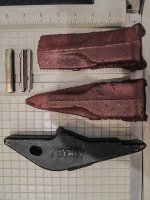
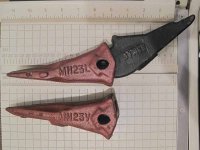
I went to HEM (Heavy Equipment Machinery, Inc.) North Phoenix, AZ 623-879-6608. I took your advice and p/u the 23 series adapter (230010), flat tooth (MH23L), tiger tooth (MH23V) and 4 flex pins (TF23P) for $47+tax. Below are a few pics for those (as myself prior) who did not know for sure what was what. One thing on the "tooth" there are several grades... make sure you get the higher grade material (made in Spain) only a few $ difference.

Series_23-2.jpg
Adapter, teeth & pin (top & side view)

Series_23.jpg
Tooth on adapter
 
   / Ripper tooth design - need your advice
  • Thread Starter
#20  
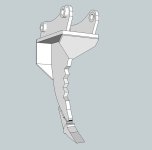
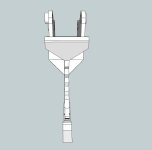
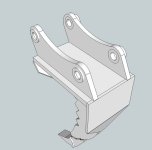
Now it's time to get your opinion of this design, although I want this to be versatile ( stump removal, rock removal & trenching) the long term main use will be trenching within soil that is very compacted clay with many rounded rocks in the 6"-18" size.

One thing for sure... it would be much easier to design without the removable tip. The interior teeth of the shank will need a knife edge added... I couldn't figure out how to do it in the software I was using.

ripper2.jpg ripper2-2.jpg ripper2-3.jpg ripper2-4.jpg ripper2-5.jpg ripper2-6.jpg ripper2-7.jpg


Tractor & Equipment Auctions

Dayton 32965 80-Gallon Horizontal Air Compressor, 22 Volts, 5 HP, 2 Stage, 3 Phase (A59076)
Dayton 32965...
2018 CATERPILLAR 320 EXCAVATOR (A60429)
2018 CATERPILLAR...
2001 Workhorse Custom Chassis P42 Delivery Truck (A59230)
2001 Workhorse...
Brock 48'x16' Flat Bottom Grain Storage Tank (A57148)
Brock 48'x16' Flat...
2025 CFG Industrial QK18R Mini Excavator (A59228)
2025 CFG...
2015 LOAD TRAIL 24+6 GOOSENECK TRAILER (A58214)
2015 LOAD TRAIL...
 
Top