Run Your Chains Floppy or Tight?

   / Run Your Chains Floppy or Tight? #1  

Henro

Super Member
Joined
Jul 4, 2003
Messages
5,005
Location
Few miles north of Pgh, PA
Tractor
Kubota B2910, BX2200, KX41-2V mini EX
Hi,

I am going to buy wheel spacers for my Kubota B2910, which has R4 tires. Until now there was just barely enough space for the chains to clear the rear fenders (most of the time) when pulled as tight as possible with spring tensioners.

My neighbor (passed away now) on his somewhat larger tractor with ag tires used to run his chains so loose they would fall off the front of the tires and hit the ground before the tire ran over them and pulled them back up off the ground.

I have not had good luck with the ladder type chains on my R4 tires. They mostly fall between the lugs and while better than nothing, don't seem to work that well.

When I get the spacers I am thinking I will run the chains like my neighbor did on his tractor. I think it would work much better that what I have been doing for the last 15 years.

What do you guys do, and what do you think about floppy chains?

Grateful of any input/advice you may have... Bill
 
   / Run Your Chains Floppy or Tight? #2  
Shug to tight IMO. Too much of a chance of them hitting under the fender or the sides of something else. Stay on better too...!
 
   / Run Your Chains Floppy or Tight? #3  
Your fender clearance is limited so watch that.

Otherwise don't worry too much about it. Fasten them as snuggly as you can and run em. Don't worry about tarp straps, bungee cords or whatever else is used for tensioners. Any tensioner that is elastic in nature isn't going to keep a tire chain on anyway.
 
   / Run Your Chains Floppy or Tight? #4  
I bought full wrap lugged chains for L4630 and when the dealer was fitting them, his helper, old Elmer, said "always leave 'em loose enough to stick your forearm under".
And so they did, but the important thing is to get the side chains snug because the full wrap style will not slip once they are tight.
They also don't need any springs, bungees or tighteners
The only time they would whack the fenders was when one or another link came loose[occasional] or broke[rare].
Also the faster one drives, the more likely the chains are to slap
 
   / Run Your Chains Floppy or Tight? #5  
When I ran ladder chains I would put them on, ensure that each crosslink was over a Vbar, and get them as tight as I could. I then would drive forward about 10 feet and tighten them again. I have never used or needed chain tensioners, on my tractor or my pickup; and in the woods they are just something more to break or lose.
 
   / Run Your Chains Floppy or Tight?
  • Thread Starter
#6  
I plan to order 3" spacers, so I should have close to 4" clearance between the tires and fenders on the side. On the top I should check, but I think I may have at least 2" or more clearance there, and I don't expect to go fast with the chains on so I am not expecting them to fly up and hit the fenders above the tires, but that is a good point.

I am thinking a couple inches of clearance (forearm distance :)) might be good. I will say again though that I was kind of amazed seeing how loose my neighbor had his chains!

Bill
 
   / Run Your Chains Floppy or Tight? #7  
On conventional ladder chains I get the side chains as snug as I can,
it they have long enough cross chains to where the side chains are well down
the sidewalls and both sides are hooked in the same links distance wise they will uually work good and stay on.

The Euro or patterned Aquline or OFA style chains are designed to be run moderately loose,
my directions called for being able to put a fist under the chains.
They intend for them to walk around the tires while being used.
 
   / Run Your Chains Floppy or Tight? #8  
From the instruction sheet for OFA euro style chains and how I run mine. Which is loose.

P1180859.JPG

P1170493.JPG

gg
 
   / Run Your Chains Floppy or Tight?
  • Thread Starter
#9  
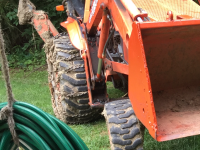
I took my chains off this summer for the first time in 15 years. This is what they look like on the R4 tires. Half of the cross links seem to drop between the lugs. After getting wheel spacers, I am thinking I may be much happier just using them in the winter and running them loose, as compared to all year round running them tight.

Of course if I do that I will not have chains on when I need them on muddy surfaces. AND just last summer I bought a new set of spring tensioner to boot, still unused.

Decisions, decisions!

02744E73-EC27-401D-80D9-4E21994805E7.png
 
   / Run Your Chains Floppy or Tight? #10  
My rear chains are very similar to Gordon Gould's. They are made by Trygg, in Norway. Their instructions recommend the same looseness indicated in Gordon's instruction sheet. The reason for the looseness is so they can be self cleaning. The mud or snow gets shaken out with each rotation. I widened the wheels as far as possible, and as long as any extra links are hitched down nothing hits the fenders. There is a video on the Trygg website that shows them being installed.

On the other hand, I stole a set of regular ladder type chains from my pickup to put on the tractor's front tires. They have to be snugged down tight because when the wheels are turned they just barely clear the loader supports.
 
   / Run Your Chains Floppy or Tight? #11  
Most chain manufacturers recommend running tensioners on ladder style chains. They say that both the chains and the tires will last longer if you do.

As several have already noted "euro" style chains like the OFA EKO chains or the Trygg chains or similar generally recommend running with slack in the chains.

I've run both at one time or another on the same tractor. I found that without a tensioner, the ladder style tended to hit my fenders when running at high speeds, even if I made a serious effort to get them as tight as I can (I even bought a chain installing tool to help with that). I suspect that the fact I was runnig R4 tires may have prevented fully tightening the chains. It be interested to know what would have happened if I had the same sized tire in something like a turf tread - I'll bet tightening chains is easier with those.

When running my OFA EKO 8 chains, I leave that fist of slack when installing (it sure makes installing easier). I can run at top speed, and the chains never hit the fenders, even though visually, the chains appear much looser.

In thinking about this, I think it has to do with the fact that on a ladder chain, the cross link moves independently, while on the Euro-style chains, the fact that the cross chains are all tied together means that any slack is strictly limited by those circumferential chains, and the cross chains are not free to stretch out independently.

I also ran Duo-Grip chains for one winter season, but did not get to use them much that year. It never did a high speed test, since the ride was so bumpy I thought I'd shake myself or my tractor to death at anything over half speed.
 
   / Run Your Chains Floppy or Tight? #12  
Most chain manufacturers recommend running tensioners on ladder style chains. They say that both the chains and the tires will last longer if you do.

As several have already noted "euro" style chains like the OFA EKO chains or the Trygg chains or similar generally recommend running with slack in the chains.

I've run both at one time or another on the same tractor. I found that without a tensioner, the ladder style tended to hit my fenders when running at high speeds, even if I made a serious effort to get them as tight as I can (I even bought a chain installing tool to help with that). I suspect that the fact I was runnig R4 tires may have prevented fully tightening the chains. It be interested to know what would have happened if I had the same sized tire in something like a turf tread - I'll bet tightening chains is easier with those.

When running my OFA EKO 8 chains, I leave that fist of slack when installing (it sure makes installing easier). I can run at top speed, and the chains never hit the fenders, even though visually, the chains appear much looser.

In thinking about this, I think it has to do with the fact that on a ladder chain, the cross link moves independently, while on the Euro-style chains, the fact that the cross chains are all tied together means that any slack is strictly limited by those circumferential chains, and the cross chains are not free to stretch out independently.

I also ran Duo-Grip chains for one winter season, but did not get to use them much that year. It never did a high speed test, since the ride was so bumpy I thought I'd shake myself or my tractor to death at anything over half speed.

This makes sense to me, which is why I run my ladder chains (w/ v-bars) tight. I have a B3030 and run front & rear chains nearly have the year. Tight has worked perfectly: I can run in high gear when need, never slipped out of a chain, and never had a part of the chains hit any part of the tractor.

I actually don't understand why you would want to run any chains loose. I would think the ideal is to have the chains as an extension of the tire and dig for grip. Loose chains seem as though the tire could still slip, albeit slightly, simply running over a chain which was placed down before it. I would also think the loose chains could more easily slide into the grooves of the tires while I set my chains specifically across the tire thread as I install them. More work? Yes. It has been worth it in my experience.

I understand commercial vehicles with auto-chains use the "loose" method, but I see that different as those have momentary needs.
 
   / Run Your Chains Floppy or Tight? #13  
This makes sense to me, which is why I run my ladder chains (w/ v-bars) tight. I have a B3030 and run front & rear chains nearly have the year. Tight has worked perfectly: I can run in high gear when need, never slipped out of a chain, and never had a part of the chains hit any part of the tractor.

I actually don't understand why you would want to run any chains loose. I would think the ideal is to have the chains as an extension of the tire and dig for grip. Loose chains seem as though the tire could still slip, albeit slightly, simply running over a chain which was placed down before it. I would also think the loose chains could more easily slide into the grooves of the tires while I set my chains specifically across the tire thread as I install them. More work? Yes. It has been worth it in my experience.

I understand commercial vehicles with auto-chains use the "loose" method, but I see that different as those have momentary needs.

I use the Euro style and they are run a bit loose , I have never seen any tire slippage in the chain as to a traction lose.
The studded Euro's grip so much more then ladder chains it is amazing.
I would like to find a set to fit my sander truck,
on it I run 2 link spaced HD ladders and while the traction is decent the ride is poor.
Also the Euro style rides on top of the tire much better then a ladder chain.
 
   / Run Your Chains Floppy or Tight? #14  
This makes sense to me, which is why I run my ladder chains (w/ v-bars) tight. I have a B3030 and run front & rear chains nearly have the year. Tight has worked perfectly: I can run in high gear when need, never slipped out of a chain, and never had a part of the chains hit any part of the tractor.

I actually don't understand why you would want to run any chains loose. I would think the ideal is to have the chains as an extension of the tire and dig for grip. Loose chains seem as though the tire could still slip, albeit slightly, simply running over a chain which was placed down before it. I would also think the loose chains could more easily slide into the grooves of the tires while I set my chains specifically across the tire thread as I install them. More work? Yes. It has been worth it in my experience.

I understand commercial vehicles with auto-chains use the "loose" method, but I see that different as those have momentary needs.

I figure there is a reason the manufacturers of the Euro-style chains all seem to recommend running them a bit loose. So that's how I run mine. I've had no problems with slipping, and as @LouNY said, they do a much better job of staying out of the grooves in the tires than the ladder style chains do (I ran the ladder style on the exact same tires and tractor for years before switching to the Ofa Eko chains).
 
   / Run Your Chains Floppy or Tight? #15  
I run trygg flexi studded diamond shaped chains and I would never go back to ladder chains. I leave them on all year long and the traction is amazing in the woods and in the winter. With the flexi chains you can remove links to suit your needs so I dont need to mess around with bungee cords, they are perfect fit once you customize them. Well worth their price.
 
   / Run Your Chains Floppy or Tight? #16  
I get them as tight as I can*, which is pretty loose**.


*: When I first put them on.
**: After driving on them for a while.
 
   / Run Your Chains Floppy or Tight? #18  
Tight chains are happy chains.

I deflate my tires before throwing them on, tighten them up as much as I can, then re-inflate the tire to spec. This really makes for an easy install and tight, tight, tight chain.

With loose chains (before I leaned to deflate the tires), I could spin the tire on the chain. This would cause damage to the chain and in some cases break it.

Look at skidder chains. Just google them for the images. These chains are worn year round on very heavy machines that are designed to pull heavy logs up steep hills in mud. Those chains are very tight!
 
   / Run Your Chains Floppy or Tight?
  • Thread Starter
#19  
No chains for me this winter and I kind of miss them, even if most of the links seem to fall between the lugs of my R4 tires.

But I keep remembering my neighbor's chains. They seemed to fall on the ground about six inches or a little more in front of his tires. Seems to me in my case, if the chains fell on the ground in front of my R4 tires, then I would end up with more chain between the rubber and the surface I am riding on, as compared to what I had when running the chains tight, and mostly pulled in between the tire lugs.

If I buy the wheel spacers, I will try running the chains loose and report back. Still seems like a viable option to me though...

Bill
 
   / Run Your Chains Floppy or Tight? #20  
Hi,

I am going to buy wheel spacers for my Kubota B2910, which has R4 tires. Until now there was just barely enough space for the chains to clear the rear fenders (most of the time) when pulled as tight as possible with spring tensioners.

My neighbor (passed away now) on his somewhat larger tractor with ag tires used to run his chains so loose they would fall off the front of the tires and hit the ground before the tire ran over them and pulled them back up off the ground.

I have not had good luck with the ladder type chains on my R4 tires. They mostly fall between the lugs and while better than nothing, don't seem to work that well.

When I get the spacers I am thinking I will run the chains like my neighbor did on his tractor. I think it would work much better that what I have been doing for the last 15 years.

What do you guys do, and what do you think about floppy chains?

Grateful of any input/advice you may have... Bill

I use 2 link ladder chains with y B1750HSDT with Z Bar rear tires and my B3350 with R-4 tires.

On both I spent the time to properly fit them as tightly as possible. Installation takes a bit longer but the chains do not move, flop around or hit the fenders, and no tensioners of any kind are needed.

Tight two link ladder chains work well with either R-1 or R-4 tires, ride well, and are safe for asphalt and concrete. Four link ladder chains will work their way between the lugs and produce a rough ride.

SDT
 

Tractor & Equipment Auctions

Mini John Deere Truck (A55853)
Mini John Deere...
2012 Freightliner M2 106 Altec TA37M 37ft Insulated Material Handling Bucket Truck (A60460)
2012 Freightliner...
SEMI AUTOMATIC QUICK CHANGE FOR MINI EXCAVATOR (A58214)
SEMI AUTOMATIC...
20 LOWBOY BUMPER PULL TRAILER (A55745)
20 LOWBOY BUMPER...
RoGator RG1100C (A56438)
RoGator RG1100C...
2001 WELLS CARGO 8' X 32' TOY HAULER DBL AXLE TRL (A57192)
2001 WELLS CARGO...
 
Top