Safety Tips

/ Safety Tips #61  
Re: Safety Tips - Tractor Overturn Hazards

Rich, did you get the tiltmeter that registers degrees or percentage of slope? I know the difference can be a little confusing, but by my calculations a 25% slope is only 11.25 degrees. Now I don't like working on side slopes, but that's not too bad so long as you go slow, know whether you might hit a dip or bump, etc. However, if you're talking about 25 degrees, I'd be surprised if you hadn't rolled it.

Bird
 
/ Safety Tips #62  
Re: Safety Tips - Tractor Overturn Hazards

Bird, I misstated my previous post. The slope is not over 25% but over 25 degrees. That's what my meter measures. I realize that I could easily have rolled over, and I have you to thank that I never will!!! Thanks, again!!!!
 
/ Safety Tips #63  
Re: Safety Tips - Tractor Overturn Hazards

Wow, Rich, I thought maybe you had confused degrees and percent./w3tcompact/icons/wink.gif If you got away with driving cross ways on 25 degrees you have a lot more nerve than I do./w3tcompact/icons/laugh.gif Straight up and down, yes, but cross ways; no way for me.

Bird
 
/ Safety Tips #64  
Re: Safety Tips - Tractor Overturn Hazards

Bird, I didn't do it intentionally! I asked some of my neighbors if the slope was too much, and they said no problem. I was freaking out as I mowed the hill, but I thought i was being paranoid....until I got my tiltmeter!!!!/w3tcompact/icons/shocked.gif I'll never take my tractor on that hill again, because the top of it is wooded, so the only way I can get to it is from side to side!!/w3tcompact/icons/mad.gif
Rich
 
/ Safety Tips #65  
Re: Safety Tips -Preventing Tractor Side Turnovers

PENPAGES: Factsheets from Pennsylvania State University

Preventing Tractor Turnover To The Side
In 1979 a middle-aged Pennsylvania farmer attempted to drive his tractor across an incline with the front-end loader raised and full of stone. The tractor upset, fatally crushing him. This accident was all the more tragic because he left behind a wife and three daughters.

Tractor overturns result in more farm accident deaths each year than any other farm-related accident. In four out of five of these accidents the tractor is turned over on its side. These statistics are especially unfortunate because nearly all overturns to the side could be avoided. To prevent side rollovers, operators must understand the specific hazards associated with the tractor and the proper safety precautions to apply when using them.

To keep your tractor firmly on the ground you must control the two forces which are responsible for side overturns. One of these forces is gravity. When setting on level ground a tractor's center of gravity is approximately two feet in front of and ten inches above the rear axle. With the center of gravity in this position the tractor is stable. However, if you change the position of the center of gravity by using certain types of mounted equipment or by driving across steep slopes, the tractor's stability decreases and the opportunities for an upset become greater.

Centrifugal force is the other major force involved in tractors turning over. This is the force that pushes at you and your tractor from one side as you turn it around or follow a bend in the roadway. Centrifugal force is dangerous; the pressure it exerts against a turning tractor multiplies rapidly as the tractor's speed increases. For instance, doubling a tractor's speed will increase the centrifugal force four times, tripling it will increase this force nine times. As the pressure exerted against a tractor becomes stronger, short or quick turns can rapidly change the vehicle's center of gravity and cause the tractor to tip over.

Fortunately, both of these forces can be controlled through the application of proper safety precautions. Remember, a tractor's center of gravity should be kept as low to the ground as possible when it is moving. A bump is less likely to tip the tractor and there is less chance that centrifugal force will upset it when turning. Drive a front-end loader with the bucket in a lowered rather than a raised position, and add weights to the tractor of off-set high-mounted liquid fertilizer tanks to keep the tractor's center of gravity low.

Tractors should be driven no faster than conditions will allow. Speed reduces the stability of tractors. Be alert to hazards in your path such as rocks, holes, or other obstructions and make your turns cautiously and at reduced speeds.

Proper braking of the tractor also reduces the chance of upset. Before driving at transport speeds, lock the brake pedals together to insure even braking pressure (brakes must be evenly adjusted). Braking only one pedal at higher speeds can force your vehicle to swerve abruptly and roll over. When travelling downhill, shift to a lower speed before you begin to descend and let the engine do most of the braking. This will help avoid the possibility of a runaway tractor which could flip over.

The safety-minded operator will avoid crossing steep slopes with his tractor if at all possible. Tractors are less stable on hillsides and can be easily over-turned. If you must work on slopes, however, use tractors with wide front ends and space your rear tires as far apart as possible. Watch for bumps or depressions and cross the slope slowly, keeping any side-mounted equipment on the uphill side of the tractor.

Together with safe operation of the tractor, it is a good idea to safeguard yourself with the extra protection provided by a roll-over protective structure. Roll-over protective structures are either protective frames or protective enclosures which, when mounted on the tractor, will limit most upsets to 90 degrees as well as protect the operator, particularly if the operator is wearing the seatbelt.

The safety oriented operator must always be concerned about maintaining his tractor in a stable position. By applying these five safety precautions the chances for turning your tractor over on its side will be greatly reduced:

1. Remember to keep the tractor's center of gravity as low to the ground as possible.

2. Drive no faster than conditions will permit.

3. Lock your brakes before travelling at transport speed and, if possible, use the engine as a braking mechanism when going downhill.

4. Avoid crossing steep slopes. If you must, drive slowly and position side-mounted equipment on the uphill side of the tractor.

5. Guard your life by installing roll-over protective structures on your tractor and use the seatbelt.


Author: Dennis J. Murphy, Associate Prof. Ag. Engr. Department of Agricultural Engineering, Penn State February 1988 PENpages Number: 0870186
__________________________________________

18-35197-JD5205JFMsignaturelogo.JPG
 
/ Safety Tips #66  
Re: Safety Tips -Preventing Tractor Rollovers

Rearward & Sideways Tractor Rollovers

TRACTOR4.JPG


TRACTOR5.JPG


18-35196-JDMFWDSigJFM.JPG
 
/ Safety Tips #67  
Re: Safety Tips - Tractor Overturn Hazards

Say what? Isn't there a little polarization here? Why can't someone be alert, safety minded, A N D have a clinometer (tiltmeter)????? I think flying an airplane is quite analgous to driving a tractor. Both are trivial motor skills with a little practice. It is the thinking about what to do and anticipating and avoiding potential problems when able and training to be able to react safely when something unanticipated happens that makes them serious adult activities. Surely you wouldn't put down a pilot just because he equips his aircraft with an altimeter, turn and bank indicator, artificial horizon, etc??? I suppose real carpenters don't use LASER levels or pneumatic nailers, either. Oh well,invite me to your next monthly Ludite meeting and we can discuss this further. :)
 
/ Safety Tips #68  
Re: Safety Tips - Tractor Overturn Hazards

A cpmparison that is not a comparison. The plane is designed to turn and bank and even roll over. With instruments to indicate the degree of turn. The only comparision would be the stall horn, but nor really for once a stall occurs, you have time to correct the condition. The problem with a tiltmeter is that it is to tell you when the slope is too steep. But steepness is not the reason most ti[povers happen. It is the sudden change in surface, e.g. dropping a wheel in a hole, that causes rollover. Using the meter to tell if the slope is too steep with the meter attached to the tractor, provides no protection for if it is too steep to drive on, why are you driving on the slope. A better idea is to mount the meter on a long 2X4 and lay the 2X4 on the slope and check the steepness. This makes sense. A 2X4 is cheaper than the tractor.

Dan L
 
/ Safety Tips #71  
Re: Safety Tips - Tractor Overturn Hazards

Most of the time, I don't pay any attention to my tiltmeters because I'm on ground that I know doesn't have much slope, but I was darned sure looking at them frequently Sunday when I was mowing on a couple of stock tank dams (OK, pond dams for you northerners/w3tcompact/icons/wink.gif).

Bird
 
/ Safety Tips #74  
Re: Safety Tips -Preventing Tractor Rollovers

Learn from Others Who Paid the Ultimate Price

"Tractor -- rear upset, pulling a stump"
"Extra rider fell off tractor..crushed by tractor tire"
"Tractor upset to the rear pulling a tree"
"Tractor rolled over on road pulling a load of lumber on wagon"
"Cut corner too short on road, rolled over in a ditch"
"Died trying to pull fence post with tractor..hit operator"
"Extra rider crushed in side roll over in a gravel pit area"
"Tractor operator was run over trying to start tractor from ground"
"Extra rider fell off tractor, struck by fail mower"
"Tractor slid off icy roadway and rolled over crushing operator"
"Extra rider fell off and struck by field mower"
"Tractor side roll over, operator found in roadway ditch under tractor"


Readers might make the mistake of saying that it can't happen to them because they are careful, it only happens to the other guy. But the facts show that a tractor accident can happen to anyone, evaluating risks and being prepared in the event of an accident is the key to safe tractor operation.

Never take a risk that you know you shouldn't! This includes taking extra riders on the tractor, even for just a short drive; using a tractor for a job where a bulldozer is needed, such as pulling stumps or large rocks; etc. If you feel there is a risk involved in a task, then there likely is and other options should be considered.

Remember, accidents do happen, even to the safest tractor operator. To reduce the risk to yourself, take necessary precautions.
{from the web}

18-35196-JDMFWDSigJFM.JPG
 
/ Safety Tips #76  
Re: Safety Tips - Rotary Cutters/Mowers

Safety with Agricultural and Industrial Rotary Mowers

An accident with a rotary mower can cost you your life! Following safety practices, using proper equipment correctly and keeping equipment in good repair are the best accident preventives.

A rotary mower can also injure innocent bystanders, so it is important that they, too, be alert and follow safety rules.

Many accidents have happened when basic safety rules weren't followed:
* A limb knocked a passenger off a tractor pulling a rotary mower. Before the tractor could be stopped, the rotary mower ran over the victim.
* An operator accidentally hit a stump while clearing out brush. He fell from the tractor and was run over by the mower.
* While watching a rotary mower in operation, a bystander was severely injured by a piece of barbed wire thrown by the mower blade.
These accidents, and many others, could have been prevented had safety practices been followed.


Safety Practices for Rotary Mowers

* Use the right type of mower for the job...
Know the job you are going to do, and use the correct kind of mower for it. For example, don't try to cut brush with a mower designed only for forage. You could be exposed to hazards caused by machine failure. Use heavy-duty blades where they are needed, and use a large enough machine to do the job properly. Check your operator's manual for the type of job your mower is designed to do.

* Keep others away.
Don't allow extra riders on your tractor, and keep other people out of your working area. Serious injury or death can result from falling off the tractor and being run over by the mower, the tractor wheel or being hit by a thrown object.

* Watch for objects that can be thrown by the mower...
Watch for objects like tin cans, stones, wire or other items that could be hurled by the mower blades. These can cause serious injury.

s-75.fig1.jpg


* Be alert to obstacles..
Obstacles such as ditches, rocks, and stumps can throw you off the tractor or cause a tractor upset. Be especially alert when objects may be hidden by tall grass, weeds or brush. If your tractor is equipped with roll-over protection, use the seat belt.

* Disengage pto, set brakes.
Disengage the power take-off (pto) and set the brakes before dismounting your tractor for any reason.

s-75.fig2.jpg


s-75.fig3.jpg


* Be sure blades are stopped ...
Many rotary mowers have blades that continue to rotate for some time after the pto is disengaged. Be sure they have stopped turning before approaching the mower.

* Be careful when turning sharp corners...
On pull-type mowers, the rear tractor wheels could catch the mower frame and throw it toward you. With three- point-hitch mounted mowers, the mower swings outward when you make a turn. Front wheel weights may be needed to help you keep control.

Maintenance for Safety
Before operating your mower, familiarize yourself with its maintenance procedures. Study your operator's manual carefully.

Begin your pre-operational check by making sure the power take-off is disengaged and the engine is shut off. Look for loose nuts and bolts.

Blade sharpness is a key to efficient mowing. Inspect the blades often, and when they become too dull for additional sharpening, replace them. Dull blades can be dangerous. because mowing will be more difficult. Hazards increase when you are having problems with the equipment.

s-75.fig4.jpg


Rotary mowers are often equipped with runners and safety chain guards. To avoid excessive wear on the runners, keep the mower just high enough so that it doesn't ride on the runner shoes.

The chain guards reduce the possibility of objects being thrown from under the mower. Be sure chain guards are maintained and kept in place. If you must remove them or raise them for certain crops, be sure to replace or readjust them as soon as you are finished.

PTO shafts should be protected by shields or guards. Keep them in place on the machine. Always replace shields and guards after maintenance or repair jobs are complete.
____{from the web}____________________


18-48044-JFM3BW5205SigFile.JPG

"You are what you eat, drink, think, say and do..."
 
/ Safety Tips #78  
Re: Safety Tips-Hydraulic Systems Safety

Pinhole Leak Injuries

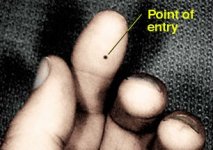
Probably the most common injury associated with hydraulic systems is the result of pinhole leaks in hoses. These leaks are difficult to locate. A person may notice a damp, oily, dirty place near a hydraulic line. Not seeing the leak, the person runs a hand or finger along the line to find it. When the pinhole is reached, the fluid can be injected into the skin as if from a hypodermic syringe.Immediately after the injection, the person experiences only a slight stinging sensation and may not think much about it. Several hours later, however, the wound begins to throb and severe pain begins. By the time a doctor is seen, it is often too late, and the individual loses a finger or entire arm.Unfortunately, this kind of accident is not uncommon. To reduce the chances of this type of injury, run a piece of wood or cardboard along the hose (rather than fingers) to detect the leak.
34-73689-Fluidhandinjuryentrywound.jpg

{Entry Wound...}
~~~from the Web~~~

18-48044-JFM3BW5205SigFile.JPG

"You are what you eat, drink, think, say and do..."
 

Attachments

  • 34-73689-Fluidhandinjuryentrywound.jpg
    34-73689-Fluidhandinjuryentrywound.jpg
    33.3 KB · Views: 103
/ Safety Tips #79  
Re: Safety Tips-Hydraulic Systems Safety

Exhausting High Pressure Oil to Atmosphere Can Cause Skin Penetration Injuries -

In addition to the risk of suffering burn injuries one must consider the consequences of high-pressure oil penetrating the skin.

According to the "Occupational Injuries Handbook," oil can penetrate the skin at pressures as low as 100 PSI -
"The force of injection, which can range from 100 to 1000 pounds per square inch, causes the fluid to track along the planes of the tissue and flexor tendon sheath. In this way, it can travel from the fingertip throughout the hand and even proximally into the forearm."
http://www.tractorbynet.com/forumfiles/34-73690-Fluidhandinjuryexitwound.jpg
{Exit wound-from a pinhole leak...}
~~~from the Web~~~

18-48044-JFM3BW5205SigFile.JPG

"You are what you eat, drink, think, say and do..."
<P ID="edit"><FONT SIZE=-1>Edited by Muhammad on 11/24/01 08:01 AM (server time).</FONT></P>
 

Attachments

  • 34-73690-Fluidhandinjuryexitwound.jpg
    34-73690-Fluidhandinjuryexitwound.jpg
    23.7 KB · Views: 124
/ Safety Tips #80  
Re: Safety Tips-Hydraulic Systems Safety

bleck! Yuck! gag!/w3tcompact/icons/tongue.gif

Now I am gonna have to find that picture of the guy who got hit in the neck by a chainsaw kickback to get you back for showing me this!
 

Marketplace Items

2014 International WorkStar 7300 4x4 Altec A55F 55ft. Material Handling Bucket Truck (A60460)
2014 International...
2006 Ford F-650 24ft. Flatbed Truck (A61568)
2006 Ford F-650...
4 Shelf Rolling Cart 6ft x 3ft (A61165)
4 Shelf Rolling...
LandHonor LHR-AGC4400 4400lb Adjustable All-Steel Gantry Crane (A60352)
LandHonor...
UNUSED TERRA FORCE 5' HYD WOOD GRAPPLE (A62130)
UNUSED TERRA FORCE...
New/Unused Wolverine 72in Quick Attach Tiller (A61166)
New/Unused...
 
Top