seeddrill

   / seeddrill #2  
   / seeddrill #3  
I am not sure what your planting, (maze in the use many times means millo a sorgum type plant with seeds about 1/8" round, and then there is corn, which is a flat seed about 1/4 across. above the feed cu[ will work on small seeds and if sized correwctly larger,

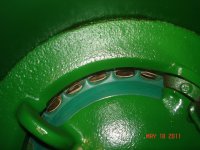
but in old corn planters, they used a "plate" which was a round disk with holes in it, and was rotated , the hole would fill with seed and then some place in the planter there was a section that covered, and under that was the drop tube, as the plate rotated the seed would be feed into the drop tube, the advantage of this is that one can space the holes to help contol rate of planting, and can be sized for diffrnet seeds, some plates were made for rounds some for flats, and some for small seeds,

they sat in a bottom of a can type seed tank, and the plates were driven by shaft under the tank (usaly a set of 45 degree gears sould tun the plate off a horzonal shaft,

but if one wants one could make a simular type of feed like the fluted but a cyclinder with holes of a given size in drill type setting,
 

Attachments

  • $(KGrHqF,!rkFE3Dzef7pBRjHF4I!,!~~60_12.jpg
    $(KGrHqF,!rkFE3Dzef7pBRjHF4I!,!~~60_12.jpg
    22.6 KB · Views: 93
  • 369050968_726.jpg
    369050968_726.jpg
    34.8 KB · Views: 101
  • PlantingSunflowers004.jpg
    PlantingSunflowers004.jpg
    151.4 KB · Views: 104
   / seeddrill #5  
The drill made by Bill Spurlock in the link given by BHD at #2 is a very good and simple design. I built one similar. I have also made others and am presently working on modifications to use cage (sometimes known as lantern) gears instead of the 45º angle bevel gears normally used. It is not easy to get the mechanics correct in this sort of system.

I know from past research that there are many sites in India that give details of simple drills. Contact me if you have problems finding them.
 
   / seeddrill
  • Thread Starter
#6  
Thanks Sir,the mentiond drill is simple n easy to build,wat iam looking for is one wth seed accracy droping,without overdroping.can u pls giv me dtks of simple drills in India.
 
   / seeddrill #7  
ravindra, I know from bitter experience that it is not possible to build your own drill that is capable of accurately placing seed. The only way to do this is with an extremely expensive manufactured precision drill. I do not have the money to buy such a piece of equipment. The seed plates mentioned by BHD are about the best most of us can hope for. Fluted mechanisms are not easy to make yourself, and are much worse than plates for accuracy.

I should have asked in my first post - can you make the drill using metal that needs to be cut and welded, do you have a workshop that can bend metal, or do you need to make one from recycled and scrap materials or wood? If I know, then I can better inform you of what I have been able to achieve, and what you might be able to do. Some of the Indian, and Pakistani and other Asian sites, assume the ability to manufacture rather than "make at home".
 
   / seeddrill
  • Thread Starter
#8  
sir,yes v do hav sasic facilities of workshop to weld n bend metal,may be wth scrap or new metirial
 
   / seeddrill #9  
OK. I will find some links that might be useful to you. I will post on here if I can, but it could be up 36 hours after the time of this post. Sorry, but I have several other commitments.

P.S. Very nice of you to address me as "Sir" but not necessary - Old Mc is fine with me.
 
   / seeddrill #11  
I was just about to leave ths site when I saw your last post - start with an Internet search for IRRI "drum seeder". These are simple machines, but effective. A lot depends on how much land you have to sow, and how much time you can give to thinning and weeding the crop afterwards. A sowing tine can be fitted below the drop point of these seeders. I have used a large funnel in the past, leading into a metal tube welded to a cultivator point. I will try to post a picture, but my skills are limited. I do not own a camera to take present day pictures.
 
   / seeddrill #12  
Ravindra, I am sorry I have been unable to reply, but I have had only intermittent internet connection. It happens whenever it is hot (around 40ºC at present) or very wet. I am drafting this offline ready to post as soon as I can.

I have not been able to check the sites I used for my information, but remember that the term “improved seed drill” will give you some more info from, I think, the Phillipines and Bangladesh. Search also for “Baker boot” to give you information on the sowing boot, and the book by C.J. Baker et al “No-tillage seeding in Conservation Agriculure” for details of Baker’s work and the boot he designed. It is a very large book and I downloaded it from somewhere, but I cannot remember where. If you can find the document “Manual for Using Zero-Till Seed-***-Fertilizer Drill and Zero-Till Drill-***-Bed Planter” it gives some really good detail for a drill. It is by Ashok Yadav et al., and was a National Agricultural Technology project sponsored by the Rice and Wheat Consortium for the Indo-Gangetic Plains and the Indian Council of Agricultural Research. It was published in 2002 and is part of the Rice-Wheat Consortium Technical Bulletin Series 4. The drills in it use fluted rollers for the seed delivery, but there is no reason why you could not adapt the basic design for use with seed plates if you prefer. The Baker boot is designed for Zero Till, but I use the concept in cultivated ground.

I recently made some notes on seed plates sizes, etc. for a modification to my own drill and one recommendation was for round holes of 9/16” (14mm) and ¼” (6mm) thick plates. I found that the round holes frequently jammed with 2 seeds in them, and increasing the size to 16mm meant there was space for 3 seeds in each hole, so it was not satisfactory. It seems much research has concluded that oval holes are best. I have 3mm thick metal which appears to be adequate, and the oval holes were made with two 3mm pilot holes spaced to drill a 10mm hole between them to form the oval. I have had to do some filing to improve the shape. I have not been able to test them due to a problem with my home-made cage(lantern) gear arrangement and lack of time to fix it. If you have the capacity to make the oval holes then it will be easier. I chose the size of the holes after measuring a large number of maize seeds. I found that the longest was 15mm and none of them exceeded 10mm in width. One end is of course pointed, and the other was always of narrower dimension than the middle of the grain. All grains fitted into the holes I made – with the invaluable assistance of another immigrant with whom I work closely on such things and who has far superior technical skills than me.

Whichever system you use you will not have absolute precision drilling. Even with the most sophisticated machines this is not possible because the length of time it takes for the seed to travel through the seed delivery tube to the sowing boot varies with every seed. Additionally there is normally some “bounce” when the seed reaches the furrow made by the boot, and they can also be moved by the earth that fills in over the top of them. We can only try to have the seeds leave the seed box in an orderly manner.

I use 8-legged “spider wheels” to provide the drive for the seed metering mechanism, and have bicycle cogs and a chain to transfer the power from the spider wheels to the seed meter. If you use the sort of cups that are in the fertiliser system of the drills mentioned above then it is a simple driving arrangement. I made up the cage gear to transfer the forward rotation to a horizontal one for use with seed plates. I am now considering using bevel gears if I can find them. I may have to import from the UK.

Best of luck with your project and I would be most interested in reading about what you decide to do.
 

Tractor & Equipment Auctions

2012 International 4300 Reefer Truck (A56438)
2012 International...
Crown RM6025-45 4,500 LB Stand-On Electric Forklift (A59228)
Crown RM6025-45...
1996 FORD F-SERIES FLATBED TRUCK (A52706)
1996 FORD F-SERIES...
Spreader Attachment (A56859)
Spreader...
MURRAY PUSH MOWER (A58214)
MURRAY PUSH MOWER...
SKID STEER ATTACHMENT PACKER (A58214)
SKID STEER...
 
Top