Should I do it myself?

   / Should I do it myself? #21  
Sendero,
There are a number of ways to get this done and only one is hard ... with a Pick and a D-Handle shovel! /forums/images/graemlins/grin.gif /forums/images/graemlins/grin.gif /forums/images/graemlins/grin.gif You can dig a decent ditch to lay the pipe in with the FEL just place the cutting edge of the bucket on the road way parallel to the center line of the future ditch. Now force the bucket to start the cut by moving the tractor forward a little and as the bucket cuts just curl it and scoop the earth out … continue to move across the road doing this until the ditch is finished. If the bucket cannot penetrate the surface of the road, then you will need to use a sub-soiler or an implement that can break thru. This is where the bucket teeth come in handy. You may need to clean the bottom of the ditch with a shovel and more than likely you will need too. Now place some sand on the bottom of the ditch … your soil maybe sandy enough without adding any more. Use this to cushion the pipe and to set the grade so it will drain proper. Back fill the pipe and compact as you go. Many people don’t do this well the first time but seem to get it right on the second time. Once you have gotten the over burden on the pipe the engineer told you about, you can either begin to push from the borrow pit (borrow ditch) with the FEL which, by the way, is also what you could do to fill the ditch if the borrow pit is close by, or just haul a bucket load at a time. Remember that you need to move, a full bucket in front of the FEL as that is much easier than just a little bit at a time. But don’t try to fill the bucket fast or you will end up wash boarding all over the place. You are becoming a dozier operator now. These 8 inches you are building to is not a speed bump so don’t built one. It is a safety and protection for the pipe … so once you get your load to ditch raise your bucket and dump it … after you have several buckets there start blading and back blading the pile. The idea here is to lay down a lift and as you go about your business of building your over lay your tractor helps to compact the lift! Remember large piles move the easiest and don’t build a speed bump. Sendero … This is one of many ways you can approach the problem and is no better solution than many others … it is a way to do it. Have fun …
Leo
 
   / Should I do it myself? #22  
You appear to be planning on burying it very shallow.
The general rule I always hear is that you want at least a foot of gravel on top. So unless you want a big hump in the road, dig it deeper.
I have put them in shallow before and the end up torn up by heavy traffic after many years of use.

A hoe is the right tool for the job IMHO.

You can do it with a rear blade, but not a cheap weak one. You need a real heavy duty blade (1000 lbs plus) that requires a lot of hp to run. The cheap ones will bend when you hit a rock.

Fred
 
   / Should I do it myself? #23  
For both digging the ditch and transferring dirt from the borrow pit, I'd think a pond scoop would be a better implement. Of course then you wouldn't have a box blade when you were finished, but I don't know why you'd need one. /forums/images/graemlins/wink.gif
 
   / Should I do it myself? #24  
I put one in with a single bottom plow. Plowed both ways, cleaned the trench out with the FEL, plowed it and cleaned until I was as deep as I could get. Covered it with modified stone. I did it in a evening, no biggie.

Layed 10in corrugated (cheaper) and covered. The rule of thumb is be at least 1/2 the diameter of the pipe down. That means that the bottom of a trench for a 12 inch pipe must be a minimum of 18 inches down. Deeper is better but ya gotta make it flow.
 
   / Should I do it myself? #25  
<font color="blue"> The rule of thumb is be at least 1/2 the diameter of the pipe down. </font>
I have often seen this quoted, and no doubt it is good practice. But around here most of them you see along the highway have no more than a few inches over them unless it is a really deep ditch. And it is not unusual to see a really old one that is beginning to show thru the cover material. None of them are collapsed or even appear to be deformed in spite of trucks and tractors driving over them. Mine is a 24" steel and has at most 6" over it. A flat bed semi drove over it multiple times when delivering my prefab metal building with no problem and his wheels got quite close to the end. I think as long as the dirt is packed very tightly especially around the bottom and sides when it is installed, it will not deform unless an exceptionally heavy load is passed over it.
 
   / Should I do it myself?
  • Thread Starter
#26  
I had a soil engineer suggest this solution. He did the survey and design for my pond and it came out just like it was supposed to. He's in his 70s and has been doing this stuff all his life, I trust his judgement.

Basically - he said that I merely need to cover it by a couple inches. I'm digging into the ground about halfway, and building up dirt the other half. After I'm done, I'll be putting 4" of crushed rock on top of it. It ain't going anywhere /forums/images/graemlins/smile.gif
 
   / Should I do it myself? #27  
Once the culvert is in place I think the box blade is the best tool for smoothing. I have known some that are very skillful back dragging a FEL, but I think it requires more skill, which I don't have. Seems like when I float the FEL it just skips over the dirt, and when I put pressure downward I end up lifting the front wheels off the ground and thus lose steering control. I have tried smoothing a friend's back yard with the FEL because I had the brush hog on at the time. Did a pretty crappy job and was wishing I had my BB which was 6 miles away.
 
   / Should I do it myself?
  • Thread Starter
#28  
I agree. I've used the FEL for smoothing dirt a few times and it really doesn't work very well. The biggest problem is the fact that it is so far out in front of the tractor, any lack of levelness on the tractor itself hugely affects the plane of the bucket edge.

It works ok for gross leveling, but I'd hate to have to make a flat level road with it /forums/images/graemlins/smile.gif
 
   / Should I do it myself? #29  
I'd go for it. I think it could be done with your FEL, but if you want a BB, it sounds like a good reason to get one.
 
   / Should I do it myself? #30  
</font><font color="blue" class="small">( I agree. I've used the FEL for smoothing dirt a few times and it really doesn't work very well. The biggest problem is the fact that it is so far out in front of the tractor, any lack of levelness on the tractor itself hugely affects the plane of the bucket edge.

It works ok for gross leveling, but I'd hate to have to make a flat level road with it /forums/images/graemlins/smile.gif )</font>

I use MY 66 Bolens with the front blade for finer leveling /smoothing after using the BX23 FEL.
 
   / Should I do it myself? #31  
</font><font color="blue" class="small">( dragging the dirt out of a "borrow" ditch next to the road.
)</font>

*********************
================
Here is how I would go about this:
Use the hoe of my BX23 and or the tiller on my 1967 Bolens to break up the dirt then scoop it up in the FEL and dump it over the culvert.

The advantage of the tiller is the dirt is finer and covers the pipe better without leaving large air pockets in the back fill around the pipe.
The finer dirt will also compact better and easier around the pipe.
========


This post is not about me however it does involve sharing experence/information.
 
   / Should I do it myself? #32  
I've built three culverts. On the first one, I used a box blade. On the other two, I did not.

You are not really going that deep. I would be suprised if you could not get the job done with a rear end implement used for ballast and a good FEL with a tootbar in a few hours.

The only time my box blade really proved its worth for me was a 150 foot drainage ditch that I built that started at about six inches deep and ended at about 24 inches deep.
 
   / Should I do it myself? #33  
If I were doing this job, my inclination would be to use my $150 middle buster and plow the area on the road where the culvert has to go. Use the FEL for scooping out the loose dirt. Plow again if you need to go deeper.

You'll have a 4 ot 5 ft wide trench across the road (depending on the width of your FEL bucket that's admittedly oversize. But so what. It's a dirt road so you won't be digging up expensive pavement. Lay the culvert and use the FEL to move the dirt back in the trench and smooth it out with the backside of the bucket. Don't need no stinkin' box blade for this job.

If you want to do it all with the FEL and not use any 3PH implements, then follow the suggestion of someone in this thread and consider getting a tooth bar for your FEL so you can dig efficiently. The cost is under $200 for 4-ft wide units (but check the shipping cost carefully before whipping out the plastic).
 
   / Should I do it myself? #34  
I have FEL and box blade. I'm not about to hold myself out as an expert on the box blade, but I've gotten compliments from a professional grading contractor.

I put in my own culvert, 15" diameter by 40' with mitered ends. There was an exisitng swale, but I prepped and graded it with my FEL, working from the side as was suggested above. It's a little bit of a pucker factor working with your front wheels down in the slope, but not really a problem -- you only feel like you're going to slide out of the seat and over the hood. /forums/images/graemlins/ooo.gif

When the culvert was delivered, we rolled it off the side of the truck down into the Vee; it actually ended up with the miters facing up the correct way! I then backfilled it carefully, again using the FEL, making sure that the first few inches of backfill got under the curves of the culvert and didn't leave any voids. There is no other way to backfill the Vee other than an FEL that I can imagine.

I use my FEL to rough grade. I find the opposite factor than you mentioned. Because the box blade is so close to the tractor, I find it reponds more quickly to the upsys and downsys of the tractor and needs a much more delicate touch on the control lever to keep it anywhere near level. The FEL is way out there in front of me where I can see it. I use a combination of back dragging with the back edge of the bucket (not recommended, because it supoosedly wears the pins, but it does such a nice job I'll willingly replace the pins if necessary); front pushing with the blade in a dozer angle, and finally back-smoothing with the nearly flat bottom of the blade and lots of down pressure. I deliberately raise the front wheels off the ground; I'm going straight back and don't need to steer.

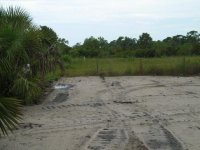
The attached is not my culvert but is a section I've graded with the above technique; I haven't gone in there yet with the box blade. (I'm cheating a little; the picture was taken after a rainfall smoothed it a bit more). But, to me, the box blade is best for going from this state to a finished state. It's a finishing tool, not a gross dirt-moving tool. I used my box blade on my culvert job only to grade my shell rock cover over the culvert into the final road grade.

If I didn't have the FEL, I'd use any of the implements mentioned above (plow, middle buster, pond scoop, rear blade, etc.) to do most of the culvert work rather than a box blade. Of course, if I didn't have a box blade and wanted to justify it to my CFO, I might alter my opinion slightly. /forums/images/graemlins/grin.gif

As for your dimensions, since your pipe will be 12" in diameter, I assume that when you say "bury it 8" you mean that the top of the pipe will be 8" underground and the bottom will be 20" underground; then when you build up the road by 6" you will have over a foot of material on top of the pipe. If this is what you mean, you'll be fine. But, if what you meant that the bottom of the pipe will be 8" down, and stick up 4" above the road until you build up the road to 6" higher over it, then I'm afraid you might have problems if you try to take anything very heavy over it. You'd only end up with 2" of fill over the culvert, and that's not really enough to spread the load over the width of the culvert. My county is pretty lax about such things, but they require 12" of shell rock (like crushed limestone) or gravel over the pipe. The bottom of my 15" pipe is only about 20" deep (because that's where the bottom of the drainage swale is), so I needed to build it up in a hump more than 8" high over the pipe, and slope up to it on either side.
 

Attachments

  • 725136-DSCN0284.JPG
    725136-DSCN0284.JPG
    48.9 KB · Views: 183
   / Should I do it myself? #36  
Sendro

I am down by Anna south of you - I have a Subsoiler/Middle buster . If you want to come by & barrow it. that might help start the cutting off.

tracy
 

Tractor & Equipment Auctions

2019 MACK PINNACLE (A55745)
2019 MACK PINNACLE...
2011 FORD F-550 (INOPERABLE) (A55745)
2011 FORD F-550...
2000 CATERPILLAR 988F WHEEL LOADER (A60429)
2000 CATERPILLAR...
2019 FREIGHTLINER CASCADIA TANDEM AXLE SLEEPER (A59905)
2019 FREIGHTLINER...
Preliminary Listing / Full Catalog Coming Soon! (A60462)
Preliminary...
LayMor Sweepmaster 300 8HC (A55314)
LayMor Sweepmaster...
 
Top