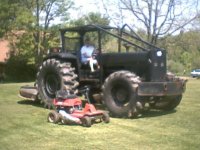
After 57 years of tractor operating/ownership and 40 years of road building in every capacity from ditchdigger to superintendant, the pucker factor still wins out. If it doesn't feel right, don't do it until you have the experience to do it safely. When going on an questionable slope with a wheel tractor I will scout it first then angle down it, always ready to turn straight down if it gets yantzy. When working cross slope, you can generally feel the high side wheel starting to slip or the front wheel starting to slide. If that happens, crank her downhill and figure a new approach or get a weedwhacker.
The angling down the slope as mentioned above by geboyes works as you're already headed downhill so turning straight down to get out of trouble is just a twist of the wheel. Trying to mow angling uphill could result in problems with soft spots, dips or rocks until you get to know the slope, because to turn down out of trouble, you've got to make that 90 degree turn back downhill. With 4 wd you could turn up the slope to get out but if it's to steep for that, you shouldn't be on it anyways.
Crawlers naturally will handle much steeper terrain but even they have limits. I've never seen one flip but have had them with the high side track clawing air.
I have a 100 hp Massey Ferguson 399 4wd with full cage and winch that was built for power/pipeline ROW maintenance and I know it's capabilities are way beyond my pucker factor so I have a built in safety factor.
As far the relationship of %/degree of slope as discussed early in this thread, one foot of fall or rise in 100 ft equals a 1% slope. 10ft in 100 = 10% and is 5 degrees, 100ft in 100ft is a 100% slope but only 45 degrees. I tried copying it to post but couldn't, so here is a link to a chart that explains it completely.
www.co.cowlitz.wa.us/buildplan/forms/Calculating Slope.pdf