Snowblower: Width vs PTO hp

   / Snowblower: Width vs PTO hp #1  

pak7819

Member
Joined
Oct 15, 2011
Messages
34
Location
SE Wisconsin
Tractor
2006 NH TC40DA
Looking for advice from other TBN owners. Have a 2006 4wd NH TC40DA rated at 33 PTO hp, w/super steer front axle and hydro trans. In market for a rear facing 3pt snowblower and have question about selecting the right width.

My 1400 ft driveway has some tighter turns, and I'm concerned about selecting a blower that just covers my tracs vs. oversizing, say up to an 84" (which is my preference), so i can turn my front wheels without dragging into the side banks. I know, not the end of the world,... I just don't want to deal with it if I can avoid it by going a little bigger on the blower width.

As I see it, my options are to find a good ~72" model out there and put some wings on it, or just go with an ~84" model right out of the gate. My concern is PTO hp, and overloading the tractor. My trans is hydro so I have infinite speed selection, but I don't want to be crawling at .2 MPH in low range either. I fully understand the variables I'll see due to snow conditions being wet or fluffy etc...

I've heard the rule of thumb, "5hp for every foot of width", but would like to hear from people with actual firsthand experience. Does that refer to flywheel hp or PTO hp? If assuming "at the PTO" I would be just barely overloading my tractor with 33 PTO hp and an 84" blower (7 ft x 5' width = min hp of 35).

Do I play safe and run a 72" or go big with an 84"? Are there any users running an 84" blower with this type of PTO hp? Also, I'm curious if the double auger blowers significantly eat more power vs. a single auger, and also impeller dia.

Any advice/feedback is appreciated. If this topic is already covered somewhere, please direct me to it.

Thanks for looking....
 
   / Snowblower: Width vs PTO hp #2  
Looking for advice from other TBN owners. Have a 2006 4wd NH TC40DA rated at 33 PTO hp, w/super steer front axle and hydro trans. In market for a rear facing 3pt snowblower and have question about selecting the right width.

My 1400 ft driveway has some tighter turns, and I'm concerned about selecting a blower that just covers my tracs vs. oversizing, say up to an 84" (which is my preference), so i can turn my front wheels without dragging into the side banks. I know, not the end of the world,... I just don't want to deal with it if I can avoid it by going a little bigger on the blower width.

As I see it, my options are to find a good ~72" model out there and put some wings on it, or just go with an ~84" model right out of the gate. My concern is PTO hp, and overloading the tractor. My trans is hydro so I have infinite speed selection, but I don't want to be crawling at .2 MPH in low range either. I fully understand the variables I'll see due to snow conditions being wet or fluffy etc...

I've heard the rule of thumb, "5hp for every foot of width", but would like to hear from people with actual firsthand experience. Does that refer to flywheel hp or PTO hp? If assuming "at the PTO" I would be just barely overloading my tractor with 33 PTO hp and an 84" blower (7 ft x 5' width = min hp of 35).

Do I play safe and run a 72" or go big with an 84"? Are there any users running an 84" blower with this type of PTO hp? Also, I'm curious if the double auger blowers significantly eat more power vs. a single auger, and also impeller dia.

Any advice/feedback is appreciated. If this topic is already covered somewhere, please direct me to it.

Thanks for looking....


About your snow blower issues:

I have written extensively about snow casters here on the forum.


It will not hurt you to purchase a seven foot (84" cut) snow caster for your snow removal duties.

Like a good flail mower it will outlive several tractors as it is a low hour useage implement.

You are depending strictly upon the horsepower rating of the gearbox and its available torque for the mounted implements intended use, not the horsepower per foot business as the cross auger is chain driven through gear reduction and the impeller is powered by the PTO shaft via the gearbox.

The wider cut will allow you to make one pass a slower speed and then half cuts at a slightly faster speed if desired.

The slower you travel the further the the snow will be cast and the impeller will not be flooded and reduce its efficiency to cast snow.

What you are looking for is the largest impeller drum size for your purchase as the larger impeller will allow the snow caster to throw the snow further at the rateed rear P.T.O., engine speed for 540 R.P.M.

Its no secret that i like the Pronovost snow casters as they are well built snow casters as are many other brands.


ANY snow caster you purchase will be improved by the purchase of one of Clarences impeller kits for the rear mount snow caster which will clean the impeller drum at each revolution to eliminate ice build up and slush in the impeller drum; for the $30.00 and the 90 day money back guarantee are win win for a purchase like this.


You have to remember that the snow fall will be 21 pounds per cubic foot per foot of width plus and that is what you are dealing with at all times and the weight will be greater when the freeze-thaw temperature cycles are encountered.


I wish the builders of these snow casters would build a rear mounted snow caster with a solid drum auger option with narrow flight distance which would meter the snow more evenly to the impeller to reduce the plugging which is always an issue when the implement carrier is driven too fast in reverse. The snow would be thrown further and faster if this was done as the torque created by the snow caster gearbox would be used to its fullest advantage.


:thumbsup:
 
Last edited:
   / Snowblower: Width vs PTO hp #3  
I used to have an 84 inch lucknow behind a 50 horse tractor. A heavy snow would make it work. I now have a NH T1510 which I think is 25 horse at the PTO, and a NH64CSR rear blower. The match is real good. If you bought oversize, you don't have to take a full cut, but compare that with a smaller blower taking a full cut??? I know from experience that wings are terrible with wet snow. FWIW, I had a Lucknow, a Woods SS, and now I have a New Holland. I don't know who makes the New Holland blowers, but it is far better then the previous two I mentioned. Definately cover your rear tracks. Believe it or not, with the smaller blower, I can clear my driveway faster. It manuvers easier..... for me.
 
   / Snowblower: Width vs PTO hp #4  
Pak7819,
Where are you located and how much snowfall do you get annually? Whats an average storm? If I had a 33hp at the pto tractor and put 84inch blower on, I would be in a big pile of snow(and no where to go) where I live. For my region, couldn't imagine it.:mur:
 
   / Snowblower: Width vs PTO hp
  • Thread Starter
#5  
Thanks for the replies. I live in Wisconsin, average snowfall is nothing outstanding compared to folks in lake effect bands etc, but we get the typical blows in Jan/Feb that can cause headaches. Been plowing with an old (beyond beat up) pickup and straight blade last 3 yrs and looking forward to finally being able to put the snow where I want to versus fighting the banks and the dealing with the spring clean up.

Seeing as how the typical snowfall we get is the 4-6" range, common sense tells me I can live with a smaller width. Hard to find good blowers around here, everything I've found is 300 miles away and not the brands that I prefer. Probably going to go new.

Found a local dealer who sells SB Select. The 75" with hydraulic chute rotation and adjustable skids seems like the right ticket. Is anyone out there familiar with this brand? Yay? Nay?
 
   / Snowblower: Width vs PTO hp #6  
the sb select is meteor knock off and more money. i would get the meteor
75in is $ 2550 and 87in $2775 both with hyd chute rotor here in MN
 
   / Snowblower: Width vs PTO hp
  • Thread Starter
#7  
Dieselbill; can you recommend any dealers in MN that carry Meteor or that have any in stock? Looking for the SB75. Preferrably the furthest east since I'm from WI and would be driving a long distance unless I found something closer to home.

I found that Walco USA located in Randolph, MN, is the Meteor distributor for both MN and WI. Plan on calling them also.

I'm assuming quoted prices normally exclude the PTO shaft?
 
   / Snowblower: Width vs PTO hp #8  
With a rear mount blower you don't want to be going too fast. Better to be going slower and have good control.
Since you have a hydrostatic transmission wider isn't a problem in heavier snows because you can adjust speed to suit the load. In lighter snows you don't have to be flying to keep enough snow in the impeller for it to throw the snow some distance. I had a rear mount blower for years. It worked well enough just got too hard on my neck and back. Really like the setup I have now. An 8-10" snow is about perfect to keep the blower loaded without having to set any speed records.
 
   / Snowblower: Width vs PTO hp #9  
Dieselbill; can you recommend any dealers in MN that carry Meteor or that have any in stock? Looking for the SB75. Preferrably the furthest east since I'm from WI and would be driving a long distance unless I found something closer to home.

I found that Walco USA located in Randolph, MN, is the Meteor distributor for both MN and WI. Plan on calling them also.

I'm assuming quoted prices normally exclude the PTO shaft?

We just bought a Meteor from Arnolds Implement in Kimbal. They have more stores in Mankato and ? and ? Look 'em up on the web. I think Meteor is carried by quite a few dealers tho...
 
   / Snowblower: Width vs PTO hp #10  
I've been running a 74" blower on 22 PTO HP for the past 7 winters (used the same blower on a bigger tractor before that) with absolutely no problems. Unless I'm in the deep salt-laden bank rolled up by the street plow, I can go as fast as I would ever want to go backwards.
 

Attachments

  • SnowJan2808_4.jpg
    SnowJan2808_4.jpg
    106.2 KB · Views: 1,331
   / Snowblower: Width vs PTO hp #11  
I've been running a 74" blower on 22 PTO HP for the past 7 winters (used the same blower on a bigger tractor before that) with absolutely no problems. Unless I'm in the deep salt-laden bank rolled up by the street plow, I can go as fast as I would ever want to go backwards.

22hp with a 74 inch? WOW impressive. But, most of you guys take diesel motor and make it run with Canadian power. I drive truck and can run with the best of them, but every once in a while a frog comes rolling by, look out. It's got Canadian power!:thumbsup:
 
   / Snowblower: Width vs PTO hp #12  
That Price includes pto shaft and hoses to the tractor but not tax
I paid $2,965 OTD for My 87in from AL. S. in kimball
 
   / Snowblower: Width vs PTO hp #13  
I am curious about this.

There are those that say it is a width to HP ratio that matters.
Then there are those that talk about the speed that your drive.

How about the type of snow you are working in? I can see a wet/heavy snow really being hard on the tractor if you are running a big blower on a small machine. How much difference would a really dry/light snow have?

Herringchoker, what has your experience been with your setup??
 
   / Snowblower: Width vs PTO hp #14  
I am curious about this.

There are those that say it is a width to HP ratio that matters.
Then there are those that talk about the speed that your drive.

How about the type of snow you are working in? I can see a wet/heavy snow really being hard on the tractor if you are running a big blower on a small machine. How much difference would a really dry/light snow have?

Herringchoker, what has your experience been with your setup??


---------------------------------------------------------------------------------------------

Not to highjack the thread but:

It all depends upon the gearbox rating of the snow caster
and the available power of the prime mover at 540 R.P.M.,
at the rated engine speed fpr the mounted snow caster.

The snow caster width has nothing to do with the ability
of the snow caster to work; its all dependent upon the
gearbox rating.


The slower you travel the better the snow casting.
The larger the impeller the better the snow casting
in heavy and light snows.


The snow entering the cross auger is being pushed/fed
into the snow caster at a slower volume per foot of advance.

The snow can weigh up to 42 pounds per cubic foot
depending entirely upon the freeze thaw cycles which
increase the weight from simple settling and melting.

A lot of folks run a wider snow caster on smaller machines,
they simply operate in a lower gear.
 
   / Snowblower: Width vs PTO hp #15  
Looking for advice from other TBN owners. Have a 2006 4wd NH TC40DA rated at 33 PTO hp, w/super steer front axle and hydro trans. In market for a rear facing 3pt snowblower and have question about selecting the right width.

My 1400 ft driveway has some tighter turns, and I'm concerned about selecting a blower that just covers my tracs vs. oversizing, say up to an 84" (which is my preference), so i can turn my front wheels without dragging into the side banks. I know, not the end of the world,... I just don't want to deal with it if I can avoid it by going a little bigger on the blower width.

As I see it, my options are to find a good ~72" model out there and put some wings on it, or just go with an ~84" model right out of the gate. My concern is PTO hp, and overloading the tractor. My trans is hydro so I have infinite speed selection, but I don't want to be crawling at .2 MPH in low range either. I fully understand the variables I'll see due to snow conditions being wet or fluffy etc...

I've heard the rule of thumb, "5hp for every foot of width", but would like to hear from people with actual firsthand experience. Does that refer to flywheel hp or PTO hp? If assuming "at the PTO" I would be just barely overloading my tractor with 33 PTO hp and an 84" blower (7 ft x 5' width = min hp of 35).

Do I play safe and run a 72" or go big with an 84"? Are there any users running an 84" blower with this type of PTO hp? Also, I'm curious if the double auger blowers significantly eat more power vs. a single auger, and also impeller dia.

Any advice/feedback is appreciated. If this topic is already covered somewhere, please direct me to it.

Thanks for looking....

It will all depend on your location and the type of snow encountered. I would, however, forget a twin auger blower, your TC40 don't have the gonads. Twin augers are for tractors with 100 PTO horsepower on up.

I live in SE Michigan and I have a Lucknow 84" rear mount 2 stage single auger and in light stuff (fluffy dry, cold snow, it barely works the tractor, however, busting 4 foot drifts of heavier stuff, it takes every bit of the 90 pto horsepower I have and I can bog the tractor down (and make it blow smoke) fairly easily and I'm turbocharged and charge air cooled so I have more torque rise than you do.... I'd say that a 72 is as wide as you want to go. You have less than half of my output besides, a quality 84" blower will be heavy. My Lucknow is around 1500 pounds.

The 5 hores per foot don't apply to blowers. The amount and density of the snow determines the power consumption.

Hope you have a cab. Blowing snow on an open station tractor is inviting frostbite
 
   / Snowblower: Width vs PTO hp #16  
Looking for advice from other TBN owners. Have a 2006 4wd NH TC40DA rated at 33 PTO hp, w/super steer front axle and hydro trans. In market for a rear facing 3pt snowblower and have question about selecting the right width.

My 1400 ft driveway has some tighter turns, and I'm concerned about selecting a blower that just covers my tracs vs. oversizing, say up to an 84" (which is my preference), so i can turn my front wheels without dragging into the side banks. I know, not the end of the world,... I just don't want to deal with it if I can avoid it by going a little bigger on the blower width.

As I see it, my options are to find a good ~72" model out there and put some wings on it, or just go with an ~84" model right out of the gate. My concern is PTO hp, and overloading the tractor. My trans is hydro so I have infinite speed selection, but I don't want to be crawling at .2 MPH in low range either. I fully understand the variables I'll see due to snow conditions being wet or fluffy etc...

I've heard the rule of thumb, "5hp for every foot of width", but would like to hear from people with actual firsthand experience. Does that refer to flywheel hp or PTO hp? If assuming "at the PTO" I would be just barely overloading my tractor with 33 PTO hp and an 84" blower (7 ft x 5' width = min hp of 35).

Do I play safe and run a 72" or go big with an 84"? Are there any users running an 84" blower with this type of PTO hp? Also, I'm curious if the double auger blowers significantly eat more power vs. a single auger, and also impeller dia.

Any advice/feedback is appreciated. If this topic is already covered somewhere, please direct me to it.

Thanks for looking....

I would think the power requirments would be dependent on the density of the snow, the throughput (the depth of snow x the width of the blower x the speed of the machine~cu ft /sec), and the tip speed of the blower at 540 or 1000 rpm of the pto drive. Once you fix the width of the machine, you can't control the density of the snow but you can control the machine speed and to some extent under certain conditions you can vary the tip speed if the density and depth are not too great. You can also take half cuts once you've cut a swath to get started or raise the blower to reduce the throughput and make multiple passes. It goes without saying that the throughput has to be matched to the blower's ability to handle the snow and that's determined by trail and error. I plan on setting the pto speed to 540 rpm (1800 engine rpm) and seeing if low reverse speed allows the blower to handle the snow at full width and depth.

I have a 7 foot dual auger ARPS blower that I will be using for the first time this winter. The factory manual recomends that it be used on tractors with 50 to 80 hp, so that's roughly 7 to 11 hp required per foot of width.

I generally can keep up with normal snows around here with a back blade but that fails when we get wind drifted snow. (We get up to two feet at a time and I'd start blowing when it got to 6-8 inches and then just keep up as required. Our snow is generally pretty dry except when the chinooks start to blow. then it starts out real fine and as the temperature rises it starts to get wet.) I'm hoping to use our Ford 4610 to do the clearing but if I have to, I can switch to the TD95D. I'm hoping to use the TD95D to spin feed large round bales to the cows . It has a cab and it will be nice to have a warm cab to feed with. But if I have to, I can feed with the open station 4610 and use the TDD to blow snow. I don't think it will come to that, however unless we have one of those 100 year winters.(Knock on wood!)

This is my first time using a snowblower so I'm sure I will learn a whole bunch about the process via trail and error. I just hope the errors are small ones.
 
Last edited:
   / Snowblower: Width vs PTO hp #17  
I would think the power requirments would be dependent on the density of the snow, the throughput (the depth of snow x the width of the blower x the speed of the machine~cu ft /sec), and the tip speed of the blower at 540 or 1000 rpm of the pto drive. Once you fix the width of the machine, you can't control the density of the snow but you can control the machine speed and to some extent under certain conditions you can vary the tip speed if the density and depth are not too great. You can also take half cuts once you've cut a swath to get started or raise the blower to reduce the throughput and make multiple passes. It goes without saying that the throughput has to be matched to the blower's ability to handle the snow and that's determined by trail and error. I plan on setting the pto speed to 540 rpm (1800 engine rpm) and seeing if low reverse speed allows the blower to handle the snow at full width and depth.

I have a 7 foot dual auger ARPS blower that I will be using for the first time this winter. The factory recomends that it be used on tractors with 50 to 80 hp, so that's roughly 7 to 11 hp required per foot of width.

I generally can keep up with normal snows around here with a back blade but that fails when we get wind drifted snow. (We get up to two feet at a time and I'd start blowing when it got to 6-8 inches and then just keep up as required. Our snow is generally pretty dry except when the chinooks start to blow. then it starts out real fine and as the temperature rises it starts to get wet.) I'm hoping to use our Ford 4610 to do the clearing but if I have to, I can switch to the TD95D. I'm hoping to use the TD95D to spin feed large round bales to the cows . It has a cab and it will be nice to have a warm cab to feed with. But if I have to, I can feed with the open station 4610 and use the TDD to blow snow. I don't think it will come to that, however unless we have one of those 100 year winters.(Knock on wood!)

This is my first time using a snowblower so I'm sure I will learn a whole bunch about the process via trail and error. I just hope the errors are small ones.

====================================================================================================================================================================================================


As it is that time of year again it will not hurt to talk about the speed of travel for a snow caster and its motive power.


The snow caster implement is totally dependent upon-

1. the implement carriers total horse power.
2. the rated horsepower of the power take off for the implement carrier
at the 540 or 1,000 RPM engine speed setting.
3. The rated gearbox horsepower rating for the snow caster implement..


I am familiar with the Chinook winds which batter Stevens Pass in The State of Washington, but I was not aware that they traveled as far inland as your location.


Being strictly dependent on temperature a fresh snow fall can weigh as little as 21 pounds per cubic foot and with freeze/thaw cycles the weight can more than double over time.

The two stage snow caster is totally dependent upon the impeller for its work as the the implement carrier is forcing the snow into the cross auger(s) which conveys the snow to the center of the snow caster where it is forced into the impeller housing strictly with the forward or reverse movement of the implement carrier.


The size of the impeller and the number of paddles in the impeller are what as Kenny Cartman would say "kicks A**" and is the business end of things.


Dependent upon the builder of the snow caster the impeller drum is dependent upon- 1., the number of impeller paddles and thier curvature within the impeller drum if applicable as a curved impeller reduces the amount of snow the snow caster can dispose of and 2., the rotation speed of the impeller at the 540 or 1,000
R.P.M., P.T.O., speed of the implement carrier at the rated engine speed of the for the Power Take Off in the front or rear but I will be using the 540 R.P.M., speed for reference.


In Pronovost's case(yes it is a shameless plug) their snow casters will have four or five or six impeller paddles and the impeller paddles are straight and slightly curved on the exterior edge and have been formed to create a cupping form to carry snow more efficiently to reduce spillage to a minimum(another shameless plug for Pronovost).


The larger the impeller drum in diameter and depth the greater amount of snow can be cast per rotation of the impeller paddles times either 540 or 1,000 revolutions.


Every snow caster will plug and shear pins if the implement carrier is traveling to fast!!!!!

If you travel at three miles per hour you are traveling at 264 feet per minute.
If you have one foot of snow to remove and the snow caster is 7 feet wide you have 147 pounds of snow entering the snow caster each second and 40,000 pounds per minute of snow (rounded higher) entering the impeller and the impeller must be running at its optimum speed(rated P.T.O., engine speed) to to cast the snow away. In the example the snow caster must have the torque to remove 667 pounds per second of the snow fall to keep up.


If you travel at one mile per hour ( I know, boring!!!!) you are only traveling at 88 feet per minute and requiring the snow caster to remove 13,000 pounds (rounded higher)(per minute of snowfall(big snooze, I know) The snow will be cast further and you will have no issues with snow banks. Just like fitting ground it takes time.
 
Last edited:
   / Snowblower: Width vs PTO hp #18  
I had a JD870 with 25HP at the pto. I used a 60" snowblower and the tires were set at 60". It worked fine but it did lug the tractor . I had to run the tractor in low range (had 3 ranges of reverse) to move anything over 6" deep. Took forever to move the deep snow so i had to start before it got to 6". If i had an HST i could have done a faster job. If i would have tried for a wider blower, it would not of ever worked... especially on wet snows. If the snows are dry, then there would be no issue. But our snows are never dry.
 
   / Snowblower: Width vs PTO hp #19  
I am curious about this.

There are those that say it is a width to HP ratio that matters.
Then there are those that talk about the speed that your drive.

How about the type of snow you are working in? I can see a wet/heavy snow really being hard on the tractor if you are running a big blower on a small machine. How much difference would a really dry/light snow have?

Herringchoker, what has your experience been with your setup??

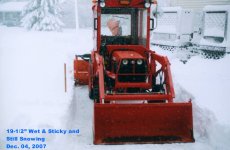
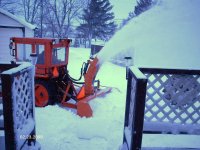
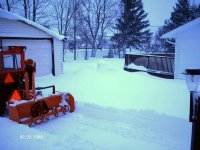
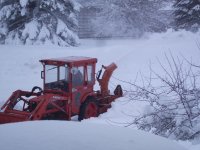
I had this blower on a previous larger gear drive tractor. When I first got the B7800, I had my doubts that it would handle such a large blower. I tried it and was very pleasantly surprised. The secret is the HST. I can go as fast as I would ever want to go backwards in deep light snow or even 8" - 10" of moderately heavy snow. Where I have to slow down is in the salt-laden banks (sometimes up to 4' deep) left by the town plow. In the attached picture of the 19-1/2" fresh snowfall, I was slowed down quite a bit mostly because the snow was so "packy" that it was pushing up to 10' ahead of the auger. I solved that by taking 2 bites (vertically - in short steps to avoid making wheel tracks in the packy snow) on the first pass, and then 1/2 width passes after that.
For me, the only drawback to this setup is that the wide blower is awkward to manoeuver on the narrow tractor - when I'm moving forward (e.g using the 54" bucket on the FEL), I have to be very careful not to sideswipe things. If I had to replace the blower, I would probably go with 60" width, for that reason only.
 

Attachments

  • SnowDec0407 .jpg
    SnowDec0407 .jpg
    82.8 KB · Views: 678
  • Storm090223_05.JPG
    Storm090223_05.JPG
    286 KB · Views: 679
  • Storm090223_10.JPG
    Storm090223_10.JPG
    297.8 KB · Views: 633
  • Snowstorm - 2011-01-13 - 002.jpg
    Snowstorm - 2011-01-13 - 002.jpg
    864.6 KB · Views: 676
   / Snowblower: Width vs PTO hp #20  
I would be willing to wager that salt came from
Canadian Rock Salt at Pugwash, N.S. EH?

Hope all is well HerringChoker, I hope I can
get all my mums planted quickly before the snow
really starts down here:thumbsup:


_________________________________________________________________
Pronovost Snow Casters :thumbsup::licking::drool:eek:r not at alll!!
 

Tractor & Equipment Auctions

2020 GENIE GTH-5519 TELESCOPIC FORKLIFT (A59823)
2020 GENIE...
2022 John Deere 5055E (A60462)
2022 John Deere...
1986 Ford LNT9000 Dump Truck (A56438)
1986 Ford LNT9000...
John Deere 5045E for sale Auction 
John Deere 5045E...
Broom Attachment (A59228)
Broom Attachment...
SEMI AUTOMATIC QUICK CHANGE FOR MINI EXCAVATOR (A58214)
SEMI AUTOMATIC...
 
Top