Stop washout

   / Stop washout #1  

mrlullabye

Member
Joined
Jun 23, 2009
Messages
40
I have some property that has two real problem water paths. the lay of my property all slants downhill slightly to the south-west. on the north and east side of my property a culvert crosses both roads and there is no planned escape route for the masses of water coming out of those culverts.

The water has cut pretty far down already through the hard packed clay so there is some real doozy spots in a sort of Y shape. The tops of the Ys are the culvert and the bottom of the Y is where it dumps out on the west end of my property. my main problem is before the Ys converge. One leg of that particularly takes a tremendous amount of water and has some potential tractor flippers washed out.

I am thinking in the long run we will need a wider, but shallower water path. For the time being though I have a real hazard. I have dropped a few loads of dirt in it to see what happens and sure enough it just washed out. I am thinking I could dig in my wider ditch maybe 6 feet wide and 6 inches deep, then cut up some railroad ties and dig them in so their tops are at grade of where the bottom of my ditch will be. Then once they are in place slowly fill up to them with some dirt/clay. I am affraid that will also just wash though. I think if I filled all the way to the top of them in one go it would wash too fast but maybe if I just added 6 inches or so between rains it would build and keep some.

Do you guys think that would work?

The only thing more aggressive I can think of is to put hay bails in the really deep spots so that as the water washes, it will wash into the hay bails and eventually the bails will rot and the dirt they held might stay.
 
   / Stop washout #2  
Without pictures, this is just a guess. I believe you want to use rock riprap. It is too heavy to wash out (normaly) and the water flows over and through the rock, not cutting into the soil beneath.

Dave.
 
   / Stop washout #3  
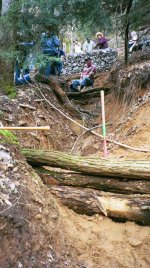
I used rocks, and bricks gathered up around here to put in a wash, down below the dam on the pond. Always a good place to get rid of those pesky things..!! Of course it is in a wooded area, so the leaves help plug the holes some, to catch the dirt. Works great..!!

If you don't have that many rocks, you can try this. We made a log dam in a washout on a trail project. Seems to be working, but will take several years to fill I'd imagine. But again the leaves help catch the sediment. You can always add to it, as it fills, or make another downstream, and catch some of what the first didn't...
 

Attachments

  • 058_58.jpg
    058_58.jpg
    196 KB · Views: 1,299
   / Stop washout #4  
I've been hauling in broken up concrete from jobs I do to fill in places like that and also line the banks of my streams on the property. I'm sure if you'd contact some of the local contractors they might be glad to find a spot to get rid of concrete they jackhammer out of patios, driveways and sidewalks. Some break them up in nice size chunks and others have slabs they tear out with a hoe. Might be a cheap way to solve the problem and it really don't look that bad if you get the smaller pieces and create a small swell and lay it in somewhat neatly.

Topstrap
 
   / Stop washout #5  
Dirt will just keep washing out, not matter what. Large gravel or rip rap will be your best long term option.
 
   / Stop washout #6  
Depending on how long these washouts are you can go to Lowes or Home Depot and buy some 6 inch flexible ( accordion type ) drain hose and they sell mini drain covers..put a layer or large gravel or aka rip rap and they lay down the drain hose - put another layer of gravel on top of the drain hose and cover with dirt.then attach the mini drain cover at the hole at the beginning of each wash ..the water will flow down the drain and follow the pipe and disperse where you have it end. A bit hard to describe without drawing it out or being there but I have done that in the past with great success. Remember if the water wants to go there..no amount of dirt or other material will stand in its way so you just want to move the water out of your way under the turf.
 
   / Stop washout #7  
If this is a county road and culvert you should be talking to them as they have changed the natural drainage.:confused:
 
   / Stop washout
  • Thread Starter
#8  
the culverts were there for years before we brought the property and the washout only became a problem when we had the land "landscaped" so really it is just damage control until the grass picks up good.


I called my farmer neighbor and he is going to pitch in some round hay bales and scrap concrete if I feel like going to get it. I'll figure it out tomorrow when I am on the scene.
 
   / Stop washout #9  
The problem with chunks of concrete and other debris is it can concentrate the flow and still wash out the dirt underneath. The advatage of rip rap is that it is round and uniform and disperses the water over a larger area and doesn't wash out as easy.
 
   / Stop washout #10  
I've found that filling up the ditches with bricks, chunks of concrete and even cinder blocks works great. In a few places, I've laid entire sacks of concrete in the ditches to dam them up.

What happens is the material catches silt as it washes through the ditches. So instead of the dirt washing out, new dirt is brought in when it rains and creates it's own dam in the ditches, then begins to fill up. In a very short amount of time, with enough rip rap, the ditch will fill up and the water will spread out. In the places where I've totally filled up the ditches with rip rap, you cannot tell there was ever a drainage ditch/canyon there. I'm mowing right over that area and wondering where it was actually at as I pass by. In the areas that I'm still adding material, it's amazing to see where it's working and where I need to add more material. The best part is the ditches are filling up with dirt where I have the concrete in them.

Good luck,
Eddie
 
   / Stop washout #11  
I agree with Eddie. I have repaired area like this before using scrap materials and I have done it with riprap.

I have also repaired areas such as this by building dams and using flexible plastic perforated pipe as a standpipe system. We wrapped the pipe with filter fabric to allow the water to drain out without washing a lot of dirt with it, the same process that is used in our area for retention ponds on grading sites.
 
   / Stop washout
  • Thread Starter
#12  
Well the price was right on round hay bales so I got two of them.... I got too much hay. We set in some railroad ties (sort of like the log dam) where the ground was severely washed at a level where eventually they will be completely covered with dirt then added a bit of hay, a bit of dirt a bit of hay you know made a hay pie. Drove over it with the tractor a few dozen times, then added half clay half dirt to make up the top few inches.

I think this hay is going to help. It sort of gives you a mark of how packed the dirt really is. When you first start driving over it you get a lot of recoil or bounce back in the dirt. After 3 or so passes the recoil stops so I think the hay is really caked in there now.

Overall I am sure we used an equal number of loose fluffy loads of hay as we did big heavy loads of dirt. It's not done yet, but I am a fan of doing some dirt work today and some a week from now. I know if you try and finish it all in the same day mother nature will kick you in the rear and let you know how pathetic you really are at landscaping.

I will have to see how much it helps, but I am sure by volume it is only 5% hay at most after packed which should help hold it together but also not leave too much settling when it rots.
 
   / Stop washout
  • Thread Starter
#13  
The good lord tooketh away with the last rain.

Apparently a small river runs through our west side culvert, and it blew my railroad ties out like they were match sticks. I'll be bringing in more gravel and concrete scrap as well as staking and cleating the railroad ties this time.
 
   / Stop washout #14  
you never did say how large of stuff your dealing with.

if you put 6" rock downstream of a 30" culvert expect it to get washed away like pebbles in a big storm.

like anything else there are some nifty equations that will tell you the size riprap youll need for what speed and quantity of water.

i suggest you look at some comerically available products for erosion control for hillsides to mend your problem while your grass takes root.
 
   / Stop washout #15  
Yeah-- I had to learn the hard way, too.... "Erosion Control" stone is called that for a reason- as stated earlier, it's stone that's too big to be washed away (normally) by water run-off.

It works. I had to dump a load of stone/rocks about 6" in diameter to stop erosion/washout as a result of recent landscaping. It hasn't budged, and gives the water a path to follow while reducing its speed at the same time. Earlier attempts with smaller stone (1-2") that I had laying around just washed away.
 
   / Stop washout #16  
If railroad ties are washing away, then you need to go to extremes to slow down the water causing the erosion. I would consider daming it up in multiple locations with 40 pound sacks of concrete. Just stack them up across the ditch like bricks, with each sack overlaping the ones below it. Then pound some rebar through the sacks so it goes down into the ground, but also through multiple sacks. I go straight through the sacks, and also through them at angles. Then through some water over the sacks to get the process started. While this won't hold water like a dam, it will slow down the water and cause it to silt up on you, thus filling in with dirt. Then I'd start filling it in with rock and chunks of concrete. Depending on the size and length of the ditch, I'd do this in multiple locations to be the most effective.

Last night, I brought home a dozen cinder blocks and about 20 flat chunks of concrete from a job that I'm working on. I got them into some ditches that I'm trying to fill up. This morning a storm hit us and I'm curious to see the results. For me, it's kind of a game to see what it will take to beat Mother Nature from what she wants to do in order to get the results that I want.

Eddie
 
   / Stop washout #17  
There is an old trick we used in OK on hillsides to stop erosion. Rip rap the gully, to about 6 inches below level, then put dirt over the rip rap, up to level. Spread grass seed, then place rolled burlap perpindicular to the fow over the grass seed, layered like roofing material going up the hill, lower on the bottom, next layer on top, etc. At the top, dig down to the rip rap and put the top edge of the burlap under the rip rap, then replace the dirt. Now stake the burlap every few feet with wood stakes along the edges. What you should have at the finish is a solid burlap surface that allows water to run over it and will not allow the dirt to move from under it. When the grass sprouts it will come up right through the burlap which will rot way. You just pick up the wood stakes. Any minor erosion will be stopped by the rocks under the dirt. You go back and fix the minor washing with a shovel and some grass seed.
Best,
Ed
 
   / Stop washout #18  
Depending on how long these washouts are you can go to Lowes or Home Depot and buy some 6 inch flexible ( accordion type ) drain hose and they sell mini drain covers..put a layer or large gravel or aka rip rap and they lay down the drain hose - put another layer of gravel on top of the drain hose and cover with dirt.then attach the mini drain cover at the hole at the beginning of each wash ..the water will flow down the drain and follow the pipe and disperse where you have it end. A bit hard to describe without drawing it out or being there but I have done that in the past with great success. Remember if the water wants to go there..no amount of dirt or other material will stand in its way so you just want to move the water out of your way under the turf.

I have what we here call a "wet water" creek cutting between two pastures..it is about 5 feet deep -V shaped with trees on both sides..it is a dry creekbed most of the time but when we get heavy rains it has been full to the top..had I filled all that in years ago where would all that water go ? My pastures would have been turned into a flood zone. My experience with water is..it will go where it wants to and the force of water is hard to believe, I have seen hydraulic cement fail to stop it etc. Water has to have a place to go..so why not dig a basin or pond with a spillway directed to where you want to dispel the water and be done with it. My experience ...in a war between you and water with you trying to stop it instead of directing it....you lose..game over.
Water always wins...has to go somewhere. JMO:)
 
   / Stop washout
  • Thread Starter
#19  
The culvert is 30 inch diameter.

It isn't that we want to stop the water, we just want it to go through a wide shallow channel, versus the 2 foot wife 3 foot deep deal it has worn. It is already in a natural depression, but in the bottom of that depression it is insanely sharp, ankle twisting, fence washing away, tractor flipping sharp drops.

We are trying to get it to spill through about a 20 foot wide path instead. It might not work who knows. We put the railroad ties back in and stacked them in place with 36 inch 2x4s pounded into the ground, filled behind that with stone, hay and dirt. We also cleated the railroad ties together with 2x6s. We were real careful to make sure the railroad ties are level across the top so the water should spill fairly evenly across the top instead of just all running down one side.

The hillside they are on drops a good bit probably 10 V feet per 100 H feet, so there is no doubt where the water is going, we just dont want the grand canyon between that culvert and the bottom of the hill.

If we can ever get the first Tie to hold I think it will all be ok. I will be very suprised if it does not hold as firmly as we secured the railroad ties. I mean the top of the first tie is still below the bottom of the culvert so it really is not a "****" just a speed bump.
 

Tractor & Equipment Auctions

2001 Dorsey 48ft Flatbed T/A Trailer (A56857)
2001 Dorsey 48ft...
2013 Frieghtliner with Altec Bucket Model LR760 (A56438)
2013 Frieghtliner...
2024 HURRICANE GF480 - 48" ROTARY DRUM SCREEN (A52706)
2024 HURRICANE...
2023 MORBARK WOOD HOG 6400XT HORIZONTAL GRINDER (A60429)
2023 MORBARK WOOD...
43023 (A59228)
43023 (A59228)
10 X6 MANIFOLD (A58214)
10 X6 MANIFOLD...
 
Top
