Stumpgrinder direction

/ Stumpgrinder direction #21  
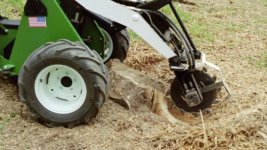
I am not sure running the saw backwards analogy applies to how I run it. I reversed my stump grinder. PT recommends that you start on the far side of the stump and backup as you are swinging side to side. Since I reversed mine, I attack the stump from the close side. I think the cutting action is identical if done that way. If you still attack the back side then you are cutting down instead of up.

Ken
 
/ Stumpgrinder direction #23  
Yes, there is a different stress load on the PT lift arms when the blade and rotation is reversed.

In the stock configuration, with the chips being thrown from the bottom towards the tractor, if the blade grabs something, it will want to pull the tractor forward and the lift arms up and over the object.

With the blade and rotation reversed, with chips being thrown from the bottom away from the tractor, if the blade grabs something, it will want to push the tractor backwards and the lift arms down and the rear end up in the air.

Of course, all that can change depending on wether you grab the object with the front or back of the blade.
 
/ Stumpgrinder direction #24  
Yep, you are right. I was just thinking about the cutting action but the forces on the tractor itself are different - just as you describe. If there is a weak link, the tractor would be better of being pulled forward and up than backward and down I would think (tension versus compression). Having said that, I did not notice any problems. I am going to a friends house tomorrow to grind 5 stumps so I get to play a little more.

Ken
 
/ Stumpgrinder direction #25  
Late to this issue...started reading the threads from the beginning to now...whew...:p

If you were to get a sheet of lexan cut it to fit the front ROPS
then cut several slots in the lexan to match up with the ROPS
finally slip some velcro straps thru the slots and around the ROPS

You cut stump grind with impunity...:D
(You could even be a mouth-breather and not swallow any debris...:D :rolleyes: )
 
/ Stumpgrinder direction #26  
Phils said:
Even with our lawsuit-happy populace, I can't imagine a suit against PT for damage caused by their equipment flinging debris.

Yes, you might not imagine it. We had a death in this area recently due to electrocution. A hot wire got into the water somehow, and an individual was working in the water. There was actually talk that the family of the dead guy was planning on suing the local electric utility company that supplied the electricity. While I don't know how this ended, the fact is there were people who apparently considered doing so.

Those who are looking to make some money will look for the deepest pockets. A company like PT has relatively deep pockets.

John
 
/ Stumpgrinder direction #27  
PaulChristenson said:
Late to this issue...started reading the threads from the beginning to now...whew...:p

If you were to get a sheet of lexan cut it to fit the front ROPS
then cut several slots in the lexan to match up with the ROPS
finally slip some velcro straps thru the slots and around the ROPS

You cut stump grind with impunity...:D
(You could even be a mouth-breather and not swallow any debris...:D :rolleyes: )

I did something like this. I spaced the plexglas away from the ROPS with wood because if against the ROPS it interferred with the steering wheel and control lever, if my memory serves me right. It did work, just too much trouble to get out and put on. I don't really use it anymore, I just keep the tilt of the quick attach plate at an angle that keeps most of the stuff off me. I also wear safety glasses.
 
/ Stumpgrinder direction #28  
PaulChristenson said:
Late to this issue...started reading the threads from the beginning to now...whew...:p

If you were to get a sheet of lexan cut it to fit the front ROPS
then cut several slots in the lexan to match up with the ROPS
finally slip some velcro straps thru the slots and around the ROPS

You cut stump grind with impunity...:D
(You could even be a mouth-breather and not swallow any debris...:D :rolleyes: )


I addressed the stump grinder rotation issue on 6/14/4 at http://www.tractorbynet.com/forums/power-trac/34740-pt-425-pros-cons-9.html !

The lexan solution is an expensive one that does NOT work! In short order the lexan is covered with mud, scratched by chips and stones, and soon is worthless!
"The first stump I ground resulted in chips and dirt flying back at the PT and me in a shower that filled the entire front area, the seat, the foot wells, and even the canopy! My clothes and face were pelted and covered with dirt and chips!! I used a 12 x 18 piece of Plexiglas to partially hide behind long enough to complete that stump. It took longer to clean the PT and myself afterward than it had taken to grind the stump! Grinding the front of the stump or rear made little difference!"

When the grinder is reversed, both the blade and the rotation are reversed, so it is NOT like reversing the blade on a Skil saw!!

If the grinder is tipped up so that just a little bit of the blade is visible from the operator's seat, nearly all the dirt, stones, and chips are thrown forward or upward. I used a piece of old tire to make a shield over the top and front. Also a sheet of plywood can be positioned on the far side of the stump to catch the debris.

The torque of the spinning blade is so low that which direction it is turning has no negative effect on the PT! The most difficult part of using the stump grinder is just keeping the blade from stopping!! Gentle movements are required!

The bottom line is that as delivered by PT the Stump Grinder is nearly unusable and is seriously dangerous to the operator!! Safety glasses and face shields are just about worthless!!

Since changing rotation I have cut dozens of stumps and hundreds of feet of trench in clean comfort and safety!!
 
/ Stumpgrinder direction #29  
Fourteen,
Glad you are back and OK.

I have been debating whether to get a stump grinder or wheeled trencher or both. I would prefer not to spend money for both but I need to grind stumps and do some trenching. My question is, how well does the stump grinder trench? How deep? I am wanting to lay outdoor romex and water lines 4"-8" below grade over several hundred feet.

Was it difficult to reverse the blade?

Thanks,
-Tim
 
/ Stumpgrinder direction #30  
tlb said:
Fourteen,
Glad you are back and OK.

I have been debating whether to get a stump grinder or wheeled trencher or both. I would prefer not to spend money for both but I need to grind stumps and do some trenching. My question is, how well does the stump grinder trench? How deep? I am wanting to lay outdoor romex and water lines 4"-8" below grade over several hundred feet.

Was it difficult to reverse the blade?

Thanks,
-Tim

Tim.

Maybe I can answer your question. I have an older PT and old implements. The unit that I use for both trenching and stump grinding, was called a trencher/stump grinder. Mine has a 26 in wheel with about 20 carbide teeth. It is not a serious stump grinder, but will get the job done. Used as a trencher, it does an outstanding job. If it hits some roots, it slows a little, and then continues on. With the trencher, you can trench down to the bottom of the frame about a 12 in trench. Some of the smaller stump grinders will trench maybe 8 in, but that is good for sprinkler or wire.

If your soil is not to tough, you can use a cutting shank like this to pull pvc or wire. A potato digger or a middle buster also works . Right now, I have about 5 different ways to lay sprinkler or wire.
I Just come across some good deals that were to good to pass up.
 

Attachments

  • ripper.bmp
    56.3 KB · Views: 175
/ Stumpgrinder direction #31  
"Fourteen, how well does the stump grinder trench?"

Quite well! I dug several hundred feet of trench ~8" x ~8" to separate the lawn from the gravel driveways and gardens. I then filled the trench with crushed stone or mulch to ****** intrusion.


"How deep?"

The blade will cut a slot an inch or two wide by 6" deep, or deeper but wider.


"I am wanting to lay outdoor romex and water lines 4"-8" below grade over several hundred feet."

That would work, but only use a Ground Fault protected circuit! Remember to protect water lines from frost!


"Was it difficult to reverse the blade?"

Not at all! Exchanging the hose ends is easy enough, but use an air impact wrench, (like they use to chance tires), to loosen the bolts, flip the blade over, and retighten the bolts. You could use some Loc-Tite, if you want, but just the impact wrench should do it!

Use whatever you have handy to fashion a front/top guard. Flexible is best, but not so big that you can't see the working edge of the blade.

Those carbide teeth will slowly cut about anything: wood, dirt, limestone, sandstone, soft concrete, soft steel, underground wiring, water lines, roots, worms, etc! Carbide is what is used for masonary drill bits! My teeth are as good as new, and on the stump grinder too!!


Have fun!
 
/ Stumpgrinder direction #32  
FOURTEEN said:
"The first stump I ground resulted in chips and dirt flying back at the PT and me in a shower that filled the entire front area, the seat, the foot wells, and even the canopy! My clothes and face were pelted and covered with dirt and chips!!"


Even before adding the top/front shield, notice how the chips have been thrown and piled in front of the stump and blade, and how clean the PT and even the top of the stump are!!

.
 

Attachments

  • Stump Grinding D .JPG
    Stump Grinding D .JPG
    103.3 KB · Views: 185
/ Stumpgrinder direction #33  
FOURTEEN said:
Even before adding the top/front shield, notice how the chips have been thrown and piled in front of the stump and blade, and how clean the PT and even the top of the stump are!!

.

Almost looks like you could place your light material out there in front and fill it up with the grinder. Less raking. I'm all for that.
 
/ Stumpgrinder direction #34  
Since the stump grinder seems to so such a fine job, why would there be any reason to buy a wheel trencher? I guess the wheel trencher has a 24" vs. 18" blade, but it is $1700 vs. $1050, which seems alot og money for a little bit larger blade and a wheel.

Anybody have the chain trencher? How does it compare in speed to the wheel trencher? It seems to me that the belt trencher would be better for dealing with rocks, since it can pull them out of the hole (but maybe the wheel trencher would just cut them in half?).
 
/ Stumpgrinder direction #35  
I have the chain trencher and stump grinder. The chain trencher's main advantage is width and depth of cut. I need to go 18 to 24 inches for power lines and at least 18 for water. The stump grinder will not do that. The chain trencher can get hung up on small rocks. There is a place that catches on about 1 inch rocks and I have to use a chisel and hammer to knock them out. If you want to bury drain pipe you need the chain trencher. I can cut a 100 foot trench 18 inches deep in about 30 minutes. Your rate will vary depending on soil, rocks, roots, etc. 1/2 inch roots are no problem, 2 inch roots take some time. Four inch roots, you should get out the wheel trencher and cut them with it.
 
/ Stumpgrinder direction #36  
Tim_in_CT said:
Since the stump grinder seems to so such a fine job, why would there be any reason to buy a wheel trencher? I guess the wheel trencher has a 24" vs. 18" blade, but it is $1700 vs. $1050, which seems alot og money for a little bit larger blade and a wheel.

Anybody have the chain trencher? How does it compare in speed to the wheel trencher? It seems to me that the belt trencher would be better for dealing with rocks, since it can pull them out of the hole (but maybe the wheel trencher would just cut them in half?).

Hi Tim,


I have the chain trencher, and the wheeled trencher/stump grinder. They both work well, but the chain trencher is designed to dig a 4 or 6 in trench as deep as 36 in. In sandy soil it will move right along. The replacement chains are about $500, and the large sprocket is about $45. I need to replace mine now, as it hangs up often, it has worn through the rollers.


The 26 in wheeled trencher is faster, but only digs down to about 12 in, and 2 in wide, and will also grind through cement and asphalt. It will also grind stumps. I can not easily replace the teeth on my trencher as they are brazed on. I can still sharpen them until they are beyond service use.

I don't have the PT stump grinder, but it should also dig shallow trenches to about 8 or 9 in. and 2 in wide.

I would also surmise that the stump grinder teeth are more aggressive than the trenchers teeth. but will still get the job done.

You mentioned a belt trencher, mine is hydraulic , direct drive.
 
/ Stumpgrinder direction #37  
J_J said:
Hi Tim,


I have the chain trencher, and the wheeled trencher/stump grinder. They both work well, but the chain trencher is designed to dig a 4 or 6 in trench as deep as 36 in. In sandy soil it will move right along. The replacement chains are about $500, and the large sprocket is about $45. I need to replace mine now, as it hangs up often, it has worn through the rollers.


The 26 in wheeled trencher is faster, but only digs down to about 12 in, and 2 in wide, and will also grind through cement and asphalt. It will also grind stumps. I can not easily replace the teeth on my trencher as they are brazed on. I can still sharpen them until they are beyond service use.

I don't have the PT stump grinder, but it should also dig shallow trenches to about 8 or 9 in. and 2 in wide.

I would also surmise that the stump grinder teeth are more aggressive than the trenchers teeth. but will still get the job done.

You mentioned a belt trencher, mine is hydraulic , direct drive.

Hi JJ,
What do you use to sharpen the teeth on the wheel trencher? Can you use a diamond wheel on an angle grinder or something like that?
 
/ Stumpgrinder direction #38  
RegL said:
Hi JJ,
What do you use to sharpen the teeth on the wheel trencher? Can you use a diamond wheel on an angle grinder or something like that?

Yes, you can use a diamond sharpener on the carbide teeth, but it is not that simple. Never sharpen the flat surface. Maintain the same back angle on the carbide cutter. Perhaps a Dremel tool with a diamond sharpener.
A 4 in grinder with a diamond wheel might work if you are steady and use a light touch.

A green silicon carbide stone might work.
 
/ Stumpgrinder direction #39  
J_J said:
Yes, you can use a diamond sharpener on the carbide teeth, but it is not that simple. Never sharpen the flat surface. Maintain the same back angle on the carbide cutter. Perhaps a Dremel tool with a diamond sharpener.
A 4 in grinder with a diamond wheel might work if you are steady and use a light touch.

A green silicon carbide stone might work.

Exactly what do you sharpen? The sides of the teeth? How do you tell they are dull. Mines has a lot of hours on it and is probably due.
 
/ Stumpgrinder direction #40  
BobRip said:
Exactly what do you sharpen? The sides of the teeth? How do you tell they are dull. Mines has a lot of hours on it and is probably due.


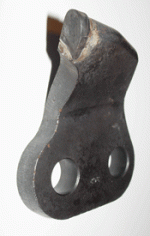
The flat side is the cutting edge, which comes to a point. . What you sharpen is the rake on the sides and back.
 

Attachments

  • chipngrind-033.gif
    chipngrind-033.gif
    27.8 KB · Views: 156

Marketplace Items

2015 John Deere 5075E (A60462)
2015 John Deere...
2018 Bobcat T590 (A60462)
2018 Bobcat T590...
iDrive TDS-2010H ProJack M2 Electric Trailer Dolly (A59228)
iDrive TDS-2010H...
2006 CHEVROLET EXPRESS 4X2 SERVICE BOX TRUCK (A59908)
2006 CHEVROLET...
BUSH HOG 406-6' ROTARY MOWER (A59823)
BUSH HOG 406-6'...
2021 Bobcat T770 (A60462)
2021 Bobcat T770...
 
Top