Supply for Yard Hydrants

   / Supply for Yard Hydrants #1  

wyeguy

Gold Member
Joined
Jun 29, 2012
Messages
396
Location
Bartlett, Iowa
Tractor
Ford 1100
I have a polyethylene pipe coming from under my house to a pit out in the yard. This is black 1" or 1-1/4" pipe that comes in a coil. It was used for my main water supply from an old well. I want to use this pipe to supply yard hydrants. But the pipe will need to be buried below the frost line (4 feet).
I need to make connections to this existing pipe and want to fill in the pit. So the pipe and connections will be buried deep where I don't want to have to deal with leaks. Is there a "high quality" connection method that will provide best reliability? I don't mind having to buy a tool or something within reason. I can use it at other locations like the hydrants. I just don't want to use hose clamps that will rust, etc. unless that is the best recommended method.
 
   / Supply for Yard Hydrants #2  
Do they make PEX adapters for that type and size? You can crimp them with stainless for durability. My old piping is polybutalene and there are changeover fittings for that to pex I plan to invest in those and PEX tools,
 
   / Supply for Yard Hydrants #3  
As silly as it may sound, the connection method that I have seen last the longest is to use the metal barbed connectors and two hose clamps per side (if joining two pieces of plastic pipe together). We've had some of the old polyethylene piping on the farm for 30+ years that was connected that way. I can't swear that the connections don't leak, but if they do, it is not apparent from the surface or the water bill.

That said, I haven't used any of that style of pipe in the last 25 years or so - I always use PVC (glued) for underground stuff now.

Good luck with whatever you choose.
 
   / Supply for Yard Hydrants #4  
What rtimgray said and make sure the hose clamps are stainless steel.
 
   / Supply for Yard Hydrants #5  
If you use hose clamps be sure they are 'all-stainless', as many have a plated steel screw that will deteriorate.

Jobs I had to re-dig resulted from hasty back-fill (customer) that pulled PB lines from fittings when it settled.

I would use PEX below ground, as well as above. Rings that we use are copper. :2cents:
 
   / Supply for Yard Hydrants #6  
I've used plastic barb connectors with two all stainless clamps. My well water is acidic and metal is attacked. Offset the clamp screws to increase the leak path. As posted above, be sure the clamps are all stainless including the screws.
 
   / Supply for Yard Hydrants #7  
When I installed GEO Thermal HVAC the pipes were ABS and they used a tool to melt the ends of the pipe and bond them together. I notice the gas company doing the same on new 6" gas lines. The gas company engineer told me the pipe will have a 150 life expectancy. My geo thermal company warrants the pipes for 50 years. It essentially makes it one pipe.

The tool was not sophisticated it was much like a soldering iron in a circular form. Probably less than $100. Could resell it afterwards on ebay.
 
   / Supply for Yard Hydrants #8  
All the methods mentioned work but the only ones I've never had to repair are Mueller or similar brass compression fittings.
 
   / Supply for Yard Hydrants
  • Thread Starter
#9  
Thanks for the great advice, everyone. All stainless hose clamps is easy enough!
 
   / Supply for Yard Hydrants #10  
I would use PEX below ground, as well as above. Rings that we use are copper. :2cents:

Copper holds up underground? I figured since copper pipe is not supposed to be run underground there was a corrosion issue. Or is that just costal areas that you can't run copper underground?

Sent from my SAMSUNG-SM-G890A using TractorByNet
 
   / Supply for Yard Hydrants #11  
Copper holds up underground? I figured since copper pipe is not supposed to be run underground there was a corrosion issue. Or is that just costal areas that you can't run copper underground?

Good question, IMO. :thumbsup: There are several copper types, with color-coded labeling. 'L' (blue) is rigid and used for commercial supply where required by code. 'M' (red) is thinner-walled and what's typically used (or was) for residential supply. Both are copper alloys and too brittle for U/G use. (lacking ductility)

'K' (green label) is used for underground here in MI. It is nearly pure copper, thickest, resilient, and by far the priciest. It's bought rolled vs in straight sections and flare vs sweat fittings are used. (DWV [yellow or orange 'stripe'] is the thinnest of the rigid, soldered copper 'pipes'.)

Copper's recent cost is leading to alternatives nowadays, but recognize that electrical grounding rods are still copper or copper-plated steel vs say even pricier stainless steel (even more SS alloys in common use).

Some of our residential build and add-on customers don't understand why we prefer to use PEX vs copper for all supply lines, besides the cost saving. It doesn't work harden like 'hard' copper ('L' & 'M') by temperature variations, doesn't corrode, and ... won't get stolen. :D That it resists freezing better than copper is from its ability to expand longitudinally as well as radially, thus relieving stress.
IMO it's still much tougher U/G than PB (black poly), and should add that the last re-dig of barn supply (1 1/4" PB) was for a leak caused by poor forming and a weak 'stripe' along several feet of a section that we had to replace. Never seen such irregularity or inconsistency with PEX, so it remains my #1 choice in all (non-industrial) applications. tog
 
   / Supply for Yard Hydrants #12  
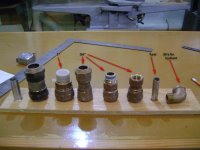
In the last 5 yrs. I've installed over 200 water meters & seen almost every kind of water line imaginable. A short time after meters are installed I get a lot of calls once the bills start coming in for water usage to fix leaks that have been ignored or just not aware ( in sandy or gravel soils). The only pipe or fittings I've never had to repair have been municipal tubing with these fittings. They also fit pex and copper ,pex is good pipe.
Comp. Fitings.jpg
 

Tractor & Equipment Auctions

Toro (A56857)
Toro (A56857)
2017 CAT 315F LCR EXCAVATOR (A58214)
2017 CAT 315F LCR...
2020 DRAGON ESP 150BBL ALUMINUM (A58214)
2020 DRAGON ESP...
2010 Toyota Highlander SUV (A59231)
2010 Toyota...
2019 KENWORTH T680 TANDEM AXLE SLEEPER (A59904)
2019 KENWORTH T680...
gps trailers (A56859)
 
Top