tractor stability

   / tractor stability #1  

cmyoung2

Platinum Member
Joined
Jun 21, 2010
Messages
546
Location
North west NC mountains
Tractor
BCS 850, Kubota BX2230 w/FEL, mid mount mower, 41" tiller Kubota L3600 w/4-1FEL, Farmi winch
I have a Kubota BX2230 with a loader. One of the many uses is mowing the pasture with a 50" flail mower. The problem is our ground is not flat and the BX is not the most stable tractor I have been on. So I am considering a larger tractor, maybe in the range of a ford 3000 or 3600 or a Massey 135. I would of course much rather have 4x4, but used under 5k sort of limits things. Other than pasture, the future might include a winch for some light logging. So, is the tilt factor enough less with the larger tractor to be significant?
I grew up with a Massey, and several other tractors about that size, but that was 50 years ago, and my pucker factor has changed over the years.
 
   / tractor stability #2  
Wider and heavier will always help stability.

Not sure how badly unstable your current rig is, but have you considered wheel spacers and filling the rear tires? Both of those things together will lower your center of gravity and spread out the weight of the tractor.
 
   / tractor stability
  • Thread Starter
#3  
Wider and heavier will always help stability.

Not sure how badly unstable your current rig is, but have you considered wheel spacers and filling the rear tires? Both of those things together will lower your center of gravity and spread out the weight of the tractor.

I thought about filling the rear tires, but I also use it as the lawn mower, not sure how much weight I want to add. Wheel spacing would be more difficult. Not sure of the slope when I get nervous, but it is not much. Not sure of the tipping point, and don't want to find out. It does have a mid mount mower, and that low weight doesn't help much.
 
   / tractor stability #4  
Basically you have two choices - wider stance and heavier unit( unit weight or added weight or both) OR learn to live with what you have.
 
   / tractor stability #5  
You must have some steep slopes, because I would consider a BX2230 with its low ground clearance, to be a fairly stable tractor platform. I know Kubota sells front suitcase weights for the BX as a way of adding some quick ballast, and there are after market suitcase systems available too. Also, the FEL will and often does contribute to instability. Removal of the loader during mowing operations should greatly increase stability.
 
   / tractor stability #6  
Filling the rears will help, but will only add about 80 lbs per tire. The most bang for your buck will be to add wheel spacers, but you may be limited by the mid mount mower.
 
   / tractor stability #7  
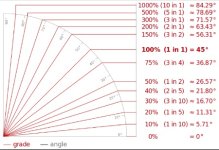
You can get a free inclinometer app for your smart phone and measure the various slopes around your house. Most will give you a slope measurement in both "percent" (as in percent of grade) and "degrees".

Slope chart:

Slope Angle Chart.jpg

As to safely "discovering" your tipping point, you can put a jack under one side of your tractor and start lifting that side, stopping to test pull from the opposite side to see how far over you can raise the tractor before the center of mass gets close to the tipping point. Once you feel the weight start to come off of the jack from pulling on it, that can be your hard stop, "not to exceed" number for that tractor.
 
   / tractor stability #8  
A subcompact tractor has a very low center-of-gravity due to its small wheels.

Your MMM adds weight near the ground, further lowering the C-O-G. Beyond the MMM I do not believe filling the two little rear tires with liquid will make a discernible difference.

Removing the entire FEL or at least the bucket will improve stability a little by lowering the C-O-G another increment but may make the tractor light in the front with a TPH mower mounted.

Going to lesser diameter, wider Turf Tires might make a slight difference but it would be somewhat costly as you would need new rims as well as tires for all four wheels.


So I am considering a larger tractor, maybe in the range of a ford 3000 or 3600 or a Massey 135. I would of course much rather have 4x4, but used under 5k sort of limits things.

None of above tractors will feel as stable as the BX with MMM on sloping ground. Without 4-WD the front wheels will have a tendency to slip downhill on slopes. Braking very limited with 2-WD tractors going downhill.

However, over flat, rutted or uneven ground the larger wheels and tires on above tractors will bridge ruts and holes better, so the larger tractor will bounce less, a separate issue from instability.

In terms of stability, you have the most stable traditional tractor platform now.


The future might include a winch for some light logging.

With all four wheels flat on the ground a BX should be capable of dragging a 1,000 pound tree using 1/4" chain as a link between the tree and tractor rear/center drawbar. Adding a second intermediary in the form of a 25' nylon strap will provide a 'reach' of 30' or more.

Progress over the ground will be slow in HST/LOW.

LINK: https://www.tractorbynet.com/forums...ar-center-tractor-drawbar-use.html?highlight=
 
Last edited:
   / tractor stability #9  
A subcompact tractor has a very low center-of-gravity due to its small wheels.

Your MMM adds weight near the ground, further lowering the C-O-G. Beyond the MMM I do not believe filling the two little rear tires with liquid will make a discernible difference.

Removing the entire FEL or at least the bucket will improve stability a little by lowering the C-O-G another increment.

Going to lesser diameter, wider Turf Tires might make a slight difference but it would be somewhat costly as you would need new rims as well as tires for all four wheels.

None of these tractors will feel as stable as the BX with MMM on sloping ground. Without 4-WD the front wheels will have a tendency to slip downhill on slopes. Braking very limited with 2-WD tractors going downhill.

However, over flat, rutted or uneven ground the larger wheels and tires on above tractors will bridge ruts and holes better, so the larger tractor will bounce less, a separate issue from instability.

In terms of stability, you have the most stable traditional tractor platform now.

Got to agree. You've got a pretty good tractor for what you are doing. I'd do a couple of simple things to make what you have work better before even considering a different tractor.

First of all figure out some way to take off the loader bucket when mowing. And don't carry anything on the 3pt. That will help a lot.

And then get some spacers for the rear tires. Move them out 4" on a side. That's standard and will make a noticeable difference. The stock tires and wheels look good to me. I doubt if I would add fluid to them - and certainly not before first tryng the spacers.
rScotty
 
   / tractor stability #10  
Some other posts have found Jeep wheel extensions cheap on Amazon that work with the BX tractors. Wish they came in my size. There are some limits with the mid mount mower interference depending on model.

On our B26 wheel extensions and ballasted tires made a significant difference in stability.

Small wheels less forgiving on rough sloped ground. 50” flail mower behind a MF135 would look kind of dinky.
 
   / tractor stability #11  
You can get a free inclinometer app for your smart phone and measure the various slopes around your house. Most will give you a slope measurement in both "percent" (as in percent of grade) and "degrees".

Slope chart:

View attachment 685433

As to safely "discovering" your tipping point, you can put a jack under one side of your tractor and start lifting that side, stopping to test pull from the opposite side to see how far over you can raise the tractor before the center of mass gets close to the tipping point. Once you feel the weight start to come off of the jack from pulling on it, that can be your hard stop, "not to exceed" number for that tractor.

If you have an iPhone, there's a Measure tool that also has a level. Works great. Lay a 2x4 on the slope and lay the iPhone on edge on the 2x4 and you get a nice reading of the slope in degrees.
 
   / tractor stability #12  
Tire spacers (or rim settings) for a wider stance will make the biggest difference on gaining more stability .
Having the center of gravity low, as compared to tractor’s width, will be the biggest factor, more than overall weight.

Standing at the back of the tractor, draw an imaginary line from the outside of the rear tire at the ground to the centerline of the tractor at height that you think represents the COG. (Probably a couple inches above the rear axle height). Your tractor can roughly tip sideways until this line becomes vertical, then it will roll (Not taking dynamic forces and momentum into account). You can see that if tractor is wider, or COG lower, this has a big impact on how far tractor can tip.

Some say taking loader off makes it more stable..IMHO, yes and no. If you keep bucket low, and the bucket and it’s contents weigh greater than the loader arms above the COG, then the bucket will actually lower the COG, as compared to having no FEL. Also having weight on the front end to counter 3 point hitch attachments will make the tractor feel more stable vs all the weight teetering on just one rear tire.
 
Last edited:
   / tractor stability #13  
IF you don't want to add weight (loaded tires) , wheel spacer will help.... I added 3 inch spacers to my MF GC 1715 and it made a lot of difference.... Basically the wider the width the more stable you tractor will be...

Dale
 
   / tractor stability #14  
Some say taking loader off makes it more stable..IMHO, yes and no. If you keep bucket low, and bucket and contents weight below normal COG is greater than loader arm weight above COG, then bucket will actually lower the COG, as compared to having no FEL. Also having weight on the front end to counter 3 point hitch attachments will make the tractor feel more stable vs all the weight teetering on just one rear tire.

We run on fairly steep hills - I have not measured the actual angle or slope. Let's just say my first time mowing them did cause some seat pucker! :D The brush hog weighed a lot and the tractor had no front weights. Making turns at the top of the hill was exciting if one did not slow to a crawl and make gentle wide turns. We added a FEL and most of those problems went away. I believe running with the bucket low - less than a foot above the ground - gives our MF1533 with a 60" hog much more stability.

We have not tried moving the wheels out further. I suspect that too would help.
 
   / tractor stability #15  
My CUT is a Mitsubishi 180-D
VERY narrow and often generates a pucker but I've learned to live with it.
Reversing my rims did help a lot as did as did tire ballast (beet juice).

When using the FEL I only drive keeping is close to ground.
And, I've 'puckered' more than a few times while learning its limitations.

If I could locate a pair of 2 inch extensions* in Canada I'd be a buyer.
\
*(W8x18 rims)
 
   / tractor stability #16  
My CUT is a Mitsubishi 180-D
VERY narrow and often generates a pucker but I've learned to live with it.
Reversing my rims did help a lot as did as did tire ballast (beet juice).

When using the FEL I only drive keeping is close to ground.
And, I've 'puckered' more than a few times while learning its limitations.

If I could locate a pair of 2 inch extensions* in Canada I'd be a buyer.
\

*(W8x18 rims)


Bro-tek - Contact


Dale
 
   / tractor stability #17  
My BX2230 felt very tippy. I put 11 gallons in each tire.
On my hill with the loader and 265 lbs on the 3pt almost dragging on the ground, I got off and could lift the uphill side rear wheel by pushing on ROPS with 1 hand. Without the loader or weight, I could not lift the wheel pushing on the ROPS. I only used ultra-cold washer fluid. It's 80-90 lbs per tire, but a world of difference.
 
   / tractor stability #18  
So removing that loader really does make a difference in overall stability during mowing. I was thinking that is correct, because just during normal tractor movement, I see increase in stability on my tractor when the loader is removed. I have only removed my loader twice in 3.5 years, but stability improvement was noticeable.
 
   / tractor stability #19  
Just another voice to endorse wheel spacers to increase stability. I have a BX25D, and I'm constantly operating on steep slopes here in the Cascade Mountains foothills investors Washington. I don't mow with the bx, but I move logs with bucket-mounted forks and by dragging, and I've been moving lots of fill dirt, big rocks, and gravel. I had the rears filled with Rimguard when I bought the tractor (1400 hrs ago), so I can't tell you what it would be like unloaded.
But I can tell you for sure that there was a really noticeable, significant improvement in stability after I installed a pair of 3" spacers on the rears last summer. I got them from Bro-tek in Canada, and it was a totally positive experience. Delivery was quick, they fit perfectly, and installation was simple. You will need a few sockets and a torque wrench. I also used blue loctite on the bolts, just in case. The instructions are very complete, and even tell you what tools and sockets you will need. Since I have a backhoe, adjusting the height of the axle with the stabilizers to put the wheels back on was easy, but you can also do it with a jack.
Your mower deck limits you as to size of spacers you can use. Bro-tek has a useful discussion of this on their website.
I only wish I had added the spacers a few years ago.
I know people have mentioned using cheaper jeep or other spacers. If you do this, check to see that the bolts will fit, and also that the hub and the central hole match, as they apparently carry a significant part of the load. The advantage of the Bro-tek spacers in this regard is that they are sized exactly for the bx. I seem to recall that they offer a choice of steel or aluminum. I went with the aluminum ones, as I didn't want to bother with priming and painting the steel ones.
By the way, in really iffy situations, I have resorted to swinging the backhoe to the uphill side and extending it. It makes a pretty good short-term movable counterweight.
 
   / tractor stability #20  
Sorry, that's western Washington. **** autocorrect...
 

Tractor & Equipment Auctions

2021 KOMATSU WA380-8 WHEEL LOADER (A60429)
2021 KOMATSU...
2014 GENIE GTH-5519 TELESCOPIC FORKLIFT (A60429)
2014 GENIE...
2007 Ingersoll Rand G240 240kVA 3-Phase Towable Diesel Generator (A59228)
2007 Ingersoll...
1984 Trailmobile Enclosed Van Trailer (A55315)
1984 Trailmobile...
2014 JOHN DEERE  544K WHEEL LOADER (A58214)
2014 JOHN DEERE...
2014 Club Car Carryall 295 4x4 Utility Cart (A59228)
2014 Club Car...
 
Top