You are using an out of date browser. It may not display this or other websites correctly.
You should upgrade or use an alternative browser.
You should upgrade or use an alternative browser.
Trailer axle/tire question
- Thread starter zmansmac
- Start date
- Views: 28615
More options
Who Replied?
/ Trailer axle/tire question
#41

I'm mentally going through the free-body diagram of the axles under braking forces, and I see where Dexter and Alko get their answer.
The front axle spring is fixed at the front of the spring. This is the pivot point for the spring; the spring can move up or down as well as laterally at the rear of the spring. When that axle brakes, the friction between the tire and the road exerts a torque on the axle, from both the direct braking torque and the torque that comes from the force of the tire on the road multiplied by the perpendicular distance from that force to the pivot point. Both of these torques make the axle tend to pivot...upwards off the ground.
The reverse is true on the rear axle. The torque acts in the same relative direction as the torque on the front axle, but the spring is fixed on the rear and free to move upwards or down at the forward end of the spring. The axle will be force downward. If the equalizer didn't stop the spring, in fact the axle could even ride under the spring pivot point and flip....
Nevertheless, I will eventually put brakes on both axles of my flatbed trailer.
edit: I see Skyco also explaine dthis at the same time I was typing. Goes to show great minds must think alike
Finally someone else "gets it"

4shorts
Elite Member
Funny- the Whaler site shows torsion axles.
If they are equalized leaf springs and the brakes are on the front only they are built wrong.
Next time I get one in I'll post a few detailed pics here for you. Interesting if nothing else. It might be a Canadin thing

sandman2234
Super Member
- Joined
- Dec 4, 2005
- Messages
- 6,688
- Location
- Jacksonville, Florida
- Tractor
- JD2555 and a few Allis Chalmers and now one Kubota
Skyco,
I completely understood your explanation. You did explain it well, and I kind of agree with you, to a point.
I was trying to make a point that not all trailers are built the same, not all trailers use the same equalizers, and not all loads require dual axle brakes. Heck, I have one trailer that has no brakes at all on it, 16' long, dual axles and made by a reputable manufacturer. Either somebody replaced the rear axle or it came with no brakes. Don't know for sure, since I bought it used and cheap. I could add a couple of new axles with brakes, or one with brakes, or just leave it alone, since it rarely leaves the yard and then only with a lawnmower on it (300 pounds max). Bottom line, if you load the front extra heavy, and your trailer is less than level (leaning forward), then your probably still going to lock up the rear axle with both axle brakes. This has been my experience, but it has been learned over the years while loading my own loads and having the tow vehicle capable of handling the tongue weight. For the people that can't adjust the axle weights due to the cargo (ie a tractor for instance) being single size and taking up all the bed space, then the rules change compared to what I normally haul, which is small heavy stuff like machinery where placement is critical, yet leaves a lot of open bed space. This type of load can change braking designs of the equalizers.
My point was each circumstance CAN be different, if you can control the varibles which makes flat statements like were made earlier just a waste of bandspace.
David from jax
I also should add that they may not have been Skyco's statements...
I completely understood your explanation. You did explain it well, and I kind of agree with you, to a point.
I was trying to make a point that not all trailers are built the same, not all trailers use the same equalizers, and not all loads require dual axle brakes. Heck, I have one trailer that has no brakes at all on it, 16' long, dual axles and made by a reputable manufacturer. Either somebody replaced the rear axle or it came with no brakes. Don't know for sure, since I bought it used and cheap. I could add a couple of new axles with brakes, or one with brakes, or just leave it alone, since it rarely leaves the yard and then only with a lawnmower on it (300 pounds max). Bottom line, if you load the front extra heavy, and your trailer is less than level (leaning forward), then your probably still going to lock up the rear axle with both axle brakes. This has been my experience, but it has been learned over the years while loading my own loads and having the tow vehicle capable of handling the tongue weight. For the people that can't adjust the axle weights due to the cargo (ie a tractor for instance) being single size and taking up all the bed space, then the rules change compared to what I normally haul, which is small heavy stuff like machinery where placement is critical, yet leaves a lot of open bed space. This type of load can change braking designs of the equalizers.
My point was each circumstance CAN be different, if you can control the varibles which makes flat statements like were made earlier just a waste of bandspace.
David from jax
I also should add that they may not have been Skyco's statements...

jimmysisson
Veteran Member
- Joined
- Jul 11, 2005
- Messages
- 2,358
- Location
- W.Mass
- Tractor
- 1993 NH 2120 (the best), 1974 MF 135 (sold, but solid), 1947 Farmall A (bought, sold, bought back, sold again), 1956 MH50 lbt (sold, in 1980, darn it)
I'm with Bill C and Skyco on the behaviour of the equalizer. What I don't get is trailer weight being shifted forward under braking. It's not like a car where the weight shifts toward the front under braking. The trailer is attached to a car or truck whose behaviour is most likely to raise the rear of the towing vehicle under braking. I know, a 3500 doesn't dive much, but still the rear of the towing vehicle rises, if anything. If the trailer axles were welded to the frame (theory) and it started out level, braking the towing vehicle would raise the tongue of the trailer, loading its rear tires. In real life, lots of factors affect which wheel locks first.
Bottom line, trailer brakes (electric) are kind of crude devices. Adjustment, rust, electrical resistance varies among the brakes on one trailer probably more than the effect of weight transfer. This seems like a gold mine for someone to come up with a better mousetrap.
Jim
Bottom line, trailer brakes (electric) are kind of crude devices. Adjustment, rust, electrical resistance varies among the brakes on one trailer probably more than the effect of weight transfer. This seems like a gold mine for someone to come up with a better mousetrap.
Jim
cleatus
Gold Member
Use two grake controlers, one for each axle. All kinds of adjustment.
aczlan
Good Morning
- Joined
- Mar 7, 2008
- Messages
- 17,540
- Tractor
- Kubota L3830GST, B7500HST, BX2660. Formerly: Case 480F LL, David Brown 880UE
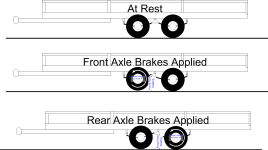
I agree with you on the not all loads needing brakes, but I disagree on the importance of different equalizers (as long as the front and back arms are the same length), as I understand it (and someone correct me if I missed something) if a trailer has dual axles with leaf springs and an equalizer between them, the weight on both axles will the the same when the trailer is loaded and stopped, if there is more weight on the front the front axle will be pushed down more than the back, this will cause the front spring to push up on the front of the equalizer which will push down on the back of the equalizer, causing the back spring (and by extension the back axle) to take an equal share of the weight, this continues until you run out of travel on the equalizer at which point the load becomes unbalanced.Skyco,
I was trying to make a point that not all trailers are built the same, not all trailers use the same equalizers, and not all loads require dual axle brakes.
Attached is a diagram of a dual axle trailer at rest, with front brakes applied and with rear brakes applied, it shows the forces applied to the equalizer and the result of said forces.
Aaron Z

J_J
Super Star Member
- Joined
- Sep 6, 2003
- Messages
- 18,973
- Location
- JACKSONVILLE, FL
- Tractor
- Power-Trac 1445, KUBOTA B-9200HST
I agree with you on the not all loads needing brakes, but I disagree on the importance of different equalizers (as long as the front and back arms are the same length), as I understand it (and someone correct me if I missed something) if a trailer has dual axles with leaf springs and an equalizer between them, the weight on both axles will the the same when the trailer is loaded and stopped, if there is more weight on the front the front axle will be pushed down more than the back, this will cause the front spring to push up on the front of the equalizer which will push down on the back of the equalizer, causing the back spring (and by extension the back axle) to take an equal share of the weight, this continues until you run out of travel on the equalizer at which point the load becomes unbalanced.
Attached is a diagram of a dual axle trailer at rest, with front brakes applied and with rear brakes applied, it shows the forces applied to the equalizer and the result of said forces.
View attachment 126079
.
Aaron Z
Can you perhaps use those same drawings for dual axle with brakes on all wheels, and explain which axle will cause the brakes to grab and lock, and why? My thoughts have been that the equalizers serve to equalize or compensate for irregular surfaces, such as a pot hole or a rock or bump, etc. In the normal trailer situation, the front axle already has more weighI on it due to the 10% tongue weight, and I am thinking that the load shifts fwd, even more in a braking situation. How much weight is shifted to the back axle is up to conjecture. No one seems to know. It would be neat to see a trailer being pulled down the road with a video camera looking at the wheels and springs to actually see what happens to the wheels, when a hard braking situation occurs, and which set of brakes will lock up.
The question might be is. if the equalizers are designed to equalize the load on the frame, do they also equalizer the braking force on the axles. Some people say some grab, and others say never.

radioman
Super Member
I agree with you on the not all loads needing brakes, but I disagree on the importance of different equalizers (as long as the front and back arms are the same length), as I understand it (and someone correct me if I missed something) if a trailer has dual axles with leaf springs and an equalizer between them, the weight on both axles will the the same when the trailer is loaded and stopped, if there is more weight on the front the front axle will be pushed down more than the back, this will cause the front spring to push up on the front of the equalizer which will push down on the back of the equalizer, causing the back spring (and by extension the back axle) to take an equal share of the weight, this continues until you run out of travel on the equalizer at which point the load becomes unbalanced.
Attached is a diagram of a dual axle trailer at rest, with front brakes applied and with rear brakes applied, it shows the forces applied to the equalizer and the result of said forces.
View attachment 126079
Aaron Z
Ok - from this picture, it would explain the front axel lockup esp when its unladen and said trailer has WD bars installed. The rear axel is the same height as front so when the braking force is applied, it appears the front rotates and LIFTS the front axel up just a hair and it would seem it locks up due to the fact there is less pressure on the road. Now this doesnt seem to happen when loaded. perhaps there should have been some sort of a cutoff switch to ONE of the axels brakes so its doesnt seem to lock up when its in unladen mode. Why do you think some manufacters put brakes up front? 80/20 weight rule and the torsion of the equalizer ? ( looks like we gonna argue on this till we are blue in the face.
)
firefighter9208
Platinum Member
Here is a link to Dexter's site that shows how to determine where to place the axles on a trailer: http://i.b5z.net/i/u/1080235/f/Design_Considerations.pdf .
I recently used this document to determine where to place the axles on a pontoon trailer that I converted from a single axle to tandems with equalizers.
I checked two factory built trailers that I have and both had the axles placed exactly where dexter recommends to place them according to the formula on the last page.
Chris
I recently used this document to determine where to place the axles on a pontoon trailer that I converted from a single axle to tandems with equalizers.
I checked two factory built trailers that I have and both had the axles placed exactly where dexter recommends to place them according to the formula on the last page.
Chris
aczlan
Good Morning
- Joined
- Mar 7, 2008
- Messages
- 17,540
- Tractor
- Kubota L3830GST, B7500HST, BX2660. Formerly: Case 480F LL, David Brown 880UE
it will act the same as the drawing with rear brakes, but the effect will be more pronounced as both axles will be moving in harmony (the front of the equalizer being pushed up by the front spring and the back being pushed down by the back spring)Can you perhaps use those same drawings for dual axle with brakes on all wheels, and explain which axle will cause the brakes to grab and lock, and why?
AFAIK with a dual axle leaf spring equalized trailer at rest on flat ground the load will be the same on both axles no matter where on the trailer the load is, if I had access to a dual axle trailer and a set of scales that would measure both axles separately I might load my FIL's 7510 Kubota and see what happens to the weight when it moved from front to back (if anyone has the chance to do this test, let me know how it turns out), I predict that the axles would be within say 25-50 pounds of each other (barring a sticky equalizer) but that the overall weight on the axles would change based on how much weight went to the tow vehicle.My thoughts have been that the equalizers serve to equalize or compensate for irregular surfaces, such as a pot hole or a rock or bump, etc. In the normal trailer situation, the front axle already has more weighI on it due to the 10% tongue weight
Good question, my math skills aren't up to figuring out the forces involved and all that good stuff.I am thinking that the load shifts fwd, even more in a braking situation. How much weight is shifted to the back axle is up to conjecture. No one seems to know
With the 20' (or was it 24') enclosed torsion spring trailer that I used to pull behind a F450 (front slightly higher than the back) when I did landscaping had the feature where if you didnt drop the power on the brake controller way down after you unloaded 3 1500#+ mowers and a pair of 800# mowers the front tires left nice black skidmarks, but that is completely unrelated to this discussion.It would be neat to see a trailer being pulled down the road with a video camera looking at the wheels and springs to actually see what happens to the wheels, when a hard braking situation occurs, and which set of brakes will lock up
The 18' dual axle leaf spring equalized open landscape trailer we had would (IIRC) lock up the LF tire first, then the RF then the back ones (if you hit the manual brakes when driving)
they cannot equalize braking force on the axles, the diagrams I did above show that when the brakes are applied on either or both axles the front axle will be lighter than the rear one, the is due to the face that the equalizer is a lever, and it will act as a lever until it breaks.The question might be is. if the equalizers are designed to equalize the load on the frame, do they also equalizer the braking force on the axles. Some people say some grab, and others say never.
as for grabbing or not that depends on how the brakes are adjusted (tensioned), where your brake controller is set (how much juice you are sending to the magnets) and how good the wiring to the brakes is.
Aaron Z
J_J
Super Star Member
- Joined
- Sep 6, 2003
- Messages
- 18,973
- Location
- JACKSONVILLE, FL
- Tractor
- Power-Trac 1445, KUBOTA B-9200HST
Aaron, Thanks, good explanation.
My thinking is that if the front axle is lighter due to spring action, and if the same current is sent to all electro magnets, then the axle with the lighter load will grab first because of the least resistance. So a question might be how do you set the brakes for the best braking force. If you set it just before lockup, which would probably the front, then the rear brakes will not be set correctly. You would think someone would have come up with a variable resistor in the front axle brakes , adjusted to match the braking force of the rear brakes, or a pulsed brake system similar to anti-lock brakes.
My thinking is that if the front axle is lighter due to spring action, and if the same current is sent to all electro magnets, then the axle with the lighter load will grab first because of the least resistance. So a question might be how do you set the brakes for the best braking force. If you set it just before lockup, which would probably the front, then the rear brakes will not be set correctly. You would think someone would have come up with a variable resistor in the front axle brakes , adjusted to match the braking force of the rear brakes, or a pulsed brake system similar to anti-lock brakes.
aczlan
Good Morning
- Joined
- Mar 7, 2008
- Messages
- 17,540
- Tractor
- Kubota L3830GST, B7500HST, BX2660. Formerly: Case 480F LL, David Brown 880UE
you could adjust the tensioners to give you a little less braking power inn the front, but that wouldn't help when unloaded, because if you were to back them off enough to keep from locking up when unloaded it wouldn't help very much when loaded... hmmm, perhaps a switch to kill the power going to the front brakes (with the breakaway switch bypassing it, because if your breakaway switch trips you want all the brakes to come on) to be used when unloaded...My thinking is that if the front axle is lighter due to spring action, and if the same current is sent to all electro magnets, then the axle with the lighter load will grab first because of the least resistance. So a question might be how do you set the brakes for the best braking force. If you set it just before lockup, which would probably the front, then the rear brakes will not be set correctly. You would think someone would have come up with a variable resistor in the front axle brakes , adjusted to match the braking force of the rear brakes, or a pulsed brake system similar to anti-lock brakes.
Probably the simplest way to do it is to dial down or shut off your brake controller when unloaded and adjust it properly when you are loaded.
Aaron Z
rdbrumfield
Veteran Member
I don't care which axle locks up as long as they are all braking. If I have to stop that quickly I want every anchor I can get. When it comes to tandems, all mine have brakes front and rear.
Ever see a semi with half the axles braking, they would be sitting until the fixit wagon showed up.
When loaded I run up the amps for braking, empty, I back it off so I just get a small tug from the rear and let the pulling vehicle take care of it.
Ever see a semi with half the axles braking, they would be sitting until the fixit wagon showed up.
When loaded I run up the amps for braking, empty, I back it off so I just get a small tug from the rear and let the pulling vehicle take care of it.


