Tree Puller for hard to get at trees

   / Tree Puller for hard to get at trees #21  
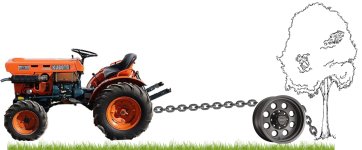
Call me dense, don't get it. I know you don't mean with the tire on it.


Never have tried the rim myself but am sure one side could sink deeper than the other but gee, how precise is pulling trees. Could not one leg sink deeper also?

The rim is the outer part of the wheel which basically retains the tire on the wheel ... I'm picking at you a little bit but now days so many people talk "Rim equals Wheel" which is not true since the rim is a part of the wheel assembly!
 
   / Tree Puller for hard to get at trees
  • Thread Starter
#22  
Sorry for the confusion, my error, rim to me means a naked wheel without a rubber tire mounted.
 
   / Tree Puller for hard to get at trees #23  
That was a nice solution to your problem and there was no problem or confusion ... I agree the wheel is also good way to go ....
Leo
 
   / Tree Puller for hard to get at trees #24  
I am still a little confused. Should you use just the rim or the entire rim/tire assembly?
 
   / Tree Puller for hard to get at trees #25  
My location has a number of interesting terrain problems. One of these is a normally well maintained earthen dam which has had recurring alders coming back each year below the mowing line, and refusing to give up no matter how many times pruned to ground level. The last couple of years pruning was not done resulting in 3"-4" trunk size trees.

Also my front yard has a few very steep and very tractor unfriendly areas where some small "trash" trees need to be removed before they become larger trees (or if simply cut, sprouting a whole bunch more suckers, etc).

Since I am not about to risk my tractor (not to mention my backside) in either of these steep areas, it was worthwhile to cobble up this frame which is designed to stand up near the base of the small tree, wrap and hook a choker chain around the base of the tree, hook the chain into the slotted top of the frame, and continue on to the tractor's drawbar (located safely on top of the dam).

I had previously tried just a straight pull without the frame, resulting in little more than laying the tree over and digging some nasty wheel wells in the top of the dam.

With the frame, the tractor didn't even slow down :D

Sherweld

I have used this type of setup to pull fence posts also. I just used an old fence post as the pivot point. You have to be very careful that everything is lined up and pulled in a straight line.
 
   / Tree Puller for hard to get at trees
  • Thread Starter
#26  
I am still a little confused. Should you use just the rim or the entire rim/tire assembly?

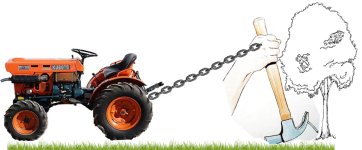
A wheel with tire mounted I believe could be unstable (tipping to the side)(although I can't say I've ever tried it) Also it could not keep the chain aligned as well as a bare wheel, and could allow the chain to slip off to the side. (but again I've never tried it)

A bare wheel shown here is being pushed down into the ground fairly hard. If it leans far enough to one side, where the down force of the chain is beyond the footprint of the wheel, it could flop on it's side. That is why I suggest using the widest wheel possible.

Also that is why I made the bipod frame with a wide stance and big feet.

Hope this helps.

Sherweld
 

Attachments

  • Wheel Puller.jpg
    Wheel Puller.jpg
    339.4 KB · Views: 1,129
   / Tree Puller for hard to get at trees #27  
hi, i think the "rim idea" is great, but it does not offer the "lever advantage" that Sherweld's bi pod does.

the rim feature is, it changes the pulling force to lift. the pull to lift ratio remains at 1:1 because there seems to be no fixed pivot point to determine a pull to lift ratio.

the bi pod not only changes pull to lift, but does utilize a fixed pivot point at its base. the bi pods height and the base distance from the lift point allows an adjustable and calculable pull to lift ratio. (as Sherweld originally stated, the chain is fixed at the bi pods top completing the lever.)

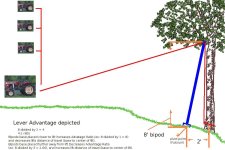
example: an 8 foot tall bi pod, base positioned 2 feet from lift point gives a 4:1 pull to lift advantage. so lets say 1 ton of pull translates to 4 tons of lifting force.

with my little YM1600 (which weighs in at about 1,500 pounds) i need every mechanical advantage i can find.

Sherweld, Thank You Again for bringing to light, a lever can be more than a straight board. my little YM1600's ego is going through the roof being able to work along side the big boys.

Rhett
 
   / Tree Puller for hard to get at trees #28  
hi, i think the "rim idea" is great, but it does not offer the "lever advantage" that Sherweld's bi pod does.

the rim feature is, it changes the pulling force to lift. the pull to lift ratio remains at 1:1 because there seems to be no fixed pivot point to determine a pull to lift ratio.

the bi pod not only changes pull to lift, but does utilize a fixed pivot point at its base. the bi pods height and the base distance from the lift point allows an adjustable and calculable pull to lift ratio. (as Sherweld originally stated, the chain is fixed at the bi pods top completing the lever.)

example: an 8 foot tall bi pod, base positioned 2 feet from lift point gives a 4:1 pull to lift advantage. so lets say 1 ton of pull translates to 4 tons of lifting force.

with my little YM1600 (which weighs in at about 1,500 pounds) i need every mechanical advantage i can find.

Sherweld, Thank You Again for bringing to light, a lever can be more than a straight board. my little YM1600's ego is going through the roof being able to work along side the big boys.

Rhett
Ok would you start with the bi pod vertical or angled toward the tree? This really sounds too simple to work. I'm an engineer, but darn flunked mechanics. :D
 
   / Tree Puller for hard to get at trees #29  
It works best with the most leverage. If you angle the bipod about 45 deg toward the tree as you pull on the chain/cable the bipod goes toward the vertical position pulling up on the trunk of the tree. Really works slick. You can try it on a simple weed in the garden with a stick and twine and just pull on the twine and watch the weed pop out
 
   / Tree Puller for hard to get at trees #30  
hi, i think the "rim idea" is great, but it does not offer the "lever advantage" that Sherweld's bi pod does.

the rim feature is, it changes the pulling force to lift. the pull to lift ratio remains at 1:1 because there seems to be no fixed pivot point to determine a pull to lift ratio.

the bi pod not only changes pull to lift, but does utilize a fixed pivot point at its base. the bi pods height and the base distance from the lift point allows an adjustable and calculable pull to lift ratio. (as Sherweld originally stated, the chain is fixed at the bi pods top completing the lever.)

example: an 8 foot tall bi pod, base positioned 2 feet from lift point gives a 4:1 pull to lift advantage. so lets say 1 ton of pull translates to 4 tons of lifting force.

Rhett

That is not technically correct. The length of the bipod doesn't matter. The reason is that the bipod/tire is a fulcrum and not a leaver. The advantage you get is you are directly lifting the tree and not trying to drag it through the ground to get it out.
 
   / Tree Puller for hard to get at trees #31  
Hard to get it all in one shot.

Besides, I already pulled all the trees at that location :D

The next place has so much other brush that I might get lost, much less take a clear picture. :eek:

So here's a sketch


Thanks, the piece I was not understanding was I was not visualizing it set (both pads on the ground) as shown in your sketch.

I was picturing it pulling over one leg of your bipod, using the other leg to increase leverage, and was not getting the mechanism to work in my mind.
 
   / Tree Puller for hard to get at trees #32  
Just being the Safety Geek that I am. When pulling things out of the ground or even up higher for that matter. Keep in mind the strength of your cable or chain. Watch for cuts and broken links. Having a cable or chain flail back at you if it snaps or pops off the tree is going to leave an impression you might not like.:eek: Going as far as to say a hard hat, safety glasses aren't a bad idea if you don't have a safety cage at the back of your favorite flavor of tractor.
Those are great ideas. I had forgotten about that method when I was pulling metal fence post out of the ground by hand using the leverage method.

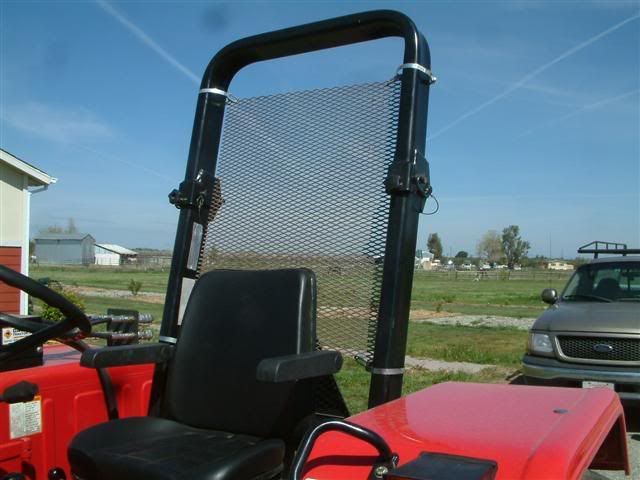
That's why I protect my backside with a simple expanded metal safety screen attached to the ROPS with hose clamps.

DSCF0083Small.jpg


I use one screen on my Mahindra 5525 for protection when I'm using the brush hog. You can sandwich several screens for added protection.
 
   / Tree Puller for hard to get at trees #33  
That's why I protect my backside with a simple expanded metal safety screen attached to the ROPS with hose clamps.

DSCF0083Small.jpg


I use one screen on my Mahindra 5525 for protection when I'm using the brush hog. You can sandwich several screens for added protection.

Now that's what I am talking about. Simple to use. I can see where a metal strip down each edge of the metal screen and attach the hose clamps to them. Then if something heavy were to hit the screen it wouldn't rip out at the attach point of one hose clamp. The metal strip would be screwed or welded on that edge and spread the forces out from an impact. I am going to have to adopt your method to my Tractor for when I am skidding logs out of the woods for my Tree business.
 
   / Tree Puller for hard to get at trees #34  
I have used a 4x4 post with a notch cut in the top for a chain guide to pull stumps out with. Works similar to what has been described.
 
   / Tree Puller for hard to get at trees #35  
Vstell is correct in that the bipod is the fulcrum and the chain is your lever. The height of the bipod is only related to how high you wish to lift the object. Just like a lever and fulcrum, the closer the fulcrum is to the object being lifted the more power you can pull, but you limit the height of lift. So you bipod must be high enough to lift the object clear of whatever it is embedded in, but you wont get any more power by having it higher.
 
   / Tree Puller for hard to get at trees
  • Thread Starter
#36  
hi, i think the "rim idea" is great, but it does not offer the "lever advantage" that Sherweld's bi pod does.

the rim feature is, it changes the pulling force to lift. the pull to lift ratio remains at 1:1 because there seems to be no fixed pivot point to determine a pull to lift ratio.

the bi pod not only changes pull to lift, but does utilize a fixed pivot point at its base. the bi pods height and the base distance from the lift point allows an adjustable and calculable pull to lift ratio. (as Sherweld originally stated, the chain is fixed at the bi pods top completing the lever.)

example: an 8 foot tall bi pod, base positioned 2 feet from lift point gives a 4:1 pull to lift advantage. so lets say 1 ton of pull translates to 4 tons of lifting force.

with my little YM1600 (which weighs in at about 1,500 pounds) i need every mechanical advantage i can find.

Sherweld, Thank You Again for bringing to light, a lever can be more than a straight board. my little YM1600's ego is going through the roof being able to work along side the big boys.

Rhett

and .... Thank You Rhett for that clear explanation.

The wheel does indeed offer a couple of advantages:
it does change the direction of pull,
it is quick (no construction involved),
it is cheap,
and there is indeed a small mechanical advantage (perhaps as much as 2:1) at the start of the pull. (but that's another discussion)

However, before we got on that wheel tangent, I was going to post the analogy of a claw hammer or wrecking bar.

The thing to remember about this scheme, is that the link from the base of the tree to the top of the bipod (or post, or 4"x4", or whatever) is fixed, making it basically a triangle lever. The mechanical advantage is determined by how far the "foot" is set from the tree.

Set it close, and there is enormous mechanical advantage. Either the tree is going to come up, or the "foot" is going to sink in (large feet help here)

In practice, I found that the bipod sometimes had to be reset a couple of times, that is, close to the tree to get things loosened up, then reset further away to get the tree out of the ground. (much the same way that putting a small block under the head of a hammer will help pulling a difficult nail)

Hope that helps

Regards
Sherweld
 

Attachments

  • Wheel Puller1.jpg
    Wheel Puller1.jpg
    345.7 KB · Views: 1,326
   / Tree Puller for hard to get at trees #37  
... hook the chain into the slotted top of the frame, ...
Sherweld

all three points are in fact fixed (somewhat), "creating a rigid lever" with a mechanical advantage. a long enough lever could move the world with very little effort. the bi pods height (length) and its bases (fulcrum) distance from the lift object do in fact allow a calculable mechanical advantage ratio (which will change during the pull as the lift object is drawn close to the bi pods base).

define fulcrum:
The point on which a lever is balanced when a force is exerted.
A prop, support, or fixed point on which a lever moves, i.e. about which rotation can take place. It is the point beyond which a cantilever extends into space, its other end anchored on the opposite side of the fulcrum.
A fixed point of support of a lever which acts as the pivot about which the lever turns. In biomechanics, when viewing the movement of the skeleton, the fulcrum is a fixed point, usually a joint, on which a bony lever moves.

the chain over rim is not rigid, so no mechanical advantage.

my little Yanmar just keeps going, Yes I Can, Yes I Can, Yes I Can, the little Yanmar that now can thanks to "Sherweld"

Rhett
 
   / Tree Puller for hard to get at trees #38  
As Sherweld points out, there is a fixed length of chain from the bipod connected to the tree. Then there is the connection from the bipod to the tractor. The two connections don't need to be in the same place. In fact, for a given connection (bipod to tree) the higher up you connect the bipod to tractor would give you more leverage.
It's like holding on to the claw hammer example.
The higher up you hold it on the handle, the easier it is to get the nail out.
 
   / Tree Puller for hard to get at trees #39  
I stand corrected, a pole that has the chain fixed, will act like a leaver. (add a pulley and its all out the window.) I am the skeptical type and did have to do the math and I did come up with an advantage.

As mentioned previously, get the post as close to the tree as you can, and have your tractor pull the chain as perpendicular to the post as you can.

Guess I was asleep at the switch on that one, my bad.
 
   / Tree Puller for hard to get at trees #40  
hi, just adding another visual aid to this awesome idea. Good Luck and be safe.

Rhett
 

Attachments

  • Tree puller bipod example of advantages.jpg
    Tree puller bipod example of advantages.jpg
    88.8 KB · Views: 1,723

Tractor & Equipment Auctions

CAT 336E (A58214)
CAT 336E (A58214)
Sellick S80 (A60462)
2015 CATERPILLAR 815F2 SOIL COMPACTOR (A60429)
2015 CATERPILLAR...
SULLIVAN PATEK AIR COMPRESSOR (A55745)
SULLIVAN PATEK AIR...
2019 CATERPILLAR 259D SKID STEER (A60429)
2019 CATERPILLAR...
2007 Ford F-550 Crew Cab 11ft Flatbed Truck (A55852)
2007 Ford F-550...
 
Top