Tree Puller for hard to get at trees

   / Tree Puller for hard to get at trees #61  
Any ideas about keeping the chain from riding up on the tree trunk?
 
   / Tree Puller for hard to get at trees #62  
you need to wrap the chain around the tree once and then the second wrap goes under the first row. Sometimes with a small tree that has bark stripping and sap oozing acting like oil, you need to wrap the chain around a few times. It's MUCH easier to use a choker chain instead of a regular chain. The choker chain has a large hook that allows the chain to slip to tighten up like a noose.
 
   / Tree Puller for hard to get at trees #63  
I like to use a chain that has a clevis on one end instead of a hook. That allows the chain to cinch down really tight.
 
   / Tree Puller for hard to get at trees #64  
Any ideas about keeping the chain from riding up on the tree trunk?

Get a 6" piece of 2" pipe. Weld a 3 link piece of chain on the outside. Put the pulling chain thru the pipe, around the tree, & hook to the third link of the short chain. When pulling chain tightens the noose the end of the pipe bites into the tree & won't slip. MikeD74T
 
   / Tree Puller for hard to get at trees #65  
MikeD that should work better or just as good a tree grubber!!!
 
   / Tree Puller for hard to get at trees #66  
hi, just adding another visual aid to this awesome idea. Good Luck and be safe.

Rhett

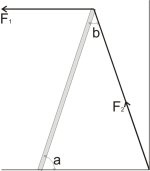
Being the geek that I am, I did the exact calculation. The mechanical advantage is actually

F2/F1 = sin a/sin b,

where a is the angle between the post and the ground (75.5 degrees in Rhett's drawing of an 8' post leaned over 2' against the tree), and b is the angle between the post and the chain down to the tree (14.5 degrees in Rhett's drawing). This formula assumes that you're pulling in a perfectly horizontal direction (i.e. your tractor hitch is as high as the top of the post, or you're pulling with a really long chain so that it's essentially parallel to the ground).

Note that it's not the length of the post per se, but rather the angles that determine the mechanical advantage. (Just like with a normal lever the mechanical advantage isn't dependent on the absolute lenght of the lever, but rather on the ratio of the lengths on either side of the fulcrum). However, for a given distance from the base of the tree, a longer post will give you a steeper angle and therefore more mechanical advantage. And more importantly a longer post means that the mechanical advantage is maintained longer (i.e. you can pull the chain a lot further before the post tips over).

For what it's worth, as the angle b gets really, really small, Rhett's simplified formula gets closer and closer to being exact. In his example, the actual mechanical advantage is 3.873:1, which is within about 3% of his back-of-the-envelope calculation of 4:1. If the post was 10x closer to the tree, the angle b would be 1.43 degrees, and the mechanical advantage would be 39.987:1, which is within 0.03% of the 40:1 ratio his formula would predict.
 

Attachments

  • TreePullerLeverage.jpg
    TreePullerLeverage.jpg
    25 KB · Views: 274
   / Tree Puller for hard to get at trees #67  
Being the geek that I am, I did the exact calculation. The mechanical advantage is actually

F2/F1 = sin a/sin b,

where a is the angle between the post and the ground (75.5 degrees in Rhett's drawing of an 8' post leaned over 2' against the tree), and b is the angle between the post and the chain down to the tree (14.5 degrees in Rhett's drawing). This formula assumes that you're pulling in a perfectly horizontal direction (i.e. your tractor hitch is as high as the top of the post, or you're pulling with a really long chain so that it's essentially parallel to the ground).

Note that it's not the length of the post per se, but rather the angles that determine the mechanical advantage. (Just like with a normal lever the mechanical advantage isn't dependent on the absolute lenght of the lever, but rather on the ratio of the lengths on either side of the fulcrum). However, for a given distance from the base of the tree, a longer post will give you a steeper angle and therefore more mechanical advantage. And more importantly a longer post means that the mechanical advantage is maintained longer (i.e. you can pull the chain a lot further before the post tips over).

For what it's worth, as the angle b gets really, really small, Rhett's simplified formula gets closer and closer to being exact. In his example, the actual mechanical advantage is 3.873:1, which is within about 3% of his back-of-the-envelope calculation of 4:1. If the post was 10x closer to the tree, the angle b would be 1.43 degrees, and the mechanical advantage would be 39.987:1, which is within 0.03% of the 40:1 ratio his formula would predict.

OUCH OUCH OUCH Math my brain is going to explode!:eek: Actually I am kidding. Thanks for the explanation.. I have used leverage techniques for pulling fence post and stuff before..
 
   / Tree Puller for hard to get at trees #68  
Another option for attaching to the tree is to use steel cable, wrapped around the tree a time or two. That's what I've used with my puller and it grips very well.
 
   / Tree Puller for hard to get at trees #69  
jcaron2,
Nice job with the calcs, being an engineer, I agree. With that in mind, the person using this method must absolutely take into consideration the added mechanical advantage on the cable or chain used from the top of the pole to the tree trunk. I would strongly recommend using a chain as they typically wont whip around as a cable does when it breaks.
 
   / Tree Puller for hard to get at trees #70  
jcaron2,
Nice job with the calcs, being an engineer, I agree. With that in mind, the person using this method must absolutely take into consideration the added mechanical advantage on the cable or chain used from the top of the pole to the tree trunk. I would strongly recommend using a chain as they typically wont whip around as a cable does when it breaks.

If this is directed towards me, I meant a short piece of steel cable with loops in the end that can be hooked to a chain. Using a steel cable by itself wouldn't work because you have no anchoring point for the puller to stay in place on the cable, unlike with the links on a chain. And as you said, not to mention whip-lash effect that a cable can give if it breaks.
 
   / Tree Puller for hard to get at trees #71  
Get a 6" piece of 2" pipe. Weld a 3 link piece of chain on the outside. Put the pulling chain thru the pipe, around the tree, & hook to the third link of the short chain. When pulling chain tightens the noose the end of the pipe bites into the tree & won't slip. MikeD74T

I'd like to see a picture of that. For some reason I'm not able to grasp the concept :(
 
   / Tree Puller for hard to get at trees #72  
Getting back to the wheel and axle idea. If the chain attached to the tree is attached to the axle and the pulling chain from the tractor is attached to the outside of the wheel, this would give a mechanical advantage equal to the ratio of the wheel diameter to the axle diameter. The problem might be that when pulling, this could roll away from the tree too much. Two wheels would be needed for stability.
 
   / Tree Puller for hard to get at trees #73  
Get a 6" piece of 2" pipe. Weld a 3 link piece of chain on the outside. Put the pulling chain thru the pipe, around the tree, & hook to the third link of the short chain. When pulling chain tightens the noose the end of the pipe bites into the tree & won't slip. MikeD74T

I like that! Thanks.
 
   / Tree Puller for hard to get at trees #74  
Since my wife won't let me drive the tractor in the back yard, I bough one of these critters sometime a while back:

Weed Wrench

While, this is not a tractor implement, it works great just pulling by hand (up to about three inch trees).

One thing the manufacturer recommends is using a "rocking" motion instead of brute force on a stubborn tree. By making repeated pulls, you gradually break the small roots with each tug, and finally get down to the tap root. I'm sure this technique also applies when using the bi-pod chained to the back of your tractor (my next project for the honey locust trees).
 
   / Tree Puller for hard to get at trees #75  
Just a word of caution on rocking large trees is widow makers being shaken loose. Small brush and things like that it would make sense to rock out a bit to loosen them.. Sorry if I sound like the Safety police.. I am head of Safety for a building of about 1000 people it's in my blood. :)
 
   / Tree Puller for hard to get at trees #76  
Just a word of caution on rocking large trees is widow makers being shaken loose. Small brush and things like that it would make sense to rock out a bit to loosen them.. Sorry if I sound like the Safety police.. I am head of Safety for a building of about 1000 people it's in my blood. :)

Sorry to hijack but this comment reminded me. Last fall I was cutting a large Locust tree. cut halfway thru, sliced out a wedge, then went to the other side. I cut in within an inch of my first cut and the tree just stood there. Hmmmmmm....... I got on the Kubota, raised the loader bucket all the way and put the bucket lip against the trunk and started to push. Before I pushed very much I had a life shaking awareness that if the remaining trunk broke at my cut and the tree decided to come my way I would be instantly crushed in the seat. It shook me so much I loaded my equipment and went home. Came back the next day and the wind had blown the tree down, in the direction my tractor was sitting....... When working with any piece of equipment we are seconds from death. :eek:
 
   / Tree Puller for hard to get at trees #77  
Sorry to hijack but this comment reminded me. Last fall I was cutting a large Locust tree. cut halfway thru, sliced out a wedge, then went to the other side. I cut in within an inch of my first cut and the tree just stood there. Hmmmmmm....... I got on the Kubota, raised the loader bucket all the way and put the bucket lip against the trunk and started to push. Before I pushed very much I had a life shaking awareness that if the remaining trunk broke at my cut and the tree decided to come my way I would be instantly crushed in the seat. It shook me so much I loaded my equipment and went home. Came back the next day and the wind had blown the tree down, in the direction my tractor was sitting....... When working with any piece of equipment we are seconds from death. :eek:

Not really hijacking the thread just pointing out the dangers.. Thank God for Guardian Angels!
 
   / Tree Puller for hard to get at trees #78  
Since my wife won't let me drive the tractor in the back yard, I bough one of these critters sometime a while back:

Weed Wrench

While, this is not a tractor implement, it works great just pulling by hand (up to about three inch trees).

One thing the manufacturer recommends is using a "rocking" motion instead of brute force on a stubborn tree. By making repeated pulls, you gradually break the small roots with each tug, and finally get down to the tap root. I'm sure this technique also applies when using the bi-pod chained to the back of your tractor (my next project for the honey locust trees).

Thanks for posting that. It looks like a better design than the brush grubber model sold at Northern (check out the negative review).
BAC Industries Brush Grubber with Fiberglass Ironclad Handle — Model# BG-03 | Weed + Brush Removal | Northern Tool + Equipment

Here is the weed wrench patent with some nice figures in case any one else is interested in building their own.
http://www.google.com/patents?id=9L...gbs_selected_pages&cad=3#v=onepage&q=&f=false


Some safe tree felling info:
Chain Saw Safety: No Tricks
Safe Chainsaw Operation
 
Last edited:
   / Tree Puller for hard to get at trees #79  
When clearing land Ive used my 30 foot ladder, gone up the tree chained it off with a chocker, 100 ft of chain and just drove it or backed it up, the tree usually comes over with not too much trouble, root ball exposed then i can get the rest of the root with the loader. THis works great on hemlocks and pine, not so good on oak and poplar, maple, shallow rooted trees no problems. little dicey when the treee is coming at you, make sure you have enough lenghts of chain.
 
   / Tree Puller for hard to get at trees #80  
Most of the 6 to 8 " pine trees I can just push over with the FEL and then get the bucket under the roots and lift them out. Thorn trees are tough and they have lots of big roots the go in all directions. I used my box blade with scarifier low as they would go, to cut the roots on all sides and then had to dig deep and curl the bucket to get it out. Maybe I could have pulled it with this device. I was really abusing my FEL trying to get this one thorn tree up because it was right where my shop was to be built. I was lifting the rear of the tractor up with the bucket and still not getting it out. After lots of digging and more box blade I finally got it. Have to build one of these to give my FEL a rest.
 

Tractor & Equipment Auctions

LMC 2-Row Planter BYJ-2F  Stainless Steel Fertilizer Boxes, Ground-Driven (A56438)
LMC 2-Row Planter...
2010 International 4300 2,000 Gallon Water Truck (A55973)
2010 International...
Case-IH 370 Steiger (A57148)
Case-IH 370...
LIKE NEW 2023 Rhino 84in Reverse Rotation Rotary Tiller (A56438)
LIKE NEW 2023...
2004 AGCO Gleaner 3000 Corn Header (A56438)
2004 AGCO Gleaner...
UNKNOWN  500BBL WHEELED FRAC TANK (A58214)
UNKNOWN 500BBL...
 
Top